Showing posts from category security.
-
UK Leads With a Military Voice on Climate Security
›December 1, 2009 // By Geoffrey D. DabelkoThe recent appointment of Rear Admiral Neil Morisetti as climate security envoy for the UK Foreign Commonwealth Office (FCO) and Ministry of Defence (MOD) represents a new level of seriousness for militaries considering climate change and security links. Morisetti made a number of appearances in
I particularly respect the broader approach the Rear Admiral’s appointment represents–a “joined-up government” framework for complex challenges like climate change that bridge traditional bureaucratic silos.
While there are plenty of examples where joined-up government efforts fall short, the MOD and FCO are finding a good balance in the climate-security case. In the United States, the CNA’s Military Advisory Board demonstrates that military leaders can serve as effective non-traditional spokespeople for climate mitigation and adaptation.
But this more political role for military leaders must spring from systematic assessments of the direct and knock-on effects of climate change on both broad human security and narrow traditional security concerns, as well as the institutions used to provide that security. A thorough and evidenced-based understanding of the direct effects of climate change on traditional security concerns is required to make an effective case and stay grounded in reality. Merely deploying military leaders as advocates because climate-security “polls well” with the American public would, in the long run, be damaging to supporters of both enhanced security and aggressive climate mitigation efforts.
The UK climate-security team is building that evidence base by funding practical analytical studies on the security impacts of climate change in key countries and regions (e.g., Colombia, China, Central America). Their use of Hadley Centre products ground the work in the latest scientific understanding, such as the new map of the world with 4C (7F) degrees of warming.
Back in the United States, the U.S. Defense Department’s Quadrennial Review (QDR) is due to Congress in February 2010. The report is required by law to include assessments of the impacts of climate change for U.S. security and of the military’s capacities to respond to those impacts. Work on that section of the report has been underway for months with in-depth consultations inside and outside government.
Here’s hoping the U.S. appoints its own flag officer to run point on the climate-security challenges outlined in the QDR. -
The Campus Beat: Using Blogs, Facebook, to Teach Environmental Security at West Point
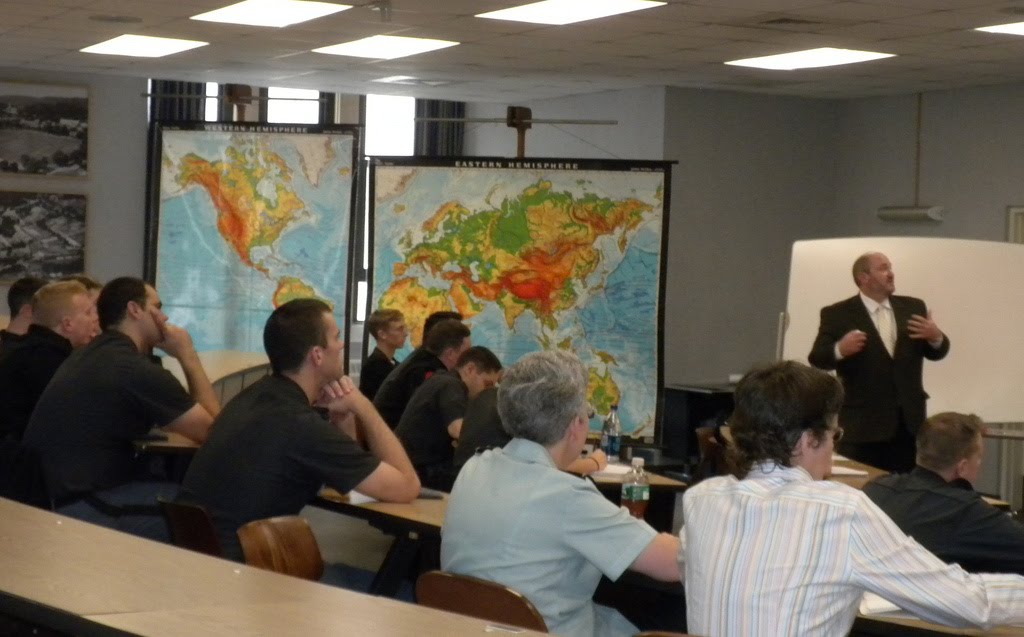
›November 17, 2009 // By Geoffrey D. Dabelko The lecture was only a few hours away. In desperation, I turned to Facebook. “I’ve got just 50 minutes with the cadets at West Point today to talk water, conflict, and cooperation. What are the most compelling examples you would use to make both hard security and human security points, both threat and opportunity points? I ask in part because it is proving harder to decide what to leave out than what to put in!”
Within seconds, experts from the Departments of State and Energy, USAID, and National Geographic responded with examples, including the Tibetan plateau and glacial melt, the lower Jordan River, and more. I used these cases and others to break through to an audience that included both those skeptical of “treehugger” issues and those eager to learn. The map of Chinese current and planned hydro projects produced audible gasps and wide eyes among the class of future officers.
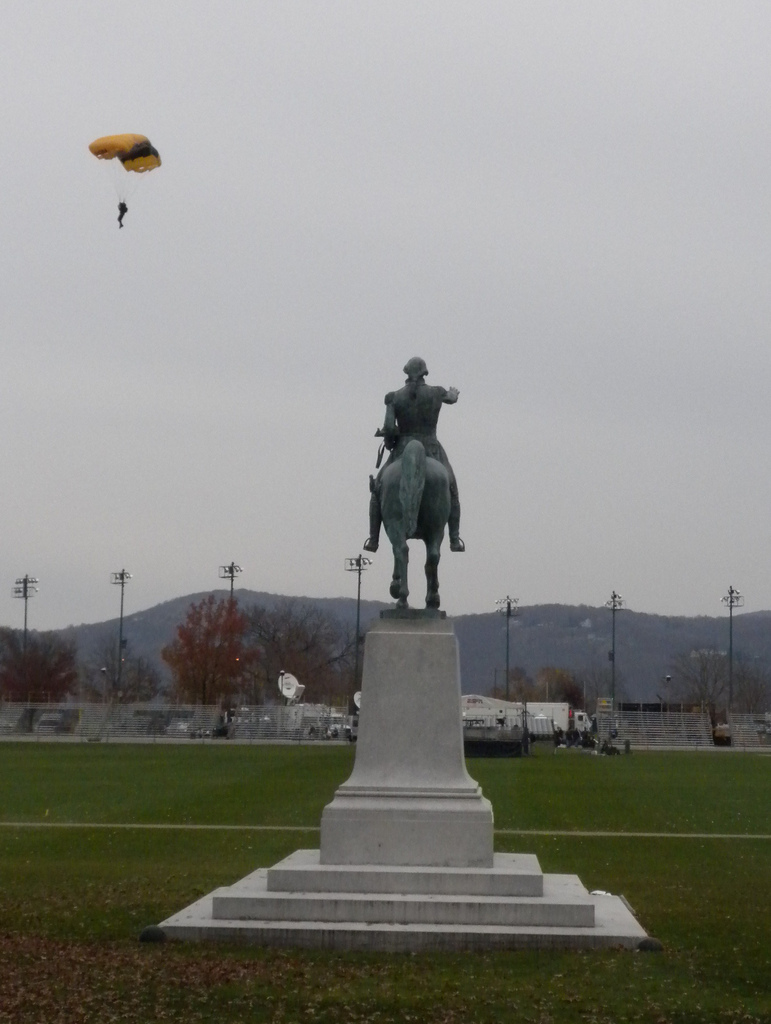
While at West Point, colleague Meaghan Parker and I met with geography faculty to better understand how and what they are teaching on environmental security and demographic security. The professors on the banks of the Hudson face similar challenges to their non-military brethren; today’s students have shorter attention spans and lack experience conducting in-depth research (or getting beyond Google).
But some challenges are unique to the service academies: isolation from academic peers; the need to make sure the material is relevant to future military leaders; and most of all, the physical and mental demands on cadets’ time placed by army training. I saw it as a sign of success that I only had three stand up during my lecture, the military’s sanctioned way to keep yourself awake in class. (LTC Lou Rios USAF, one of the faculty members we met with, wrote about teaching environmental security at West Point previously on New Security Beat.)
Video, blogs, and other new media seem like a way to bridge some of these gaps. We’re especially excited that the cadets in at least three courses will be using the New Security Beat as part of their classes by reading posts, commenting, and proposing a post on a topic of their choosing. We’re looking forward to a cadet joining us next summer for internship with ECSP.
All of these outreach efforts are part of our strategy to both understand how all types of actors—including future army officers—come to understand environment and security links while providing insights and analysis to that same diverse group.
Photos by Geoff Dabelko and Meaghan Parker -
UNEP’s David Jensen on Linking Environment, Conflict, and Peace in the United Nations
›November 16, 2009 // By Sajid AnwarAt the United Nations, “we see more and more interest in looking at natural resources: how do they contribute to a conflict, and how can they contribute to peacebuilding,” says David Jensen of the UN Environment Programme’s Post-Conflict and Disaster Management Branch in a video interview with ECSP Director Geoff Dabelko.
For example, UNEP experts travel to the UN Peacebuilding Commission’s target countries to examine how natural resources may have contributed to conflict and what role they could play in restoring peace, explains Jensen: “A new module was approved on environment and natural resources. So it’s now integrated within the overall UN post-conflict assessment framework,” which is used by the UN, World Bank, and the European Commission.
Currently, “there are tremendous opportunities,” Jensen says, for environmental security to become a mainstream issue within the United Nations, as exemplified by the Secretary-General’s report, Climate change and its possible security implications. -
Pakistan’s Demographic Challenge Is Not Just Economic
›In a meeting with business leaders in Lahore in late October, Secretary of State Hillary Rodham Clinton pointedly warned of the potential economic impacts of Pakistan’s rapidly growing population: “There has to be…in any plan for your own economic future, a hard look at where you’re going to get the resources to meet these needs. You do have somewhere between 170 and 180 million people. Your population is projected to be about 300 million as the current birth rates, which are among the highest in the world, continue,” she said.
Pakistan is ranked 141 (out of 182 countries) in the Human Development Index. High rates of unemployment are compounded by low levels of education and human capital. Clinton noted that Pakistani women are more vulnerable to poverty; only 40 percent are literate, compared to 68 percent of men.
The Secretary’s emphasis on the need to provide adequate education, jobs, and resources to motivate economic growth and improve well-being is welcome. But demography also has important political consequences. U.S. policymakers and the Pakistani government should consider the impact of population dynamics on the country’s intensifying instability.
As Pakistan’s population grows rapidly, it is maintaining a very young age structure: in 2005, two-thirds of its population was younger than age 30. Research by Population Action International has shown that countries with very young age structures are three times as likely to experience outbreaks of civil conflict than those with a more balanced age distribution.
The members of a “youth bulge” are not inherently dangerous, but when governments are unable to foster employment opportunities or the prospects of stability, a young age structure can serve to exacerbate the risks of conflict, as recently noted by John O. Brennan, assistant to the president for Homeland Security and Counterterrorism, in a speech on “A New Approach to Safeguarding Americans.”
As Secretary Clinton and her colleagues consider the complex barriers to achieving peace and stability for Pakistan’s people, their humanitarian and development strategies should include demographic issues. When couples are able to choose the number and timing of their children, very young age structures like Pakistan’s, can change.
Family planning and reproductive health services are fundamental human rights, but remain out of reach for many in Pakistan, where one-quarter of all married women (and 31 percent of the poorest) have an unmet need for family planning.
Greater access to family planning would lower fertility rates and increase the share of working-age adults in the population. In this transition, countries can harness the “demographic dividend”—a change that could turn Pakistan’s age structure into an economic opportunity.
However, funding from the United States—the world’s largest single donor for international family planning—has declined by one-third over the past 15 years. The foreign assistance funding priorities of the Obama administration should reflect this recognition of the linkages between population, development, and stability.
By addressing the high unmet need for family planning and reproductive health services of women in countries like Pakistan, the United States could help to create a more balanced age structure in future generations—and promote stability at the same time.
Elizabeth Leahy Madsen is a research associate at Population Action International (PAI). She is the primary author of the 2007 PAI report The Shape of Things to Come: Why Age Structure Matters to a Safer, More Equitable World.. -
The Youth Bulge Question
›Right now, Rich Cincotta is live on “PRB Discuss Online,” answering the question, “Does a Young Age Structure Thwart Democratic Governments?” He is responding to reader questions like “Do Democratic governments being overcome by poverty and high unemployment rates have a chance to succeed” and “Why do you think the mainstream demography community is so slow or unwilling to pick up the research questions you have pursued?” Read the transcript and Cincotta’s recent article on this topic, “Half a Chance: Youth Bulges and Transitions to Liberal Democracy.”
A new World Bank working paper, “Breaking the Waves? Does Education Mediate the Relationship Between Youth Bulges and Political Violence?” by Bilal Barakat and Henrik Urdal finds “evidence that large, young male population bulges are more likely to increase the risk of conflict in societies where male secondary education is low”–particularly in low and middle-income countries. Mardy Shualy of Foreign Policy’s blog suggests policymakers do the math to compare the costs of secondary education to the economic toll of war and civil conflict. -
Climate-Security Gets “To the Point” Today
›Today’s episode of NPR’s “To the Point” with Warren Olney will focus on “Global Warming and the Geo-Political Map,” seeking to answer the question, “What are the risks to natural resources, immigration, and political stability worldwide?”
As one of the four panelists, ECSP Director Geoff Dabelko will draw on his recent article in the Bulletin of Atomic Scientists and ECSP’s climate-security resources.
Climate security has been heating up the media for the last few months, although most news coverage has been rather thin. That’s understandable, given the complexity of the drivers involved, and the crushing constraints on environmental reporters’ time and budgets these days. But climate security is a politically powerful argument, one which advocates from all over the political spectrum have increasingly adopting, and it deserves a more thorough, thoughtful treatment.
“Come to Attention,” a panel at this year’s SEJ annual conference (audio) moderated by ClimateWire’s Lisa Friedman, delved into some of the finer points of this often oversimplified connection. As part of the panel, Dabelko outlined seven cautions to keep in mind and suggestions for improving coverage of the difficult link.
While Grist’s Robert McClure jokingly called the session “doom and gloom without the sense of humor,” Dabelko ended on a positive note, pointing out that by coming together to battle climate change, countries may build bridges to peace, rather than war–particularly if the militaries cooperate in the fight.
In a recent op-ed, Dabelko and the U.S. Army War College’s Kent Butts argue that climate could be one of the most productive avenues for improving military relations with China, suggesting that “U.S. and Chinese militaries should jointly assess the security implications of climate change that concern both sides: rising sea levels, changing precipitation patterns, uncertain migration scenarios, and instability in resource-rich regions.”
“To the Point” airs live online at 3 PM EST. In the Washington, DC, area listen to it at 10 PM EST tonight on WAMU 88.5. -
VIDEO: Alexander Carius on Climate Change and Security in Europe
›October 20, 2009 // By Sean Peoples“The landscape has changed since 2007,” says Alexander Carius of the climate change and international security debates now taking place in Europe. In this short video, Carius, who is managing director at Adelphi Research, discusses the progress made by institutionalizing communication within the European Commission as well as the formal and informal channels between the four member states leading the debate, Germany, Britain, Sweden, and Denmark. “Whether this debate is driven by science, I have my doubts,” said Carius.
Even though the climate-security debate is well underway, the current draft resolution for the United Nations climate conference in Copenhagen remains silent on the connections between security and climate change. Moreover, there is a lack of consensus among negotiators on basic issues. As December approaches, skepticism of the likelihood of a comprehensive treaty is growing. -
VIDEO: Geoff Dabelko on Environment and Security at Society of Environmental Journalists Conference
›October 9, 2009 // By Sean PeoplesThe 19th annual Society of Environmental Journalists (SEJ) conference began today in the crisp autumn air of Madison, Wisconsin. ECSP Director Geoff Dabelko discusses Al Gore’s keynote address explicitly connecting climate change to national security issues, as well as his questions and expectations as the country’s premier gathering of environmental journalists gets underway.