Showing posts from category security.
-
Momentum Magazine
Where Does It Hurt? Climate Vulnerability Index
›The original version of this article appeared in the University of Minnesota’s Momentum Magazine. Text by Mary Hoff, page layout by Todd Reubold.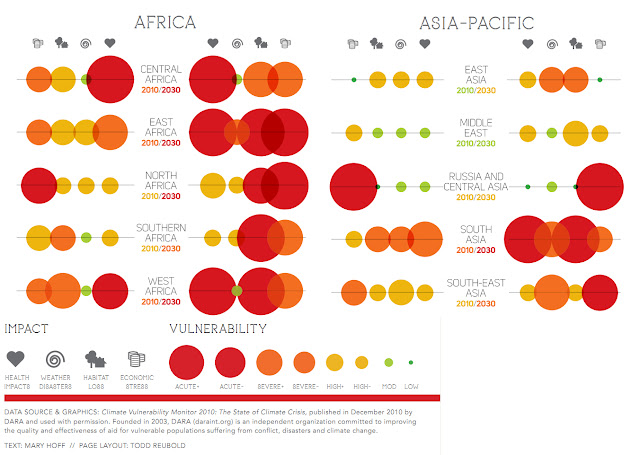
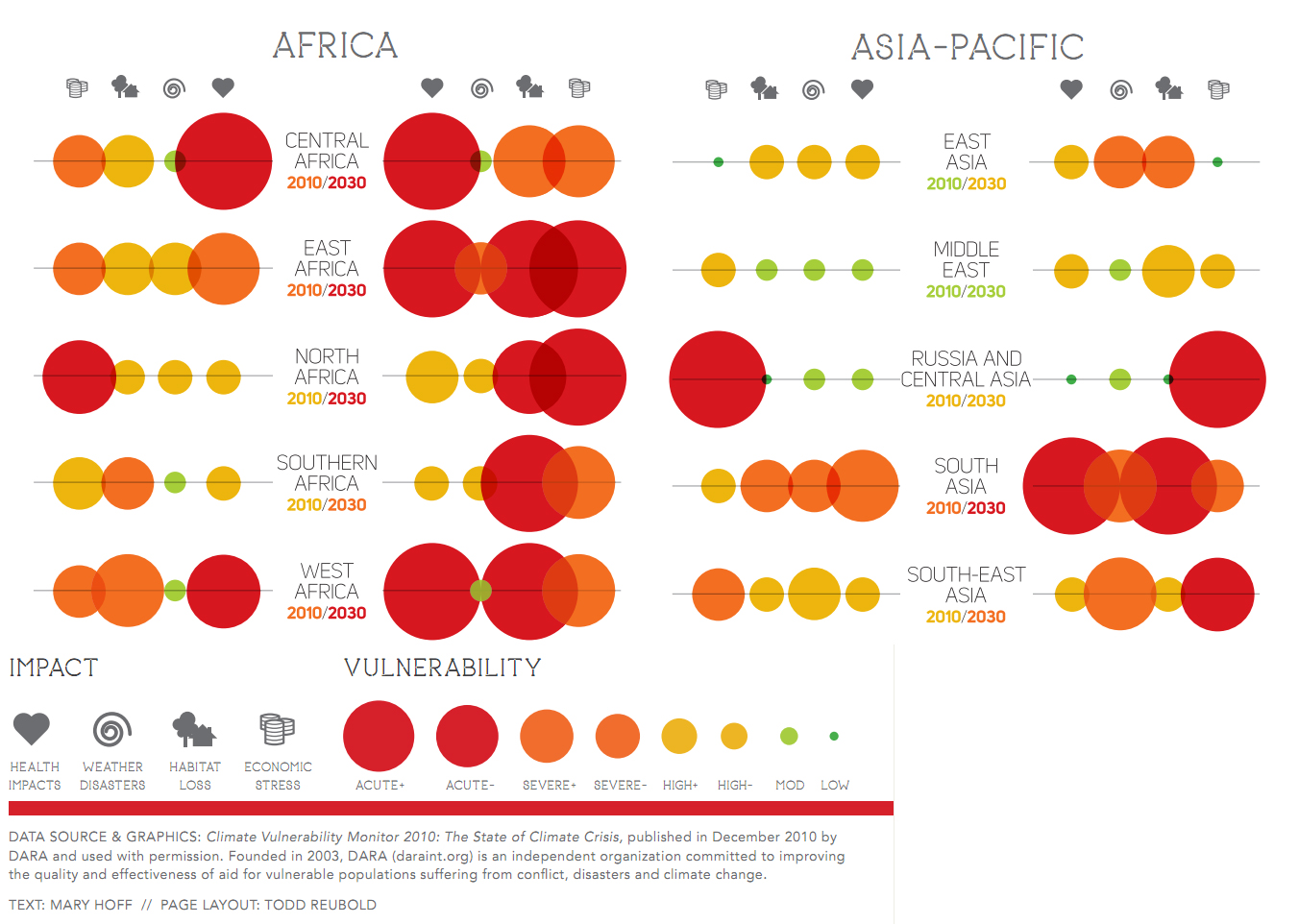
The punch climate change packs varies from one country, region, or continent to another. DARA, a Madrid-based humanitarian advocacy organization, recently partnered with the Climate Vulnerable Forum, comprising countries particularly vulnerable to climate change, to create Climate Vulnerability Monitor 2010, an atlas of vulnerability. This infographic presents a small portion of the picture the Climate Vulnerability Monitor paints.
Vulnerability is grouped into four categories: health impacts, weather disasters, habitat loss and economic stress. Circles on the left side of each set indicate relative magnitude of vulnerability in 2010. Circles on the right indicate the same for 2030.
See the full “Where Does it Hurt?” infographic on the Momentum site or download the Climate Vulnerability report from DARA.
Image Source: Climate Vulnerability Monitor 2010: The State of Climate Crisis, published in December 2010 by DARA (daraint.org). Used with permission. -
Watch: Jennifer Dabbs Sciubba on Population and National Security
›April 28, 2011 // By Schuyler Null“Long-term trends really are what shape the environment in the future,” said Jennifer Dabbs Sciubba in this interview with ECSP. “As we’ve seen recently with…revolution in North Africa, it’s the long-term trends that act together for these things to happen – I like to say demography is not usually the spark for a conflict but it’s the fodder.”
Sciubba is the Mellon Environmental Fellow in the Department of International Studies at Rhodes College. In her new book, The Future Faces of War: Population and National Security, she discusses the importance of demographic trends in relation to security and stability, including age structure, migration, youth bulges, population growth, and urbanization.
One of the most important things to emerge from the book, said Sciubba, is that countries that are growing at very high rates that are overwhelming the capacities of the state (like many in sub-Saharan Africa) really will benefit from family planning efforts that target unmet need.
Afghanistan, for example, “has an extremely young age structure,” Sciubba pointed out. “So if you’re trying to move into a post-conflict reconstruction atmosphere…you absolutely have to take into account population and the fact that it will continue to grow.”
“Even if there are major moves now in terms of reducing fertility, they have decades ahead of this challenge of youth entering the job market,” Sciubba said. “Thousands and thousands more jobs will need to be created every year, so if you have a dollar to spend, that’s a really good place to do it.”
For more on Jennifer Dabbs Sciubba and The Future Faces of War, see her book launch at the Wilson Center with Deputy Under Secretary Kathleen Hicks of the Department of Defense (video) and some of her previous posts on The New Security Beat. -
Watch: Addressing the National Security Implications of U.S. Oil Dependency
›April 27, 2011 // By Schuyler NullBoth the civilian and military sectors have key roles to play in achieving energy security as the United States addresses the national security implications of its oil dependency. Yesterday, the White House hosted a forum with senior officials from both the public and private sector to highlight avenues toward achieving that security. Co-hosts Deputy Energy Secretary Daniel Poneman and Deputy Defense Secretary William Lynn were joined by Woodrow Wilson Center President Jane Harman, John Podesta of the Center for American Progress, and John Deutch of the Massachusetts Institute of Technology.
The panelists discussed ongoing cooperation between the Department of Energy and Department of Defense, and Harman in particular highlighted the power of the military to drive innovation and more efficient production of energy-efficient technologies.
“‘Energy security’…reminds us that important domestic energy developments have international consequences, and important international events have domestic consequences,” said Deutch, pointing out the linked, global nature of energy markets and climate change.
Deputy Secretary Lynn highlighted the tactical tactical benefits of reduced petroleum dependence with the example of a solar panel pilot program being conducted by the Marine Corps in Afghanistan:The regiment selected to try out the solar panels deployed to one of the most violent districts in Helmand province. The operational gains were immediate: Marines ran two patrol bases completely on solar power and cut diesel fuel consumption at a third base by over 90 percent. On one three-week foot patrol, flexible solar panels eliminated battery resupply needs entirely, ending supply drops that previously were required every 48 hours.
Watch the full forum above, and see also the recent National Conversation at the Woodrow Wilson Center that focused on “A New National Security Narrative.” -
Overcoming Pakistan’s Demographic Challenges
›Download Reaping the Divided: Overcoming Pakistan’s Demographic Challenges from the Wilson Center. Excerpted below is the introductory essay, “Pakistan’s Demographics: Possibilities, Perils, and Prescriptions,” by Michael Kugelman.
On July 11, 2010, Pakistani Prime Minister Yousaf Raza Gilani delivered a speech in Islamabad to commemorate World Population Day. He announced that in order to highlight the crucial connection between demographics and economic growth, 2011 would be designated “Population Year” in Pakistan. “All hopes of development and economic prosperity would flounder if we as a nation lose the focus and do not keep [the] population issue in the spotlight,” he declared.
Hopefully that spotlight comes with a long shelf life. Pakistan faces acute population challenges. If they are to be overcome, they will need to be illuminated for far more than a year.
Yet, there are exciting opportunities here as well. A long-term approach to managing the challenges presented by Pakistan’s burgeoning population, if accompanied by effective policies and sustained implementation, could spark a monumental transformation: one that enables the country to harness the great promise of a large population that has usually been viewed as a hindrance to prosperity. Indeed, demographers contend that Pakistan’s young, growing, and rapidly urbanizing population can potentially bring great benefits to the country. If birth rates fall substantially, and if young Pakistanis are properly educated and successfully absorbed into the labor force, then the nation could reap a “demographic dividend” that sparks economic growth, boosts social well-being, and promotes the rejuvenation of Pakistan.
The Young and the Rising
Because Pakistan has not conducted a census since 1998, estimating the country’s total population size is a highly inexact science. The Pakistani government lists the current figure at about 175 million people, while the United Nations believes the number is closer to 185 million. However, while the precise figure may be in doubt, the population’s rapid rise is not. Though no longer increasing at the 3 percent-plus rate seen in the 1980s, Pakistan’s population is still growing at a 2 percent pace. According to the UN Population Division’s latest mid-range demographic projections, released in 2009, the population will rise to 335 million by 2050. More than 60 million people are expected to be added in just the next 15 years.
This explosive increase, however, merely represents the best-case scenario, and will prevail only if the country’s fertility rates drop from the current average of about four children per woman to two. Should fertility rates remain constant, the UN estimates the population could exceed 450 million by 2050, with a total population of nearly 300 million as early as 2030.
Pakistan’s population is not only large and growing, but also very young, with a median age of 21. Currently, two-thirds of Pakistanis are less than 30 years old. As a percentage of total population, only Yemen has more people under the age of 24. Additionally, given that more than a third of Pakistanis are now 14 years old or younger, the country’s population promises to remain youthful over the next few decades. In the 2020s, the 15-to-24 age bracket is expected to swell by 20 percent. Pakistan’s under-24 population will still be in the majority come 2030. And as late as 2050, the median age is expected to be only 33.
Pakistan’s demographic profile contrasts with what is happening in much of the rest of the world. Sub-replacement level fertility rates (about two births per woman) prevail not only throughout the developed world, but also across much of Southeast Asia, the Middle East, and Latin America. As one commentator has noted, “the twenty-first century’s hallmark [demographic] trend appears to be a fertility implosion.” South Asia, along with sub-Saharan Africa, is one of the last regional bastions of youthful, rapidly proliferating populations. Yet even within South Asia, Pakistan stands out. Excluding Afghanistan, of all the member states of the South Asian Association for Regional Cooperation – Bangladesh, Bhutan, India, Maldives, Nepal, and Sri Lanka – Pakistan has the highest population growth, birth, and fertility rates; the youngest median age (tied with Nepal); and the largest percentage of people 14 years old or younger.
Continue reading “Pakistan’s Demographics: Possibilities, Perils, and Prescriptions,” or download the full report from the Wilson Center.
Michael Kugelman is a program associate with the Asia Program. -
Climate Adaptation, Development, and Peacebuilding in Fragile States: Finding the Triple-Bottom Line
›“The climate agenda goes well beyond climate,” said Dan Smith, secretary general of International Alert at a recent Wilson Center event. “In the last 60 years, at least 40 percent of all interstate conflicts have had a link to natural resources” and those that do are also twice as likely to relapse in the five years following a peace agreement, said Neil Levine, director of the Office of Conflict Management and Mitigation at USAID. [Video Below]
Development, peace, and climate stability are “the triple-bottom line,” said Smith. “How would you ever think that it would be possible to make progress on one, while ignoring the other two?” Levine and Smith were joined by Alexander Carius, managing director of Adelphi Research, who pointed out that climate change is both a matter of human security and traditional security. For example, as sea-level rise threatens the people of small-island states, “it also affects, in a very traditional sense, the question of security and a state’s sovereignty,” he said.
The Triple-Bottom Line
Conflicts are never attributable to a single cause, but instead are caused by “a whole pile-up, a proliferation, a conglomeration of reasons” that often include poverty, weak governance, traumatic memory of war, and climate change, said Smith. “Climate adds to the strains and the stresses that countries are under,” and works as a “risk-multiplier, or conflict multiplier,” he said.
Focusing development and peace-building efforts on those regions experiencing multiple threats is both a “moral imperative” and a “self-interested imperative,” said Smith. “We benefit from a more prosperous and a more stable world.”
There are currently one and a half billion people in the world living in countries that face these interlinked problems, said Smith, “and interlinked problems, almost by definition, require interlinked solutions.” Responding to the needs of these people requires developing resiliency so that they can respond to the consequences of climate change, which he called “unknown unknowns.”
“What we need are institutions and policies and actions which guard us not only against the threats we can see coming… but against the ones we can’t see coming,” said Smith. The strength and resilience of governments, economies, and communities are key to determining whether climate events become disasters.
Interagency Cooperation
“Part of making the triple-bottom line a real thing is to understand that we will have to be working on our own institutions, even the best and most effective of them, to make sure that they see the interlinkages,” said Smith.
But even though individuals increasingly understand the need to address security, development, and climate change in an integrated fashion, “institutions have only limited capacities for coordination,” said Carius. Institutions are constrained by bureaucratic processes, political mandates, or limited human resources, he said. “Years ago, I always argued for a more integrated policy process; today I would argue for an integrated assessment of the issues, but to…translate it back into sectoral approaches.”
Levine expressed optimism that with “a whole new avalanche of interagency connections” being established in the last few years, U.S. interagency cooperation has become “the culture.” However, if coordination efforts are not carefully aligned to advance concrete programs and policies, they run the risk of “getting bogged down in massive bureaucratic exercises,” he said. “‘Whole of government’ needn’t be ‘all of government,’ and it needn’t be whole of government, all of government, all the time.”
Building Political Will
Europe has a “conducive political environment to making [climate and security] arguments,” said Smith, but the dialogue has yet to translate into action. In 2007, the debate on climate and security was first brought to the UN and EU with a series of reports by government agencies and the first-ever debate on the impacts of climate change on security at the UN Security Council, said Carius. However, none of the recommendations from the reports were followed and “much of the political momentum that existed…ended up in a very technical, low-level dialogue,” he said.
More recently, the United Kingdom included energy, resources, and climate change as a priority security risk in their National Security Strategy. And Germany, which joined the UN Security Council as a rotating member this year, is expected to reintroduce the topic of climate and security when they assume the Security Council Presidency in July. These steps may help to regain some of the political momentum and “create legitimacy for at least making the argument – the very strong argument – that climate change has an impact on security,” said Carius.
Sources: AFP, UK Cabinet Office, Telegraph, United Nations
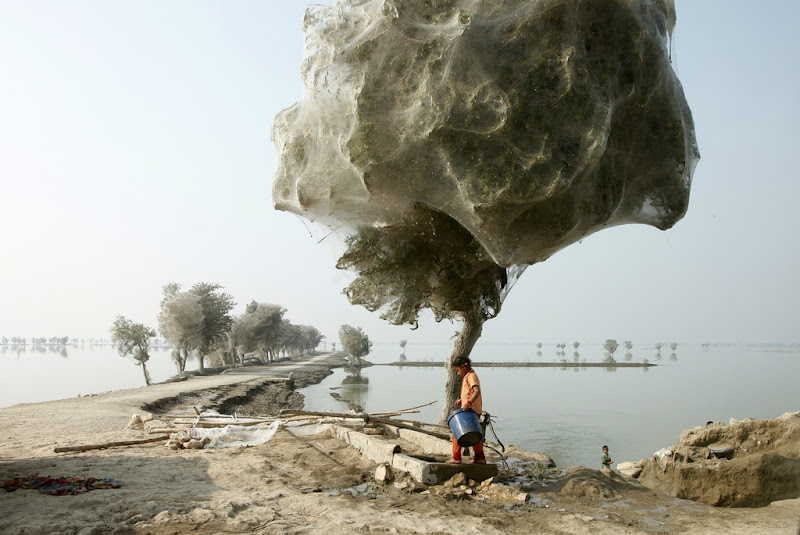
Image Credit: “Trees cocooned in spiders webs after flooding in Sindh, Pakistan” courtesy of flickr user DFID -
Youth Bulge, Demography-Security Dialogue, and NATO
PRB Discussion on Population and National Security
›April 14, 2011 // By Schuyler NullThe Population Reference Bureau (PRB) held an online discussion this week with demographer Jennifer Dabbs Sciubba of Rhodes College on the topic of “Population and National Security.” On tap were questions on sex ratios, youth bulge, the definition of “national security,” whether the United States should be giving population and health-related advice, and other demographic security topics. Click through to PRB for the full transcript, or check out some select questions from ECSPers Richard Cincotta, Geoff Dabelko, and Schuyler Null below:
Richard Cincotta: Jennifer, my concern is with the lack of specificity that seems inherent in the youth bulge model in terms of civil and ethnic conflict. In other words, the highest probability of civil conflict (often protracted) is associated with very young populations – the Afghanistan, Iraq, sub-Saharan African situations. But, there is also a situation that arises among populations that are demographically somewhat older that is associated with democratization (i.e., the North African situation). These seem to have been conflated by the press and political scientists, yet they are demographically and politically very different cases. Any thoughts on how to recognize these and separate them?Jennifer Dabbs Sciubba: Rich, I think that until we have a stronger theoretical foundation for understanding the conditions under which a “youthful” population leads to civil conflict (very young pop) or democracy (slightly older pop) it will be hard to relay the difference in these two structures to non-experts. The democratization connection, in particular, needs to be refined to move firmly away from correlation and into causation. Right now, it seems to me that we give the same theoretical reasoning to both conflict and democratization (motive, cohort crowding). Do you agree?
Geoff Dabelko: Is the security community, so accustomed to framing issues as threats, internalize your messages about opportunity? Is there a recognition that low cost interventions such as provision of voluntary family planning services could be part of a holistic sustainable security approach? What are the steps that would need to happen to gain more adherents to this perspective?
(Editor: Read more discussion between Cincotta and Sciubba here and here)Sciubba: I’m sorry to say, but no, not really. The positive perspective does not resonate much because most in defense and intelligence are tasked with imagining the worst-case scenario. Opportunities and happy stories just do not fit in this paradigm (or even most of their job descriptions). I’ve tried to figure out what needs to happen to get them to pay attention to prevention, and the only place I see some chance of breaking through is in discussing Afghanistan. Many realize the challenges posed by Afghanistan’s young and growing population and there is some recognition that family planning may be relevant there. I think that for a paradigmatic shift to occur, it would have to be top-down – the vision of the President, Secretary of Defense, etc.
Dabelko: What would be the benefits of demographers and population experts taking more seriously a dialogue with the security community? Your book shows why security sector actors should pay attention to demography. Why should demographers pay attention to security?Sciubba: Some in the security community don’t necessarily understand the assumptions behind demographic projections or other aspects of the data, which means they sometimes misuse the info or distrust it and discard it all together. I also think that scholars of any discipline have a responsibility to understand how their work is being used.
Dabelko: What will be the subject of your next book?Sciubba: I’ll be returning to the politics of population aging. I’m particularly interested in comparing how different regime types have dealt with these issues, including not just Western European states, but also states like Singapore and Russia.
Schuyler Null: There’s been a lot of talk about how aging populations in Europe will affect defense sectors there, in terms of shifting budget priorities. But there’s also the aspect of how aging might affect European decision-making processes when it comes to foreign intervention (perhaps less willing put boots on the ground, stay for long, etc.).
Can you speak to how aging might affect the decision-making process and behavior of European countries when it comes to conflict in the future? How might aging affect the operation of NATO or the UN?Sciubba: Isn’t France a puzzle right now given your question? France, a low fertility country with an aging population and HUGE challenges ahead in terms of paying for entitlements to seniors, has recently shown a greater willingness to contribute to military missions. There is no doubt that aging states in Europe will be under strain trying to meet their promises to seniors and also maintain defense. But, European states still feel that there are sufficient threats in the world to warrant maintaining a military. They are trying to reduce redundancies among themselves and increase their efficiency – great cost-saving measures. Technology can compensate a bit as well. I think European states are willing to use their militaries when the threat is sufficient. Aging, however, may raise the threshold for what qualifies as “sufficient” and US-European opinions on what qualifies may increasingly diverge.
See the full transcript of questions and Sciubba’s responses at the Population Reference Bureau. -
In Search of a New Security Narrative: National Conversation Series Launches at the Wilson Center
›The United States needs a new national security narrative, agreed a diverse panel of high-level discussants last week during a new Wilson Center initiative, “The National Conversation at the Woodrow Wilson Center.”
Hosted by new Wilson Center President and CEO Jane Harman and moderated by The New York Times’ Thomas Friedman, the inaugural event was based on a white paper by two active military officers writing under the pseudonym “Mr. Y” (echoing George Kennan’s “X” article). In A National Strategic Narrative, Captain Wayne Porter (USN) and Colonel Mark Mykleby (USMC) argue that the United States needs to move away from an outmoded 20th century model of containment, deterrence, and control towards a “strategy of sustainability.” [Video Below]
Anne-Marie Slaughter of Princeton University, who wrote the white paper’s preface, summarized it for the panel, which included Brent Scowcroft, national security adviser to President Ford and President H.W. Bush; Representative Keith Ellison (D-Minn.); Steve Clemons, founder of the American Strategy Program at the New America Foundation; and Robert Kagan, senior fellow for foreign policy at the Brookings Institution.Framing a 21st Century Vision
We can no longer expect to control events, but we can influence them, Slaughter said. “In an interconnected world, the United States should be the strongest competitor and the greatest source of credible influence – the nation that is most able to influence what happens in the international sphere – while standing for security, prosperity, and justice at home and abroad.”
“My generation has had our whole foreign policy world defined as national security,” said Slaughter, “but ‘national security’ only entered the national lexicon in the late 1940s; it was a way of combining defense and foreign affairs, in the context of a post-World War II rising Soviet Union.”
As opposed to a strategy document, their intention, write Porter and Mykleby, was to create a narrative through which to frame U.S. national policy decisions and discussions well into this century.
“America emerged from the Twentieth Century as the most powerful nation on earth,” the “Mr. Y” authors write. “But we failed to recognize that dominance, like fossil fuel, is not a sustainable source of energy.”It is time for America to re-focus our national interests and principles through a long lens on the global environment of tomorrow. It is time to move beyond a strategy of containment to a strategy of sustainment (sustainability); from an emphasis on power and control to an emphasis on strength and influence; from a defensive posture of exclusion, to a proactive posture of engagement. We must recognize that security means more than defense, and sustaining security requires adaptation and evolution, the leverage of converging interests and interdependencies. [italics original]
Prosperity and Security a Matter of Sustainability
The “Mr. Y” paper is similar in some respects to other strategic documents that have promoted a more holistic understanding of security, such as the State Department’s Quadrennial Diplomacy and Development Review, which was partially authored by Slaughter during her time in State’s Policy Planning Office. But there’s a markedly heavy focus on economics and moving beyond the “national security” framework in Porter and Mykleby’s white paper. They outline three “sustainable” investment priorities:
“These issues have come in and out of the security debates since the end of the Cold War, but they have not been incorporated well into a single national security narrative,” Geoff Dabelko, director of the Wilson Center’s Environmental Change and Security Program, told The New Security Beat. “This piece is a positive step toward achieving a coherent and inclusive national security narrative for the United States.”- Human capital: refocus on education, health, and social infrastructure;
- Sustainable security: use a more holistic, whole-of-government approach to security; essentially, expand the roles of civilian agencies and promote stability as much as ensuring defense; and,
- Natural resources: invest in long-range, sustainable management of natural resources, in the context of expanding global demand (via population growth and consumption).
To provide a “blueprint” for this transition, Porter and Mykleby call for the drafting of a “National Prosperity and Security Act” to replace the national security framework laid by the National Security Act of 1947 (NSA 47) and followed by subsequent NSAs.A New Geostrategic Model?
The panel unanimously praised the white paper’s intentions, if not its exact method of analysis and proposed solutions. All agreed that globalization and technology have helped create a more interconnected and complex world than current foreign policy and national security institutions are designed to deal with. Scowcroft called the 20th century “the epitome of the nation-state system” and said he expects an erosion of nation-state power, especially in light of integrated challenges like climate change and global health.
Kagan disagreed, saying he’s less convinced that the nation-state is fading away. “If anything, I would say since the 1990s, the nation-state has made a kind of comeback,” he said, adding that the paper lacks “a description of how the world works, in the sense of ‘do we still believe in a core realist point that power interaction among nation states is still important?’” In that sense, he said, “I’m not at all convinced we’ve left either the 20th century or the 19th century, in terms of some fundamental issues having to do with power.”
“I think there are three things that really are new,” said Slaughter. “The first [is the] super-empowered individual…the ability of individuals to do things that only states could.” We saw that with 9/11, with individuals attacking a nation, and we’re seeing that with communications as well, she said. “I can tell you, Twitter and the State Department’s reporting system, they’re pretty comparable and Twitter’s probably ahead, in terms of how much information you can get.”
Second, there is a “whole other dimension of power that simply did not exist before and that is how connected you are,” Slaughter said. “The person who is the most connected has the most power, because they’re the person who can mobilize, like Wael Ghonim in Egypt.”
Third, there are a greater number of responsible stakeholders. “What President Obama keeps telling other nations is ‘you want to be a great power? It’s not enough to have a big economy and a big army and a big territory, you have to take responsibility for enforcing the norms of a global order,’” Slaughter said. Qatar’s willingness to participate in the international community’s intervention in Libya, she said, was in part an example of a country responding to that challenge and stepping up into a role it had not previously played.
These new dimensions to power and security don’t entirely replace the old model but do make it more complex. “It’s on top of what was,” Slaughter said, and “we have to adapt to it.”
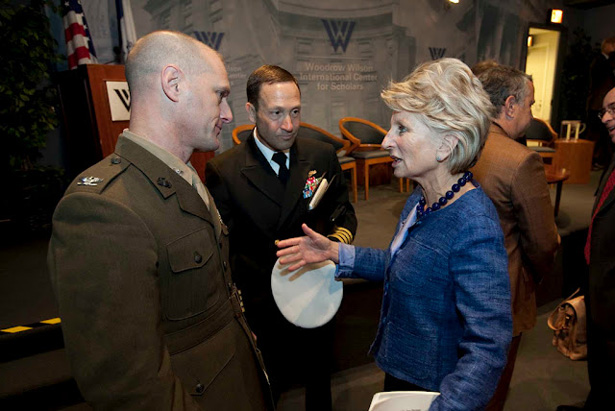
Photo Credit: Colonel Mark Mykleby (USMC), Captain Wayne Porter (USN), and Wilson Center President and CEO Jane Harman, courtesy of David Hawxhurst/Wilson Center. -
Book Review: Envisioning a Broader Context to Security With ‘The Ultimate Weapon is No Weapon’
›The Ultimate Weapon is No Weapon: Human Security and the New Rules of War and Peace, by a career U.S. Army officer, Lieutenant Colonel Shannon Beebe, and Professor Mary Kaldor, director of the Centre for the Study of Global Governance at the London School for Economics, is the product of an intriguing partnership. Despite the fact that their respective professions have often displayed distrust and hostility toward one another, the coauthors’ combined perspectives have created a particularly prescient and non-partisan challenge to the security status quo.
Beebe and Kaldor add to the growing call to re-evaluate existing constructs of “national security” and to reconsider the roles of Western militaries and international aid agencies in the globalized 21st century world. In particular, they emphasize the urgent need for a more nuanced understanding of security that includes humanitarian considerations as an integral component in these institutions’ agendas. This “human security” is the right of all people to livelihoods, clean drinking water, nourishing food, and education and proper health care, in addition to a safe and secure place to live, free from the fear of personal crime and violence.
Such insecurity affects us all even if it does not directly result in open warfare. According to Misha Glenny in his 2009 book, McMafia, it is estimated that 20 percent of the global GDP is generated through criminal activities, which exploit the weak and the vulnerable on a global scale. It is difficult to say what role the traditional Western military can play under situations in which vast networks of tyranny through corruption are rapidly growing.
Historical and General Context
The Ultimate Weapon is No Weapon is a persuasive argument in favor of deconstructing the conventional credo of war that has dominated U.S. military theory since World War II. Beebe and Kaldor argue that the political and financial capital mined from the Greatest Generation significantly influenced the “state-against-state” model of the American military machine, and then helped perpetuate and sustain it. The United States’ Cold War experience reinforced the notion that the goal of security is to defeat a great enemy, preferably in open battle using the best available military hardware.
But, the authors ask, did such displays of military superiority and readiness actually accomplish the strategic goal of maintaining our security in today’s world? Did we perhaps narrow the definition of security too much, and in using the wrong tools, did we worsen the very problems we set out to solve?
Beebe and Kaldor provide ample evidence to suggest we have taken the narrow approach, from NATO’s involvement in Yugoslavia, to the debacle in Somalia, and the current conflicts in Afghanistan and Iraq. The authors are not simply out to criticize the military, but instead suggest that the lines that define nation-states today no longer hold the same power that they once did. Other forces at work, from economic globalization to climate change, must be recognized.
Definitions and Prescriptions for a Changing World
When civilians become targets of violence, their resilience is weakened, write Beebe and Kaldor, for a variety of reasons that are often difficult to ascertain without on-the-ground intelligence. For instance, is violence against civilians intended to provide opportunities for political gain by certain groups, or just cover up criminal behavior intended for monetary gain? In this kind of environment, where does the modern Western military machine fit, and how can international humanitarian institutions be more effective?
Beebe and Kaldor contend that instead of developing strategic operations focused on killing the enemy, the military should be focused instead on creating safe spaces for civilians:A human-security approach would emphasize bottom-up reconstruction of governance and justice systems, local security capabilities, and, of course, addressing poverty, education, and health. It would, as well, have to be part of a more global strategy for dealing with the transnational criminal networks, especially drug networks, that are nourished by and that nourish conflicts (p. 196).
Even if it is not the sole responsibility of the military to provide such resources, the authors argue, failure to recognize the importance of human security or to protect resources will ultimately increase our security risks.
An Unobtainable Utopia or Early Warning?
Undoubtedly, the problems that the authors describe are real; it is time to re-evaluate what kind of world we want to live in and how this might be achieved. What should we do if there is no legitimate state government to negotiate with, and yet there is clearly a violent and deadly situation, such as the 1994 genocide in Rwanda? Would the American people tolerate spending money on a military operation without there being any direct sign of imminent threat or danger to them, and without the ability to declare some sort of traditional military victory? Or would their reaction be the same as Neville Chamberlain’s to Czechoslovakia in 1938, that human security merely describes “a quarrel in a faraway country between people of whom we know nothing?”
The recent intervention in Libya is a case in point. Speaking on Meet the Press recently, Secretary of Defense Gates admitted that the country was of no vital interest to the United States, and instead defended spending money on military air strikes based upon humanitarian grounds. Despite the clear mandate from the UN, NATO, and the Arab League to respond to this human security crisis, there has clearly been little appetite in the United States to lead military interventions in Libya without an obviously defined motive of self-interest.
The difficulty lies in explaining that basic security and instability have grave consequences, even across great distances, and that addressing potential conflicts early prevents the need for making harder choices later on. The U.S. Department of State has tackled that difficult task in the recent Quadrennial Diplomacy and Development Review, which calls for greater focus on human security interventions as a way to avoid or mitigate future military conflicts.
Though a few of the solutions postulated in this book may seem overly idealistic to some, I would argue that Beebe and Kaldor’s ideas represent less a utopian vision than an early warning and plea for change in the years to come. Rather than succumbing to the easy temptation to fear globalization and the world outside our borders, we must learn to engage with and help create a thriving global civil community.
A must-read for a broad range of audiences, The Ultimate Weapon is No Weapon offers a historical and contemporary basis for envisioning a broader context to security and understanding that the “ultimate weapons of the twenty-first century are, in fact, not weapons in the military sense at all” (p. 202).
Tracy Walstrom Briggs is currently the Minerva Associate Chair for Energy and Environmental Security (USAF). She has worked with the Swedish Defense Forces (FOI) and the UN Environment Programme to facilitate more sustainable peacekeeping installations using rapid impact assessment tools. She was also a professor and associate chair for the Graduate Environmental Studies Program at California State University Fullerton.
Sources: HistoryVideos101, McMafia (Glenny), NBC, U.S. Department of Defense.
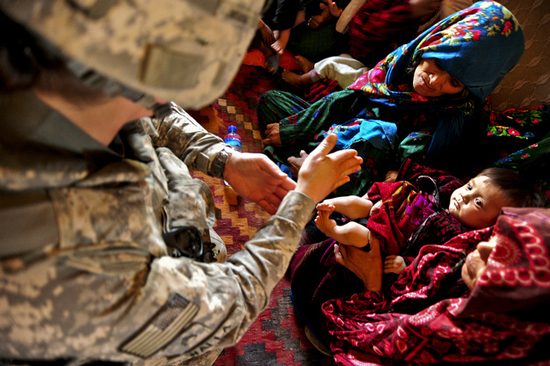
Photo Credit: “3-6 Soldiers Provide Medical Aid,” courtesy of flickr user expertinfantry.