-
Special Issue of ‘Reproductive Health Matters’ Highlights Integrated Development, Resilience Efforts
› The May edition of Reproductive Health Matters is a special edition on sustainable development and reproductive health and rights. Our own Roger-Mark De Souza writes that in the quest to build resilience, development practitioners can learn from integrated population, health, and environment (PHE) programs.
 -
Climate Change and Conflict in West African Cities: Early Warning Signs in Lagos and Accra
›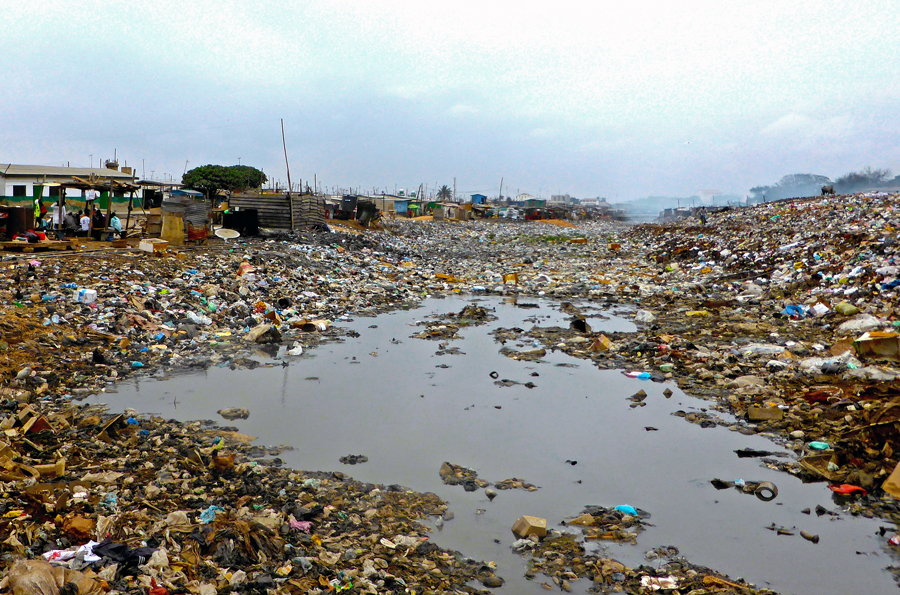
Despite the threat posed by flooding and sea-level rise, relatively little attention has been paid to the potential for environmentally induced instability in coastal West African cities. However, current trends, including rapid population growth, land use patterns, and increasing climate impacts, suggest the costs of inaction in these urban areas are rising.
-
The New World of Climate Suffering
›To date, there have been two proposed responses to climate change: mitigation, aimed at stopping the buildup of greenhouse gases, and adaptation, focused on accommodating ourselves to a warmer world. There is a third option, however, that is increasingly relevant: suffering.
-
Can Social Accountability Help Ensure Rights and Better Participation in Maternal Health Services?
›Over the last two decades, social accountability has emerged as a strategy to make health services more responsive to community needs. It’s an approach that creates a space for “interaction between citizen engagement and government responsiveness,” said Jonathan Fox, professor of international development at American University at the Wilson Center May 5. [Video Below]
-
Partnering on Climate Change Adaptation, Peacebuilding, and Population in Africa
›June 12, 2014 // By Lauren Herzer RisiRapid population growth can be a contributing factor to climate change vulnerability and should be considered in climate adaptation and peacebuilding efforts, said the Wilson Center’s Roger-Mark De Souza at a workshop on climate change adaptation and peacebuilding hosted by the Institute for Security Studies (ISS) in Addis Ababa.
-
CNN Profiles the Work of Conservation Through Public Health in Uganda
›Reporting on long-term, complex human-environment interactions can be daunting. As the saying goes, “if it bleeds, it leads,” and slow, sometimes-distant changes rarely make headlines. Yet, earlier this year CNN International’s African Voices program took a stab at it, diving into the world of integrated development in a three-part profile of Conservation Through Public Health (CTPH), a Ugandan NGO that is working to preserve one of Central Africa’s most important biodiversity hotspots while strengthening the health and wellbeing of nearby communities.
-
Not Just Climate Change: Marcel Leroy on How Demography Contributes to Africa’s Scarcity Problems
›
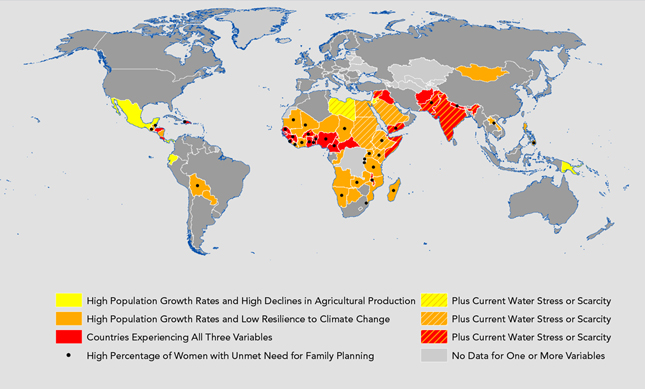
The Sahel has endured multiple debilitating food crises over the last five years and climate change has often been fingered as the culprit. But it is important to equally consider the amplifying effects of demographic trends on resource scarcity, says the University of Peace’s Marcel Leroy in this week’s podcast.
-
Heidi Worley, Population Reference Bureau
New Kenyan Population Policy
›May 29, 2014 // By Wilson Center StaffIn 2012, the government of Kenya passed a landmark policy to manage its rapid population growth. The new population policy aims to reduce the number of children a woman has over her lifetime from five in 2009 to 3 by 2030. The policy also includes targets for child mortality, maternal mortality, life expectancy, and other reproductive health measures.
Showing posts from category poverty.