-
Seven Ways Seven Billion People Affect the Planet
›October 31, 2011 // By Geoffrey D. DabelkoSeven billion people now live on earth, only a dozen years after global population hit six billion. But the seven billion milestone is not about sheer numbers: Demographic trends will significantly impact the planet’s resources and peoples’ security.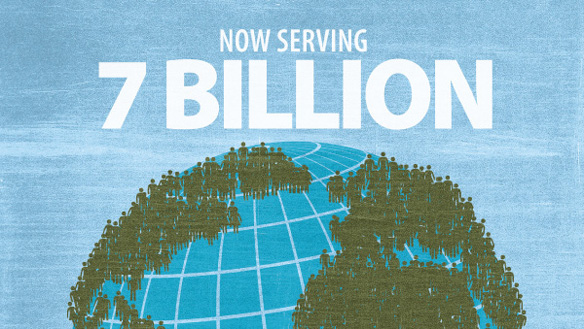
Growing populations stress dwindling natural resource supplies while high levels of consumption in both developed countries and emerging economies drive up carbon emissions and deplete the planet’s resources. And neglected “youth bulges” could bolster extremism in fragile states like Somalia and destabilize nascent democracies like Egypt.
Here are seven ways seven billion people affect the planet, according to recent research:
Security: Nearly 90 percent of countries with very young and youthful populations had undemocratic governments at the end of the 20th century. Eighty percent of all new civil conflicts between 1970 and 2007 occurred in countries where at least 60 percent of the population is under age 30, says demographer Elizabeth Leahy Madsen. According to research by demographer Richard Cincotta, these countries may achieve democracy, but are less likely to sustain it.- Richard Cincotta: Tunisia Predicted: Demography and the Probability of Liberal Democracy in the Greater Middle East
- Elizabeth Leahy Madsen: Demographic Security 101
Water: By 2025, 1.8 billion people will be living in countries with water scarcity, and fully two-thirds will be living in conditions of water stress. People are using groundwater faster than it can be naturally replenished, putting us in danger of “peak water,” says MacArthur “Genius” Fellow Peter Gleick. “We cannot talk about water without also understanding the enormously important role of population dynamics and population growth.”- Peter Gleick: Population Dynamics Key to Sustainable Water Solutions
Forests: The growing demand for energy has helped devastate tropical forests, as more than two billion people depend on wood for cooking and heating, particularly in developing countries. Projects in Indonesia, Nepal, and Uganda are fighting deforestation by providing alternative energy and incomes along with health and family planning services.- Indonesia: Health in Harmony
- Nepal: Forests for the Future
- Uganda: Sharing the Forest
Future Growth: By 2050, the UN says global population could range anywhere from 8 billion to 11 billion – and where it ends up depends in large part on the status of women in developing countries. “Even if fertility rates remain constant at current levels (which is unlikely), developing regions would grow from 5.7 billion in 2010 to 9.7 billion in 2050, but the total population of developed countries would remain essentially unchanged,” writes Madsen.- Elizabeth Leahy Madsen: How Did We Arrive at 7 Billion – and Where Do We Go From Here? [Part One] [Part Two]
There are no quick solutions to these seven problems. But meeting the unmet need for contraception of more than 200 million women is an effective and inexpensive way to start.
Sources: Population Action International, UN, World Health Organization.
Image Credit: Used with permission courtesy of Scott Woods, The University of Western Ontario. -
Watch: Gidon Bromberg Gives an Update on Jordan River Rehabilitation Efforts
›October 27, 2011 // By Kate Diamond Gidon Bromberg, co-director of Friends of the Earth Middle East (FOEME), says in this short interview with ECSP that his outlook on rehabilitating the Jordan River has changed completely over the last five years. We had been “laughed at” for trying to restore the waterway, he said; now though, “we are very confident that the Jordan River south of the Galilee down to the Dead Sea will be rehabilitated.”
By building a cross-border peace park and encouraging collaboration between Israelis, Palestinians, and Jordanians on water scarcity and quality issues, FOEME aims to improve environmental and security problems that bind the three groups together.
The Jordan River has become so polluted that visitors, many of whom are devout Christians making a pilgrimage to one of the religion’s most sacred sites, have been barred from its waters due to health concerns. Furthermore, more than 98 percent of its fresh water is diverted for agricultural work, meaning that the pollutants that end up in the river are highly concentrated.
But today, Bromberg said, sewerage is being removed on both the Israeli and Jordanian sides and there is a commitment to do the same from the Palestinians. For the first time in 60 years, there are concrete plans to return fresh water to a river that is “so holy to half of humanity.”
Sources: The Age, Friends of the Earth Middle East, The Guardian, U.S. Environmental Protection Agency -
Watch: Understanding Peak Water Can Help Us “Avoid the Worst Disasters,” Says Peter Gleick
›October 26, 2011 // By Kate Diamond“The advantage of the idea of peak water is that it lets us think differently about the limits that face us,” said MacArthur “Genius” Fellow and Pacific Institute President Peter Gleick in this short interview with ECSP. Gleick, who launched the latest edition of The World’s Water at the Wilson Center last week, has been talking about peak water since 2009 when he and Pacific Institute colleague Meena Palaniappan first wrote about the concept in that year’s water report (see our interview from then too).
Renewable vs. Non-Renewable
Peak water is “the idea that we are effectively running into constraints and limits on our water use,” said Gleick, in part because of population growth. “It lets us think differently about the limits to the water that’s available for us to use, and about the water that it’s appropriate for us to use, and about the policies to put in place to avoid the bad things that happen when we reach or exceed peak constraints.”
Gleick breaks the concept into three categories:- Peak renewable water: “Where we can no longer increase the amount of water we’re taking out of rivers – when we take all of it.”
- Peak nonrenewable water: “Where, very much like oil, we’re over-pumping a non-renewable ground water supply – a nonrenewable aquifer – and it becomes more and more expensive and more and more damaging and more and more difficult to pump ground water.”
- Peak ecological water: “Where the use of additional water causes more ecological harm than it provides economic benefit.”
Across all three categories, said Gleick, we are very bad at understanding limits. “We don’t measure peak water carefully, we don’t collect the data necessary to understand when we’re approaching or exceeding peak water limits.”
“But without a doubt we are exceeding peak water limits in more and more regions of the world,” he said. “And that’s going to have implications for our economies. It’s going to have implications for our environment.”
“Understanding and applying the idea of peak water is the first step toward developing strategies and institutions to avoid the worst disasters associated with overuse and inappropriate use of our water resources.” -
Peter Gleick: Population Dynamics Key to Sustainable Water Solutions
›October 21, 2011 // By Theresa Polk“Water is tied to everything we care about,” said MacArthur “Genius” Fellow and President of the Pacific Institute Peter Gleick in an interview with ECSP. However, “we cannot talk about water or any other resource issue…without also understanding the enormously important role of population dynamics and population growth.”
-
Watch: Scott Wallace on the Amazon’s Last Uncontacted Tribes and the Intersection Between Human Rights and Conservation
›October 19, 2011 // By Wilson Center StaffIn the far west of the Amazon, some of the last uncontacted indigenous tribes on Earth live untouched by modern society. Scott Wallace, frequent contributor to National Geographic and former public policy scholar at the Wilson Center, spoke to New Security Beat about his new book, The Unconquered: In Search of the Amazon’s Last Uncontacted Tribes, which chronicles his harrowing trip through the Javari Valley Indigenous Land. Wallace accompanies former sertanista (“agent of contact”)-turned-native rights advocate Sydney Possuelo as he attempts to map and protect the territory of the flecheiros, or Arrow People, named for the poison-tipped arrows they use.
The Brazilian government and activists are trying to protect the areas where these native groups live and allow them to choose for themselves if they want contact. “It’s not that hard to find us,” Wallace said. For the moment, however, “it’s clear that they do not want that contact.”
By protecting these people, the government is also protecting thousands, if not millions, of acres of virgin rainforest, said Wallace, creating a mutually beneficial intersection between human rights and environmental conservation.
“The assumption is that there is now a global village, everyone’s connected…no one of us is separated from anyone else on the planet by more than six degrees of separation,” said Wallace. But that assumption breaks down in the face of these people who live in complete isolation from the rest of the world.
We have to decide whether to leave them alone and let them live their lives or try to make lasting contact, said Wallace. Contact would open up the tribe’s land and resources to development but come at great risk to their society, their lives (due to vulnerability to disease), and the Amazonian ecosystem, as the example of India’s Adavasi tribes demonstrates. -
Women and Water: Streams of Development
›“One of the things that we consistently learn is that water is a woman’s issue,” said Lisa Schechtman, WaterAid America’s head of policy and advocacy, leading off a September 23 Wilson Center on the Hill panel on gender, water, and development. Schechtman was joined in the discussion by Jae So, director of the World Bank’s Water and Sanitation Program; Christian Holmes, USAID’s Global Water Coordinator; and Geoff Dabelko, moderator and director the Wilson Center’s Environmental Change and Security Program.
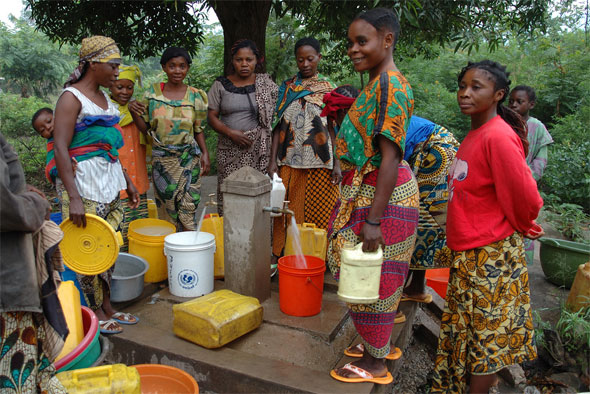
Water issues affect everyone, but women often bear the brunt of water collection responsibilities, making them vulnerable to changes in access or sanitation, especially in developing countries. “Studies show that about 26 percent of a rural African woman’s time is spent collecting water,” Schechtman said. “That means that they can’t go to school, they can’t take care of their families, or go to clinics, or spend time generating income, or doing other things in their community like participating in political processes.”
What’s more, as women make the hours-long hike to get water, “they’re risking injury and sexual assault,” Schechtman added. “So there’s a really wide-ranging set of impacts, just out of the actual act of collecting water.”
The Horn of Africa: Severe Problems, Small Changes
In one town in northeastern Kenya, Holmes said women have to travel 12 miles to find water – and even then, they are drawing it from a waterhole shared with wildlife. In Ethiopia, “we have severe problems,” he said, “not the least of which is not just sanitation but also HIV and AIDS,” as HIV/AIDS patients often drink unsanitary water to take their medications. That water gives them diarrheal disease, “so they’re excreting the value of the treatment” – and women, as household caregivers, bear an ever greater burden.
In Somalia, girls drop out of school once they start menstruating because schools do not have latrines that allow them to meet their needs safely and privately. “To think that the lack of a latrine could make you drop out of school and your entire life is going to change overnight – it’s just not acceptable,” said Holmes.
In each of these cases, small changes could dramatically reduce strains on women. Holmes pointed to a USAID project in Kenya that is building wells closer to population centers and empowering women by bringing them into the decisions on developing and managing wells. In Ethiopia, NGOs are working to train women on sanitation and hygiene, which could reduce the burden of illness on women and their families. And in Somalia, the simple addition of women’s latrines at schools would mean girls can continue their education beyond puberty.
Closing the Water Gender Gap
The World Bank’s 2012 World Development Report on Gender Equality and Development recommends that development professionals “look at the gender gaps in basic endowments, like access to health, access to water resources, access to land,” and determine not just how they affect men and women differently but why those gaps exist in the first place, said Jae So.
A CARE and Swiss Development Corporation study of water services in Nicaragua found that when men realized how much of a role water-related activities played in women’s day-to-day lives, “it energized the entire community to really devote their collective resources” towards improving water management, said So.
“Water touches everything else in one’s life,” said Holmes. “You can link it to water and climate change, water and health, water and food, water and conflict, water and education – all are interwoven.”
Event ResourcesSources: The United Nations, UNICEF, USAID, WaterAid America, The World Bank.
Photo Credit: “Repatriated Mamas at the fountain,” courtesy of flickr user Julien Harneis -
Watch: Dennis Taenzler on Four Key Steps for REDD+ to Avoid Becoming a Source of Conflict
›The UN Program on Reducing Emissions from Deforestation and Forest Degradation (REDD) provides financial incentives to developing countries to conserve their forests and invest in low-carbon pathways to sustainable development. However, it may also be a potential new source of conflict, says Dennis Taenzler, a senior project manager at adelphi in Berlin, who works on climate and energy policies as well as peace and conflict issues.
-
Aaron Wolf on Water Management, Agriculture, and Population Growth in the Middle East
›In terms of groundwater depletion, “Yemen and Gaza are probably the two places worst off in the Middle East,” Aaron Wolf told ECSP in a recent interview. Wolf, a water expert and geography professor at Oregon State University, said population growth across the broader Middle East region has led to intensified groundwater pumping in recent years. This trend has raised the prospects for water-related conflict down the road, as countries drain their groundwater stocks faster than the aquifers can recharge. Potentially complicating matters further, said Wolf, is that most aquifers in the Middle East cross international boundaries.
Despite the region’s history of water tensions, Wolf said the unprecedented level of demographic change currently being experienced across the Middle East is not necessarily a recipe for future confrontations over the resource, in part thanks to the existence of water-sharing agreements in the area. Nevertheless, mounting demand will likely force water-users across the region – especially within the agriculture sector – to change the ways they utilize the resource.
Accounting for 80 to 90 percent of total water usage in some Middle Eastern countries, agricultural operations have already been forced to adjust to the evolving water-access situation. While moving from flood irrigation to drip irrigation represents one policy option if sufficient funds are available, Wolf said doing away with local food production “is a path that a lot of countries are going to have to take” to ensure a relatively stable water supply for their populations’ drinking, cooking, and cleaning needs.
Wolf added that one frequently discussed but not entirely realistic option for addressing the region’s water-supply concerns involves desalination. To date, widespread deployment of the technology has been hampered by high costs and substantial energy requirements, although that hasn’t stopped a few countries in the region – among them the United Arab Emirates, Saudi Arabia, and Israel – from becoming partially reliant on converted fresh water.
Wolf maintained that desalination’s hefty price tag means the technology is useful only for urban population centers near the coast. Moving converted sea water further inland remains a non-starter, he said, because transporting it requires an enormous amount of energy (a cubic meter of water weighs a metric ton).
For the same reasons, Wolf asserted, using desalinated water for agriculture doesn’t seem to be in the cards any time soon. “Right now a cubic meter of desalinated water costs about 40 cents, and you can’t use that for agriculture unless it drops down to about 8 cents a cubic meter,” Wolf said. “So until you can irrigate with desalinated water, it really doesn’t go a long way towards mitigating the larger water crisis.”
The “Pop Audio” series is also available as podcasts on iTunes.
Sources: American University, International Food Policy Research Institute, World Bank.
Showing posts from category natural resources.