-
Improving Food Security Through Land Rights and Access to Family Planning
›“In a future world affected by climate change, population growth is one lever that can be addressed to ameliorate the impacts of climate change, particularly in the area of food security,” write Scott Moreland and Ellen Smith in “Modeling Climate Change, Food Security, and Population,” a recent study for MEASURE Evaluation and USAID. Moreland and Smith combine demographic changes, food needs, and economic capacity into a single aggregate model to assess how family planning and climate change might affect food security from now until 2050. Using Ethiopia as an example, the model finds that if access to family planning services were increased to meet existing needs, the subsequent decrease in demand for food would reduce child malnutrition and effectively counteract a projected 25 percent shortfall in caloric availability from climate change’s impact on agriculture. Programs designed to increase access to family planning should therefore be incorporated into national adaptation and food security strategies, they conclude. “Family planning, especially in countries with high unmet need, provides a potential solution not only for women’s reproductive health, but also for adapting to the effects of climate change.” The Food and Agriculture Organization’s Committee on World Food Security recently endorsed a set of voluntary guidelines for land tenure governance in the context of food security that aims to strike a balance between encouraging productive investment and ensuring equitable and sustainable development. Population growth, climate change, and environmental degradation are putting pressure on the legal and cultural systems that govern land rights, resulting in “inadequate and insecure tenure rights” which can “increase vulnerability, hunger and poverty, and can lead to conflict and environmental degradation when competing users fight for control of these resources.” The guidelines, drawn from consultations with hundreds of people from both the private and public spheres and representing more than 130 countries, emphasize the need to safeguard access to land, fisheries, and forests – as well as the resources they provide – in a way that respects customary tenure systems, which are not always reflected in official tenure policies or records. They also emphasize strengthening the ownership rights of women and other traditionally marginalized groups in order to enhance food security and minimize the risk of instability and conflict in the future.
 -
Nigeria Beyond the Headlines: Environment and Security [Part Two]
›In the coming years, Nigeria’s cohort of unemployed youth has equal potential to “be converted into either a religious or a regional clash, as certain youths get opportunities and other youths do not,” said Pauline Baker, President Emeritus of the Fund for Peace, during the day-long “Nigeria Behind the Headlines” event at the Wilson Center on the April 25 (read part one here). [Video Below]
-
Michael Kugelman, AfPak Channel
Pakistan’s Climate Change Challenge
›May 11, 2012 // By Wilson Center StaffLast month, an avalanche on the Siachen glacier in Kashmir killed 124 Pakistani soldiers and 11 civilians. The tragedy has intensified debate about the logic of stationing Pakistani and Indian troops on such inhospitable terrain. And it has also brought attention to Pakistan’s environmental insecurity.
Siachen is rife with glacial melt; one study concludes the icy peak has retreated nearly two kilometers in less than 20 years. It has also been described as “the world’s highest waste dump.” Much of this waste-generated from soldiers’ food, fuel, and equipment-eventually finds its way to the Indus River Basin, Pakistan’s chief water source.
Siachen, in fact, serves as a microcosm of Pakistan’s environmental troubles. The nation experiences record-breaking temperatures, torrential rains (nearly 60 percent of Pakistan’s annual rainfall comes from monsoons), drought, and glacial melt (Pakistan’s United Nations representative, Hussain Haroon, contends that glacial recession on Pakistani mountains has increased by 23 percent over the past decade). Experts estimate that about a quarter of Pakistan’s land area and half of its population are vulnerable to climate change-related disasters, and several weeks ago Sindh’s environment minister said that millions of people across the province face “acute environmental threats.”
Continue reading on the AfPak Channel.
Sources: Daily Times, Dawn.com, Environment News Service, The Express Tribune, The New York Times, Remote Sensing Technology Center of Japan.
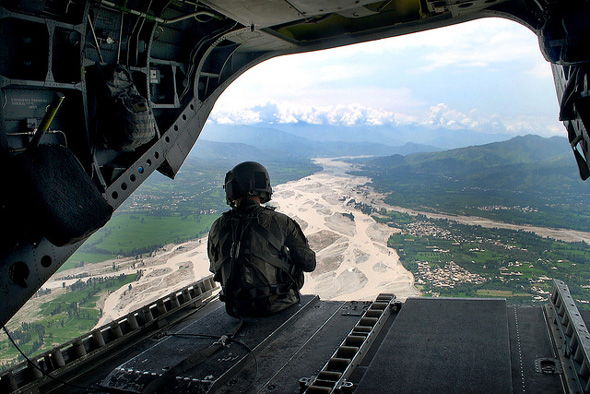
Photo Credit: “Surveying damage in Pakistan,” courtesy of the U.S. Army.
-
A Northern View: Canada’s Climate Claims and Obligations
›Reneging on Kyoto, Keystone pipeline drama, pain at the pump, re-aligned Arctic sovereignty, melting outdoor hockey rinks – all these aspects of climate change are being discussed in Canada.
However, Canadians, as potential citizens of the next energy superpower, need a more comprehensive and enriching debate. Climate change adaptation measures, at home and abroad, are inevitable, but the issue has largely been ignored by the federal government thus far.
To many Americans, it may seem that Canada has equated energy production with national prosperity, but Canadians are increasingly concerned about the human security and eco-justice implications of ongoing climate change as well. Lack of leadership at the federal level on Kyoto-related energy efficiency and emissions mitigation has been partially offset by actions at the provincial and municipal levels, but climate change is occurring now and it demands a coordinated response from the federal government, the only political apparatus capable of channeling the resources necessary for making a solid contribution to global climate change adaptation.
A moderate predictive scenario suggests that the regional impacts of climate change will be very expensive: the UN projects the global Green Climate Fund will require up to $100 billion a year by 2020. Water stress – too little, too much, or the perception of either – may be the most common theme. Coastal flooding, shoreline erosion, glacier retreat, chronic water shortages, loss of biodiversity and habitat, increased spread of invasive species, extreme weather events; taking preventive action against these (beyond the obvious call for reduced emissions) will be prohibitively expensive for most communities around the globe, including the coastal and northern regions of Canada.
The UN Convention to Combat Desertification has become a conduit for the argument that drought and land degradation related to climate change justifies southern demands for northern investment in initiatives in Africa and elsewhere. As a high emissions per capita nation, Canada has an obligation to contribute to such international efforts.
But I also don’t see why the indigenous peoples of the circumpolar north should be denied claims as permafrost thaws and ice-cover vital for subsistence hunting disappears. Citizens of small island states, to whom adaptation may well mean the abandonment of their homeland, have charged willful ignorance or purposeful negligence of their plight; so too might riparian communities along Canada’s many ocean shorelines, lakes, and rivers. Farmers, fishers, First Nations communities: all will need to adapt. We need to start seriously planning ahead to meet climate change scenarios, instead of burying the issue under the tar sands.
Of course, people will adapt to shifting conditions; such is the imperative of survival. And there are many ingenious ways this will materialize. Indeed many mitigation and adaptation strategies blend together as hybrids today. Building more effective alternative energy systems can be seen as much as responses to climate change as preventive measures and involve both public and private sector funding, for example.
However, paying for adaptation is another matter, and here it is vital in my view to stress the potential role of infrastructure spending by the federal government. Much of Canada’s current fiscal restraint is indeed a welcome development if the government cuts back on waste and redundancy, but not if it serves as a veil for sacrificing principles of eco-justice – the idea that those who made the least contributions to and benefit the least from environmental problems should not bear disproportionately higher risks.
Of course there will be nasty disputes ahead about the accounting, accountability, legitimacy, and purpose of climate change adaptation funding for Canada, in or out of the UNFCCC process, but let me draw just a few general conclusions at this stage:- There is an ethical imperative to contribute to international adaptation funding, perhaps just as great an imperative as traditional efforts to help former colonized countries. It’s not just about money, at least not directly: Canadian technical, policy, and financial expertise should be harnessed for this purpose as well.
- Unlike in other policy areas, there is no way to unload or pass the buck on climate change adaptation efforts: they demand the utilization of centralized resources redistributed throughout the country and through multilateral funding mechanisms.
- Adaptation funding should not, however, supplant more traditional emergency, humanitarian, or environmental funding. It should be seen as a supplement, albeit one with increasing importance, but not as a new form of dependency or gold-rush of aid-with-obligations opportunities. The current government is right to worry about accountability issues.
- But accountability goes both ways: we need at least to get the accounting and communications right on this, thus the need for open dialogue and ongoing consultation. Killing the well-respected National Roundtable on the Environment and the Economy, which consulted various Canadian stakeholders on key environmental questions, was not a good start.
Peter Stoett is the Fulbright Research Chair in Canada-U.S. Relations at the Wilson Center’s Canada Institute and professor in the Department of Political Science at Concordia University, Montreal.
Sources: CBC, The Catholic Register, The Huffington Post, International Institute for Sustainable Development, UNFCCC.
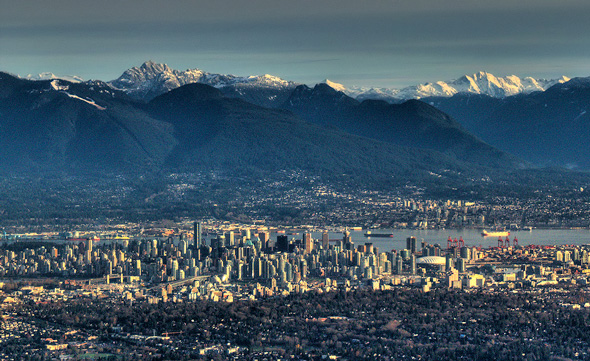
Photo Credit: “City, Suburb, Ocean, Mountain,” courtesy of flickr user ecstaticist (Evan Leeson). -
Richard Matthew: Responsive Peacebuilding Includes the Environment and Natural Resources
›April 30, 2012 // By Stuart Kent“After 20 years of peacebuilding experimentation, one of the good signs is that the countries receiving this [peacebuilding] attention…more and more are shaping the process,” said Professor Richard Matthew, director of the Center for Unconventional Security Affairs at the University of California, Irvine.
Peacebuilding is shifting, he said, from internationals going in with pre-existing conceptions of “what you need for stability and development, what will make you attractive to investors, what will make your people secure,” to instead sitting down and talking with stakeholders about “what types of capacity do you need, and how can we support you in acquiring those.”
Along with the shift towards more responsive peacebuilding has come an elevated interested in the environment and natural resources. For people living in the peacebuilding countries themselves, “there was never any doubt that water and forest and access to minerals and so on were critical to their future,” said Matthew, but Western and Northern countries often thought of it as a “second tier issue that you might get to once people were safe, and the government was functioning, and the economy was up and running again.”
Matthew co-authored the 2009 UNEP report, From Conflict to Peacebuilding: The Role of Natural Resources and the Environment, which examined environmental factors all along the conflict continuum – from inception to peacebuilding. Successful peacebuilding, the report argues, requires that “environmental drivers are managed, that tensions are defused, and that natural assets are used sustainably to support stability and development in the long term.” -
Uganda’s Demographic and Health Challenges Put Into Perspective With Newfound Oil Discoveries [Part Two]
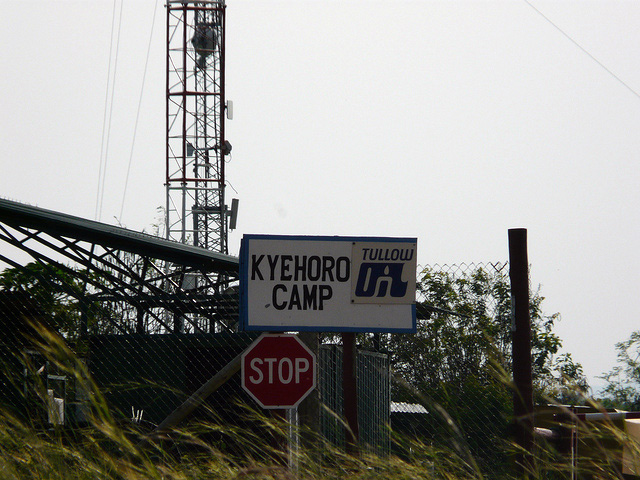
›April 26, 2012 // By Kate Diamond“We never thought we would end up having the same problems here as the people in the Niger Delta. But now I’m worried,” Henry Ford Mirima, a spokesman for Uganda’s Bunyoro kingdom, said last fall in Le Monde Diplomatique. The kingdom – which calls itself East Africa’s oldest – sits along Lake Albert, where over the past seven years British oil company Tullow Oil has discovered oil reserves big enough to produce an estimated 2.5 billion barrels.
-
Uganda’s Demographic and Health Challenges Put Into Perspective With Newfound Oil Discoveries [Part One]
›April 26, 2012 // By Kate DiamondUganda’s population is the second youngest in the world, with half of the country younger than 15.7 years old (just older than Niger’s median age of 15.5 years). In the past 10 years, the country – about half the size of France in land area – has added 10 million people, growing from 24 to 34 million. That growth, paired with other factors like poor governance and long-standing insecurity, has made providing basic services a difficult task for a government that is one of Africa’s most aid-dependent.
-
Richard Cronin, World Politics Review
China and the Geopolitics of the Mekong River Basin
›April 25, 2012 // By Wilson Center StaffThe original version of this article, by Richard Cronin, appeared in World Politics Review.
Two decades after the Paris Peace Accord that ended the proxy war in Cambodia, the Mekong Basin has re-emerged as a region of global significance. The rapid infrastructure-led integration of a region some call “Asia’s last frontier” has created tensions between and among China and its five southern neighbors – Cambodia, Laos, Myanmar, Thailand, and Vietnam. Both expanded regional cooperation as well as increased competition for access to the rich resources of the once war-torn region have created serious environmental degradation while endangering food security and other dimensions of human security and even regional stability.
China’s seemingly insatiable demand for raw materials and tropical commodities has made it a fast-growing market for several Mekong countries and an increasingly important regional investor. Economic integration has been boosted by a multibillion dollar network of all-weather roads, bridges, dams, and power lines largely financed by the Asian Development Bank (ADB) that is linking the countries of the Lower Mekong to each other and to China. To date, the ADB’s Greater Mekong Subregion (GMS) cooperative development program has primarily benefited large population centers outside the basin proper in China, Thailand, and Vietnam. Unfortunately, the same infrastructure that speeds the flow of people and goods to urban centers also facilitates the environmentally unsustainable exploitation of the forests, minerals, water resources, and fisheries that are still the primary source of food and livelihoods to millions of the Mekong’s poorest inhabitants.
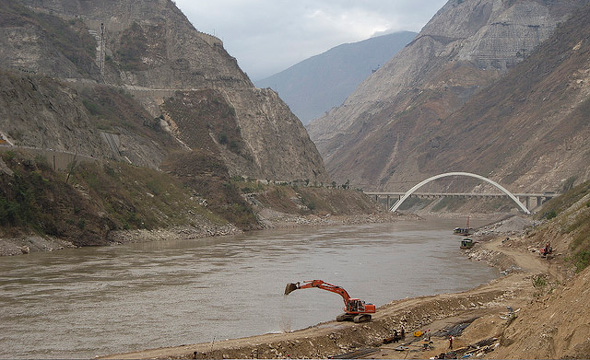
No aspect of China’s fast-growing role and influence in the Mekong region is more evident and more problematic than its drive to harness the huge hydroelectric potential of the Upper Mekong through the construction of a massive cascade of eight large- to mega-sized dams on the mainstream of the river in Yunnan Province. The recently completed Xiaowan dam, the fourth in the series, will mainly be used to send electricity to the factories and cities of Guangdong Province, its coastal export manufacturing base some 1,400 kilometers away. China’s Yunnan cascade will have enough operational storage capacity to augment the dry season flow at the border with Myanmar and Laos by 40-70 percent, both to maintain maximum electricity output and facilitate navigation on the river downstream as far as northern Laos for boats of up to 500 tons.
Continue reading in World Politics Review.
Photo Credit: “Xiaowan Dam Site,” courtesy of International Rivers.
Showing posts from category natural resources.