-
Paradigm Shift in Chinese Environmental Sector Needed, Says Activist Wang Canfa
›
A well-known Chinese proverb describing the relationship between the central government in Beijing and its people says, “Heaven is high and the emperor is far away” (天高皇帝远, tian gao, huang di yuan). It’s not too far of a stretch to apply the same proverb to the current state of China’s environment sector, where relatively strong pollution control laws are poorly enforced on the ground.
-
UNEP Highlights Environmental Impacts on Health in Africa
›March 20, 2013 // By Carolyn Lamere
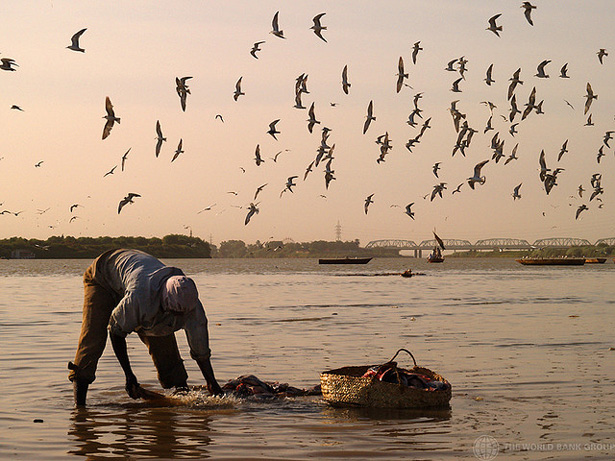
While it can be convenient to think of human health and the environment as unrelated silos, they are in fact closely related. The United Nations Environment Program (UNEP) recently released a report underscoring this point especially for Africa, where large numbers of people are directly reliant on natural resources for their livelihoods.
-
East Asia’s Many Maritime Disputes and the Imperative of Energy Access
›Friction between Japan and China in the East China Sea has escalated this year to the point where jets on both sides have been scrambled and Chinese military vessels have locked their fire control radar onto their Japanese counterparts multiple times. The source of this tension is the Senkaku (as they are known in Japan) or Diaoyu (if you’re in China) Islands – specifically, who owns them.
-
‘Global Trends 2030’ Author Mathew Burrows Describes Demographic and Environmental Megatrends
›“The world of 2030 will be radically transformed from our world today,” reads the opening of Global Trends 2030: Alternative Worlds, produced by the National Intelligence Council. In this podcast, principal author Mathew Burrows breaks down some of the scenarios discussed in the report, and describes how demographic and environmental trends – two of four “megatrends” – could play out over the next few decades.
-
In Uganda, Integrating Population, Health, and Environment to Meet Development Goals
›Fifty years after independence, Uganda has one of the highest population growth rates in the world at 3.3 percent – a rate which puts the country on track to nearly double in population over the next two decades. More than 50 percent of the population is under the age of 18. This large youth cohort will ensure that the country continues to grow for decades to come, even if couples choose – and are able – to have smaller families. And according to the State of Uganda Population Report 2011, “with more than one million people added to the population every year, the quality of [health] service delivery will suffer.”
-
‘Dialogue’ Interviews Caryle Murphy & John Sullivan: Saudi Arabia’s Demography & 2013’s Big Environment Stories
›Dialogue at the Wilson Center tackled demography and the environment last week, interviewing Pulitzer Prize-winning journalist and former Wilson Center public policy scholar Caryle Murphy about her new book, A Kingdom’s Future: Saudi Arabia Through the Eyes of Its Twentysomethings, followed by John Sullivan, director of the Environment and Health and Safety News Division for Bloomberg BNA, on the most important energy and environmental issues of 2013.
-
Breaking Out of the Green House: Indian Leadership in Times of Environmental Change (Book Preview)
›The 2009 Copenhagen summit was a watershed moment in the history of climate change negotiations, especially from an Indian perspective. Brazil, South Africa, India, and China – the “BASIC” group – asserted their position, which led to a virtual collapse in talks, ostensibly marking the ascent of the global “south” and relative descent of the “north.”
-
Cleo Paskal and Uttam Sinha on the Geopolitical Implications of Climate Change for India and China
›India and China – “the two most important countries going forward in this century” – will both experience domestic concerns as a result of environmental change, but they are responding very differently, said Cleo Paskal, an associate fellow at Chatham House, in an interview with the Environment, Conflict, and Cooperation (ECC) Platform.
Showing posts from category natural resources.