Showing posts from category military.
-
Water, Energy, and the U.S. Department of Defense
›
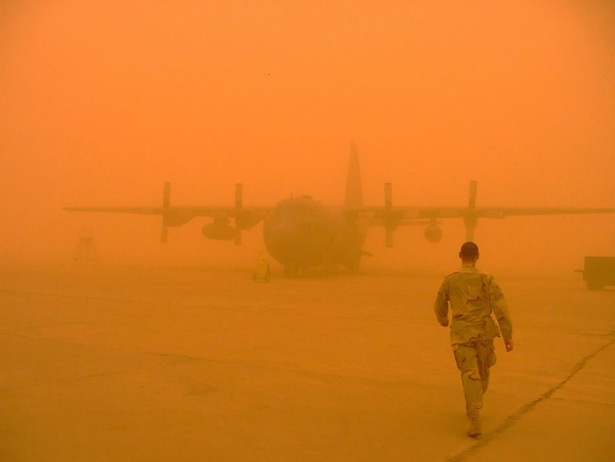
Energy for the War Fighter is the U.S. Department of Defense’s first operational energy strategy, mandated by congress last year. Energy security for the department means having assured access to reliable supplies of energy and the ability to protect and deliver energy to meet operational (non-facilities-related) needs. The report is divided into three main parts, which address reducing current demand for energy in military operations; expanding and securing the supply of energy for military operations; and building consideration of energy security into future force decisions. The strategy is designed to both support current military operations and to focus future energy investments accordingly. Previous federal energy mandates exempted the military’s field operations, which account for three-quarters of the department’s energy consumption. The department as a whole makes up 80 percent of the federal government’s annual energy use.
The Water Energy Nexus: Adding Water to the Energy Agenda, by Diana Glassman, Michele Wucker, Tanushree Isaacman, and Corinne Champilouis of the World Policy Institute, attempts to show the correlation between energy and water to motivate policy makers to consider the implications of their dual consumption. “Nations around the world are evaluating their energy options and developing policies that apply appropriate financial carrots and sticks to various technologies to encourage sustainable energy production, including cost, carbon, and security considerations,” write the authors. “Water needs to be a part of this debate, particularly how communities will manage the trade-offs between water and energy at the local, national, and cross-border levels.” The study provides the context needed to evaluate key tradeoffs between water and energy by providing “the most credible available data about water consumption per unit of energy produced across a wide spectrum of traditional energy technologies,” they write.
Sources: U.S. Department of Defense. -
Preparing for the Impact of a Changing Climate on U.S. Humanitarian and Disaster Response
›Climate-related disasters could significantly impact military and civilian humanitarian response systems, so “an ounce of prevention now is worth a pound of cure in the future,” said CNA analyst E.D. McGrady at the Wilson Center launch of An Ounce of Preparation: Preparing for the Impact of a Changing Climate on U.S. Humanitarian and Disaster Response. The report, jointly published by CNA and Oxfam America, examines how climate change could affect the risk of natural disasters and U.S. government’s response to humanitarian emergencies. [Video Below]
Connecting the Dots Between Climate Change, Disaster Relief, and Security
The frequency of – and costs associated with – natural disasters are rising in part due to climate change, said McGrady, particularly for complex emergencies with underlying social, economic, or political problems, an overwhelming percentage of which occur in the developing world. In addition to the prospect of more intense storms and changing weather patterns, “economic and social stresses from agricultural disruption and [human] migration” will place an additional burden on already marginalized communities, he said.
Paul O’Brien, vice president for policy and campaigns at Oxfam America said the humanitarian assistance community needs to galvanize the American public and help them “connect the dots” between climate change, disaster relief, and security.
As a “threat multiplier,” climate change will likely exacerbate existing threats to natural and human systems, such as water scarcity, food insecurity, and global health deterioration, said Vice Admiral Lee Gunn, USN (ret.), president of CNA’s Institute for Public Research. Major General Richard Engel, USAF (ret.), of the National Intelligence Council identified shifting disease patterns and infrastructural damage as other potential security threats that could be exacerbated by climate change.
“We must fight disease, fight hunger, and help people overcome the environments which they face,” said Gunn. “Desperation and hopelessness are…the breeding ground for fanaticism.”
U.S. Response: Civilian and Military Efforts
The United States plays a very significant role in global humanitarian assistance, “typically providing 40 to 50 percent of resources in a given year,” said Marc Cohen, senior researcher on humanitarian policy and climate change at Oxfam America.
The civilian sector provides the majority of U.S. humanitarian assistance, said Cohen, including the USAID Office of Foreign Disaster Assistance (OFDA) and the State Department’s Bureau of Population, Refugees, and Migration. These organizations provide leadership, funding, and food aid to developing countries in times of crisis, but also beforehand: “The internal rationale [of the Office of Foreign Disaster Assistance] is to reduce risk and increase the resilience of people to reduce the need for humanitarian assistance in the future,” said Edward Carr, climate change coordinator at USAID’s Bureau for Democracy, Conflict, and Humanitarian Assistance.
The U.S. military complements and strengthens civilian humanitarian assistance efforts by accessing areas that civilian teams cannot reach. The military can utilize its heavy lift capability, in-theater logistics, and command and control functions when transportation and communications infrastructures are impaired, said McGrady, and if the situation calls for it, they can also provide security. In addition, the military could share lessons learned from its considerable experience planning for complex, unanticipated contingencies with civilian agencies preparing for natural disasters.
“Forgotten Emergencies”
Already under enormous stress, humanitarian assistance and disaster response systems have persistent weaknesses, such as shortfalls in the amount and structure of funding, poor coordination, and lack of political gravitas, said Cohen.
Food-related aid is over-emphasized, said Cohen: “If we break down the shortfalls, we see that appeals for food aid get a better response than the type of response that would build assets and resilience…such as agricultural bolstering and public health measures.” Food aid often does not draw on local resources in developing countries, he said, which does little to improve long-term resilience.
“Assistance is not always based on need…but on short-term political considerations,” said Cohen, asserting that too much aid is supplied to areas such as Afghanistan and Iraq, while “forgotten emergencies,” such as the Niger food crisis, receive far too little. Furthermore, aid distribution needs to be carried out more carefully at the local scale as well: During complex emergencies in fragile states, any perception of unequal assistance has the potential to create “blowback” if the United States is identified with only one side of a conflict.
Engel added that many of the problems associated with humanitarian assistance will be further compounded by increasing urbanization, which concentrates people in areas that do not have adequate or resilient infrastructure for agriculture, water, or energy.
Preparing for Unknown Unknowns
A “whole of government approach” that utilizes the strengths of both the military and civilian humanitarian sectors is necessary to ensure that the United States is prepared for the future effects of climate change on complex emergencies in developing countries, said Engel.
In order to “cut long-term costs and avoid some of the worst outcomes,” the report recommends that the United States:
Cohen singled out “structural budget issues” that pit appropriations for protracted emergencies in places like Iraq, Afghanistan, and Darfur against unanticipated emergencies, like the 2010 earthquake in Haiti. Disaster-risk reduction investments are not a “budgetary trick” to repackage disaster appropriations but a practical way to make more efficient use of current resources, he said: “Studies show that the return on disaster-risk reduction is about seven to one – a pretty good cost-benefit ratio.”- Increase the efficiency of aid delivery by changing the budgetary process;
- Reduce the demand by increasing the resilience of marginal (or close-to-marginal) societies now;
- Be given the legal authority to purchase food aid from local producers in developing countries to bolster delivery efficiency, support economic development, and build agricultural resilience;
- Establish OFDA as the single lead federal agency for disaster preparedness and response, in practice as well as theory;
- Hold an OFDA-led biannual humanitarian planning exercise that is focused in addressing key drivers of climate-related emergencies; and,
- Develop a policy framework on military involvement in humanitarian response.
Edward Carr said that OFDA is already integrating disaster-risk reduction into its other strengths, such as early warning systems, conflict management and mitigation, democracy and governance, and food aid. However, to build truly effective resilience, these efforts must be tied to larger issues, such as economic development and general climate adaptation, he said.
“What worries me most are not actually the things I do know, but the things we cannot predict right now,” said Carr. “These are the biggest challenges we face.”
“Pakistan Floods: thousands of houses destroyed, roads are submerged,” courtesy of flickr user Oxfam International. -
Rare Earths No More? Mineral Discoveries a Potential Game-Changer for East Asia
›July 7, 2011 // By Schuyler NullDiscoveries announced in a journal article over the weekend may prove a game-changer for global rare earth supplies and recent diplomatic maneuvering in East Asia between China, Japan, Vietnam, and the United States. A team of researchers from Japan’s Agency for Marine-Earth Science and Technology published findings in Nature Geoscience that indicate vast underwater reserves of rare earth minerals are scattered across a huge swath of the Pacific, including south and east of Japan. The U.S. Geological survey estimates current global reserves of rare earth minerals at about 110 million tons; Yasuhiro Kato, the lead author of the Japanese team, told Reuters that the sites surveyed could contain an additional 80 to 100 billion metric tons (yes, with a “b”) of the valuable resources.
The authors write that an “area of just one square kilometer, surrounding one of the sampling sites, could provide one-fifth of the current annual world consumption of these elements.” The team collected data from 78 sites in total, with the largest concentrations centered east of the Hawaiian and Polynesian islands (see a map of the surveyed areas here).
Resource Relationships
The discovery could prove crucial for Japan, as it has been seeking alternative sources of rare earth minerals after an embargo earlier this year by China, which controls 97 percent of the world’s current supply. The embargo (which China denied) was imposed in October of last year after the Japanese navy arrested the captain of a Chinese fishing boat, which was alleged to be encroaching on Japanese territorial waters. China’s response increased tensions across the region and produced a flurry of warnings in Washington over the security of U.S. supplies.
Although the embargo was later lifted, Japan and Vietnam reached an agreement for development of Vietnamese mines in November. The tensions sparked by the encounter also spread to the South China Sea where Chinese, Vietnamese, and Filipino forces have stepped up their jockeying over disputed and resource-rich waters to the highest levels in years. Vietnamese and Chinese naval forces recently held mirror exercises, and Filipino officials invoked a 1950-era defense pact with the United States. Chinese Vice Foreign Minister Cui Tiankai told reporters in June: “I believe the individual countries are actually playing with fire, and I hope the fire will not be drawn to the United States.”
Secretary of State Hillary Clinton called concerns over navigability and Chinese insistence on bilateral (as opposed to multilateral) negotiations in the South China Sea a matter of “national interest” for the United States last year.
The Japanese team’s discovery has the potential to significantly impact the power dynamics behind these tensions. China has used its rare earth monopoly to pressure Japan and the United States, which in turn may have also helped embolden its recent more aggressive maritime policies. If the new rare earth discoveries prove viable, that calculus could change considerably.
However serious questions remain: Many of the discoveries lie outside of established exclusive economic zones, so who has the rights to mine them? They’re also between 11,500 and 20,000 feet below the surface – how long before we have the technologies to extract them at an industrial scale? And how safe – both for humans and the environment – will those processes be? Aboveground rare earth mines are some of the most damaging to the environment – part of the claimed reason China curbed overall exports earlier this year, which drove up global prices and drew the ire of the World Trade Organization.
For more on the importance of rare earth minerals to the defense and electronics industries, see New Security Beat’s “Rare Earth: A New Roadblock for Sustainable Energy?” and “Reading Radar: The Mineral Security of the United States.” For more on the exclusive economic zones map, see “Eye on Environmental Security: Natural Resource Frontiers at Sea;” and on the South China Sea and what it reveals about future diplomatic fault lines between the United States and China, see “U.S. v. China: The Global Battle for Hearts Minds and Resources.”
Sources: Asia Sentinel, The Atlantic, BBC, Government Accounting Office, Nature Geoscience, The New York Times, Reuters, Tech News Daily, U.S. Department of State.
Photo Credit: Adapted from “USS Mustin underway in the Pacific Ocean,” courtesy of flickr user Official U.S. Navy Imagery, and “Exclusive Economic Zone,” used with permission courtesy of Theo Deutinger and TD Architects. -
Inaugural Lee Hamilton Lecture at the Wilson Center
Admiral Mullen: “Security Means More Than Defense”
›Chairman of the Joint Chiefs of Staff Admiral Mike Mullen delivered the inaugural talk in the Lee Hamilton Lecture Series on Civil Discourse and Democracy at the Wilson Center yesterday where he spoke on the importance of “taking the long-view” on U.S. engagement with the world and the changing field of 21st century geopolitics.
Mullen, whose aides, Captain Wayne Porter and Colonel “Puck” Mykleby, wrote the recently launched Mr. Y paper on a new national strategic narrative, echoed many of the same sentiments.
“[The Mr. paper] has some interesting things to say about how we are seeing a shift away from 20th century concepts of power and control to that of promoting strength and influence,” Mullen said. “Frankly, in this small, flatter, and faster world, I think any nation that believes it can, in a very clinical way, control events does so at their own peril.”
“The narrative also happens to share my long-held belief that we must remain engaged internationally if we wish to pursue the world that our children [and] our grandchildren deserve,” he continued:As challenging as engaging others with different views may be, the alternative of abandoning these partners in these regions is far worse. We’ve gone down that road before, and it is one that leads to isolation and resentment, ultimately making our nation less secure as we deceive ourselves into believing that ignoring these challenges will somehow make them go away.
Mullen also agreed with the Mr. Y authors’ view on adopting a more holistic view of national security:
…
Until we restore a sense of hope in these challenged regions, we will see again and again that security without prosperity is ultimately unsustainable.Wayne and Puck put it well when they said we must recognize that security means more than defense. And sustaining security requires adaptation and evolution, the leverage of converging interests, and interdependencies. We must accept that competitors are not necessarily adversaries and that a winner does not demand a loser.
The military’s energy initiatives are an important focus as well, Mullen said. “We’re the biggest consumer of energy in the U.S. government…and I don’t think we’ll ever get to a position where that’s not the case, but we certainly ought to recognize that and figure out a way to do it more effectively, efficiently, and at a much reduced cost.”
What we learned in Iraq is “there were too many people getting killed in long convoys,” Mullen said. The Marines were able to adapt to that threat by developing self-contained green cooling kits, and “that’s where we’re headed,” he said. “Our focus on and investments in the green world has taken off.”
“Now it is really mainstream: The service chiefs, combatant commanders, [they] talk about it,” Mullen continued. “There are investments being made, both from an S&T; standpoint – science and technology – as well as research and development.”
Read the transcript in its entirety here for the Chairman’s remarks on the continued importance of the UN, G-20, and NATO; the short-term intractability of challenges in Iran and North Korea; the rise of China; continued American military dominance; the defense budget; and the Arab Spring, which he called the “most significant change afoot in the world today.”
Photo Credit: Chairman of the Joint Chiefs of Staff Admiral Mike Mullen, courtesy of David Hawxhurst/Wilson Center. -
Rosemarie Calvert, Center for a Better Life
Winning Hearts and Minds: An Interview with Chief Naval Officer Admiral Gary Roughead
›May 23, 2011 // By Wilson Center StaffThe original version of this article, by Rosemarie Calvert, appeared in the Center for a Better Life’s livebetter magazine.
Few people understand “smart” power as well as Chief Naval Officer (CNO) Admiral Gary Roughead. To this ingenious, adept leader of the world’s largest and most powerful navy, it’s not just about military strategy or political science; it’s about heart. It’s about the measure of a man with regard to honor, courage and commitment. And, it’s about appreciation and respect for the natural world. As one of the U.S. Defense Department’s most powerful decision-makers, Roughead has helped mold a new breed of sailor who understands that preventing war is just as important as winning war – that creating partners is more important than creating opponents. Add mission mandates such as humanitarian assistance, disaster relief, and environmental stewardship, and it’s clear why Roughead and his brand of smart power are having a profound impact on international peace, national security, and natural security.
Engendering Environmental Advocacy
“You don’t live on the ocean and not love it. My appreciation for the environment came from a very early age – from just loving to be on the water. It’s something that’s had a very strong impact on me,” explains Roughead, who grew up in North Africa where his father worked in the oil business. He and his family lived along an uninhabited area of coastline where his father’s company built a power plant and refinery to process and transport Libya’s huge oil field finds to offshore tankers.
“We were the first people to move there; I was still in grammar school. The beauty in being the first was that the coastline was absolutely pristine. Even before school, I would get up and go skin diving. There were beautiful reefs, and fish were everywhere. The vegetation was just incredible. The company built an offshore loading area a few miles off the beach with 36-inch pipes pumping crude oil out to where these big supertankers would come in. Back then, there wasn’t a high regard for the environment, so when storms would kick-up and ships got underway in a hurry, they would just cast them off and all that oil would go into the ocean.
“Fast forward about five years, and the last time I went skin diving I didn’t see a living thing. The vegetation was dead. At that time I was visiting my folks on summer leave from the Naval Academy. There were periods when I would skin dive and then surface after being down about 35-40 feet, and my lungs would be ready to burst. I’d look up, having moved from my original location, and see this massive oil slick. And, I’d go, ‘Oh gosh…no!’ But, you didn’t have any choice. I would come home and actually have to clean the oil off with kerosene because it was caked on me.
“I saw and experienced environmental devastation, and it had an effect on me. Being at sea all the time – I love going to sea and seeing everything about it – drove me to the views I have. I really do think there’s compatibility between the Navy and the environment. We have things we must accomplish, but we can do them cleanly and responsibly. That’s what we’ve tried to demonstrate to those who have different views – that there has to be compatibility between the two.”
Continue reading on the Center for a Better Life.
Rosemarie Calvert is the publisher and editorial director of livebetter magazine and director of the Center for a Better Life.
Photo Credit: Adapted from “USS Nitze underway with ships from U.S. Navy, Coast Guard and foreign navies,” courtesy of flickr user Official U.S. Navy Imagery. -
Southern Africa, China, and “Sustainable Access”
The Mineral Security of the United States
›In a report titled “Elements of Security: Mitigating the Risks of U.S. Dependence on Critical Minerals,” author Christine Parthemore from the Center for a New American Security writes, “Growing global demand coupled with the mineral requirements necessary for both managing military supply chains and transitioning to a clean energy future will require not only clearer understanding, but also pragmatic and realistic solutions.” Minerals and rare earth elements such as lithium, gallium, and rhenium are critical elements for many defense technologies (e.g. jet engines, satellites, missiles, etc.) and alternative energy sources (batteries and wind turbines). Parthemore argues that U.S. policy should focus on preventing suppliers from exerting undue leverage (as China did in 2010), mitigating fiscal risk and cost overruns, reducing disruption vulnerability, and ensuring the United States is able to meet its growth goals in clean energy and other high-tech fields.
In a report from the U.S. Air War College, author Stephen Burgess writes of the potential for conflict over competition for “strategic minerals” in five southern African states: South Africa, the Democratic Republic of the Congo, Zambia, Zimbabwe, and Namibia. The report, titled “Sustainability of Strategic Minerals in Southern Africa and Potential Conflicts and Partnerships,” states that growing industrial countries like China will compete, potentially aggressively, with the United States for sustainable access to elements such as chromium, manganese, cobalt, uranium, and platinum group metals. Burgess recommends that the United States become more engaged in southern Africa by providing development assistance to mining communities and developing strategic partnerships. -
A New Security Narrative: What’s America’s Story for the 21st Century?
›We rarely had to question our place in the world during World War II or the Cold War when good guys and bad guys were easier to identify. A clear narrative, whether in the form of opposing Hitler or containing the spread of “The Evil Empire,” fueled our sense of global mission. Sure there were disagreements, but the big picture (and the big enemy) loomed large.
Our sense of realities, large and small, begins with the stories that frame our understanding of the events around us. The fall of the USSR took the wind out of the sails of our mythic sense of purpose. We were still “us,” but we now lacked a “them.”
A security narrative often emerges from our collective sense of threat assessment. It’s not only about what we stand for, but also what we stand against. On that fateful day of September 11, 2001, many believed that we had found the enemy that would provide the story lacking from our national security narrative since the fall of the Soviet empire. But an ill-defined foe lacking a nation-state home has only contributed to our post-Cold War drift. When we ask ourselves why we are committing military might in Libya (or Afghanistan, or Iraq), we’re really asking bigger questions. What is our purpose in the world? What is the story that defines our friends and our foes? And what does that story tell us about when to sit back or step up? When to watch or when to act?
The lack of a storyline also gives those who hate us the opportunity to define us as evil. So it becomes ever more urgent to start the conversation and to provide a non-partisan forum for what is bound to be a difficult deliberation. When Jane Harman left Congress to accept the leadership post at the Wilson Center, she brought her sense that toxic partisanship prevents Congress from addressing the biggest questions facing the nation in a productive and nonpartisan manner. Under her leadership, the Wilson Center has begun the “National Conversation” series to tackle the toughest issues.
The recently held inaugural event showed great promise. Two active military officers, Captain Wayne Porter (USN) and Colonel Mark Mykleby (USMC), writing under the pseudonym, “Mr. Y,” provided the framework for the discussion. Their vision for a new U.S. security story was presented in a white paper titled, “A National Strategic Narrative.” Their stated purpose is to provide a framework through which to view policy decisions well into the 21st century.
The encounter was lively and challenging, sometimes provocative, but always civil. I can summarize the immediate outcome by reporting a consensus that a narrative is missing and needed. It was a good start, but the discussion needs to continue until we reach a national consensus and not just one among five panelists and a moderator. I will not go into great detail in recapping the arguments and ideas presented, but will instead offer a contribution from each participant to whet your appetite.
Anne-Marie Slaughter, Princeton professor and former Director of Policy Planning for the U.S. Department of State began the session with a summary of the white paper, describing the changing nature of power and influence:We were never able to control international events but we had a much better possibility during the Cold War when you essentially had a bipolar world with two principal actors than we do in a world of countless state and non-state actors. Nobody controls anything in the 21st century, indeed it’s just not a very good century to be – it’s not a good time to be a control freak. [Laughter] Whether it’s your e-mail or global events it’s sort of the same problems. What you can do is influence outcomes. So we have to start by saying it’s an open system; you can’t control it but you can build up your credible influence.
Brent Scowcroft, National Security Advisor to two U.S. presidents, provided an historical framework for the discussion:I think we’re facing a historical discontinuity. The Treaty of Westphalia recognized the existence of the nation-state system codified it and so on. That was a replacement for the feudal system where our sovereignty was vague, divided between kings and princes and landowners and religious leaders. It created a new system and I think the epitome of the nation-state system was the 20th century. I think that globalization writ large is changing that system and globalization is eroding national borders. The financial crisis of 2008 showed us we’ve got a global economic system, what happened in one country spread immediately around. It also showed we don’t have a global way to deal with a global economic situation. Now, this force of globalization to me the best way to look at it is akin to the force of industrialization 250 years ago. Industrialization really created the modern nation state with a lot more power over its citizens to deal with issues than the earlier Westphalia state system had. And it brought the state together. It made it more powerful. Globalization is reacting the same way but in the opposite direction. It is diluting the power of the nation state to deal with the important things.
Thomas Friedman, Pulitzer-prize winning columnist for The New York Times, described the difference between virtual and real action:Exxon Mobil, they’re not on Facebook, they’re just in your face. [Laughter] Peabody Coal, they don’t have a chatroom. They’re in the cloakroom of the U.S. Congress with bags of money. So if you want to change the world, you gotta get out of Facebook and into somebody’s face whether that’s in the U.S. Congress or Tahrir Square. You’ll say, why I blogged on it. I blogged on it, really? That’s like firing a mortar into the Milky Way Galaxy, okay. [Laughter] There is a faux sense of activism out there that is really dangerous. The world, your world, may be digital but politics is still analog and we’ve kind of gotten away from that. Egypt changed. Yes, Facebook was hugely important in organizing people, but the fundamental change happened because a million people showed up in Tahrir Square.
Steve Clemons, founder of the American Strategy Program at the New America Foundation, added this thought on the essence of globalization:What globalization really is, is the disruption of cartels. What blogging is, individual blogging is saying is, I’m not gonna wait for The New York Times editor to tell me no any more or [laughter] to say yes three weeks from now. You know, it is the disruption of cartels and that is happening in every sector of society.
Robert Kagan, senior fellow with The Brookings Institution and a former State Department Policy Planning Officer, cautioned against rushing to utopian conclusions about the impact of our new levels of interconnectedness:Let me just give you an example of how even something new doesn’t necessarily change things the way we want them to or the way we expect them to. I’m positive by the way that human nature is not new. So you’re kind of dealing with the same beast, and I use the term advisably, as you’ve been dealing with for millennia. Let’s talk about the fact that everyone can communicate with each other on the internet. You know, when people communicate with each other especially across national boundaries sometimes it makes them grow closer. Sometimes it makes them hate each other more. If you read the Internet in China now it’s hyper nationalistic. Now, you can argue that because that’s where the government channel said and because they don’t let anybody else or anything else or you could say the Internet is a great vehicle for the Chinese people to express their hatred of the Japanese people. It certainly is doing that now. So does that mean the Internet is going to bring nations closer and solve problems? Not necessarily.
Representative Keith Ellison (D-MN), talked about the expectations of youth and how demographics will be a key consideration when defining a narrative:The Middle East is on my mind a lot these days, what it means if you have all these societies where 50 percent of the population is under 18 years old? You know this is – this has big implications. I mean, this is a demographic reality that is going to have vast implications for the United States. So one thing is it’s not going away because lots of these people who are 18 years old, their cohort just moves through. You know, they’re going to be there a long time and they have demands, they’re going to have needs, they’re going to have expectations. You mentioned justice. They expect us to act justly. And I, when people talk about anti-Americanism, for me part of what’s going on is unmet expectations not just ‘we don’t like it.’
For this abbreviated summary of the discussion, I give the final cautionary word to Steve Clemons, who had this to say in response to an audience question about how to begin the process of constructing a new narrative:This is a town of risk-averse institutions, a town of inertia, a town of vested interests. It’s not a town that really embraces the notion of how do you pivot very quickly and rapidly in a different direction. So, fundamentally you need to begin putting out narratives like this.
A transcript and video of the event is available from the Wilson Center and additional coverage can also be found right here on The New Security Beat.
John Milewski is the host of Dialogue Radio and Television at the Woodrow Wilson Center and can also be followed on The Huffington Post or Twitter.
Photo Credit: Adapted from “1989 – Berlin, Germany,” courtesy of flickr user MojoBaer. -
Watch: Jennifer Dabbs Sciubba on Population and National Security
›April 28, 2011 // By Schuyler Null“Long-term trends really are what shape the environment in the future,” said Jennifer Dabbs Sciubba in this interview with ECSP. “As we’ve seen recently with…revolution in North Africa, it’s the long-term trends that act together for these things to happen – I like to say demography is not usually the spark for a conflict but it’s the fodder.”
Sciubba is the Mellon Environmental Fellow in the Department of International Studies at Rhodes College. In her new book, The Future Faces of War: Population and National Security, she discusses the importance of demographic trends in relation to security and stability, including age structure, migration, youth bulges, population growth, and urbanization.
One of the most important things to emerge from the book, said Sciubba, is that countries that are growing at very high rates that are overwhelming the capacities of the state (like many in sub-Saharan Africa) really will benefit from family planning efforts that target unmet need.
Afghanistan, for example, “has an extremely young age structure,” Sciubba pointed out. “So if you’re trying to move into a post-conflict reconstruction atmosphere…you absolutely have to take into account population and the fact that it will continue to grow.”
“Even if there are major moves now in terms of reducing fertility, they have decades ahead of this challenge of youth entering the job market,” Sciubba said. “Thousands and thousands more jobs will need to be created every year, so if you have a dollar to spend, that’s a really good place to do it.”
For more on Jennifer Dabbs Sciubba and The Future Faces of War, see her book launch at the Wilson Center with Deputy Under Secretary Kathleen Hicks of the Department of Defense (video) and some of her previous posts on The New Security Beat.