-
Farzaneh Roudi for the Middle East Program
Iran Is Reversing Its Population Policy
›Excerpted below is the introduction by Farzaneh Roudi. The full report is available for download from the Wilson Center’s Middle East Program.
Once again, the Iranian government is reversing its population policy – its fertility policy, to be more precise. Alarmed by the country’s rapidly aging population, Iran’s Supreme Leader Ayatollah Ali Khamenei is now calling on women to procreate and have more children, and the Iranian Minister of Health and Medical Education Marzieh Vahid Dastjerdi has recently said, “The budget for the population control program has been fully eliminated and such a project no longer exists in the health ministry. The policy of population control does not exist as it did previously.”
-
Coming of Age: Reason for Optimism in Burma’s Turn Towards Democracy
›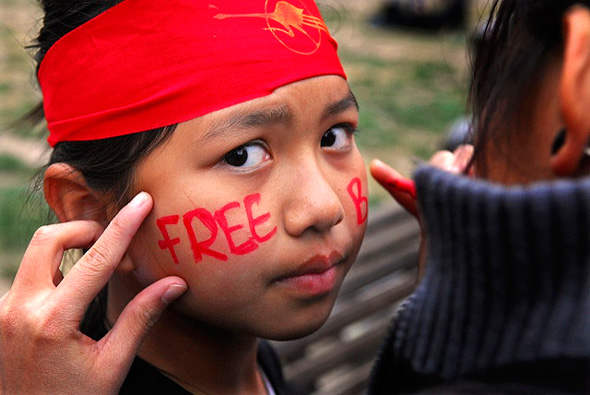
Burma (also known as Myanmar), a country plagued by internal political turmoil and direct or tacit military rule since 1962, had its first general elections in 50 years in 2010 and long-time jailed opposition leader Aung San Suu Kyi won a seat in the National Assembly, but questions remain as to how much power the military is willing to cede. Demography provides reason for hope that this turn towards democracy is more than temporary.
-
Geoff Dabelko on the Evolution of Integrated Development and PHE
›August 27, 2012 // By Schuyler Null“Population-health-environment [PHE] connections have really been a focus of ours here at the Wilson Center for the last 15 years,” said outgoing ECSP Director Geoff Dabelko in an interview at the Wilson Center. The goal of ECSP’s project – HELPS (health, environment, livelihoods, population, and security) – is “really trying to understand these issues together.”
-
Resource Revolution: Supplying a Growing World in the Face of Scarcity and Volatility
›August 24, 2012 // By Kate Diamond
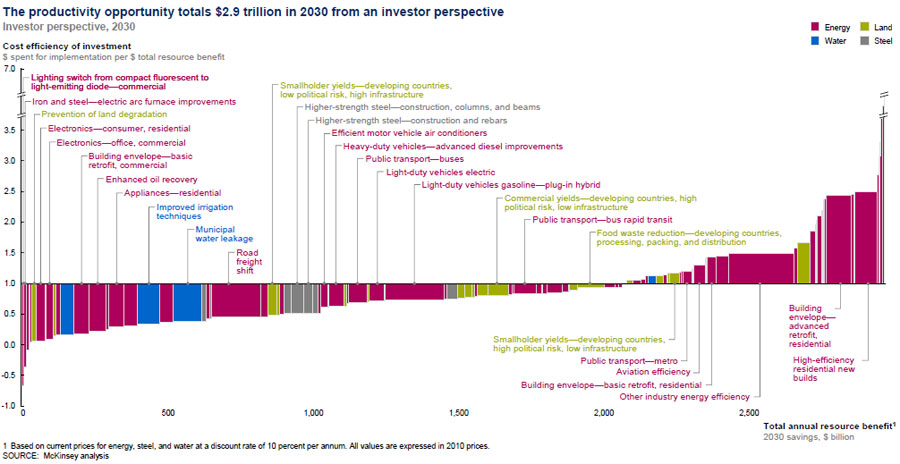
Over the next two decades, as many as three billion people will join the middle class, even as billions more live without electricity, modern cooking fuel, and safe and reliable access to food and water. Resources are becoming more scarce and more difficult to extract, and combined with environmental factors ranging from climate change to soil erosion, those changes will make meeting middle class demand all the more difficult while leaving the world’s poorest more vulnerable to price shocks and resource shortages. In a recent report, the McKinsey Global Institute concludes that nothing less than a “step change” in how resources are managed will be required if individuals, businesses, and governments are to overcome these trends and pave the way for a more sustainable and equitable future.
-
The Economist
In Poor Countries, Is Lower Fertility Bad for Equality?
›August 23, 2012 // By Wilson Center StaffThe original version of this article appeared on The Economist.
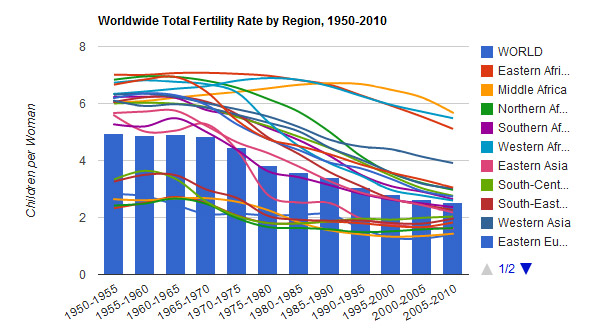
Economies benefit when people start having smaller families. As fertility falls, the share of working-age adults in the population creeps up, laying the foundation for the so-called “demographic dividend.” With fewer children, parents invest more in each child’s education, increasing human capital. People tend to save more for their retirement, so more money is available for investment. And women take paid jobs, boosting the size of the workforce. All this is good for economic growth and household income. A recent National Bureau of Economic Research study estimated that a decrease of Nigeria’s fertility rate by one child per woman would boost GDP per head by 13 percent over 20 years. But not every consequence of lower fertility is peachy. A new study by researchers at the Harvard School of Public Health identifies another and surprising effect: higher inequality in the short term.
-
Christina Larson, Yale Environment 360
Gauging the Impact of Warming On Asia’s Life-Giving Monsoons
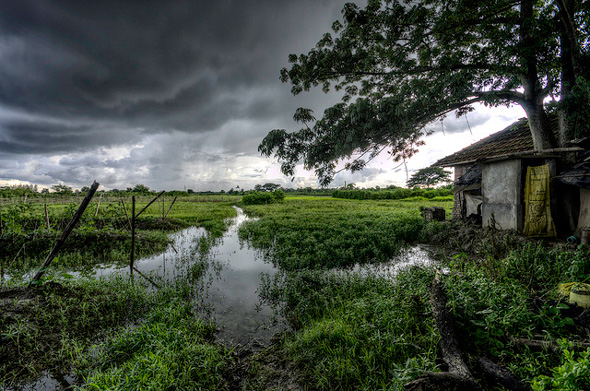
›August 21, 2012 // By Wilson Center StaffThe original version of this article, by Christina Larson, appeared on Yale Environment 360.
Bouncing along bad roads in a jeep through central Mongolia, with bright blue skies and high clouds overhead, we drive for miles through a treeless landscape, passing only dry grasslands dotted with cattle and white yurts. But as we head north – myself, two U.S. scientists, and one Mongolian forestry expert – we begin to notice Siberian pine and larch growing on the northern slopes of rolling hills, but not the southern slopes, and at some elevations, but not others. In water-scarce Mongolia, as my travel companion Neil Pederson of Columbia University’s Lamont-Doherty Earth Observatory explained, the precarious growth of trees is limited by temperature and moisture availability; small variations – northern slopes are slightly cooler and wetter – can make all the difference.
-
Stress Levels of Major Global Aquifers Revealed by Groundwater Footprint Study
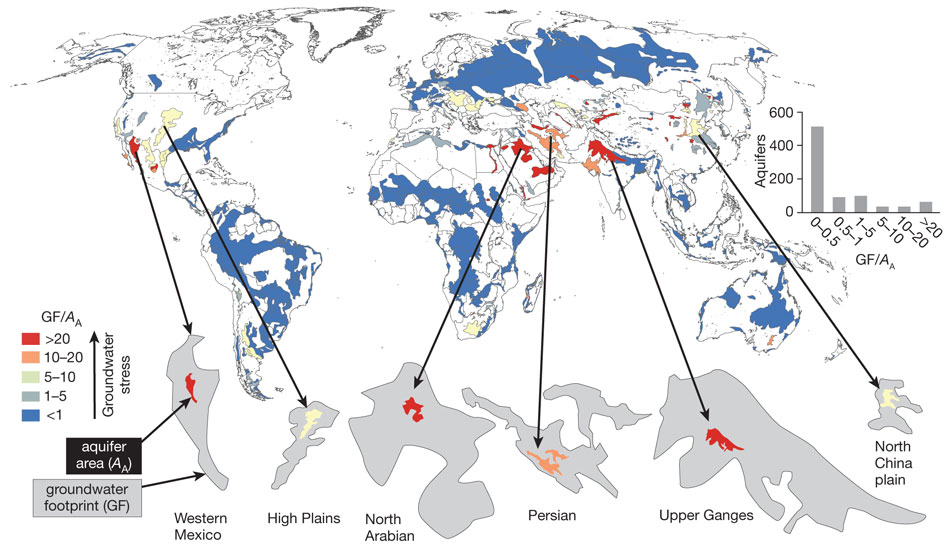
›In the “first spatially explicit comparison of groundwater use, availability, and environmental flow for aquifers globally,” a new article in Nature finds that the “size of the global groundwater footprint is currently about 3.5 times the actual area of aquifers.” An aquifer’s footprint is the theoretical size it would need to be to sustainably support use at its current rate, so groundwater footprints being much larger than their corresponding aquifers is a sign of overuse.
-
Hans Rosling on Religion, Babies, and Poverty
›“I’m going to talk about religion. But it’s a broad and very delicate subject, so I have to limit myself. Therefore I will limit myself to only talk about the links between religion and sexuality…I will talk on what I remember as the most wonderful – it’s the moment when the young couple whispers, ‘tonight, we are going to make a baby,’” said Hans Rosling, the eclectic Swedish doctor and statistician known for his Gapminder tool, in a TedxSummit presentation in April.
Showing posts from category population.