-
66th Session of the Commission on the Status of Women: Six Pillars to Support Midwives
›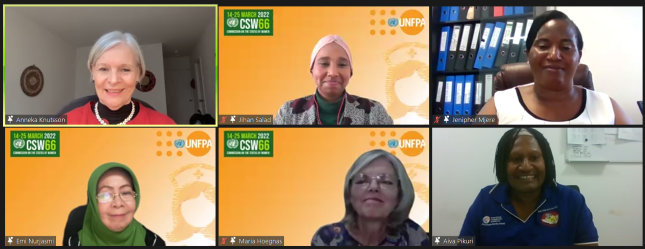
“When women can decide on the timing and spacing of their births, are treated with respect, and offered quality of care across the life course—they are not only able to survive, they, their families, and their communities are able to thrive and flourish. By directly and indirectly contributing to women’s empowerment, midwives are contributing to strengthen economic and productive and equitable societies,” said Dr. Julitta Onabanjo, Director of the Technical Division at the United Nations Population Fund (UNFPA), New York, at a recent event hosted by UNFPA as part of the 66th Session of the Commission on the Status of Women. Midwives and midwifery experts convened to discuss the important role that midwives play in the improvement of gender equality, women’s economic empowerment, and climate justice.
-
Raising Momentum for Integrating Respectful Maternity Care in Humanitarian Settings
›
Greater than one third of all women experience mistreatment during facility-based childbirth. Mistreatment, particularly in humanitarian settings, may include verbal or physical abuse, poor patient-provider rapport, a lack of information about maternal and newborn health (MNH) services for both pregnant women and providers, lack of privacy within facilities, challenges with receiving informed consent from women for medical procedures due to language and cultural barriers, and denied or delayed care. Such mistreatment can stem from historical tensions between populations seeking care and health workers (both foreign and local) as well as systemic mistreatment of providers who are burned out and possibly carry their own biases. Evidence shows that some women delay seeking care, or avoid care entirely because of social fears stemming from negative stigma or negative perceptions of their situation.
-
No Progress Without Quality: Why Quality of Care Matters
›Evidence shows that in low- and middle-income countries, the expansion of health coverage or access to care has not always reduced overall mortality, said Dr. Patricia Jodrey, Child Health Team Lead in the Office of Maternal and Child Health and Nutrition at the U.S. Agency for International Development (USAID). “However, the analysis also showed that when countries have progressed in improving the quality of their health systems, the survival rate tends to improve,” she said.
-
COVID-19 Costs: Declining Maternal and Child Nutrition in Low-and Middle-Income Countries
›“The pandemic and related global economic recession are severe setbacks to already insufficient progress towards meeting the global nutrition targets set for 2025 for stunting, wasting, maternal anemia and breastfeeding,” write the authors of a 2021 study examining the effects of COVID-19 on child and maternal health and nutrition. Adequate nutrition in the perinatal period is essential for healthy mothers and babies, and COVID-19-induced poverty and disruptions to global supply chains have compromised the food security of people around the world, mostly in low-to-middle-income countries (LMICs).
-
Has Maternal Mortality Risen During the COVID-19 Pandemic? The Need For More Data
›Since its onset, the impact of the COVID-19 pandemic on maternal mortality has been a question of great concern. And yet, few empirical attempts have been made to capture the potentially profound impact of the pandemic on maternal deaths, particularly in resource-limited settings.
-
The First-Ever White House Maternal Health Day of Action – Access to Care is Critical
›“Regardless of income level, regardless of education level, Black women, Native women, women who live in rural areas are more likely to die or be left scared or scarred from an experience that should be safe and should be a joyful one; and we know a primary reason why this is true – systemic inequities,” said Vice President Kamala Harris during her opening remarks at the first-ever White House Maternal Health Call to Action Summit on December 7, 2021. Members of Congress and maternal health advocates gathered to discuss the importance of addressing racial disparities and systemic challenges in maternal health through national policy.
-
Through the COVID-19 Lens: Essential Services Needed to Prevent Unintended Pregnancies
›“The current pandemic is straining human resources, disrupting supply chains and service delivery, and negatively impacting service seeking among women and girls in countries across the globe,” said Sarah Barnes, Project Director of the Wilson Center’s Maternal Health Initiative. She spoke at a recent event, co-hosted by the UN Population Fund (UNFPA), on unintended pregnancies during the COVID-19 pandemic. The increasing rates of unintended pregnancies during the pandemic have exacerbated the vulnerabilities of many women, said Anneka Knutsson, Chief of the Sexual and Reproductive Health Branch at UNFPA.
-
16DaysCampaign Calls to End Femicide: Research Shows Women in Perinatal Period at Risk
›“Femicide is an important, but often unreported, cause of maternal mortality. This research documents the immediate need for universal abuse assessment of all pregnant women,” write the authors of the self-declared first study to report a definite link between abuse during pregnancy and attempted/completed femicide—the gender related killing of women. This study was published in 2002.
Showing posts from category maternal health.