

-
Great Power Resource Competition in a Changing Climate: New America’s Natural Security Index
›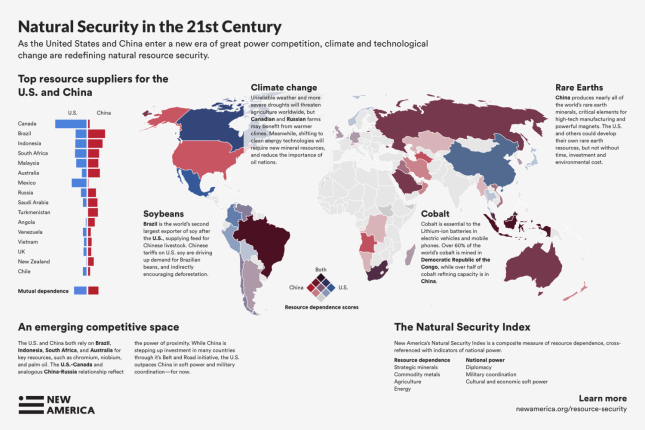
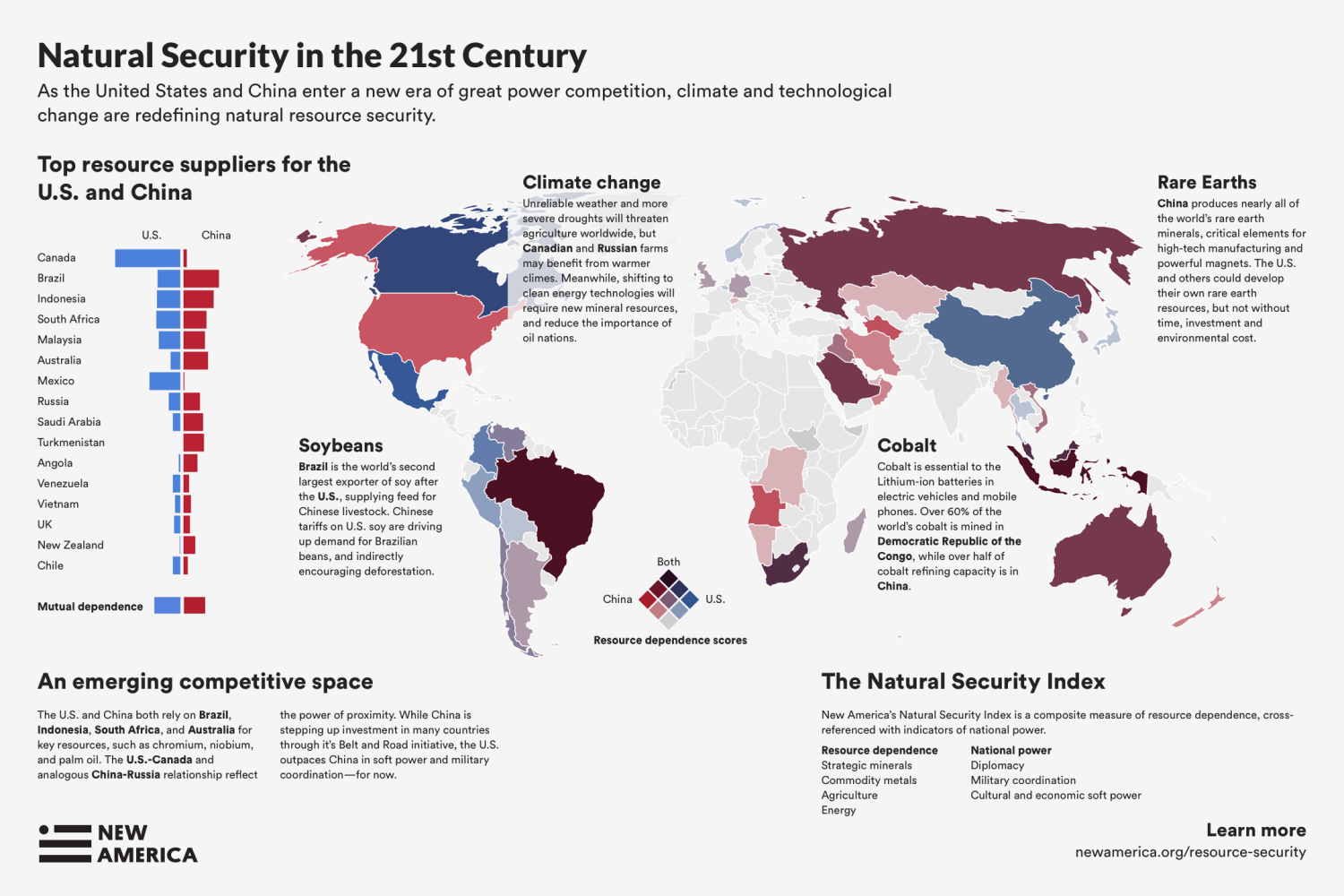
Late last year, Reuters reported that the U.S. Defense Department plans to fund mining and processing operations for rare earth elements—a class of minerals for which China dominates the global market, producing over 80 percent of the world’s supply. In the past, China has restricted exports of rare earths, and recently threatened to do so again. Even with a phase one trade deal hammered out between the United States and China, natural resources are likely to remain a point of geopolitical tension.
-
Beware the Dark Side of Environmental Peacebuilding
›
Environmental peacebuilding is a good idea. As a practice, it aims to address simultaneously environmental problems and challenges related to violent conflict. Examples include the promotion of environmental cooperation between rival states, conflict-sensitive adaptation to climate change, and restoring access to land and water in post-conflict societies. As a concept, environmental peacebuilding directs researchers’ and politicians’ attention to cooperative adaptation as a response to environmental stress. It thus helps to correct one-sided narratives about environment-conflict links.
-
Community Input Improves Climate Change-Induced Resettlement Effort
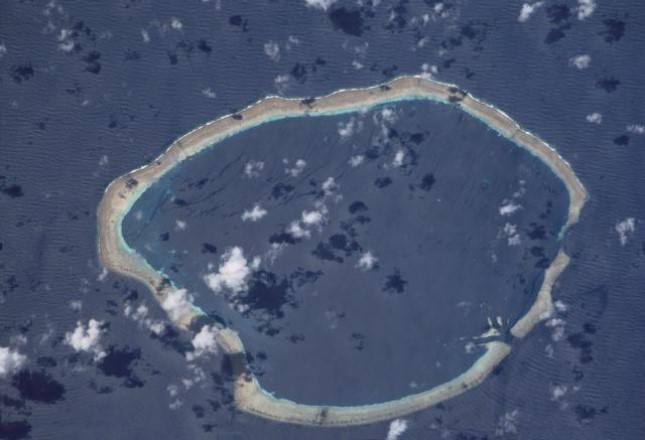
›In the Global South, climate change-induced resettlement requires a holistic and integrated approach, involving all stakeholders—state institutions, local customary and civil society institutions—and in particular respectful engagement with local traditional actors and networks. In a policy brief for the Toda Peace Institute, we examined climate change-induced resettlement from the Carteret Islands in the Pacific, a case which encompasses a broad range of issues relevant to future relocation efforts elsewhere. Those who seek to make this type of resettlement possible would do well to heed these lessons.
-
To Help Save the Planet, Stop Environmental Crime
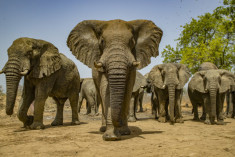
›Since the dawn of the Industrial Revolution, humans have so vastly altered Earth’s systems that we’re now in the midst of what many are calling the Anthropocene Epoch. Human activity has become the dominant influence on climate and the environment, inflicting changes that may persist for millennia.We are razing the planet’s last intact wild lands, degrading, deforesting, carving up, and destroying huge swathes of habitat. We’re overfishing and poisoning our rivers and oceans. We continue to pump greenhouse gases into the atmosphere, raising CO2 levels and hastening climatic changes that are already affecting all life on Earth.
-
Protecting the Protectors: Environmental Defenders and the Future of Environmental Peacebuilding
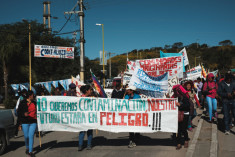
›Early scholarship on environmental peacemaking recognized the important role that local civil-society can play in promoting regional cooperation while, at the same time, pressuring governments to protect the environment. For example, in the late 1980s/early 1990s, nongovernmental organizations (NGOs), such as the Union for Defense of the Aral Sea and Amu Darya in Uzbekistan and the Dashowuz Ecological Club in Turkmenistan, were at the forefront of the fight to restore the Aral Sea and protect the region’s biodiversity. -
Foresight for Action | Weathering the Storm: Improving Predictive Capabilities for Extreme Weather and Water Events in the Caribbean
›For two weeks, Hurricane Dorian, one of the strongest hurricanes to make landfall in the Pacific, decimated large swaths of the Caribbean displacing 70,000 people and killing at least 50. Natural disasters like Hurricane Dorian in the Caribbean have only been worsening over the last decade, a trend often attributed to warming oceanic and atmospheric temperatures. -
Safe from the Start: Addressing Gender-Based Violence in Times of Conflict and Crises
›“As a leader in providing global humanitarian aid, the United States must be a leader in protecting all aid recipients,” said Congresswoman Chrissy Houlahan (D-PA-6) at a recent event on Capitol Hill about gender-based violence in humanitarian settings. A violation against human rights, gender-based violence (GBV) is deeply rooted in gender inequality. It’s a global phenomenon that involves sexual, physical, and/or psychological violence, including child marriage, female genital mutilation, and other harmful practices.
-
Which Demographic “End of History”?
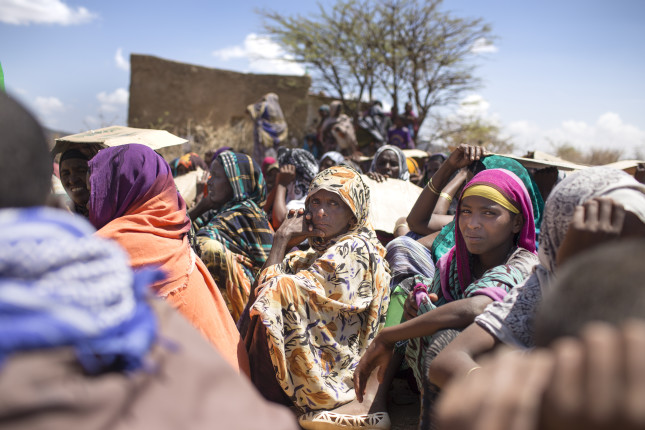
›First published 30 years ago in the National Interest, Francis Fukuyama’s landmark essay, “The End of History?,” argued that, with the fall of fascism and communism, no serious blueprint for modern-state development lay open, save for those paths that would ultimately embrace both political and economic liberalism. Over the past two decades, movement toward this ideal end-state has trickled to a halt. Instead, the political elites of Eurasia’s regional powers—Russia, Turkey, Iran, and China—have crafted stable illiberal regimes that borrow whatever they need from free-market economics, electoral politics, nationalism, and religion. Their ascent has produced a form of “non-endpoint stability”—two mutually antagonistic camps: one composed of liberal democracies, the other a mix of illiberal hybrids. As long as these camps remain stable, the international system falls far short of Fukuyama’s theoretical end of history.
Showing posts from category security.
 Since the dawn of the Industrial Revolution, humans have so vastly altered Earth’s systems that we’re now in the midst of what many are calling the
  Early scholarship on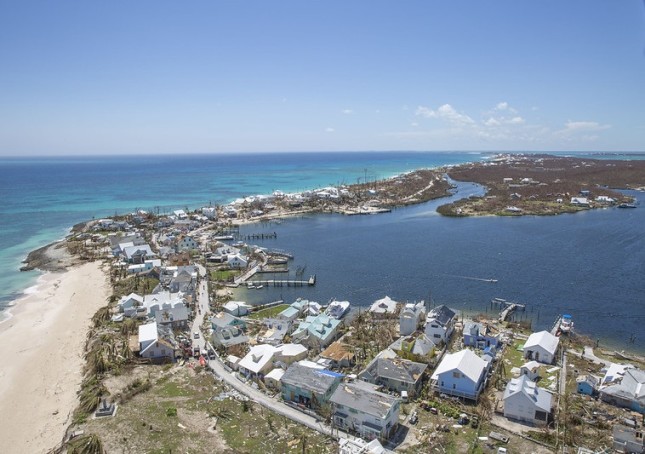
 First published 30 years ago in the National Interest, Francis Fukuyama’s landmark essay, “

