-
UNEP Maps Conflict, Migration, Environmental Vulnerability in the Sahel
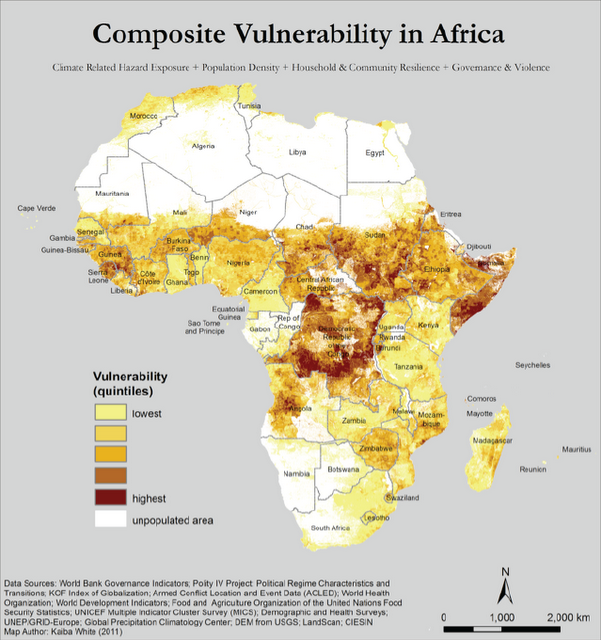
›A new set of maps from the United Nations Environment Programme (UNEP) identifies “climate hotspots” – areas vulnerable to instability exacerbated by climate change – in 17 sub-Saharan countries in and bordering the Sahel region. The maps reflect the fact that, more often than not, the impact of climate change on local populations is compounded by changes in migration, conflict, or both. According to Livelihood Security: Climate Change, Migration and Conflict in the Sahel, the UNEP report accompanying the maps, understanding “the exacerbating effect of changes in climate on population dynamics and conflict in the region” will be essential to developing successful adaptation strategies throughout the region.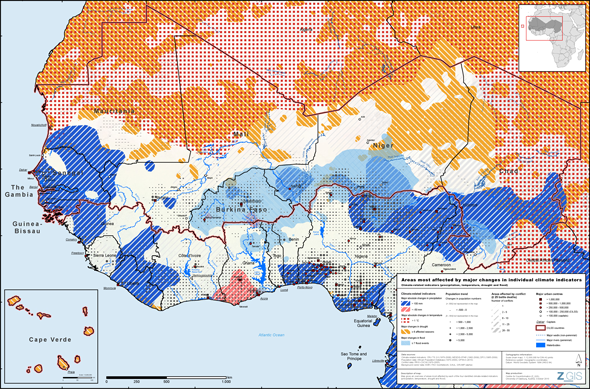
UNEP’s maps analyze 40 years of data to pinpoint where the region’s most at-risk populations are located based on environmental, population, and conflict trends dating back to 1970. In a single map pinpointing the Sahel’s 19 hotspots, UNEP synthesizes subnational data from four environmental indicators over time – rainfall (from 1970 to 2006), temperature changes (1970 to 2006), drought (1982 to 2009), and flooding (1985 to 2009) – which are then layered on top of population trends (1970 to 2010) and conflict data (1970 to 2005) in order to identify the region’s most insecure areas.
Composite Vulnerability
At first glance, the map can appear hard to decipher; it is flooded with different colors and symbols, each indicating something different about the extent of climate change, migration, and conflict in the region. A Google Earth version of the map (available for download here) makes all this information easier to process by allowing users to select which indicators they want to see mapped out, cutting back on the number of lines, dots, colors, and pie charts the user has to decode.
Given the vast amount of the information being condensed into these maps, the report is a helpful and worthwhile read. For instance, eight hotspots are in places with growing populations and another seven are located in places that have experienced conflict; altogether, 4 of the 19 hotspots have both past conflict and growing populations. The report digs deeper into the confluence of climate, conflict, and migration by discussing case studies that highlight how the three intersect in local communities (at the same time, the report is careful to avoid suggesting that there is a causal relationship between the three issues.). In Niger, Nigeria, and Chad, for example, tensions have been mounting between northern pastoralists and southern farmers as each group has moved further and further afield in search of water and arable land to sustain their livelihoods.
Holes In the Data
While the hotspot maps include a wealth of information, the report makes clear that it is by no means exhaustive. Rising sea levels are, for instance, a major impending threat to coastal populations in the Sahel, but only the downloadable Google Earth map – not the hotspot map in the report or the Google Earth map as presented online – incorporates this factor. Compounded with a skyrocketing population in the coastal areas – the coast between Accra and the Niger delta is expected to be “an urban megalopolis of 50 million people” by 2020, according to the report – an increase in sea levels could have a huge impact on the region’s stability.
The report also readily admits that the datasets for population trends and conflict have shortcomings. Population data is largely based on censuses, which both the report and its data sources (UNEP’s African Population Database and the Gridded Population of the World, version 3) acknowledge can be inconsistent in their accuracy. Additionally, after 2000, population data is based on projections rather than estimates, which, as last year’s update from the UN Population Division showed, have often proven inaccurate, particularly in sub-Saharan Africa.
Regarding conflict, the UNEP report is straightforward in admitting its limits. The report lacks data on small-scale conflict (fewer than 25 battle deaths, following the Uppsala Conflict Data Program’s threshold that separates conflicts from lower-level violence), even as it acknowledges that such conflict is “often the first to occur” when climate change threatens communities’ access to resources and livelihoods.
Ultimately, however, these maps give valuable data on specific locations that are uniquely vulnerable to trends in population, climate, migration, and conflict. They add focus to the conventional wisdom that climate change will impact the region’s stability, and, taken together, the maps and the report provide a valuable resource for scholars and policymakers attempting to craft adaptation policies that take into consideration these complex links.
Sources: Socioeconomic Data and Applications Center at Columbia University’s Earth Institute, UNEP, Uppsala Conflict Data Program.
Image Credit: UNEP. -
Ethan Goffman, SSPP Blog
Securing a Sustainable Future: The Military Takes On a New Mission
›January 25, 2012 // By Wilson Center StaffThe original version of this article, by Ethan Goffman, appeared on the Sustainability: Science, Practice, and Policy blog.
In a time of polarized politics in the United States, over the environment and just about everything else, an overlooked development is how much the military, as well as the national security apparatus, has taken on climate change and other environmental challenges. “Environment and Security” was thus a profoundly important choice of theme for the 2012 National Conference on Science, Policy, and the Environment, held last week in Washington, DC. With the early effects of climate change apparently already occurring, notably in an increase in natural disasters and in a new northwest passage through the Arctic, those responsible for our security can’t afford to sit around and engage in speculation that climate change is caused by sunspots or isn’t really occurring. It is the military’s job, after all, to take action against potential threats rather than getting immersed in domestic politics.
The concern with climate change is the next step in a widening of the concept of security from strict military matters, to include such interrelated strands as food and water access, public health, and the environment. Much of the military has already acknowledged that armed force alone won’t make us safe. “Energy security, economic security, environmental security, and national security are all inextricably linked. Address one and you need to think of the others,” explained Vice-Admiral Dennis McGinn at the conference.
One obvious linkage is the connection of our oil dependency with security risks that can easily draw us into conflict in politically unstable parts of the world. Just how much the recent wars in the Middle East are about oil, and how much about a clash of civilizations, is a matter of considerable debate, although undoubtedly both factors play a part. The Iranian threat to close the Strait of Hormuz, choking outgoing oil deliveries, underscores vulnerability on the energy issue. From another angle, in Afghanistan, the military experienced the fragility of supply lines for a force strongly dependent on large quantities of oil. The Air Force, in particular, is working on algal jet fuel to free us from such reliance. And the Navy’s need for more icebreakers and other capacity shows concern regarding shipping and resource exploitation enabled by the melting of Arctic ice and the new passage.
Continue reading on the SSPP blog.
Photo Credit: Sherri Goodman and Rear Admiral Neil Morisetti, courtesy of Sean Peoples/Wilson Center. -
New Research on Climate and Conflict Links Shows Challenges for the Field
›“We know that there will be more conflicts in the future as a result of climate change than there would have been in a hypothetic world without climate change,” said Marc Levy, deputy director of the Center for International Earth Science Information Network (CIESIN) at Columbia University’s Earth Institute, although existing data and methodologies cannot predict how many additional conflicts there will be, or which causal factors will matter most. [Video Below]
-
Jon Barnett: Should Climate Change Be Addressed by the UN Security Council?
›For a small island state like Tuvalu, climate change is an enormous security issue and they have told the UN Security Council as much, said Jon Barnett, professor of resource management and geography at the University of Melbourne, in an interview with ECSP. But, despite debate in 2007 and 2011, the Council has been unable to reach agreement on whether climate change is an international security issue or not.
-
Marc Sommers, Woodrow Wilson Center
Assessing Africa’s Youth Bulge
›January 9, 2012 // By Wilson Center StaffThe original version of “Governance, Security, and Culture: Assessing Africa’s Youth Bulge,” by Marc Sommers, first appeared in the International Journal of Conflict and Violence, Vol. 5 (2), 2011.
Although Africa has a youth-dominated population, African government policies are often not youth-centered and African governments and their international supporters are frequently under-informed about the priorities of most youth. Reliance on the “youth bulge and instability thesis” leads to distorted assessments of everyday realities. Examination of the lives, priorities, and cultural contexts of African youth, and the cases of youth in Rwanda and Burundi in particular, shows that the nature of relations between the state and massive populations of young, marginalized, and alienated citizens directly impacts the governance, security, and development prospects of African nations.
Learning from Liberia
If ever there was a youth-dominated conflict in modern times, it was Liberia’s long and grueling civil war (1989-1996 and again in 2000-2003). Ignited by Charles Taylor’s Christmas Eve incursion from neighboring Côte d’Ivoire late in 1989, together with perhaps one hundred other men, the conflict soon took the form of youth-led chaos. “What initially was seen as a revolution…fought with sticks and cutlasses,” Mats Utas writes, “was eventually transformed into a war of terror where young people started fighting each other” (2005: 55). In fact, some youth continued to view the war as their revolution, for as long as they were able to take advantage of the opportunity that armed conflict afforded. The civil war provided them with “a chance to become someone in a national system that had marginalized them, but also a chance to get rid of the load of work and expectations that the parental generation had laid on them” (65). Some of the more successful young soldiers, sometimes goaded by their girlfriends, “felt so affluent that they could wash their cars in beer – a beverage most could not even afford to drink prior to the war – and that they could drive a car until it ran out of gasoline and then just dump it for another one” (66). The result was a war that wreaked colossal destruction. By 1997, civil war had already left a nation of perhaps two and a half million with up to 200,000 dead, 700,000 refugees, and much of the remaining population internally displaced (Utas 2008: 113).
The region of sub-Saharan Africa has the most youthful population in the world. Of the 46 countries and territories where at least 70 percent of the population is under the age of 30, only seven are not in sub-Saharan Africa. With this in mind, one of the most striking aspects of contemporary Africa is how male African youth have so frequently been viewed as threats to their own societies. However, the view from below differs dramatically from the largely quantitative analyses from above and from outside the continent. Again, the Liberian example is illuminating. A nation long renowned for grasping leaders and withered government institutions has more recently provided truly upbeat signs of forward movement. That said, most youth continue to be left far, far behind. Fieldwork in rural Liberia uncovered a widespread fear of “rebel behavior youth” – youth who had assumed the attitudes of wartime combatants and became socially sidelined. Liberia’s post-war youth unemployment has been estimated at the astonishing rate of 88 percent. Taking all of this into account – a widespread sense of estrangement and social distance felt by many youth and an economic recovery that is passing most of them by – one could certainly argue that Liberian youth are among the world’s most peaceful populations.
Continue reading in the International Journal of Conflict and Violence.
Marc Sommers is a fellow with the Woodrow Wilson Center’s Africa Program and visiting researcher at Boston University’s African Studies Center.
Sources: Government of Liberia, Population Action International, Sommers (2007), Utas (2005 and 2008).
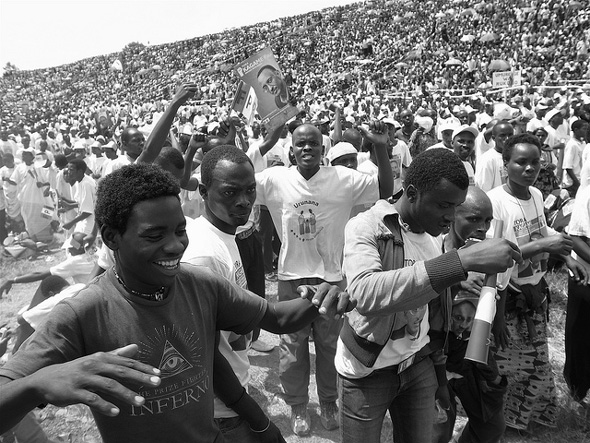
Photo Credit: “RPF rally in Gicumbi, Rwanda,” courtesy of flickr user noodlepie (Graham Holliday). -
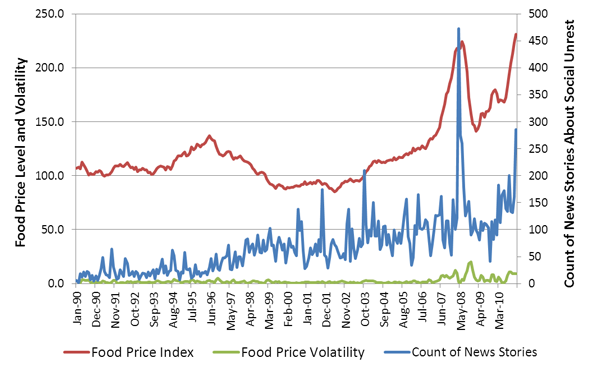
Do High Food Prices Cause Social Unrest?
›In March 2011, a senior Brookings Institution official wrote that “the crux of the food price challenge is about price volatility, rather than high prices per se” and that “[i]t is the rapid and unpredictable changes in food prices that wreak havoc on markets, politics, and social stability.”
-
Migration and Environmental Change, Minority Land Rights and Livelihoods
›Migration and Global Environmental Change: Future Challenges and Opportunities, from the UK Government Office for Science’s Foresight Programme, looks at how environmental change, including climate change, land degradation, and the degradation of coastal and marine ecosystems, over the next 50 years will affect migration trends. The report emphasizes that migration is a complex and multi-causal phenomenon, which makes it difficult to differentiate environmental migrants as a distinct group. Nevertheless, research suggests that global environmental changes will affect the drivers of migration, particularly economic forces, such as rural wages and agricultural productivity.
Though Foresight finds that many will use migration as an adaptation strategy that improves resilience to environmental change, they also point out that some affected individuals may become “trapped” in vulnerable situations, lacking the financial capacity to respond to environmental changes, while others may be able to move but will inadvertently enter more exposed areas, particularly, at risk urban centers. For recommendations, they stress the importance of strategic, long-term urban planning, and recognition within adaptation and development policies that migration can be part of the solution.A study, released on December 5 by Minority Rights Group International, finds that minority communities in Kenya, Uganda, and South Sudan face significant challenges around access to and control of critical natural resources. The report, Land, Livelihoods, and Identities: Inter-Community Conflicts in East Africa, shows how rapid population growth, climate change, and globalization are increasing competition for land, water, and forest and mineral resources in territories traditionally occupied by minority groups. These pressures can undermine livelihoods and trigger multiple and overlapping conflicts, especially where ownership has not been formalized in law. The study also notes that women are doubly vulnerable as their access to land and resources is frequently mediated through customary law, which depends on their communities retaining control over traditional territory. Although the report makes national-level legal and policy recommendations, the authors note that some of the most effective resource management and conflict resolution strategies adapt traditional cultural practices to the current circumstances of communities. -
Three New Reports Highlight Ongoing Significance of Youth Demographics in Global Trends
›January 2, 2012 // By Elizabeth Leahy MadsenAmidst world population reaching seven billion and last year’s Arab Spring, which in some nations is continuing into this winter, it can be easy to miss emerging pieces of research that tell us something relatively objective about youth and instability. Three new studies give practitioners and policymakers a stronger foundation of evidence to highlight the challenges and opportunities facing the world’s largest generation of young people.
Results of a recent UNICEF staff survey indicate that the people responsible for the UN’s efforts targeting children and youth are seriously concerned about demographic and economic dynamics. Asked to review a list of 20 “global trends,” UNICEF staff rated “growing disparities” and “youth bulge and youth unemployment” as the most significant to children. The results, which the agency will soon publish in a paper on “The Next Generation and Global Trends,” also indicate that staff members feel that UNICEF has a strong capacity to influence the future of these trends.
UNICEF’s recent “Child Outlook” report on global trends discusses the issues highlighted in the survey. The report notes that although many countries are moving toward middle-income status, poverty rates remain stubbornly high, indicating that economic development does not benefit all equally. Income and consumption in such countries tend to be concentrated among the wealthiest households. “While many families will prosper, others are being left behind,” the report explains.
“Tensions and discouragement arising from youth unemployment, combined with higher food prices and fiscal contractions, may have contributed to increased civil unrest, protests, and political instability,” UNICEF asserts. In many developing countries, the number of young people entering the labor market far surpasses the number of available jobs. Although some youth are not working because they are enrolled in secondary or tertiary education, low rates of youth participation in the workforce often are not a matter of choice. Young people, especially those with low levels of education and from poorer families, are often unable to find secure, decent jobs. More than one-quarter of all young people with jobs worldwide live below the poverty line of $1.25 per day.
Economic Pressures on Youth in East Africa
Two other research projects – one published, one still underway – provide additional context to the combination of demographic and economic challenges that face the world’s young people. In the first, part of a recent special U.S. Institute of Peace series on South Sudan, Stephanie Schwartz and Wilson Center fellow Marc Sommers probe the expectations of and obstacles faced by youth in the newly created country.
According to the incipient government’s statistics agency, 72 percent of South Sudan’s population is younger than 30, which places it among the 20 youngest age structures in the world. Only 40 percent of youth ages 15 to 24 are literate, and nearly 80 percent of households depend on agriculture for their income. Based on interviews conducted with urban and rural youth in three areas of South Sudan, the authors find that the pressure of paying rising dowry costs is the most salient issue facing young men, while young women are treated as economic assets with no influence in their own future. The authors’ research suggests that “some young men join armed gangs, at least in part, because they believe it will help them pay dowries.”
Although many young people in South Sudan aspire to the stability of government work, the limited number of jobs and shortage of relevant skills inhibit their aspirations. With an underdeveloped private sector, few opportunities for training, and nepotistic practices in hiring, there is little work for those living in towns and urban areas beyond manual labor and selling goods. The authors recommend that education and job training be expanded, with a focus on equitable access among young people from varied geographic backgrounds.
Across the border in northern Uganda, Chris Blattman, an associate professor of political science at Yale, has been studying the social effects of the government’s youth employment program started in 2007. The program offered grants to small groups of young people for vocational training or to fund the costs of starting a new business. Although a full paper has not yet been published, preliminary findings indicate strong economic benefits of the program which in turn improve social cohesion and community participation while diminishing aggression and “disputes with authorities” among young men. If they bear out, the results may well confirm the oft-repeated policy recommendation that focusing on youth employment is critical to improving national development as well as reducing the likelihood of instability and conflict.
In the year of seven billion, we heard much about the need to invest in young people and the tremendous potential they embody, for demographic dividends as well as overall development. Yet 2011 was also a year of tremendous upheaval, much of which was driven by young people – and their older counterparts – seeking representative and democratic governance. This should serve as a reminder that youth can be a remarkable force for positive change, but in too many places – South Sudan among them – their opportunities, prospects, and contributions are constrained. As the UNICEF survey results reiterate how important this issue is to development programming, the Uganda research may be another important piece of evidence that direct investment in young people reaps tangible results not only for them, but also for society.
Elizabeth Leahy Madsen is a consultant on political demography for the Wilson Center’s Environmental Change and Security Program and senior technical advisor at Futures Group. She was previously a senior research associate at Population Action International.
Sources: Bill and Melinda Gates Institute for Population and Reproductive Health, Chris Blattman, ILO, Sommers and Schwartz (2011), South Sudan National Bureau of Statistics, UNICEF, World Bank.
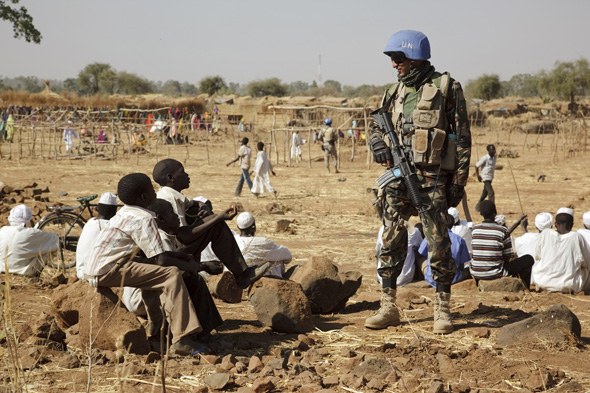
Photo Credit: “UNAMID Peacekeeper Speaks with Sudanese Youth,” courtesy of UN Photo/Albert Gonzalez Farran.
Showing posts from category security.