-
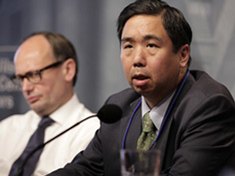
Dennis Taenzler, ECC Platform
What’s Next in European Climate Diplomacy?
›September 5, 2013 // By Wilson Center StaffThe original version of this article appeared on the Environment, Conflict, and Cooperation (ECC) Platform.
At the end of June, the European Union Foreign Affairs Council adopted a set of conclusions on EU climate diplomacy that left us with mixed feelings. Acknowledging and recalling that climate change is of paramount importance is commonplace – too often quoted and very seldom followed by decisive action. Explicit reference to the positive results of the Durban and Doha climate conferences is even a reason to get nervous. Many negotiators and observers will doubt a similarly enthusiastic framing for the most recent results.
-
Harvesting Peace: Food Security, Conflict, and Cooperation
›Since 2008 – a year in which rapid increases in the global prices for major grains helped to trigger outbreaks of civil unrest in more than 40 countries – scholars and policymakers have paid increased attention to the potential influence of global food prices on social and political instability. Since that time, spiking prices have periodically sparked public protests and governments have struggled to respond.
-
DOD’s Daniel Chiu: Climate, Energy Concerns Emblematic of Future Security Challenges
›
Factoring in the costs of fuel in operations, both in terms of the monetary and battlefield effect, is a relatively new development for the U.S. military. “Our view was, when we were at war, we would bear those costs,” says U.S. Deputy Assistant Secretary of Defense for Strategy Daniel Chiu in this week’s podcast. “However, as we have started to appreciate the nature of the kinds of military challenges we face, we’ve realized this is not a sustainable approach.”
-
Prospects for Gender Parity in UN Peacekeeping Forces, Evaluating Girls’ Empowerment Efforts
›The Population Council’s annual report highlights new work from one of the largest organizations doing research on the lives of adolescent girls in the developing world. Of particular note is the Council’s Adolescent Girls Empowerment Program, a four-year study launched in May which will involve 42,000 girls in seven countries – Bangladesh, Burkina Faso, Ethiopia, Guatemala, India, Tanzania, and Zambia. The aim is to evaluate successful strategies for helping girls avoid child marriage, sexually transmitted infections, and unintended pregnancies at a critical juncture in their lives. Council President Peter Donaldson writes that young girls are “one of the potentially most influential figures in the developing world.” A typical 12-year-old girl “in the next few years…will either abandon or continue her schooling, be pushed into marriage and childbearing, or develop a sense of proud ownership of her physical self… As her future is reconfigured, so is ours.”
-
Flooding in Uttarakhand Shows Why India Needs to Take Environmental Security More Seriously
›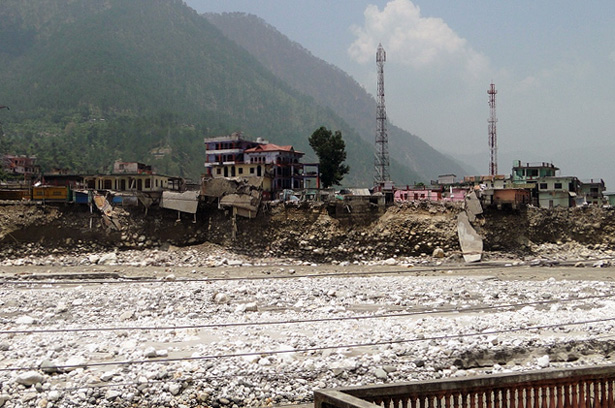
The disastrous flooding in the Himalayan state of Uttarakhand this summer, which claimed more than 6,000 lives, was the outcome of a changing climate and poorly planned development. It was also another case in point of the increasing importance of environmental security in India – especially for the military.
-
Rear Admiral Neil Morisetti on Opportunities for Transatlantic Cooperation on Climate Change, Energy
›
“We’ve got real pressure on key natural resources: food, water, energy, and land,” says Rear Admiral Neil Morisetti, the U.K. Foreign and Commonwealth Office’s special representative on climate change, in this week’s podcast. “But what we haven’t got, if I can use the words of Winston Churchill, we haven’t got ‘action this day.’”
“Morisetti spoke at the Wilson Center on June 6 for the launch of The Climate and Energy Nexus: Challenges and Opportunities for Transatlantic Security, by CNA and the Royal United Services Institute. As climate change threatens stability in some places, energy security has emerged as a key vulnerability to Western militaries’ abilities to respond to conflict and assist in disaster relief operations, says Morisetti.
-
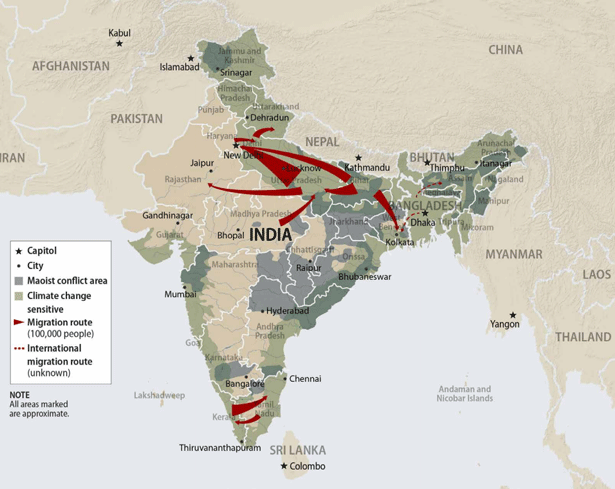
India’s Assam Shows Second-Order, Dangerous Effects of Climate Change in South Asia
›August 13, 2013 // By Ashley ZieglerTo use the military parlance, climate change is often considered a “threat multiplier,” challenging stability and development around the world by exacerbating underlying conditions of vulnerability. South Asia is one region that faces multiple stressors that have the potential to feedback off each other.
Higher temperatures, more extreme weather, rising sea levels, flooding, and increased cyclonic activity in the Bay of Bengal and the Arabian Sea are reshaping the environment, warns the Center for American Progress (CAP) in a report.
-
Babbage, The Economist
Cloudy With a Chance of War?
›August 8, 2013 // By Wilson Center StaffThe original version of this article appeared on The Economist’s Babbage blog.
Earth’s climate is changing, whether you like it or not. As it does, other changes – like rising sea levels or falling crop yields – follow. It is easy to see how this might lead to conflict. Competition for ever scarcer resources such as arable land and its bounty can turn ugly. As the price of food rises the poor, who spend more of their income on it, are hit more than the rich, exacerbating income inequality and leading to disaffection, resentment and, possibly, violence.
Showing posts from category security.