

-
Field Trips: Success Stories from PHE Programs in Kenya, DRC, and Madagascar
›November 7, 2008 // By Will Rogers
People in the Democratic Republic of the Congo (
Improving Health, Conservation, Livelihoods in an Insecure Region
According to Merlo, charcoal production, illegal mining, poaching, and ongoing conflict have converged to create a punishing environment for conservationists in Landscape 10, a 50,000-square kilometer region in eastern
For instance, a micro-hydroelectric power plant in Kasugho village—backed by the
The
Healthy Communities Lead to Healthy Environments
“People on the forefront [of conservation] need to be healthy…in order to be able to accomplish conservation,” argued
A Dose of a Vaccine, a Dose of Conservation
“Although we protect marine turtles on our side of the border, they are butchered across the border” in
In
WWF implemented a fishing-gear exchange program to reduce the incidence of illegal gear; improve fishermen’s income by using legal, larger mesh nets that catch bigger fish; and bolster the health of the environment. WWF has also supported beach cleanup by creating programs where local residents turn flotsam like flip-flops into art—in some instances increasing household income by US $130 per month.
“By and large, the conservation world is practiced by biologists, and therefore we may not know how to deal with changing peoples’ behaviors and attitudes,” Weru said. To be truly effective in implementing a PHE program, “you need skills beyond the biological, the ecological skills—you need social skills.”
Photo: Sam Weru. Courtesy of Dave Hawxhurst and the Woodrow Wilson Center.
For more information, including a webcast of this event, visit ECSP’s website. To receive invitations to future events, e-mail ecsp@wilsoncenter.org. -
Probing Population Growth Near Protected Areas
›Justin Brashares and George Wittemyer’s recent article in Science, “Accelerated Human Population Growth at Protected Area Edges,” presents data showing that average population growth at the edges of protected areas in Africa and Latin America is nearly double average rural population growth in the same countries. The authors argue that this phenomenon is due to migration, as people from surrounding areas are drawn to the health-care and livelihoods programs made available to people expelled from the parks.
It’s not news that high population growth rates have implications for conservation, both in terms of land-cover change and biodiversity loss. Yet at last month’s World Conservation Congress, I heard scarcely a mention of population growth or other demographic factors. So I appreciate that the authors are urging us to look at this aspect of conservation. In addition, by studying a large number of countries and protected areas, their work helps move our thinking beyond the inherent limitations of case studies focused on a single protected area.
I feel obligated to take issue with a few of the authors’ assumptions, methods, and conclusions, however. For instance, the authors compare growth rates for individual protected areas with national rural rates, and find the former are significantly higher in the vast majority of cases. I wonder why they don’t make the comparisons with the rural population growth rates for the region in which the protected area is located, since that seems as if it would make for an even more compelling argument.
My second issue is a note of caution regarding gridded population data. The creation of a gridded population layer depends both on the size of the population data units and the way in which the population is distributed. Given the inherent inaccuracies in this process at detailed levels of analysis, how can we be sure that the populations for the 10 km “buffer areas” surrounding the protected areas are accurate? Is there any way to validate these data, and how would errors impact the authors’ analysis? This issue is particularly important because rural areas tend to have large administrative units and sparse populations.
My third issue is with the authors’ examination of infant mortality rates as a proxy for poverty. The authors analyzed poverty in an attempt to determine whether poverty-driven population growth was informing their result; they concluded it was not. Measures of infant mortality are notoriously poor at the local level, and the authors need to go further in assessing what portion of growth is due to migration and what portion due to natural increase. While such an analysis would take time, it is necessary, given higher fertility in remote rural areas.
Despite my reservations about how the authors came to their conclusion, I tend to agree that migration is driving higher population growth in areas of high biodiversity and around protected areas. The reasons for migration, however, are diverse, and my fourth issue is that I don’t think the authors provide adequate evidence to demonstrate that conservation investments are driving migration to these areas. My three main reasons for taking issue with this finding:- The number of protected areas in the world has grown rapidly over the last 40 years, and they are generally located in sparsely populated areas. During this same period, the populations of most African and Latin American countries have doubled at least once. Thus, people have migrated to new frontiers—often near protected areas—seeking available agricultural land.
- Extractive industries—including timber, mining, oil and gas, and industrial agriculture—often provide lucrative jobs near protected areas. These jobs offer migrants far greater economic benefits than the meager amounts spent on conservation. Tourism is likely the only industry than can compete with these industries in attracting migrants, and only in areas with high numbers of visitors.
- The correlations the authors found between population growth and Global Environment Facility spending and population growth and protected area staff could, as the authors note, simply mean that conservationists are wisely spending their limited dollars on the protected areas facing the greatest threats.
Jason Bremner is program director of the Population Reference Bureau’s Population, Health, and Environment Program. -
Close Quarters: Population-Climate Panel Draws Crowd at Society of Environmental Journalists’ Annual Conference
›October 23, 2008 // By Rachel WeisshaarAt “Close Quarters: Could an End to Population Growth Help Stabilize the Climate?,” the only panel on population at the annual Society for Environmental Journalists (SEJ) conference, Steve Curwood, host and executive producer of Public Radio International’s “Living On Earth,” pointed out that while it’s “something we don’t talk about at all in America,” U.S. population growth increases emissions faster than developing-country population growth, due to our larger per capita consumption. Curwood discussed the major connections between population and climate change, such as water use; food production and consumption; economic growth; and migration. Hypothesizing that climate change will lead to great demographic shifts not only in developing countries, but also in the United States, he noted that historically, “we haven’t dealt with them well.”
The panelists explored environmental reporters’ relative silence on the impact of population growth and other demographic dynamics on environmental issues. According to moderator Constance Holden of Science, the possible barriers to coverage—listed below—should be “irrelevant” to working journalists:- Population’s association with controversial issues like contraception;
- Fear of appearing anti-immigration;
- The widespread belief that population growth is necessary for economic growth; and
- The difficulty of researching and writing about the complex issues related to population and demographics.
Robert Engelman, vice president for programs at the Worldwatch Institute, criticized journalists for not delving into population’s significant, albeit complex, impacts on the environment. Reporters may wish to avoid writing about problems they believe have no easy solutions, but it is just as important for them to explore these thorny topics as more straightforward subjects, he said.
As an example of a potential story angle, Engelman displayed a graph showing that U.S. carbon emissions and population grew by the same percentage between 1990 and 2004. Yet when the data are disaggregated by state, they reveal a very different, surprisingly diverse picture. Some states’ populations and emissions increased roughly equally, but others, like Delaware, managed to decrease their emissions even while their populations grew. Engelman suggested that reporters could explore which factors had influenced the population-emissions relationship in their state.
Freelance writer Tom Horton explained how population growth has helped foil attempts to clean up the Chesapeake Bay. As he wrote recently in Growing! Growing! Gone! The Chesapeake Bay and the Myth of Endless Growth, “[I]t seems questioning the expansion of the economy and the population are off the table, either because they are considered sacred cows, or they are just too hard to deal with. It is assumed we can cure the symptoms while vigorously expanding their root causes.” In an interview following the panel, Horton lauded the efforts of integrated population-environment programs in the Philippines, saying Filipinos “are far more advanced than we are” in their understanding of the relationships between coastal management and population growth.
While “Close Quarters” was the only SEJ panel to directly address population, Dennis Dimick, executive editor of National Geographic Magazine, noted the importance of population in a panel he moderated on agriculture and climate change. In addition, keynote speaker Rajendra K. Pachauri, chair of the Intergovernmental Panel on Climate Change, briefly mentioned the opportunities presented by India’s youthful population and the “demographic dividend.” However, he did not use the opportunity to discuss global population growth’s implications for climate change. -
Watching the World Grow: The Global Implications of Population Growth
›October 16, 2008 // By Will RogersIn a recent nationwide Roper Poll commissioned to study the U.S. public’s attitudes toward population, barely 50 percent of respondents believed there is a strong link between global population growth and climate change, reported Thomas Prugh of World Watch magazine at the September 30, 2008, launch of World Watch’s population issue co-sponsored by the Worldwatch Institute and the Environmental Change and Security Program. People need to learn about population growth’s impact on climate change and other indicators of environmental health, said Prugh.
To Grow or To Shrink? That Is the Question
Historically, governments viewed population growth as a sign of a nation’s vitality; some promoted it by offering incentives to have more children. Prugh noted that such pronatalist attitudes are far from obsolete: “Last year, Russian President Vladimir Putin declared September 13th a national holiday for conceiving children. And couples who delivered a baby nine months later, which not coincidentally would have been on Russia Day, got refrigerators for that accomplishment,” he said. In contrast, many governments are now promoting voluntary family planning rather than population growth. But a lack of political urgency has limited their success. “Support and funding for family planning is actually flat or in decline,” Prugh emphasized.
Empowering Women and Expanding the Discourse
Population has always been an “incredibly gendered issue,” argued Robert Engelman of the Worldwatch Institute, which is one reason for the lack of public discourse on the subject. He called for a broader discussion of population and urged women who work in the sexual and reproductive health and rights fields to actively participate. If you “don’t talk about population from your perspective and from what you know about these issues, others will,” he warned, “and they may not know as much as you do about it.” For Engelman, providing access to family planning and placing population decisions in the hands of women “is natural—this is understandable—and in general, it’s a very good thing.”
The Good, The Bad: Urbanization
“This is the first year, 2008, in which half of us have become city-dwellers,” said Karen Hardee of Population Action International, a development that will have both positive and negative consequences. Urban populations have better access to family planning and education. However, urban growth can outpace local governments’ ability to enforce environmental regulations, treat hazardous and solid waste, and limit air pollution. At the same time, Hardee argues, technological innovation, access to information, efficient land and energy use, and better living conditions—as well as economies of scale—can limit urbanization’s negative environmental impacts. “Urbanization is inevitable, and it’s also accelerating, with most of the growth in the population in developing countries,” she stated.
Population and the Changing Nature of Security
“To be sure, rapid population growth does not have a simple causal relationship with conflict. And to suggest so would fail to take into account additional aggravating factors, such as poverty, poor governance, competition over natural resources, and environmental degradation,” said Sean Peoples of the Wilson Center’s Environmental Change and Security Program. But population dynamics can fuel instability and increase the risk of a country falling victim to intrastate violence. According to The Shape of Things to Come, a report by Peoples’ co-author, Elizabeth Leahy, countries with youthful age structures—where 35 percent of the population is younger than 15—have a 150 percent greater chance of seeing conflict erupt than countries with more balanced age structures, due to pervasive joblessness, lack of education, and competition over resources.
Since countries with very young and youthful age structures represent a great challenge to international stability, population should be included in national security discussions. Secretary of Defense Robert Gates recently said, “We also know that over the next 20 years certain pressures—population, resource, energy, climate, economic, and environmental—could combine with rapid cultural, social, and technological change to produce new sources of deprivation, rage, and instability.” But there is hope of avoiding insecurity: “Progress toward more balanced age structures occurs when health care improves, leading to lower mortality rates and longer life expectancies, and when fertility rates fall, which happens when women and men have access to the services they need to choose their own family size,” said Peoples.
Photo: Thomas Prugh. Courtesy of Dave Hawxhurst and the Woodrow Wilson Center. -
Conservation Learning Exchange Highlights Climate, Energy, Population, Poverty
›October 15, 2008 // By Rachel WeisshaarThe Nature Conservancy’s first Conservation Learning Exchange, or ConEx, concludes tomorrow in Vancouver, Canada. It focuses on six themes: climate change and energy; poverty, population growth, and consumerism; ecosystem services; science and technology; working with others; and values and society. You can read more about the goings-on on the ConEx blogs. A sampling from today: “People, poverty and diversity are major themes running throughout this conference and the underlying buzz from the ballrooms to the bars is mission drift. In the sessions I’ve attended, over and over I hear that the Conservancy needs to bring people, of all races, religion and socio-economic backgrounds into our work. Conservation is not just about biodiversity, it is also about human diversity.” -
The Security Implications of Societies’ Demographic Growing Pains
›In their provocative article in The National Interest entitled “The Battle of the (Youth) Bulge” (subscription required), Neil Howe and Richard Jackson take a critical look at the limits of the “youth bulge hypothesis,” which posits that a large and growing proportion of young adults puts societies at greater risk for political instability and civil conflict. The authors’ bigger target in this article is an assumption they perceive as widespread in the security community: that ongoing decline in youth bulges will necessarily produce what the authors dub a “demographic peace.” Howe and Jackson argue that such an expectation is overblown, and that’s clearly the case: Researchers, including myself, describe the effects of a declining youth bulge in terms of lowered risk of instability or conflict (see articles in ECSP Report 10 and ECSP Report 12). Its effects have never been proven absolute or inalterable.
For me, Howe and Jackson’s strongest points lie in their identification of four complications that can arise at various points during the demographic transition:- Unsynchronized fertility decline among politically competitive ethnic groups, leading to shifts in ethnic composition;
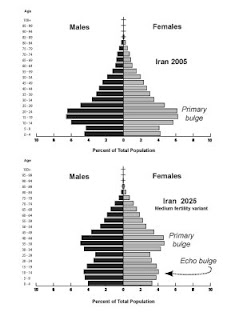
- Possible instabilities arising from a secondary youth bulge (an echo bulge), created as the previous generation’s bulge passes through its prime childbearing years (see figure);
- Questions about whether fertility can decline “too fast”; and
- The implications of continuous flows of foreign migrants into low-fertility countries—in particular, European countries today.
Some of Howe and Jackson’s other points seem muddled and inconsistent with quantitative studies, however. They cite researchers who argue that the mid-stages of economic development are the most threatening to security, and then link this to the demographic transition by declaring that “economic development…tend[s] to closely track demographic transition in each country.” This is mistaken: An extensive body of research informs demographers that economic development and fertility decline have been only weakly linked, even during the European fertility decline. While in several countries (including Brazil, Mexico, and South Africa) fertility declined abreast of rising per capita income, none of the East Asian “tigers” escaped the World Bank’s low-income country status until fertility dropped to near 3 children per woman, even though this measure had been declining steadily for years.
Nor can Howe and Jackson validate their assertion that having one of the middle structures is riskier than having one of the younger structures. Studies using the Uppsala Conflict Database’s record of minor and major conflicts show that, from 1970-1999, the very youngest countries (median age less than 18) and the middle group (median age 18-25) both experienced elevated risks of the emergence of a civil conflict —and both have large youth bulges. As Leahy and colleagues have shown, the youngest group was at greatest risk.
However, there is a way to salvage Howe and Jackson’s point. When infant mortality declines rapidly in the absence of fertility decline, age structures actually grow younger—in other words, some aspects of development push countries back into the youngest, most vulnerable category. If this is what the authors mean, they could have been clearer.
The authors go on to contend that neo-authoritarian regimes are likely to crop up among late-transition age structures. Here Howe and Jackson cede demography too much power over a state’s destiny. If one considers Deng Xiaoping the architect of China’s neo-authoritarian state, Lee Kwan Yew Singapore’s, Ali Khamenei Iran’s, and Hugo Chávez Venezuela’s, then this thesis has little empirical support. None of these regimes were established during the latter part of the demographic transition. Deng, Lee, and Ali Khamenei actually hastened fertility decline from high levels. I will, however, grant that Deng and Lee grew powerful as their countries’ age structures matured, and as that maturity promoted economic growth and reduced political tensions.
Overall, I’m much more positive than Howe and Jackson. I believe that parts of the world will, indeed, be left more politically stable and more democratic when very young age structures mature. Look at much of East Asia. Few veterans of conflicts in that region would have expected that, in 2008, most of its countries would be listed as vacation spots. I find it hard to believe, as Howe and Jackson do, that the most advanced phases of the demographic transition—a period yet to come—pose the greatest global security threats. Of course, I’m guessing…and so are they.
Richard Cincotta is the consulting demographer for the Long-Range Analysis Unit of the National Intelligence Council.
Figure: Iran’s 2005 youth bulge could give rise to an echo bulge in 2025. Courtesy of Richard Cincotta. -
Environment, Population in the 2008 National Defense Strategy
›The 2008 National Defense Strategy (NDS), released by the U.S. Department of Defense (DoD) earlier this summer, delivers the expected, but also throws in a few surprises. The NDS reflects traditional concerns over terrorism, rogue states, and the rise of China, but also gives a more prominent role to the connections among people, their environment, and national security. Both natural disasters and growing competition for resources are listed alongside terrorism as some of the main challenges facing the United States.
This NDS is groundbreaking in that it recognizes the security risks posed by both population growth and deficit—due to aging, shrinking, or disease—the role of climate pressures, and the connections between population and the environment. In the wake of the Intergovernmental Panel on Climate Change (IPCC) reports on climate change and the CNA study on climate change and security, Congress mandated that the NDS include language on climate change. The document is required to include guidance for military planners to assess the risks of projected climate change on the armed forces (see Section 931 of the FY08 National Defense Authorization Act). The document also recognizes the need to address the “root causes of turmoil”—which could be interpreted as underlying population-environment connections, although the authors provide no specifics. One missed opportunity in the NDS is the chance to explicitly connect ungoverned areas in failed or weak states with population-environment issues.
What really stands out about this NDS is how the authors characterize the future security environment: “Over the next twenty years physical pressures—population, resource, energy, climatic and environmental—could combine with rapid social, cultural, technological and geopolitical change to create greater uncertainty,” they write. The challenge, according to DoD, is the uncertainty of how these trends and the interactions among them will play out. DoD is concerned with environmental security issues insofar as they shift the power of states and pose risks, but it is unclear from the NDS what precisely those risks are, as the authors never explicitly identify them. Instead, they emphasize flexibility in preparing to meet a range of possible challenges.
The environmental security language in this NDS grew out of several years of work within the Department, primarily in the Office of Policy Planning under the Office of the Under Secretary for Defense. The “Shocks and Trends” project carried out by Policy Planning involved several years of study on individual trends, such as population, energy, and environment, as well as a series of workshops and exercises outlining possible “shocks.” The impact of this work on the NDS is clear. For example, the NDS says “we must take account of the implications of demographic trends, particularly population growth in much of the developing world and the population deficit in much of the developed world.”
Finally, although the NDS mentions the goal of reducing fuel demand and the need to “assist wider U.S. Government energy security and environmental objectives,” its main energy concern seems to be securing access to energy resources, perhaps with military involvement. Is this another missed opportunity to bring in environmental concerns, or is it more appropriate for DoD to stick to straight energy security? The NDS seems to have taken a politically safe route: recognizing energy security as a problem and suggesting both the need for the Department to actively protect energy resources (especially petroleum) while also being open to broader ways to achieve energy independence.
According to the NDS, DoD should continue studying how the trends outlined above affect national security and should use trend considerations in decisions about equipment and capabilities; alliances and partnerships; and relationships with other nations. As the foundational document from which almost all other DoD guidance documents and programs are derived, the NDS is highly significant. If the new administration continues to build off of the current NDS instead of starting anew, we can expect environmental security to play a more central role in national defense planning. If not, environmental security could again take a back seat to other national defense issues, as it has done so often in the past.
Jennifer Dabbs Sciubba is the Mellon Environmental Fellow in the Department of International Studies at Rhodes College. She worked in the Office of Policy Planning as a demography consultant during the preparations for the 2008 NDS and continues to be affiliated with the office. The views expressed in this article are those of the author and do not reflect the official policy or position of the Department of Defense or the U.S. government.
For more information, see Sciubba’s article “Population in Defense Policy Planning” in ECSP Report 13. -
Weekly Reading
›The Intergovernmental Panel on Climate Change has released a paper examining climate change’s likely effects on water resources, as well as how these changes in water resources could affect ecosystems, agriculture, human health, and the economy.
In “Warfare Ecology” (abstract), an article published in the September issue of BioScience, Gary Machlis and Thor Hanson argue that a new, holistic approach to the ecological study of warfare is needed, encompassing preparations for war, combat, and post-conflict activities.
Investing in economic development and education—both at home and abroad—is a more efficient way to prevent violence than investing a similar amount in weaponry or defense infrastructure, argue Representative Danny Davis (D-IL) and Michael Shank of George Mason University’s Institute for Conflict Analysis and Resolution in The Hill.
This year’s Clinton Global Initiative Annual Meeting featured a panel devoted exclusively to water and sanitation issues.
“UN demographers projected in 2002 that the population of the Philippines in 2008 would reach between 75 and 85 million. But the population has already overshot the high projection and now stands at 89 million, up from 60 million in 1990. And the country’s forests, as well as its people, are paying the price in terms of urban overcrowding and rural deforestration [sic],” writes Henrylito Tacio.
Economist environment correspondent Edward McBride moderates an online debate over whether water should be priced according to its market value.
Showing posts from category population.


 In a recent nationwide
  In their provocative article in The National Interest entitled “

