

-
Start With A Girl: A New Agenda For Global Health
›November 16, 2009 // By Calyn OstrowskiThe Center for Global Development’s latest report, Start With A Girl: A New Agenda For Global Health, sheds light on the risks of ignoring the health of adolescent girls. Like other reports in the Girls Count series, it links broad social outcomes with adolescent health. “Adolescence is a critical juncture for girls. What happens to a girl’s health during adolescence determines her future–and that of her family, community, and country,” state coauthors Miriam Temin and Ruth Levine.
Between childhood and pregnancy, adolescent girls are largely ignored by the public health sector. At the same time, programs and policies aimed at youth do not necessarily meet the specific needs of girls. Understanding the social forces that shape girls’ lives is imperative to improving their health.
Like recent books by Michelle Goldberg and Nicholas Kristof, the report argues for increased investment in girls’ education to break down the social and economic barriers that prevent adolescent girls from reaching their full potential. Improving adolescent girls’ health will require addressing gender inequality, discrimination, poverty, and gender-based violence.
“For many girls in developing countries, well-being is compromised by poor education, violence, and abuse,” say Temin and Levin. “Girls must overcome a panoply of barriers, from restrictions of their movement to taboos about discussion of sexuality to lack of autonomy.” The report points to innovative government and NGO programs that have successfully changed negative social norms, such as female genital cutting and child marriage. However, the authors urge researchers to examine the cost-effectiveness and scalability of these programs.
In the last five years, the international community has become increasingly aware of the importance of youth to social and economic development. Some new programs are focused on investing in adolescent girls, such as the World Bank’s Adolescent Girls Initiative and the White House Council on Women and Girls, but significant additional investment and support is needed.
“Big changes for girls’ health require big actions by national governments supported by bilateral and multilateral donor partners, international NGOs…civil society and committed leaders in the private sector,” maintain Temin and Levin. They offer eight recommendations:
1. Implement a comprehensive health agenda for adolescent girls in at least three countries by working with countries that demonstrate national leadership on adolescent girls.
2. Eliminate marriage for girls younger than 18.
3. Place adolescent girls at the center of international and national action and investment on maternal health.
4. Focus HIV prevention on adolescent girls.
5. Make health-systems strengthening and monitoring work for girls.
6. Make secondary school completion a priority for adolescent girls.
7. Create an innovation fund for girls’ health.
8. Increase donor support for adolescent girls’ health.
“We estimate that a complete set of interventions, including health services and community and school-based efforts, would cost about $1 per day,” say the authors of Start With a Girl. There is no doubt in my mind that this small investment would indeed have a high return for the entire global community. -
Pakistan’s Demographic Challenge Is Not Just Economic
›In a meeting with business leaders in Lahore in late October, Secretary of State Hillary Rodham Clinton pointedly warned of the potential economic impacts of Pakistan’s rapidly growing population: “There has to be…in any plan for your own economic future, a hard look at where you’re going to get the resources to meet these needs. You do have somewhere between 170 and 180 million people. Your population is projected to be about 300 million as the current birth rates, which are among the highest in the world, continue,” she said.
Pakistan is ranked 141 (out of 182 countries) in the Human Development Index. High rates of unemployment are compounded by low levels of education and human capital. Clinton noted that Pakistani women are more vulnerable to poverty; only 40 percent are literate, compared to 68 percent of men.
The Secretary’s emphasis on the need to provide adequate education, jobs, and resources to motivate economic growth and improve well-being is welcome. But demography also has important political consequences. U.S. policymakers and the Pakistani government should consider the impact of population dynamics on the country’s intensifying instability.
As Pakistan’s population grows rapidly, it is maintaining a very young age structure: in 2005, two-thirds of its population was younger than age 30. Research by Population Action International has shown that countries with very young age structures are three times as likely to experience outbreaks of civil conflict than those with a more balanced age distribution.
The members of a “youth bulge” are not inherently dangerous, but when governments are unable to foster employment opportunities or the prospects of stability, a young age structure can serve to exacerbate the risks of conflict, as recently noted by John O. Brennan, assistant to the president for Homeland Security and Counterterrorism, in a speech on “A New Approach to Safeguarding Americans.”
As Secretary Clinton and her colleagues consider the complex barriers to achieving peace and stability for Pakistan’s people, their humanitarian and development strategies should include demographic issues. When couples are able to choose the number and timing of their children, very young age structures like Pakistan’s, can change.
Family planning and reproductive health services are fundamental human rights, but remain out of reach for many in Pakistan, where one-quarter of all married women (and 31 percent of the poorest) have an unmet need for family planning.
Greater access to family planning would lower fertility rates and increase the share of working-age adults in the population. In this transition, countries can harness the “demographic dividend”—a change that could turn Pakistan’s age structure into an economic opportunity.
However, funding from the United States—the world’s largest single donor for international family planning—has declined by one-third over the past 15 years. The foreign assistance funding priorities of the Obama administration should reflect this recognition of the linkages between population, development, and stability.
By addressing the high unmet need for family planning and reproductive health services of women in countries like Pakistan, the United States could help to create a more balanced age structure in future generations—and promote stability at the same time.
Elizabeth Leahy Madsen is a research associate at Population Action International (PAI). She is the primary author of the 2007 PAI report The Shape of Things to Come: Why Age Structure Matters to a Safer, More Equitable World.. -
Ethiopia: A Holistic Approach to Community Development Blossoms Two Years After Taking Root
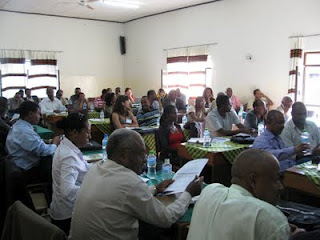
›November 12, 2009 // By Sean Peoples As evening fell upon Yirgalem, Ethiopia, more than 70 participants from a large cross-section of Ethiopia’s NGO community—as well as a few international participants like myself—gathered in a packed conference room in the Furra Institute for the second annual General Assembly of the Consortium for the Integration of Population, Health, and Environment (CIPHE).
 -
Covering Climate: What’s Population Got to Do With It?
›November 9, 2009 // By Dan Asin“There’s a correlation between CO2 and population. And it’s that we live in a world of more people, more money and more things, and that all distills down to the need for more energy,” said Dennis Dimick, executive editor of National Geographic, at a Wilson Center event on the media’s coverage of climate change and population, co-sponsored by the Society of Environmental Journalists and the International Reporting Project.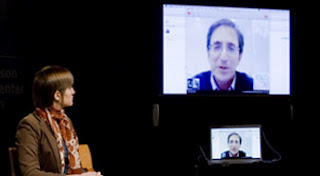
“Thinking about population and trends in population is a vital reality check for assessing policies you hear about on global warming,” said New York Times reporter Andrew Revkin, who joined Dimick and Nation Web Editor Emily Douglas via video conference. “When you start to think about that number—nine billion—a lot of cheery suppositions or assertions you’ve heard about how we’re going to de-carbonize the world without too much effort…[get] challenged in a hurry,” he said.
The Inconvenient Truth of Population
Despite these strong connections, the mainstream media has been reluctant to write about population growth, which Revkin called the “ultimate incremental story.”
“We, I think, are guilty to some extent, in the media, of not paying adequate attention to this part of the whole issue,” he said, partly because there is the perception that “we kind of solved that problem. But, again, just run those numbers: Nine billion people does not solve the climate problem and it has to be considered in every stage of assessing solutions to the climate problem.”
“We need to talk about it so we understand this issue at a level beyond more people means more emissions,” said Douglas. Other factors like levels of consumption, urbanization, and household structure make the population-emissions relationship complex and difficult to explain.
Revkin added that “consumption is even a tougher story to get at in print, because we’re a medium that advertises consumption, among other things.”
The Population-Energy Challenge
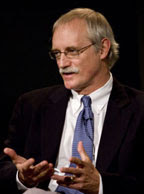
One-quarter of the world’s population lacks access to electricity. “We are in this sortof double-vise, trying to constrain our own [energy] demand while also trying to provide the opportunities for people who have little to none,” said Dimick.
With fossil fuels currently providing 80 percent of global energy, and with energy demand estimated to increase dramatically to meet the needs of 2.3 billion more people by 2050, the “scale of the challenge before us . . . is immense,” he said. “To think that we’re somehow simply going to go to solar and wind—I think we’re deluding ourselves.”
Nevertheless, Dimick insisted on the need “to de-carbonize at a tremendous scale.” He proposed sustainably addressing energy needs by improving energy efficiency, expanding mass transit systems, changing land use, and considering nuclear power.
Reproductive Health Is Key
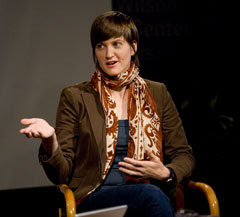
Douglas, who previously edited the RH Reality Check blog, emphasized that population issues go far beyond climate change. “I’m encouraging us to look at population not only from the perspective of the environment, but also from the perspective of individual women and their human rights, their right to determine the number and spacing of their children, and not purely to depress fertility rates in service of mitigating climate change,” she said.According to Douglas, each year 60 million pregnancies—one-third of the global total—are unintended, and 200 million women worldwide have an unmet need for contraception. Family planning programs are “cheap to employ and deploy, and women and societies want them anyway,” said Douglas. A few recent studies have argued that universal access to family planning could be one of the most cost-effective ways to reduce greenhouse gas emissions.
And not just mitigation, but adaptation as well: “Women with access to reproductive health services are healthier and they’re better able to deal with the impacts of climate change,” she said. “Poorer countries are going to need adaptation strategies, and one of those strategies is to allow women to better determine the size of their families.”
However, “many political leaders–not only on the right—don’t like reproductive health programs,” said Douglas. Disagreements over abortion and birth control are part of the problem, as well as past instances of coercive contraceptive methods in some developing countries.
Douglas cited a Population Action International survey that “found that 41 countries identified population growth as a factor that makes them more vulnerable to climate change, but only two of those countries proposed programs that address reproductive health.”
Douglas decried the “significant gap between political leaders’ understanding that population growth makes it more difficult for them to respond to climate change, and political leaders being able to muster the political will that will empower women to better control their own fertility.”
Close-Up on the Most Vulnerable
“We also can’t talk about this as though all people added to the world population produce greenhouse gases in equal measure,” said Douglas. “The world’s richest half billion people, that’s 7 percent of the global population, are responsible for 50 percent of the world’s carbon dioxide emissions. Meanwhile, the poorest 50 percent are responsible for just 7 percent of emissions.”
Revkin urged reporters to use a “close-up lens” when examining population trends impact on climate—especially in “areas of the world where there are significant risks that could be amplified by human-driven climate change, like urban severe flooding and severe rains, like we saw in Manila recently.”
With rapid urbanization in the developing world, “you have to look at places where you have hugely increased numbers of people moving essentially into harm’s way—or being born in harm’s way, if you’re talking about sub-Saharan Africa,” said Revkin.
A Thought Experiment
“What if the whole world were equal in emissions?” Revkin asked. Suppose advanced industrial countries, such as the United States, reduce their annual emissions intensity from 20 tons of CO2 per person to 10 tons. At the same time, suppose rapidly developing countries, such as India, reach the same emissions intensity. In a world with nine billion people that equates to 90 billion tons—“three times today’s current annual emissions of CO2,” he said.
“Probably the single most concrete and substantive thing a young American could to do to lower a carbon footprint is not turning of the lights or driving a Prius, but having fewer children,” said Revkin. “Eventually, should you get credit—if we’re going to become carbon-centric—for having a one child family when you could’ve had two or three? Obviously it’s just a thought experiment, but it raises some interesting questions.”
Drafted by Daniel Asin and Meaghan Parker
Edited by Meaghan Parker -
VIDEO: José G. Rimon on Key Trends in Funding Family Planning
›October 29, 2009 // By Wilson Center Staff“The downward trend, in terms of donor funding for international family planning, since the middle of the 1990s to around 2006 has been reversed,” José Rimon II, senior program officer for global health policy and advocacy at the Bill and Melinda Gates Foundation, told ECSP Director Geoff Dabelko following a discussion on the future of family planning at the Woodrow Wilson Center.
“There is a lot of scientific evidence that if we don’t revitalize the family planning/ reproductive health agenda, it will be very difficult to achieve the health Millennium Development Goals, especially in the area of reducing maternal mortality,” said Rimon. “Just by addressing the unmet need [for contraceptives] and the unintended pregnancies which result from it, you can reduce maternal mortality by 31 percent.”
Rimon said the Gates Foundation is working closely with donors and partner organizations to exchange information on strategy and funding priorities, which, he says, is “not happening in other issues, but it’s happening in the family planning and reproductive field.” -
Video: Laurie Mazur on Population, Justice, and the Environmental Challenge
›October 21, 2009 // By Wilson Center Staff“It’s fairly well known that we’re at a pivotal moment environmentally . . . but I think it’s less well known that we’re also at a pivotal moment demographically,” Laurie Mazur, director of the Population Justice Project, tells ECSP’s Gib Clarke.
“Half the population, some three billion people, are under the age of 25,” Mazur says. “Their choices about childbearing will determine whether world population grows from 6.8 billion to as many as 8 or even almost 11 billion by the middle of the century.”
Mazur’s new book, A Pivotal Moment: Population, Justice, and the Environmental Challenge, launches at the Woodrow Wilson Center on October 27. Mazur will be joined by contributors John Bongaarts of the Population Council, Jacqueline Nolley Echegaray of the Moriah Fund, and Roger-Mark De Souza of the Sierra Club.
“These issues, population growth and the environment, are connected in ways that are very complex,” says Mazur.
“Population growth is not the sole cause of the environmental problems we face today, but it does magnify the impact of unsustainable resource consumption, harmful technologies, and inequitable social arrangements. It’s a piece of the pie. Slowing population growth is part of what we need to do to ensure a sustainable future.” -
If It Bleeds It Leads: Pop-Climate Hits the Blogosphere
›Population and climate change get short shrift in the media—that is, until Rush Limbaugh urges you to commit suicide. It’s a disturbing sign that this extremely complex topic only gets play when the knives come out. And as this summer’s health care circus demonstrates, the blogosphere is often more interested in covering the shouting than the issues at hand.
So what happened? At the Wilson Center last week, the New York Times’ Andrew Revkin (via Skype) mentioned a thought experiment he had put forward in a recent post on his blog: “Should you get credit — if we’re going to become carbon-centric — for having a one-child family when you could have had two or three. And obviously it’s just a thought experiment, but it raises some interesting questions about all this.”
Limbaugh, picking up on a post on CNS.com, a conservative online news outlet, said Revkin and “militant environmentalists, these wackos, have so much in common with the jihad guys.” The furor was reported by a number of news blogs, including NYT’s Paul Krugman, the Guardian, and Politico.
An earlier and more substantial account by Miller-McCune’s Emily Badger deftly hits the highlights, including some historical context from The Nation’s Emily Douglas. While earlier projections assumed population growth would decline following the dissemination of birth control in the West, “that assumption turned out to be false,” said Douglas, because women in developing countries have not received similar access to contraceptives.
Indeed, as Worldwatch Institute’s blog post on the event points out, “an estimated 200 million women who want to avoid pregnancy are risking it anyway because they have inadequate access to contraception and related reproductive health services.”
I’m disheartened that this kerfluffle follows a recent uptick in thoughtful coverage of the population-climate connection. At a standing-room-only panel (audio) on covering population and environment at the most recent SEJ conference, Baltimore Sun reporter Tim Wheeler (video) said that population “has those challenges of so, what do you do about it, how do you deal with it.” But he said it was reporters’ “constant challenge to continue to wrestle with these issues.”
Moving the wrestling match into the center ring is bringing a new focus to the debate, which could be useful, as Suzanne Petroni writes in the ECSP Report: “A careful discussion of the ways in which voluntary family planning can further individual rights, community development, and, to some extent, climate change mitigation, could increase awareness not only of the outsized contribution of developed nations to global emissions, but also of their appropriate role in the global community.”
As Revkin says at the end of his response to Limbaugh: “And of course there’s the reality that explosive population growth in certain places, particularly sub-Saharan Africa, could be blunted without a single draconian measure, many experts say, simply by providing access to family planning for millions of women who already want it, but can’t get it – whether or not someone gets a carbon credit in the process.”
Family planning advocates—who have long been wary of linking contraception to climate mitigation—would mostly agree with that statement, although they would phrase it a little differently. Better reproductive health care is “an end in itself,” with climate mitigation being the “side effect,” rather than the primary goal, Barbara Crossette writes in The Nation.
Population experts cautiously agree there is a link, but warn that quantifying it is not so simple. At a major conference of demographers in Marrakesh, researchers previewed forthcoming research described the potential for emissions “savings” brought by decreases in fertility.
In the near term, it doesn’t look likely that all this attention will lead to policy action at Copenhagen. Population Action International reports that while almost all of the least developed countries’ adaptation plans mention population as a factor which increases their vulnerability to climate change, only a few state that investing in family planning should part of their strategy.
I encourage you to watch the webcast of the event and add your own (thoughtful) comments to the dialogue below. No suicide threats, please. -
Population’s Links to Climate Change
›“Covering Climate: What’s Population Got to Do With It?”—webcast live from the Wilson Center—will analyze the challenges facing science and environmental reporters as they prepare to cover what New York Times reporter Andrew Revkin calls “the story of our time.” Cosponsored by the Society of Environmental Journalists and the International Reporting Project, the panel—including Dennis Dimick of National Geographic and the Nation’s Emily Douglas—will discuss the significant barriers to nuanced reporting, including stovepiped beats, the shrinking news hole, and old-fashioned squeamishness.
However, in the past month, there’s been a veritable baby boom of news coverage on climate change and population. Spurred by three high-profile reports—the study commissioned by the Optimum Population Trust, research in the Bulletin of the WHO, and an editorial in the Lancet—the mainstream media and some key bloggers finally got some condoms in their climate change.
It’s gratifying to finally see this issue pop up in the media, almost a year to the day after the 2008 SEJ conference panel on population and climate change moderated by Constance Holden of Science that attracted a respectable (but not remarkable) audience of 40. The panelists decried the media’s relative silence on the impact of population growth and other demographic dynamics on environmental issues.
NPR’s Steve Curwood pointed out that while it’s “something we don’t talk about at all in America,” U.S. population growth increases emissions faster than developing-country population growth, due to our larger per capita consumption. A lone AP article, “Population growth contributes to emissions growth,” reported on the discussion.
In contrast, a population-climate panel at last week’s SEJ conference drew an overflow crowd of more than 100 people. Former SEJ President Tim Wheeler read off recent headlines demonstrating that the media does mention population. However, he noted that “most of the instances I cited are op-ed opinion pieces, not news coverage or feature stories.” In recent climate coverage, he said, “population gets mentioned as an undercurrent and afterthought; our attention intends to be on the immediate. And it has those challenges of so, what do you do about it, how do you deal with it.” But it is “our constant challenge to continue to wrestle with these issues.”
Here’s a short list of recent coverage:
Associated Press: “Birth control could help combat climate change”
Reuters: “Contraception vital in climate change fight -expert”
Bloomberg: “African Condom Shortage Said to Worsen Climate Impact”
Matt Yglesias: “Population and Climate Change”
The Nation: “Factoring People Into Climate Change”
Inter Press Service: “POPULATION: Where’s Family Planning on Climate Change Radar? Zofeen Ebrahim interviews noted social demographer KAREN HARDEE”
The New Republic’s The Vine: “Abortion: The Third Rail of Climate Policy?”
Treehugger.com: Contraception Five Times Less Expensive Than Low-Carbon Technology in Combating Climate Change
Washington Post: “When It Comes to Pollution, Less (Kids) May Be More”
Inter Press Service: “CLIMATE CHANGE: Rising Seas Demand Better Family Planning”
LA Times Booster Shots blog: “Can condoms combat climate change?”
Showing posts from category population.
 As evening fell upon Yirgalem, Ethiopia, more than 70 participants from a large cross-section of Ethiopia’s NGO community—as well as a few international participants like myself—gathered in a packed conference room in the
  of double-vise, trying to constrain our own [energy] demand while also trying to provide the opportunities for people who have little to none,” said Dimick.
 According to Douglas, each year 60 million pregnancies—one-third of the global total—are unintended, and

