Showing posts from category population.
-
Assessing Our Impact on the World’s Rivers
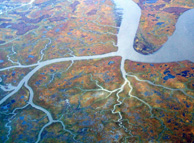
› In a special “Rivers in Crisis” issue of Nature, the lead article, “Global Threats to Human Water Security and River Biodiversity,” presents damning evidence that manipulation of river systems — through the construction of canals, levees, hydroelectric projects, and other infrastructure — has caused serious and lasting biological damage to watersheds throughout both the developing and developed worlds. The authors (all 11 of them!) report that key rivers have become shadows of their former selves in terms of the amount of aquatic life they can support. Without drastically improved stewardship of waterways, “we are pushing these river systems toward catastrophe,” warns Peter McIntyre, an article co-author.The human impact on the world’s river systems will be hard to reverse, says Margaret Palmer, author of a second Nature article on freshwater biodiversity loss, “Beyond Infrastructure.” Human-induced changes to watersheds affect local hydrology at a fundamental level, she contends, weakening rivers’ ability to deliver crucial “ecological goods and services” — such as clean water and nutrient-rich sediment loads — that help maintain the health of local environments and the human populations that depend on them. To fully understand the scope of the problem, Palmer says more research is needed to explore the linkages between biodiversity levels and “ecosystem services” that healthy rivers provide.
 -
Barbara Crossette on UNFPA State of the World Population 2010 Report
›“Particularly when you go into a society that’s been broken by war or conflict or is so impoverished that is has nowhere to start climbing up, there have to be integrated programs and they have to work with people in mind,” said former New York Times foreign correspondent Barbara Crossette in an interview with The New Security Beat. “The people themselves will solve a lot of the problems around them if they’re just given the tools to do so.”
Crossette is one of the lead authors of the UN Population Fund’s latest State of the World Population Report, “From Conflict and Crisis to Renewal: Generations of Change,” set to launch this Wednesday, October 20th. She spoke to us particularly about the challenges of women around the world and the unique storytelling aspect of this year’s report.
The “Pop Audio” series offers brief clips from ECSP’s conversations with experts around the world, sharing analysis and promoting dialogue on population-related issues. Also available on iTunes. -
Laurie Mazur at SEJ 2010 on ‘A Pivotal Moment: Population, Justice, and the Environmental Challenge’
›“Right now, half the world’s population – some 3 billion people – are under the age of 25,” began Laurie Mazur on the “Population, Climate, and Consumption” panel at the Society for Environmental Journalists 20th Annual Conference. “It’s the largest generation ever that’s coming of age, and the choices that those young men and women make about childbearing will determine whether world population…grows to anywhere between 8 and 11 billion by the middle of this century.”
“The good news is that everything we need to do to slow population growth is something we should be doing anyway,” she continued. Mazur is the author of A Pivotal Moment: Population, Justice, and the Environmental Challenge and director of the Population Justice Project.
She was joined on the panel by Brian O’Neill, who spoke about a new study examining the impact of demographics on carbon emissions, and Jack Liu, who spoke about the impact of household size on emissions in China.
The “Pop Audio” series offers brief clips from ECSP’s conversations with experts around the world, sharing analysis and promoting dialogue on population-related issues. Also available on iTunes. -
Brian O’Neill: Population is Neither a Silver Bullet nor a Red Herring in Climate Problem
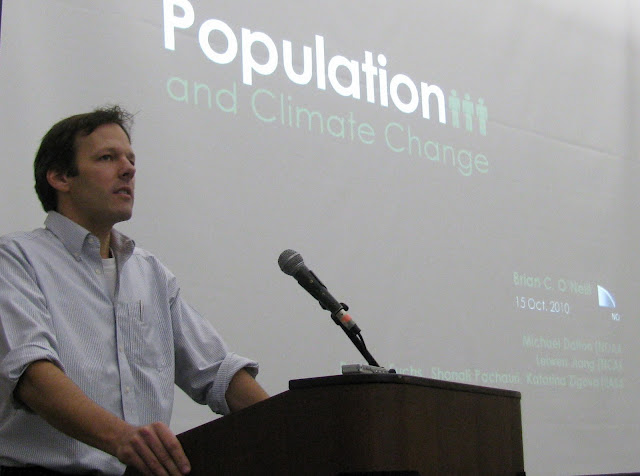
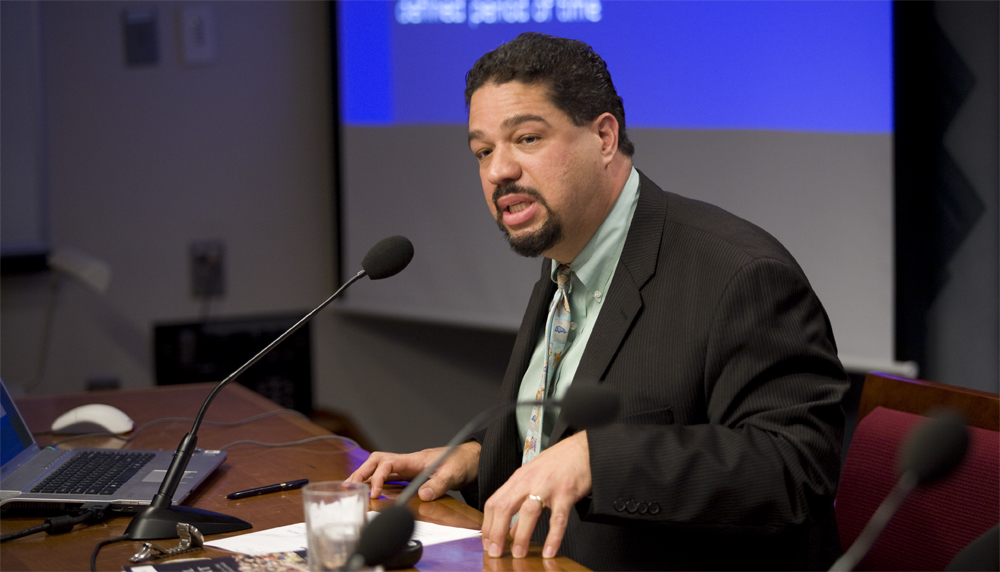
›October 16, 2010 // By Meaghan Parker“Slower population growth would not solve the climate problem, but it could make a contribution. It is neither a silver bullet nor a red herring,” said Brian O’Neill of the National Center for Atmospheric Research at the annual Society of Environmental Journalists’ conference in Missoula, MT. On Friday, he presented the results of a new demographic study as part of a panel, “Population, Climate, and Consumption,” moderated by Ken Weiss of the Los Angeles Times.
-
New Study Finds Lower Population Growth Could Cut Carbon Emissions
›A new study, “Global Demographic Trends and Future Carbon Emissions,” finds that slowing population growth by 2050 would meet 16-29 percent of the reductions in carbon emissions necessary to avoid dangerous climate change — roughly equivalent to 1-1.5 “stabilization wedges.” Published in PNAS this week, the article reports the results of a comprehensive assessment, led by Brian O’Neill of the National Center for Atmospheric Research (NCAR), of the impact of demographic changes, including urbanization and aging, on global carbon emissions.
The authors conclude that policies designed to meet the substantial unmet need for family planning and reproductive health services, particularly in the United States and developing countries, would lead to emission reductions that amount to about one-half of a wedge. These results suggest that “family planning policies would have a substantial environmental cobenefit,” they write.
O’Neill will discuss the study’s results and recommendations on Friday morning at the annual Society of Environmental Journalists’ conference in Missoula, MT. The panel, “Population, Climate, and Consumption,” which I helped organize, will be moderated by Ken Weiss of the Los Angeles Times. Weiss wrote on the Times’ Greenspace blog that “the study offers a novel way to quantify how changes in human population influence the buildup of greenhouse gases in the atmosphere.”
To tease out the complex connections between climate, population, and consumption, O’Neill and his coauthors looked beyond population size to delve into household location and composition. They found that urbanization and aging trends will have differential–and potentially offsetting–impacts on carbon emissions.
Aging, particularly in industrialized countries, will reduce carbon emissions by up to 20 percent in the long term. On the other hand, urbanization, particularly in developing countries could increase emissions by 25 percent.
The Taboo Against Mixing Condoms and Climate
Most coverage to date, including the widely distributed press release from the National Science Foundation, overlooked the study’s recommendations to increase access to family planning and meet unmet need for contraception as a climate mitigation strategy.
Unfortunately, that’s the case in many venues: “You don’t see policymakers talking about in the climate negotiations,” climate scientist Richard Somerville told Weiss. Family planning has long been off the table–Mother Jones recently called it “The Last Taboo” – especially at the big climate conferences. At Copenhagen, it was only discussed at side events; NYT’s Andrew Revkin called it the “missing ‘P’ word.“
One of this year’s panelists, Laurie Mazur, who last year published, A Pivotal Moment: Population, Justice and the Environmental Challenge, will likely explore the environmental cobenefits of improving women’s reproductive health. In addition to mitigation, some developing countries have identified family planning as a strategy in their national climate adaptation plans.
Growth Story: Population at SEJ
Friday’s panel is the only one to consider population’s role in environmental issues at this year’s SEJ conference, the premier event for U.S. environmental journalists. Given the issue’s historic marginalization within environmental community, that’s not necessarily surprising.
But there appears to be a growing interest among reporters: last year’s SEJ panel on population moderated by Tim Wheeler of The Baltimore Sun drew a standing-room-only crowd, following a popular 2008 SEJ panel on the topic moderated by Steve Curwood of Living on Earth.
More surprisingly, Friday’s panel is one of less than a handful at this year’s conference to address international environmental issues. I hope next year’s conference in Miami will draw on that city’s vibrant immigrant community and short flights to Latin America and the Caribbean to bring in more international flavor.
Sources: DotEarth, Greenspace, National Science Foundation, Population Action International, UNFPA. -
Gayle Tzemach Lemmon, Council on Foreign Relations
MDGs for Women Largely Unmet
›October 15, 2010 // By Wilson Center Staff
Excerpt from a First Take by Gayle Tzemach Lemmon at the Council on Foreign Relations:
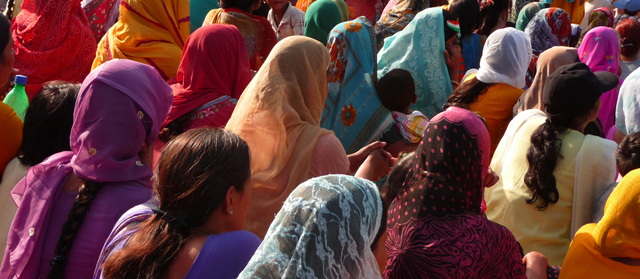
Ten years after global leaders vowed to work toward eradicating extreme poverty, achieving universal primary education, reducing child mortality, and more, the eight Millennium Development Goals (MDGs) – particularly those relating to women – remain a distant hope. Though women were a focus of much discussion this week at the MDG summit in New York, the forward movement so far has been discouraging on the two MDGs directly relating to women: “promoting gender equality and empowering women” and “reducing by three-quarters the maternal mortality ratio.”
An MDG report released in June noted that when it comes to women, “progress has been sluggish on all fronts – from education to access to political decision-making.”While progress has been made on girls’ primary school enrollment, only three of ten regions are on track regarding women’s share of paid employment. The figure is even bleaker concerning women’s equal representation in national parliaments.
Data is still being collected, but early figures show the maternal mortality ratio reduction rate is “well short” of the 5.5 percent annual decline required to slash global maternal mortality by the MDGs’ stated 75 percent. Data from 1990 shows 430 maternal deaths per one hundred thousand live births. As of 2008, that figure had dropped only slightly to four hundred deaths per one hundred thousand live births, nowhere near the goal of below 150.
Continue reading at the Council on Foreign Relations.
Photo Credit: Adapted from “Untitled,” courtesy of flickr user :Bron:. -
Meeting the Needs of Latin America’s Rural and Urban Populations
›October 14, 2010 // By Kayly OberThere are two Latin Americas according to demographers. In one of the most urbanized regions of the world, the population of some countries remains highly rural. While countries like Chile, Argentina, and Uruguay are close to 90 percent urbanized, much of Central America, as well as Ecuador, Paraguay, and Bolivia, are only about 50-60 percent urban.
Across the continent, Latin America’s total fertility rate has fallen from almost six children per woman in the 1960s to 2.2 children in 2005. Population growth rates are projected to continue to decline from 1.5 percent in 2010 to roughly 0.75 percent by 2020. But less-urbanized countries continue to experience high population growth in their rural areas, particularly among their large indigenous populations, who are not experiencing the same shifts from high to low fertility.
For example, since 1990, communities surrounding Guatemala’s Sierra de Lacandon National Park have grown by 10 percent each year, with birthrates averaging eight children per woman. These larger communities and households have led to agricultural expansion into the park, which has lost 10 percent of its forest canopy since 1990.
Rural-to-rural migration is also a key, but often overlooked, dynamic as migrants move to other rural areas in search of new land to farm. Between 1961 and 2001, Central America’s rural population increased by 59 percent. This increased population was accompanied by a 15 percent increase in deforestation, totaling some 13 million hectares.
Although many rural areas of Latin America have high fertility rates and expanding populations, they also have a high unmet demand for contraception. Indigenous populations are particularly underserved by health providers for many reasons, including cultural barriers, language, and accessibility. According to the Population Reference Bureau, an estimated 50 percent of indigenous women in the Ecuadorian Amazon do not want another child, yet 98 percent of them do not have access to a modern contraceptive method.
While reaching historically disadvantaged populations in rural communities is not easy, some programs have had considerable success—and saved money—by combining environmental and health efforts. For example, the Guatemalan NGO ProPeten trained more than 80 midwives and health promoters and developed a radio soap opera in both Spanish and Q’eqchi’ to deliver health services and environmental education to the communities living near the Maya Biosphere Reserve.
Given links between rural population growth and agricultural expansion, expanding access to family planning may not only be a cost-effective way to help women reach their desired family size, but also a smart investment in forest conservation and climate mitigation—and perhaps a down-payment on a more secure future for all. -
Welcome Back, Roger-Mark: A Powerful Voice Returns to PHE
›October 13, 2010 // By Geoffrey D. Dabelko“I’m thrilled to be back.” That was the sentiment that Roger-Mark De Souza relayed to me, in his famous lilting baritone, about becoming the new vice president of research and director of the climate program at Population Action International (PAI). De Souza has long been a leading voice on integrated development programs that feature population, health, and environmental (PHE) dimensions. But three years as the Sierra Club’s director of foundations and corporate relations took him away from day-to-day work on these issues.
In his new posts, Roger-Mark will lead PAI’s research team in establishing a strong evidence base and engaging new allies in the effort to support healthier women and families, according to PAI. “Roger-Mark’s diverse research experience makes him an ideal fit for PAI as we undertake critical projects on reproductive health, population and environment issues,” said PAI President and CEO Suzanne Ehlers in a press release.PAI is a research-based advocacy NGO long known for innovative work connecting demographic considerations with other key development realms: mainly environment, security, and poverty. PAI’s policy-friendly briefs on population’s links with water, forests, and biodiversity provide practical meta-analysis of these complex and evolving connections. The organization’s more recent work on demographic security has been instrumental in advancing research and policy in that largely neglected arena.
De Souza captured his insights last year for our Focus series, in his brief, “The Integration Imperative – How to Improve Development Programs by Linking Population, Health, and Environment” (see also his follow-up interview on NSB). He combines lessons learned from community-based development efforts in Southeast Asia and East Africa with a savvy sense of the policy debates among donors and recipient countries alike.
This move reunites De Souza with Kathleen Mogelgaard, with whom he made key contributions to the PHE field as colleagues at Population Reference Bureau earlier this decade, and who is now Senior Advisor for Population, Gender, and Climate at PAI.
De Souza returns to his former focus on PHE issues at a time when the field is collectively searching for the best ways to respond to the challenges of climate mitigation and adaptation, as well as ongoing hurdles such as scaling up, sustainability, and labeling.