Showing posts from category population.
-
How Does Organic Farming in the U.S. Affect Global Food Security?
›The feature story for last month’s Wilson Center newsletter, Centerpoint, was on the popular full-day conference “Rebuilding the U.S. Economy – One Heirloom Tomato at a Time,” hosted by the Program on America and the Global Economy in March. The conference focused on organic, local farming and the idea of creating “sustainable” food production that was healthier but also better for the economy than relying on imports from afar.
ECSP was asked to provide some international context for the discussion with a brief “Point of View.” I tried to paint a little bit of the big picture 21st century supply and demand story and give a sense of how today, globalization has helped linked everyone in this food security discussion:Dramatic events over the last year have shone a spotlight on the problem of global food security: massive fires in Russia, which reduced wheat supplies; famine and drought in Niger and Chad; and food price riots in the Middle East and elsewhere. These stresses come amid price spikes that echo the food crises of 2008 and reveal the linked nature of food security today and some of the fundamental challenges facing poor countries’ efforts to feed their growing populations.
What do you think: What’s the best way to inject the urgency that people looking at demographics and consumption rates around the world are feeling about global food security into a discussion about organic agriculture in the United States? Is there a tension between quality and quantity of food in the organic vs. agrobusiness debate that needs to be addressed in a global context? And what’s the role of policy in determining that balance?
In most countries, food insecurity is a symptom of poverty, poor governance, and/or poor infrastructure. For example, developed countries can often rebound from natural disasters relatively quickly. However, in drought-prone countries like Niger and Chad or flood victims like Pakistan and North Korea, such structural weaknesses leave them unable to bounce back as quickly from extreme events. This makes development efforts more difficult and can cause vulnerable countries to quickly become a burden on their neighbors or more prone to internal instability.
In the long term, reducing vulnerability in developing countries will be one of the most critical factors to ensuring global food security. But to meet the projected demand from increased consumption and continuing population growth, global yields must also increase.
The Green Revolution of the 1960-70s saved millions of lives by introducing heartier strains of rice and improving other staple crops in South and Southeast Asia, and most agree that a “Second Green Revolution” (whether or not it looks like the first) will likely be necessary. If so, the current tensions in the West over organic or sustainable practices versus agribusiness models will need to be reconciled in a way that can provide the most immediate help for the world’s hungry.
An important requirement, however, is that in a more resource-constrained world, these yields must be increased without destroying our future capacity. How we go about this, whether through traditional industry, organic techniques, or a mixture of both, will be one of the defining challenges of the 21st century. -
Population Growth and Climate Change Threaten Urban Freshwater Provision
›May 6, 2011 // By Emanuel FeldBy 2050, more than one billion urban dwellers could face perennial freshwater shortages if major improvements are not made to water management practices and infrastructure, according to a recent study published in the journal PNAS, “Urban Growth, Climate change, and Freshwater Availability.” These challenges will arise as hydrologic changes due to climate change compound “an unprecedented wave of urban growth,” with nearly three billion additional urban residents forecast by 2050. “It is a solvable problem,” the study argues, “but one that will take money, time, political will, and effective governance.”
Using demographic data from the Earth Institute at Columbia University, as well as a variety of climate and city-level demographic scenarios, the researchers estimate per-capita water availability for cities in the developing world, where urban growth will be most rapid. They advise, however, that their findings should be taken as conservative estimates, since the study assumes cities can use all nearby water and does not account for key challenges relating to water quality and delivery to urban centers.
In 2000, 150 million people in developing countries lived in urban areas that could not support their own water requirements (i.e. less than 100 liters available per person per day). By 2050, according to the study, urban population growth alone could bring this figure to 993 million and more than three billion could face intermittent shortages at least one month out of the year. When the researchers expanded the area on which cities can draw upon to include a 100 km buffer zone, these values drop to 145 million and 1.3 billion, respectively.
However, once climate and land use change are included in the models, the aggregate number of people facing perennial shortages rises a further 100 million, if only water stores within the urban area are considered, or 22 million, for the 100 km buffer zone model.
Remarkably, these aggregate figures differ very little among the various demographic and climate scenarios. The particularities of the challenge do however vary at the regional level. Perennial water shortage will generally be limited to cities in the Middle East and North Africa. Seasonal water shortages, on the other hand, will be geographically widespread, although rapidly urbanizing India and China will be especially hard hit.
The study acknowledges the temptation to view water shortage “as an engineering challenge.” Still, the lead author, Rob McDonald of The Nature Conservancy, cautions against exclusive reliance on grey infrastructure solutions (e.g. canals and dams) in an article for Nature Conservancy, saying:Some new infrastructure will be needed, of course – that’s the classic way cities have solved water shortages. But especially in parts of the world where there’s lots of cities, just going out farther or digging deeper to get water can’t be the only solution.
Instead, McDonald and co-authors Pamela Green, Deborah Balk, Balazs M. Fekete, Carmen Revenga, Megan Todd, and Mark Montgomery, emphasize the need for cities to encourage more efficient water use by their industrial and residential sectors, as well as the potential to engage the water-intensive agriculture sector in surrounding rural areas.
“Bottom line,” McDonald said in an interview with Robert Lalasz of The Nature Conservancy’s Cool Green Science blog, “don’t think of those high numbers as a forecast of doom. They are a call to action.”
Emanuel Feld is a student at Yale University studying economics and the environment.
Sources: Cool Green Science, PNAS, The Nature Conservancy.
Photo Credit: Adapted from “Chennai prayed too hard…. Part I,” courtesy of flickr user Pandiyan. -
Watch ‘Dialogue’ TV on Integrating Development, Population, Health, and the Environment
›Last week on the Wilson Center’s Dialogue radio and television program, host John Milewski spoke with Geoff Dabelko, director of ECSP, Roger-Mark De Souza, vice president for research and director of the Climate Program for Population Action International, and George Strunden, vice president of Africa programs for the Jane Goodall Institute. They discussed the challenge of integrating population, health, and environmental programs (PHE) to address a broad range of livelihood, development, and stability issues. [Video Below]
“Many times that we tackle development or poverty and human well-being challenges…we do it in an individual sector – the health sector, or agriculture sector, or looking at issues of water scarcity – and it makes sense in many respects to take those individual focuses,” said Dabelko. “But of course people living in these challenges, they’re living in them together…so both in terms of understanding the challenges…and then in responding to those challenges, we have to find ways to meet those challenges together.”
De Souza noted that the drive for integrated development stems from the communities being served, not necessarily from outside aid groups. “We’ve seen that there’s a greater impact because there’s longer sustainability for those efforts that have an integrated approach,” he said. “There’s a greater understanding and a greater appreciation of the value that [PHE] projects bring.”
Strunden said that the Goodall Institute has found similar success in tying health efforts with the environment in places where previously conservation work alone had been unsuccessful.
The panelists also discussed the role of population in broader global challenges, including energy, water, and food scarcities, and women’s rights.
Dialogue is a co-production of the Woodrow Wilson International Center for Scholars and MHz Networks. The show is also available throughout the United States on MHz Networks, via broadcast and cable affiliates, as well as via DirecTV and WorldTV (G19) satellite.
Find out where to watch Dialogue where you live via MHz Networks. You can send questions or comments on the program to dialogue@wilsoncenter.org. -
Watch: Jennifer Dabbs Sciubba on Population and National Security
›April 28, 2011 // By Schuyler Null“Long-term trends really are what shape the environment in the future,” said Jennifer Dabbs Sciubba in this interview with ECSP. “As we’ve seen recently with…revolution in North Africa, it’s the long-term trends that act together for these things to happen – I like to say demography is not usually the spark for a conflict but it’s the fodder.”
Sciubba is the Mellon Environmental Fellow in the Department of International Studies at Rhodes College. In her new book, The Future Faces of War: Population and National Security, she discusses the importance of demographic trends in relation to security and stability, including age structure, migration, youth bulges, population growth, and urbanization.
One of the most important things to emerge from the book, said Sciubba, is that countries that are growing at very high rates that are overwhelming the capacities of the state (like many in sub-Saharan Africa) really will benefit from family planning efforts that target unmet need.
Afghanistan, for example, “has an extremely young age structure,” Sciubba pointed out. “So if you’re trying to move into a post-conflict reconstruction atmosphere…you absolutely have to take into account population and the fact that it will continue to grow.”
“Even if there are major moves now in terms of reducing fertility, they have decades ahead of this challenge of youth entering the job market,” Sciubba said. “Thousands and thousands more jobs will need to be created every year, so if you have a dollar to spend, that’s a really good place to do it.”
For more on Jennifer Dabbs Sciubba and The Future Faces of War, see her book launch at the Wilson Center with Deputy Under Secretary Kathleen Hicks of the Department of Defense (video) and some of her previous posts on The New Security Beat. -
Marissa Mommaerts, Aspen Institute
Aspen Institute: The Revolution We Need in Food Security and Population
›April 27, 2011 // By Wilson Center StaffThe first months of this year brought the second global food price crisis in just three years, with soaring food prices against a backdrop of bad weather, poor harvests, and political turmoil in North Africa and the Middle East. This year will see another milestone: the planet’s population is set to surpass seven billion, with most of the population growth occurring in countries least equipped to meet rising demands on agriculture and the environment. As part of its 7 Billion: Conversations that Matter roundtable series, the Aspen Institute’s Global Health and Development Program brought together three experts to discuss “The Revolution We Need in Food Security and Population” on April 12.
-
Population Growth and its Relation to Poverty, the Environment, and Human Rights
›“Population, Poverty, Environment, and Climate Dynamics in the Developing World,” in the Interdisciplinary Environmental Review, by Jason Bremner, David Lopez-Carr, Laurel Suter, and Jason Davis, attempts to illuminate and clarify the complex relationships between environmental degradation, population dynamics, and poverty. Population growth is a key driver for the degradation of ecosystem services which has a direct impact on livelihoods and human well-being, write the authors, especially for the poor. They argue that “population growth itself, however, remains an insufficient explanation of the relationship between population, ecosystems, and poverty.” While the field has a come a long way since its “original Malthusian roots,” they write, the relationships between these dynamics differ greatly depending on the area in question, and much work remains to be done on the less well-studied ecosystems.In “An End to Population Growth: Why Family Planning Is Key to a Sustainable Future” from the Solutions Journal, Robert Engelman reminds us that population projections are not set in stone and that the widespread belief that population has to reach nine billion before leveling off is wrong. Nor is coercive “population control” necessary, he writes: “Population growth rates and average family size worldwide have fallen by roughly half over the past four decades, as modern contraception has become more accessible and popular.” Unfortunately, there remains a large number of people around the world without access to family planning, the majority of whom live in developing countries. Engelman points out that while the number of people of reproductive age has steadily increased in these countries over the last decade, donor support has declined. He argues that research, courage, and creativity are needed to reverse this situation, but in a world where most of all pregnancies were intended, population growth would slow long before reaching nine billion. -
Overcoming Pakistan’s Demographic Challenges
›Download Reaping the Divided: Overcoming Pakistan’s Demographic Challenges from the Wilson Center. Excerpted below is the introductory essay, “Pakistan’s Demographics: Possibilities, Perils, and Prescriptions,” by Michael Kugelman.
On July 11, 2010, Pakistani Prime Minister Yousaf Raza Gilani delivered a speech in Islamabad to commemorate World Population Day. He announced that in order to highlight the crucial connection between demographics and economic growth, 2011 would be designated “Population Year” in Pakistan. “All hopes of development and economic prosperity would flounder if we as a nation lose the focus and do not keep [the] population issue in the spotlight,” he declared.
Hopefully that spotlight comes with a long shelf life. Pakistan faces acute population challenges. If they are to be overcome, they will need to be illuminated for far more than a year.
Yet, there are exciting opportunities here as well. A long-term approach to managing the challenges presented by Pakistan’s burgeoning population, if accompanied by effective policies and sustained implementation, could spark a monumental transformation: one that enables the country to harness the great promise of a large population that has usually been viewed as a hindrance to prosperity. Indeed, demographers contend that Pakistan’s young, growing, and rapidly urbanizing population can potentially bring great benefits to the country. If birth rates fall substantially, and if young Pakistanis are properly educated and successfully absorbed into the labor force, then the nation could reap a “demographic dividend” that sparks economic growth, boosts social well-being, and promotes the rejuvenation of Pakistan.
The Young and the Rising
Because Pakistan has not conducted a census since 1998, estimating the country’s total population size is a highly inexact science. The Pakistani government lists the current figure at about 175 million people, while the United Nations believes the number is closer to 185 million. However, while the precise figure may be in doubt, the population’s rapid rise is not. Though no longer increasing at the 3 percent-plus rate seen in the 1980s, Pakistan’s population is still growing at a 2 percent pace. According to the UN Population Division’s latest mid-range demographic projections, released in 2009, the population will rise to 335 million by 2050. More than 60 million people are expected to be added in just the next 15 years.
This explosive increase, however, merely represents the best-case scenario, and will prevail only if the country’s fertility rates drop from the current average of about four children per woman to two. Should fertility rates remain constant, the UN estimates the population could exceed 450 million by 2050, with a total population of nearly 300 million as early as 2030.
Pakistan’s population is not only large and growing, but also very young, with a median age of 21. Currently, two-thirds of Pakistanis are less than 30 years old. As a percentage of total population, only Yemen has more people under the age of 24. Additionally, given that more than a third of Pakistanis are now 14 years old or younger, the country’s population promises to remain youthful over the next few decades. In the 2020s, the 15-to-24 age bracket is expected to swell by 20 percent. Pakistan’s under-24 population will still be in the majority come 2030. And as late as 2050, the median age is expected to be only 33.
Pakistan’s demographic profile contrasts with what is happening in much of the rest of the world. Sub-replacement level fertility rates (about two births per woman) prevail not only throughout the developed world, but also across much of Southeast Asia, the Middle East, and Latin America. As one commentator has noted, “the twenty-first century’s hallmark [demographic] trend appears to be a fertility implosion.” South Asia, along with sub-Saharan Africa, is one of the last regional bastions of youthful, rapidly proliferating populations. Yet even within South Asia, Pakistan stands out. Excluding Afghanistan, of all the member states of the South Asian Association for Regional Cooperation – Bangladesh, Bhutan, India, Maldives, Nepal, and Sri Lanka – Pakistan has the highest population growth, birth, and fertility rates; the youngest median age (tied with Nepal); and the largest percentage of people 14 years old or younger.
Continue reading “Pakistan’s Demographics: Possibilities, Perils, and Prescriptions,” or download the full report from the Wilson Center.
Michael Kugelman is a program associate with the Asia Program. -
Is Universal Access to Family Planning a Realistic Goal for Sub-Saharan Africa?
›“What do we require to ensure universal access to family planning services that are appropriate, affordable, accessible, and of good quality?” asked Michael Mbizvo, director of the Department of Reproductive Health and Research at the World Health Organization at the Wilson Center last month. [Video Below]
To talk about this difficult question and present research and programmatic evidence for sub-Saharan Africa, Mbizvo was joined by panelists Fred Makumbi, senior lecturer and head of the Department of Epidemiology and Biostatistics at Makerere University, Uganda; Oladosu Ojengbede, director of the Center for Population and Reproductive Health, University of Ibadan, Nigeria; and Frank Taulo, director of the Center for Reproductive Health and senior lecturer of obstetrics and gynecology at the University of Malawi.
Integrating Family Planning and HIV Services
Makumbi shared a number of findings on fertility preferences, behaviors, and contraceptive uptake in the context of HIV infection and care in Uganda. “Integrating family planning services into HIV services could help address the family planning needs of both HIV infected and uninfected,” he said.
According to new research conducted as part of the Rakai Community Cohort Study, despite significant gains in family planning use over time, there is still a high unmet need for contraception, irrespective of HIV status, in the Rakai district of central Uganda, said Makumbi. Male partner’s fertility desires were found to play an important role in pregnancy rates, and compared with previous studies conducted in the Rakai district, researchers saw an increase in pregnancy incidence and prevalence among HIV positive women, especially those on anti-retroviral therapy. HIV care that included voluntary counseling and testing was associated with significant increases in the use of family planning, and in particular, the use of condoms.
To effectively promote universal family planning in sub-Saharan Africa, “there is a need to strengthen family planning services in HIV care programs, with promotion of modern contraceptive methods, and with particular attention to women on anti-retroviral therapy,” said Makumbi. “Strategies to address desire for high fertility need to be developed, especially with regard to male involvement,” he added.
Multi-Pronged Approach to Universal Family Planning
“Family planning success in sub-Saharan Africa is a must for the region’s sustainable development,” said Ojengbede. “Poor commitment to women’s health in sub-Saharan Africa” has not only resulted in high fertility rates and poor maternal health indices but has also negatively impacted economic and human development in the region, said Ojenbede.
To increase access to and use of family planning, Ojengbede stressed the need to generate and sustain government commitment, promote legislation to support women’s autonomy, and implement policies to improve access to quality reproductive health services.
At the community level, Ojengbede said, the public health community must work to integrate family planning services into all reproductive health programs, including prevention of mother to child transmission; accelerate female empowerment programs; actively engage males in family planning access and uptake; and address social and cultural barriers that prevent widespread adoption of family planning.
“Traditional rulers can occupy a critical position to enact positive change in their communities and at the national level,” said Ojengbede. In Nigeria, for example, providing education about the health and economic benefits of family planning has helped traditional leaders embrace family planning and develop their own strategies to promote birth spacing in their communities.
“Universal family planning access must be achieved through a multi-pronged approach that should be colored with socio-cultural sensitivity, solid evidence, and sustainability,” concluded Ojengbede.
Eliminating Unmet Need: “Yes, We Can”
“It is time to prioritize issues that are affecting women and family planning is a very critical area,” said Taulo.
There are still many challenges to overcome before Malawi can achieve universal family planning access, including poverty, misconceptions and myths about family planning, lack of availability of reproductive health supplies, poor infrastructure, shortage of trained professionals, and religious and cultural barriers.
“Commodities are also very much dependent on the donor,” said Taulo, pointing to the challenges of insufficient funding and political will. “Failure to connect family planning to economic development and political stability is one of the main areas that we are struggling with,” he added.
“We have lots of challenges, but also many achievements,” said Taulo. Malawi has made important strides in expanding access to family planning by implementing community-based strategies and youth-friendly programs, developing public-private partnerships, engaging policymakers and traditional leaders, and encouraging media coverage of family planning issues.
“Education is another family planning product,” said Taulo. Moving forward, a “deliberate focus on girl child education” and promotion of women’s welfare can have a major impact on fertility reduction, he said.
“We can eliminate unmet need for family planning in Malawi, if we put our heads together, our thoughts together, and our energy together,” concluded Taulo.
Source: World Health Organization.
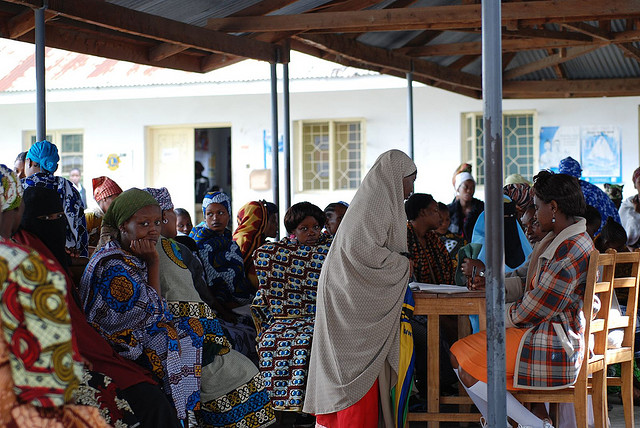
Image Credit: “Women’s Health Clinic” courtesy of flickr user advencap.