-
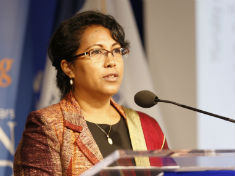
Eliane Razafimandimby: Improving the Quality of Maternal and Child Care
› “Even in a weak system without a quality improvement structure, it is possible to support district managers and facility providers to measure and improve quality care,” said Eliane Razafimandimby, Chief of Party of USAID’s flagship Maternal and Child Survival Program (MCSP) in Madagascar, at a recent Wilson Center event on improving the quality of reproductive, maternal, newborn, and child healthcare (RMNCH).
 -
Everybody Counts: Saving the World One Condom at a Time
›Can we save the world one condom (or birth control pill) at a time? The third episode of Everybody Counts, hosted by Jennifer D. Sciubba, a professor of political demography at Rhodes College, makes the case that family planning is the foundation of peace and security by highlighting the links between population growth and political instability. -
Mothers of Invention: New Podcast from Mary Robinson and Maeve Higgins
›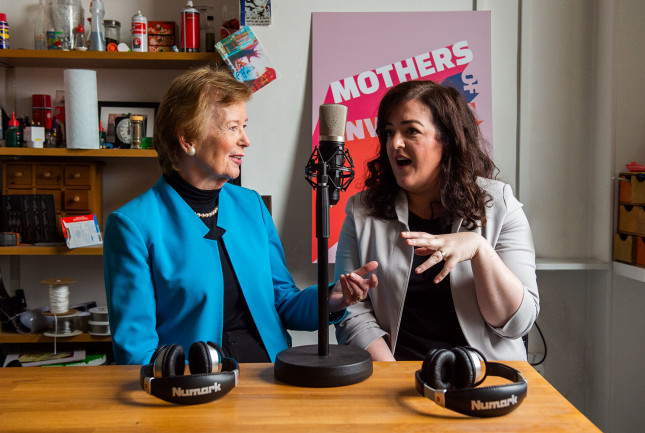
Mary Robinson, the first female president of Ireland, and Maeve Higgins, Irish comic, have teamed up to talk climate change with pioneering women leaders from around the world. In the coming weeks, their new podcast, Mothers of Invention, will feature an African politician, an Indian scientist, a Native American activist, and many more.
-
Everybody Counts: Maternal Mortality
›It’s 2018, so why are women still dying in childbirth? This episode of Everybody Counts, hosted by Jennifer D. Sciubba, a professor of political demography at Rhodes College, explores why maternal mortality is a global issue, what policy solutions can keep mothers healthy, and why valuing women is at the heart of the issue. -
Parfait Eloundou-Enyegue: Moving from Laundry Lists to Bottom Lines
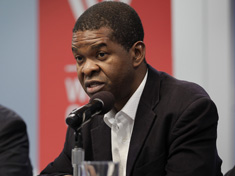
›“A lot of the advocacy of family planning has been built around establishing a long list of the many ways in which family planning can be relevant” to other development goals, says Parfait Eloundou-Enyegue of Cornell University in our latest Friday Podcast. While comprehensive accounts of the ways family planning access benefits communities, these “laundry lists” are not “clear, synthetic, or integrative,” he says. -
Franklin Moore: Fostering Local Innovation Through Community Organization
›Africare’s work has been built on a “strong belief that community mobilization and local capacity building and innovation are the cornerstones of successful development, and that, for us, includes resilience,” says Franklin Moore, Chief of Programs for Africare, in a podcast from a recent Wilson Center event. “Community engagement, capacity building, and looking at locally driven behavior and social change is what empowers communities.” -
Everybody Counts: New Podcast Series on How Global Population Trends Shape Our World
›From mass urbanization to massive refugee flows, high fertility to record low birth rates, global population is changing in unprecedented ways. “Everybody Counts,” a new podcast series hosted by Rhodes College Professor and Wilson Center Global Fellow Jennifer D. Sciubba, launches a lively and thoughtful conversation about the ways human population shapes our world and how we live today. -
Energy Innovation in Remote Arctic Communities
›Without connections to wider electrical grids, communities in the remote, rural Arctic depend on diesel generators for power—which makes electricity “ten times more expensive” than in the rest of Canada or the United States, said Martha Lenio of the World Wildlife Fund-Canada Arctic Team during a recent Wilson Center Ground Truth Briefing. In addition, spilled diesel “can harm wildlife, impact food and water security, and compromise permafrost integrity,” said Lenio. These challenges have led some communities in the Arctic to seek cheaper, safer, and more innovative energy solutions, said panelists during the briefing organized by the Wilson Center’s Polar Initiative and Canada Institute.
Showing posts from category podcast.
 “Even in a weak system without a quality improvement structure, it is possible to support district managers and facility providers to measure and improve quality care,” said
  Can we save the world one condom (or birth control pill) at a time? The third episode of
  “A lot of the advocacy of family planning has been built around establishing a long list of the many ways in which family planning can be relevant” to other development goals, says Parfait Eloundou-Enyegue of Cornell University in our latest Friday Podcast. While comprehensive accounts of the ways family planning access benefits communities, these “laundry lists” are not “clear, synthetic, or integrative,” he says.
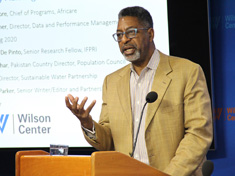 Africare’s work has been built on a “strong belief that community mobilization and local capacity building and innovation are the cornerstones of successful development, and that, for us, includes resilience,” says
  From
From