Showing posts from category podcast.
-
Tamara Kreinin on Women’s Empowerment, Population Growth, and Sustainability
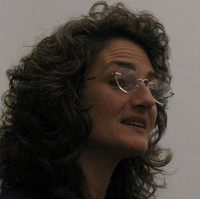
› “We know that when that when we empower women – whether it’s giving them control over their bodies and access to family planning or whether it’s by including them in planning around climate change – their agency can make huge leaps for us,” said Tamara Kreinin, executive director of women and population at the UN Foundation, in this interview with ECSP.
Seventy percent of the world’s poor are women and they’re also the members of the household most likely to be responsible for food, water, and firewood collection.
“At the same time, we know that women are often not at the table,” she said. “They’re not at the table in country when countries are creating aid to adaptation strategies around the environment and climate change, and they’re not at the table at places like Copenhagen and some of the big climate change meetings.”
The “Pop Audio” series is also available as podcasts on iTunes. -
Christian Leuprecht on Demography, Conflict, and Sub-National Security
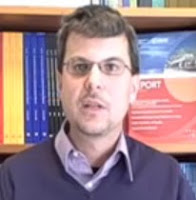
›“Demographics are going to be to the 21st century what class cleavages were to the 19th century,” said Christian Leuprecht in this conversation with the Environmental Change and Security Program. Leuprecht is an assistant professor at the Royal Military College of Canada and was one of the authors featured in ECSP Report 13.
“Specifically with regards to demography and security, the challenge that I see is at the sub-national level. That is to say that most of the conflict, if you look around the world – the intractable conflicts, the violent conflicts, the conflicts that have been dragging on for decades – tend to be at the sub-national level,” he said. “Yet much of the academic work and the way data are gathered are at the national level.”
The “Pop Audio” series offers brief clips from ECSP’s conversations with experts around the world, sharing analysis and promoting dialogue on population-related issues. Also available on iTunes. -
Barbara Crossette on UNFPA State of the World Population 2010 Report
›“Particularly when you go into a society that’s been broken by war or conflict or is so impoverished that is has nowhere to start climbing up, there have to be integrated programs and they have to work with people in mind,” said former New York Times foreign correspondent Barbara Crossette in an interview with The New Security Beat. “The people themselves will solve a lot of the problems around them if they’re just given the tools to do so.”
Crossette is one of the lead authors of the UN Population Fund’s latest State of the World Population Report, “From Conflict and Crisis to Renewal: Generations of Change,” set to launch this Wednesday, October 20th. She spoke to us particularly about the challenges of women around the world and the unique storytelling aspect of this year’s report.
The “Pop Audio” series offers brief clips from ECSP’s conversations with experts around the world, sharing analysis and promoting dialogue on population-related issues. Also available on iTunes. -
Laurie Mazur at SEJ 2010 on ‘A Pivotal Moment: Population, Justice, and the Environmental Challenge’
›“Right now, half the world’s population – some 3 billion people – are under the age of 25,” began Laurie Mazur on the “Population, Climate, and Consumption” panel at the Society for Environmental Journalists 20th Annual Conference. “It’s the largest generation ever that’s coming of age, and the choices that those young men and women make about childbearing will determine whether world population…grows to anywhere between 8 and 11 billion by the middle of this century.”
“The good news is that everything we need to do to slow population growth is something we should be doing anyway,” she continued. Mazur is the author of A Pivotal Moment: Population, Justice, and the Environmental Challenge and director of the Population Justice Project.
She was joined on the panel by Brian O’Neill, who spoke about a new study examining the impact of demographics on carbon emissions, and Jack Liu, who spoke about the impact of household size on emissions in China.
The “Pop Audio” series offers brief clips from ECSP’s conversations with experts around the world, sharing analysis and promoting dialogue on population-related issues. Also available on iTunes. -
Nicholas Kristof on Maternal Health Challenges and Opportunities
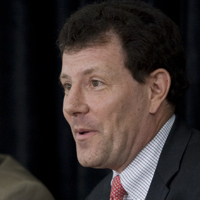
›After a Wilson Center Global Health Initiative event last year, New York Times columnist Nicholas Kristof spoke with ECSP Director Geoff Dabelko about the importance of maternal health issues and what can be done about it.
“You just know that if men had uteruses and were dying at this rate, every country would have a Minister of Paternal Mortality, the Security Council would be meeting…this would be a real international priority,” said Kristof. “It just should not happen that one woman dies a minute for reproducing.” He recently revisited this topic with a column titled, “Birth Control Over Baldness.”
The “Pop Audio” series offers brief clips from ECSP’s conversations with experts around the world, sharing analysis and promoting dialogue on population-related issues. Also available on iTunes. -
Jon Barnett on Climate Change, Small Island States, and Migration
›Contrary to the iconic image of lapping waves submerging low-lying countries, few Pacific islanders are emigrating from their homes due to climate change, according to Australian geographer Jon Barnett of the University of Melbourne.
-
Alex Evans on Resource Scarcity and Global Consumption
›“Why should we be concerned with scarcity issues?” asks New York University’s Alex Evans. Beyond general population growth, there is also an expanding global middle class that is shifting to more Western diets and consuming more energy, he explains. The net result is that demand for food, water, oil, and land is outpacing supply. These scarcity issues should be grouped together, argues Evans, because you can’t address one without affecting the others.
The “Pop Audio” series offers brief clips from ECSP’s conversations with experts around the world, sharing analysis and promoting dialogue on population-related issues. Also available on iTunes. -
Joseph Speidel on Population, the Environment, and Growth
›“If we could do something about unintended pregnancies – which are about 80 million a year – we could dramatically reduce population growth,” and reduce pressure on the environment, says Joseph Speidel in this short analysis from the Environmental Change and Security Program. Speidel discusses the connections between population, health, and environment issues, and offers solutions for the way forward.
The “Pop Audio” series offers brief clips from ECSP’s conversations with experts around the world, sharing analysis and promoting dialogue on population-related issues. Also available on iTunes.