

-
Global Cooperation for the Environment: Policy, Technology, and Community Action
›From the Wilson Center // June 9, 2020 // By Elizabeth M.H. Newbury, Alex Long, Metis Meloche & Magdalena Baranowska
“50 years ago, 20 million young people protested about the damage to our Earth. Over the past 5 decades, a lot has happened. Our ozone layer is healing, renewable energy is booming worldwide, environmental awareness has never been higher. But some risks are even more acute than before,” said Denis Hayes, coordinator of the first Earth Day and founder of Earth Day Network, in a video message at a recent Wilson Center event commemorating the 50th Earth Day.
-
Brewing Biogas in the United States and China
›
Marmite, a popular food spread developed from yeast at the Burton on Trent brewery in west-central England, is a by-product of brewing beer. The sticky brown food paste adopted the marketing slogan “love it or hate it,” hinting that its strong flavor is an acquired taste. For centuries, Burton on Trent brewed beer, but it has now gained another valuable brewing by-product in addition to Marmite—methane biogas. In 2008, the brewery built an anaerobic digester that converts the beer waste to methane, which is then burned to heat boilers to make beer.
-
How to Create a Successful Cross-Sectoral Collaboration
›It helps to think of collaboration as a skill to develop, rather than a value to impart, said Francesca Gino, Professor and Unit Head of Negotiation, Organization and Markets at Harvard Business School, at a recent Wilson Center virtual event on the importance of cross-sectoral collaboration. Many organizations make collaboration one of their values, she said. However, this has no substantial effect. “It could be a first step, but on its own it doesn’t create a culture where all of a sudden people are collaborating effectively,” Gino said.
-
How to Think and Work Politically to Reach Biodiversity Conservation Goals
›“You might know what to do,” said Rachel Kleinfeld, a Senior Fellow for Democracy, Conflict, and Governance Program at the Carnegie Endowment for International Peace. “But if you don’t think about how to do it, your reform isn’t going to move forward.” She spoke at a recent Wilson Center virtual event on how to think and work politically while supporting biodiversity conservation goals. It may sound counterintuitive, she said, but undertaking what’s considered the best intervention may not be the best approach.
-
Improve Biodiversity Conservation, Enhance Public Health and Food Security
›Our collective development objectives will not be achieved if they come at the expense of biodiversity and natural resource management, said Jeff Haeni, Acting Deputy Assistant Administrator in the Bureau for Economic Growth, Education, and Environment at USAID. He spoke at a recent Wilson Center virtual event, co-hosted with USAID, that explored the links between conservation and public health with examples from USAID’s BRIDGE project, which aims to build the evidence base for integrating biodiversity conservation considerations into policy discussions and decision-making across sectors. “The ability of societies around the world to develop and thrive is dependent on the health of the forests, fisheries, and natural systems around them,” he said.
-
A Plague of Ravenous Locusts Descends on East Africa, Jeopardizes Food Security
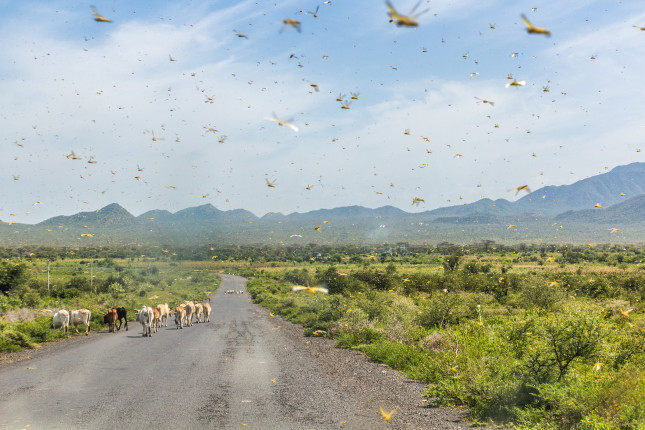
›May 18, 2020 // By Wania YadWeeks before most of the world began to take the spread of COVID-19 seriously, Africa was already threatened by another plague, the biggest locust outbreak in the last 70 years. Locusts swarmed into Ethiopia, Kenya, Somalia, Uganda, and South Sudan in January and February this year. Those hordes of voracious locusts laid eggs, and now the second wave, 20 times the size of the first group, is arriving. According to Locust Watch, “The current situation in East Africa remains extremely alarming as more swarms form and mature in northern and central Kenya, southern Ethiopia, and probably in Somalia.”
-
Fair Trade Seeks a Foothold in Artisanal Gold Mining
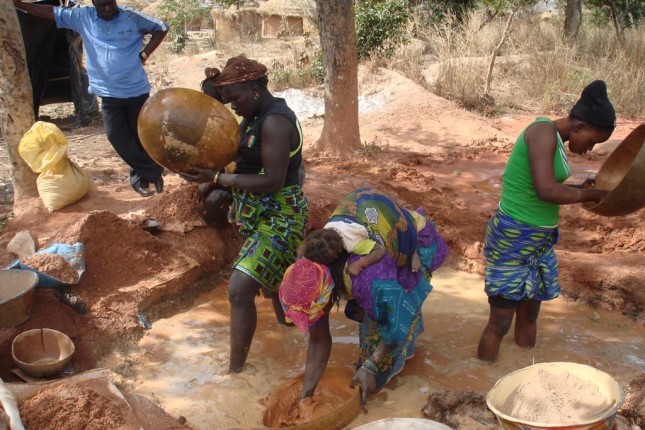
›COVID-19 isn’t the only problem going viral. Economic insecurity is driving gold prices to record highs around $1,700 per ounce, causing levels of global mercury pollution to rise too. In the United States coal-fired power plants drive mercury pollution, but globally, the leading cause is small-scale ‘artisanal’ gold mining. Roughly 30 million men, women, and children in poor countries depend on mining for subsistence incomes. Unfortunately, the cheapest and easiest way to mine gold uses mercury, a highly toxic heavy metal the United Nations is striving to eliminate.
-
Flying High: Q&A with Birding Beijing’s Terry Townshend
›On March 20, the lawsuit filed by the three organizations successfully blocked the construction of the Jiasajiang I Hydropower Station in Yunnan Province, meaning that at least for now, these long-legged endangered birds are safe. This environmental victory for China’s birds builds on the designation of some of China’s Migratory Bird Sanctuaries along the coast of the Yellow Sea-Bohai Gulf as UNESCO World Heritage sites in July 2019, with more planned in the next two to three years. However, these highpoints in avian protection do not negate the fact that nearly 40 percent of China’s endemic birds are listed as threatened and require greater protection.
Showing posts from category environment.

 On
On 

