• woodrow wilson center
  • ecsp

New Security Beat

Subscribe:
  • rss
  • mail-to
  • Who We Are
  • Topics
    • Population
    • Environment
    • Security
    • Health
    • Development
  • Columns
    • China Environment Forum
    • Choke Point
    • Dot-Mom
    • Friday Podcasts
    • Navigating the Poles
    • Reading Radar
  • Multimedia
    • Water Stories (Podcast Series)
    • Backdraft (Podcast Series)
    • Tracking the Energy Titans (Interactive)
  • Films
    • Water, Conflict, and Peacebuilding (Animated Short)
    • Paving the Way (Ethiopia)
    • Broken Landscape (India)
    • Scaling the Mountain (Nepal)
    • Healthy People, Healthy Environment (Tanzania)
  • Publications
  • Events
  • Contact Us

NewSecurityBeat

The blog of the Wilson Center's Environmental Change and Security Program
Showing posts from category environment.
  • Thinking Outside the (Lunch) Box: Meat and Family Planning

    ›
    May 3, 2010  //  By Dan Asin
    Joel Cohen, a renowned population expert and professor at Columbia and Rockefeller universities, recently gave a lecture simply titled “Meat.” As it was co-sponsored by the International Food Policy Research Institute and the Population Reference Bureau, I was hoping for an insightful discussion of meat eating and its implications for feeding a world of nine billion. While I think Cohen avoided the question of whether meat eating is ultimately sustainable, I was pleased that he included two key insights: the potential for family planning services to contribute to food security, and the importance of using multidisciplinary approaches to solve today’s global problems.

    Family Planning for Food Security

    In working to improve food security, Cohen said policymakers and practitioners need to focus on those who are most vulnerable. To this end, he identified five groups and suggested targeted policies for each:

    While the healthy eating policies will not surprise food security experts, his recommendations on family planning might. He highlighted what should be–but is not always–apparent: that tackling food security without thought for family planning is like attempting to fill an empty bucket without first plugging the holes.

    Feeding the one billion hungry people in the world today is an enormous challenge that cannot be met by any single policy. Instead, it will take an array of partial solutions, and offering family planning services to women and young people is an important part of the package. Such projects can help reduce the number of children being born into hunger by allowing women and couples to assess their economic and food situations and plan according to their needs and wishes. Voluntary family planning services and materials will not solve the food security challenge on their own, but they can make it more manageable, especially in the long run.

    Family planning’s potential contribution to food security is just one part of Cohen’s larger take-home message: population, economics, environment, and culture all interact. To meet today’s multidisciplinary challenges, single-sector approaches are not up to task.

    The Many Faces of Meat

    Cohen offered two competing perspectives on meat eating. On the one hand, average global meat production generates a fraction of the calories and protein, per unit of land, that could be derived from plant sources. It is likely the “largest sectoral source of water pollution,” said Cohen, and is at least partly responsible for the spread of over a dozen zoonotic diseases. It contributes to only 1.4 percent of world GDP while comprising 8 percent of world water consumption.

    These hidden “virtual water” costs made headlines in Britain the other week, when a study on global water security published by the Royal Academy of Engineering popularized the Water Footprint Network’s earlier findings that that an average kilogram of beef requires 15,500 liters of water–over eight times the volume needed to produce the equivalent weight in soybeans and greater than 10 times that needed for the equivalent amount of wheat.

    On the other hand, Cohen pointed out that meat production provides livelihoods for an estimated 987 million of the world’s rural poor, and has important cultural significance in many societies. And it can provide many essential nutrients, even in small doses.

    In one study he cited, children living in Kenya who were provided 1 ounce of meat a day received 50 percent of their daily protein requirements and showed greater increases in physical activity and development, verbal and arithmetic test scores, and initiative and leadership behaviors as opposed to students who received the calorie-equivalent in milk or fat.

    The Four Factors: Population, Economics, Environment, and Culture

    Clearly, Cohen’s four factors all come in to play when evaluating meat’s role in food security. An analysis of any global health issue that looks at only one factor would miss indispensable parts of the problem.

    “Population interacts with economics, environment, and culture,” Cohen concluded. “If you use that checklist when somebody gives you a simple-minded solution to a problem, you can save yourself a lot of simple-minded thinking.”

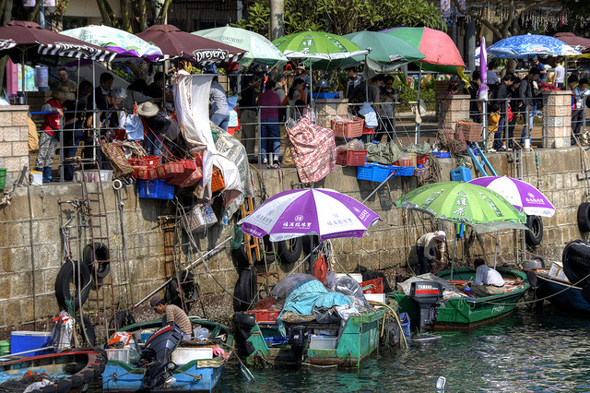
    Photo: Pigs on a farm, courtesy Flickr user visionshare.
    MORE
  • Paul Collier Discusses the Plundering of the Planet at the World Bank

    ›
    April 27, 2010  //  By Dan Asin
    “Nature is something that is both vulnerable and valued,” Paul Collier said yesterday at the World Bank. “It is being mismanaged…what it has turned into is a series of environmental battles between environmentalists and economists.”

    Collier was giving the first public presentation of of his new book, The Plundered Planet: Why We Must—and How We Can—Manage Nature for Global Prosperity. In it, he asserts that disputes between environmentalists and economists often arise from a fundamental misunderstanding on both sides about the unique qualities and purposes of “natural assets.” This misunderstanding, he says, has created a state of natural plunder. In Plundered Planet, Collier elucidates the ethical and economic considerations for the proper management of natural assets, how a greater understanding of natural assets and better environmental management can be achieved, and lessons for development.

    Paul Collier will be joining ECSP for an in-depth discussion of Plundered Planet, economics, and development at the Wilson Center in June. Until then, for a more detailed look, check out the New Security Beat’s previous coverage of Collier’s book preview with Nancy Birdsall, president of the Center for Global Development, at the U.S. Institute of Peace.
    MORE
  • Cassie Gardener

    Integrating Population, Health, and Environment in Ethiopia’s Bale Mountains

    ›
    Beat on the Ground  //  April 14, 2010  //  By Cassie Gardener
    Ethiopia suffers from vast deforestation, rapid population growth, and high rates of maternal mortality. But development programs that address these issues in an integrated fashion may help end that suffering. As part of my two-month internship with the PHE-Ethiopia Consortium, I recently visited the Movement for Ecological and Community Action (MELCA) Project in the rural Bale Zone of southeastern Ethiopia to witness these programs in action.

    Ethiopia’s Spectacular Bale Mountains

    The little-known Bale Mountains are national and global treasures of biodiversity, teeming with dozens of endemic mammal, bird, and plant species. Ethiopia’s most important region for migrating birds, the rivers and streams in the Bale watershed flow to more than 12 million people in southern Ethiopia and western Somalia. Bale Mountains National Park hosts half of the world’s population of its rarest canid, the Ethiopian wolf, which has dwindled to a mere 250 individuals due to human interaction. When I toured the park, I was lucky enough to spot bushbucks, mountain nyalas, molerats, and several Ethiopian wolves.

    As in many parts of the country, rural communities around the park face grave livelihood and health challenges, and their unsustainable use of land to eke out a living is threatening its conservation efforts. Due to diminishing agricultural land and an average total fertility rate of 6.2 children per mother in the region, people are increasingly forced to cut trees for fuel and timber in order to feed and house their families.

    If Bale’s resources continue to be exploited in an unsustainable way, more mammal species would become extinct here than in any other area of equivalent size in the world. Even worse, MELCA Project Manager Tesfaye Teshome told me that if deforestation and impending climate change dry up Bale’s precious watershed, drought and famine could lead to the displacement or death of millions of Ethiopian citizens.

    Raising PHE Awareness in the Community

    Since 2005, MELCA, a member organization of the PHE-Ethiopia Consortium, has been working to protect biodiversity and culture in the Bale region through research, advocacy, and their award-winning youth environmental education program called SEGNI, or “Social Empowerment through Group and Nature Interaction.” In March 2008, with funding from Engender Health and the Packard Foundation, MELCA launched an integrated population, health and environment (PHE) project that provides culturally sensitive training at the community, school, and government levels.

    I was impressed that after just seven months of raising awareness, I met dozens of community members and key stakeholders who strongly believe in both the conceptual and operational benefits of PHE integration. For example, the Health Extension Workers and beneficiaries explained to me that community members in the Bale region, most of whom are conservative Muslims, held negative perception of family planning, which contributed to the area’s large family sizes and maternal mortality. But by involving Islamic community leaders in the project’s discussions, MELCA helped convince religious leaders that family planning is an important part of improving the health and livelihoods of the community.

    “After the PHE training, we have improved awareness of population, family planning, health and environmental issues, and we understand that child spacing is better. Even my wife is now using family planning services, and as a result our lives are improved,” said Shihase, a religious leader in the community.

    Join the Club: PHE Goes to School

    Inspired by training sessions at schools, the SEGNI nature clubs, women’s clubs, and anti-AIDS clubs joined together to form new “PHE Clubs.” With the support of MELCA, PHE Club students plant indigenous tree seedlings in school nurseries for distribution to the community. They also create dramas, songs, poems, and illustrated storyboards about population, health, and environment issues, and use modest “mini-media” equipment such as a stereos and microphones to share these stories with their peers and other community members.

    When I arrived at Finchaa Banoo Elementary School, hundreds of students greeted me with a PHE song, wearing traditional costumes with PHE banners strewn across their chests. They led me to their nursery site where they had planted 60,000 indigenous tree seedlings. A beautifully decorated cultural hut was filled with 10 PHE storyboard panels, painted by a local PHE-trained artist.

    Fatiye, a 21-year old PHE club leader in 8th grade, proudly told me, “Before the coming of PHE, I’d been working only on SEGNI and knew only about biodiversity and culture. But now, I clearly understand health and population issues, including HIV/AIDS, taught to me by my peers. By having the integration of clubs, we’ve strengthened our power to accomplish more.”

    Working Together to Save Time and Improve Health

    MELCA’s PHE trainings also helped government officials and development workers who had previously operated in isolated sectors to integrate their work at the planning and implementation levels. Health Extension Workers and experts from the Agricultural and Rural Development Office said that collaboration is beneficial to them and the community, because it saves time and accomplishes greater results. Shankore, one of the Health Extension Workers, told me that integrating efforts across sectors allows them to help more households adopt both family planning and better sanitation, by more consistently and efficiently delivering services at the same time.

    And their efforts are paying off: “Previously, we were giving birth just like chickens, our forest coverage was diminishing, and we were damaging our resources. We had cattle in our homes, and our children had health problems. Now, we understand how to improve these issues,” Khasim Sheka, a male member of the community, told me. “Health Extension Workers are teaching us about cleaning our home gardens and homes, and we separate our house from our cattle, liquid, and solid waste. My wife wasn’t using any family planning before, and now she’s using five-year Norplant.”

    Although MELCA’s PHE project is still in its early stages, it appears capable of being scaled up with a little investment in additional training and by building the capacity of its staff and community members. In particular, the reproductive health component of the project needs to be strengthened, since Health Extension Workers are not trained on simple long-term family planning methods like IUDs, and are afraid they will lose clients if they continue to have to refer them to the distant health clinic.

    With these improvements, MELCA could more successfully implement the integrated PHE approach, which will not only reduce the impact of population growth and deforestation on Bale Mountain Natural Park, but will improve the health and livelihoods of its neighbors, and ultimately protect its biodiversity for Ethiopia and the global community.

    For more information about PHE-Ethiopia, please contact phe-ethiopia@gmail.com or visit their website at http://www.phe-ethiopia.org. For more information about MELCA, please contact melca@ethionet.et or visit their website at http://www.melca-ethiopia.org.

    Cassie Gardener was the National Campus Organizer for the Sierra Club’s Global Population and Environment Program from 2006-2010, and is currently traveling around the world and volunteering for integrated health and development programs like PHE-Ethiopia and GoJoven prior to beginning her Masters in Public Health Program at UCLA in the fall.

    Photo Credits: Morgennenbel034_31a, courtesy of flickr user Agoetzke Practitioners, courtesy of Cassie Gardener.
    MORE
  • Watch: Jennifer Dabbs Sciubba on Bringing Demography Into the Classroom

    ›
    April 7, 2010  //  By Julien Katchinoff
    “You can’t just mention [population] in passing…If you’re going to talk about it, [students] will probably be interested in it, and you have to give it a really serious treatment,” cautioned Jennifer Sciubba, Mellon Environmental Fellow and professor at Rhodes College, during a panel discussion on science and policy in the classroom at the 2010 International Studies Association Conference.

    Drawing on her experience as a practitioner of population studies, both within the Beltway and in the classroom, Sciubba shared techniques for bridging the gaps that exist between the study of political science and issues of population and environment. “I don’t think there’s that much of a difference between policy makers and students in some ways. They want to know the solutions, and they want you to break it down for them,” she said.

    Bringing demography into the classroom should not start with population, recommended Sciubba. Rather, population and environment should be thought of as elements that shape and facilitate understanding of each topic covered in International Relations theory, from issues of conflict, war, and cooperation, to economics and development.

    “It’s possible,” she concluded, “to put these things in any course–they’re part of the discipline. If we go back to some of the roots of international relations, this is how people thought of it to begin with and it’s very interesting to get back to that.”

    Jennifer Sciubba is the author of a forthcoming book on demography and security, The Future Faces of War: Population and National Security, Praeger International Security Press, 2010
    MORE
  • Population, Health, and Environment

    ›
    Reading Radar  //  April 6, 2010  //  By Wilson Center Staff
    The WWF and Equilibrium Research released a report on the interplay between the environment and human health. Vital Sites: The Contribution of Protected Areas to Human Health documents the environmental-human health connection, provides case studies from both the developed and developing worlds, and offers recommendations to enhance the health outcomes that can be gained from environmental good governance. “[P]rotected areas are not a luxury but are key sites to protect not only biodiversity, but also ecosystem services and our wider well-being,” the World Bank’s Kathy MacKinnon writes in the foreword.

    “Family Planning and the Environment: Connected Through Human and Community Well-Being,” part of PATH‘s Outlook series, details the importance of family planning-environmental projects to communities living in remote and ecologically vulnerable areas. Designed for practitioners, the article aims to promote cross-discipline dialogue and offers case studies from the Philippines and Uganda. The article concludes that “more collaborative family planning and environmental efforts aimed at reducing inequities would better ensure sustainable community development as well as the right of individuals to achieve what they value.”
    MORE
  • To Invest in a Sustainable Future, Fund Voluntary Family Planning

    ›
    Guest Contributor  //  April 6, 2010  //  By Rebecca Wadler
    President Obama’s proposed federal budget for FY2011 includes $715.7 million for international family planning and reproductive health assistance—10 percent ($67 million) more than what was included in the FY2010 budget that Congress approved last December. If approved, the FY2011 allocation would be 54 percent more than the FY2008 budget, which was equivalent to the amount allotted in 1974 when adjusted for inflation. The recent increases mark the end of more than 30 years of stagnation in U.S. funding for voluntary family planning—and herald a new investment in a sustainable future.

    Over the last 20 years, the number of women of reproductive age in the developing world has increased by 465 million. Today, the Guttmacher Institute estimates that 201 million women in developing countries want but lack access to modern contraceptives. “Satisfying the unmet need for contraceptive services in developing countries would avert 52 million unintended pregnancies annually, which, in turn, would save more than 1.5 million lives and prevent 505,000 children from losing their mothers,” the Institute reports.

    Rapid population growth in some of the world’s most economically disadvantaged countries poses a significant threat to their natural resources and the environment. Currently, more than 1 billion people live in ecological hotspots—areas that are both rich in plant and animal diversity and highly threatened by human activity. Although these areas comprise just 12 percent of the Earth’s land surface, they hold nearly 20 percent of the global population and possess a population growth rate nearly 40 percent greater than the world average. The cumulative impact of a growing global population, which demands more natural resources and exacerbates already unsustainable patterns of consumption, degrades the most basic foundations of life—air, water, croplands, forests, and fisheries—and contributes to climate change.

    Improving access to voluntary family planning not only contributes to smaller, healthier families, but also eases the strain on natural resources. By giving couples the information and supplies to plan the number and timing of their children, U.S.-funded population and reproductive health programs have helped countries slow population growth and reduce population pressures on finite natural resources, including local habitats and wildlife. In addition, the success of USAID’s population, health, and environment programs also offers important lessons for climate change adaptation and building resilience in local communities.

    In our interconnected environment, the impacts of natural resources use, management, and protection around the world are felt here in the United States. Despite the difficult budgetary and economic environment our country faces, the president’s request for approximately $716 million in international family planning and reproductive health assistance funding is a wise long-term investment. These resources are an important step toward the broader goal of investing $1 billion in these critical programs to create a healthier, more sustainable future for our world.

    Rebecca Wadler Lase is the program associate for the Sustainability Education Program at the Izaak Walton League of America.

    Map: “Poverty-Biodiversity Mapping Applications.” Courtesy UNEP/Grid Arendal.
    MORE
  • Visualizing Natural Resources, Population, and Conflict

    ›
    Eye On  //  March 4, 2010  //  By Julia Griffin
    Environmental problems that amplify regional security issues are often multifaceted, especially across national boundaries. Obtaining a comprehensive understanding of the natural resource, energy, and security issues facing a region is not fast or easy.

    Fortunately, the Environment and Security Initiative (ENVSEC) has created highly informative, easy-to-understand maps depicting environmental, health, population, and security issues in critical regions.

    Published with assistance from the United Nations GRID-Arendal, these maps offer policymakers and the public a snapshot of the complex topography of environmental security hotspots in Central Asia, Eastern Europe, Southeastern Europe, and the Southern Caucasus.

    Some that caught our eye:

    • Environmental Issues in the Northern Caspian Sea: Overlaying environmental areas and energy production zones, this map finds hydrocarbon pollution in sturgeon spawning grounds, seal habitats in oil and gas fields, and energy production centers and waste disposal sites in flood zones.

    • Water Withdrawal and Availability in the Aral Sea Basin: Simple and direct, this combination map and graph contrasts water usage with availability in Turkmenistan, Uzbekistan, and Kazakhstan—which stand in stark comparison to the excess water resources of Tajikistan and Kyrgyzstan.

    • Environment and Security Issues in Belarus: In addition to noting the parts of the country with poor water quality and potassium mining, the map also delineates wildfires that occurred in areas contaminated by the Chernobyl explosion, thus threatening downwind populations.

    Maps: Illustrations courtesy of the Environment & Security Initiative.
    MORE
  • Video—Ken Conca: ‘Green Planet Blues: Four Decades of Global Environmental Politics’

    ›
    February 19, 2010  //  By Julia Griffin
    “Much of the conversation about the global environment, frankly, is an elite conversation,” says Ken Conca, professor of government and politics at the University of Maryland. “But at the same time there are community-level voices, there are voices of indigenous people, there are voices of the powerless, as well as the powerful…. I think it’s important to capture them and not just limit [the conversation] to the most easily accessible voices.”

    Conca and co-editor Geoff Dabelko include these oft-muted voices in the newly released 4th edition of Green Planet Blues: Four Decades of Global Environmental Politics. “One of the things we were really trying to achieve was to give people a sense of the history,” said Conca. To fully understand the origins of today’s debates, students must go back to the beginning of the last four decades of international environmental politics.

    Three key paradigms—sustainability, environmental security, and ecological justice—frame the debates in Green Planet Blues. “Ideas do matter,” says Conca. “They really do change the world, and one of the premises of our work and of the book is to try to understand what sorts of ideas people bring to the table when they think of global environmental problems.”
    MORE
Newer Posts   Older Posts
View full site

Join the Conversation

  • RSS
  • subscribe
  • facebook
  • G+
  • twitter
  • iTunes
  • podomatic
  • youtube
Tweets by NewSecurityBeat

Trending Stories

  • unfccclogo1
  • Pop at COP: Population and Family Planning at the UN Climate Negotiations

Featured Media

Backdraft Podcast

play Backdraft
Podcasts

More »

What You're Saying

  • Volunteers,At,The,Lagos,Food,Bank,Initiative,Outreach,To,Ikotun, Pan-African Response to COVID-19: New Forms of Environmental Peacebuilding Emerge
    Rashida Salifu: Great piece 👍🏾 Africa as a continent has suffered this unfortunate pandemic.But it has also...
  • A desert road near Kuqa An Unholy Trinity: Xinjiang’s Unhealthy Relationship With Coal, Water, and the Quest for Development
    Ismail: It is more historically accurate to refer to Xinjiang as East Turkistan.
  • shutterstock_1779654803 Leverage COVID-19 Data Collection Networks for Environmental Peacebuilding
    Carsten Pran: Thanks for reading! It will be interesting to see how society adapts to droves of new information in...

What We’re Reading

  • Rising rates of food instability in Latin America threaten women and Venezuelan migrants
  • Treetop sensors help Indonesia eavesdrop on forests to cut logging
  • 'Seat at the table': Women's land rights seen as key to climate fight
  • A Surprise in Africa: Air Pollution Falls as Economies Rise
  • Himalayan glacier disaster highlights climate change risks
More »
  • woodrow
  • ecsp
  • RSS Feed
  • YouTube
  • Twitter
  • Facebook
  • Home
  • Who We Are
  • Publications
  • Events
  • Wilson Center
  • Contact Us
  • Print Friendly Page

© Copyright 2007-2021. Environmental Change and Security Program.

Woodrow Wilson International Center for Scholars. All rights reserved.

Developed by Vico Rock Media

Environmental Change and Security Program

Woodrow Wilson International Center for Scholars

Ronald Reagan Building and International Trade Center

  • One Woodrow Wilson Plaza
  • 1300 Pennsylvania Ave., NW
  • Washington, DC 20004-3027

T 202-691-4000