• woodrow wilson center
  • ecsp

New Security Beat

Subscribe:
  • rss
  • mail-to
  • Who We Are
  • Topics
    • Population
    • Environment
    • Security
    • Health
    • Development
  • Columns
    • China Environment Forum
    • Choke Point
    • Dot-Mom
    • Friday Podcasts
    • Navigating the Poles
    • Reading Radar
  • Multimedia
    • Water Stories (Podcast Series)
    • Backdraft (Podcast Series)
    • Tracking the Energy Titans (Interactive)
  • Films
    • Water, Conflict, and Peacebuilding (Animated Short)
    • Paving the Way (Ethiopia)
    • Broken Landscape (India)
    • Scaling the Mountain (Nepal)
    • Healthy People, Healthy Environment (Tanzania)
  • Publications
  • Events
  • Contact Us

NewSecurityBeat

The blog of the Wilson Center's Environmental Change and Security Program
Showing posts from category environment.
  • Managing the Planet: The World at Seven Billion

    ›
    From the Wilson Center  //  December 14, 2012  //  By Carolyn Lamere

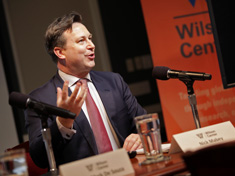
    Population growth “is highly concentrated in what are today the poorest and least well-governed areas of the world,” said George Mason University professor Jack Goldstone at the Wilson Center on December 5.

    Goldstone was joined by Suzanne Ehlers, president and CEO of Population Action International (PAI), and Matthew Erdman, population-health-environment technical advisor at USAID, to discuss the implications of seven billion people and counting for the environment as part of the joint Wilson Center-George Mason University Managing the Planet series. [Video Below]

    MORE
  • Autumn Spanne, The Daily Climate

    Colombia’s Unexplored Cloud Forests Besieged by Climate Change, Development

    ›
    December 13, 2012  //  By Wilson Center Staff

    The original version of this article, by Autumn Spanne, appeared on The Daily Climate.

    Five hours by truck and mule from the nearest town, a rumbling generator cuts through the silent night to power large spotlights as botanists crouch and kneel on large blue tarps spread across a cow pasture. It’s nearly midnight, and the team works urgently to describe every detail of the dozens of colorful orchids, ferns, and other exotic plants they have collected that day in Las Orquídeas National Park, one of the single most biologically diverse places on the planet.

    MORE
  • Climate Change’s Impact on Human Development

    ›
    Reading Radar  //  December 13, 2012  //  By Carolyn Lamere

    One of the greatest challenges in addressing climate change is the uncertainty of outcomes. The world is warming and greenhouse gases are accumulating at an unprecedented rate – what does that mean for the future of human development? In Barry B. Hughes, Mohammod T. Irfan, Jonathan D. Moyer, Dale S. Rothman, and José R. Solórzano’s paper, “Exploring Future Impacts of Environmental Constraints on Human Development,” they describe three possible futures for the world (a base line scenario, an environmental challenge scenario, and an environmental disaster scenario) and their potential impact on the indicators of the Human Development Index (HDI). The environmental disaster projection features a flat-lining HDI starting around 2015, with global life expectancy at birth seven years shorter than the baseline in 2060. The report also notes that the future of the planet will be drastically different if the world population peaks “well before 2100,” as is the case in the base line scenario, or continues to grow, as it does in the other scenarios.

    MORE
  • National Intelligence Council Releases ‘Global Trends 2030’: Prominent Roles Predicted for Demographic and Environmental Trends

    ›
    December 11, 2012  //  By Schuyler Null & Kate Diamond

    “We are at a critical juncture in human history, which could lead to widely contrasting futures,” writes the chairman of the National Intelligence Council (NIC) Christopher Kojm in the council’s latest forward-looking quadrennial report, Global Trends 2030: Alternative Worlds, released yesterday.

    This year, principal author Mathew Burrows and his colleagues focus on a series of plausible global scenarios for the next 20 years and the trends or disruptions that may influence which play out. Among the most important factors in these projections are demography and the environment.

    MORE
  • World Bank Issues Dire Warning About “Four Degree World”

    ›
    December 10, 2012  //  By Carolyn Lamere

    Without decisive action, global temperatures could rise by at least four degrees Celsius (seven degrees Fahrenheit) by the end of the century. A new World Bank report says that such a world would be “so different from the current one” that it would be difficult to even anticipate the challenges we would face.

    MORE
  • ‘The Christian Science Monitor’ Explores the Global Water Crisis: Should We Charge More for Water?

    ›
    On the Beat  //  December 6, 2012  //  By Schuyler Null

    “There is as much of that water on the planet today as when the first amphibian flopped ashore; as much as when the ancient Greeks divined the future in the babble of brooks,” writes William Wheeler in The Christian Science Monitor. “So why do experts in science, economics, and development warn that a ‘global water crisis’ threatens the stability of nations and the health of billions?”

    MORE
  • Water Scarcity, Agriculture, and Energy Are Focus of ‘Choke Point: China Part II’

    ›
    Choke Point  //  December 5, 2012  //  By Carolyn Lamere

    With the start of part two of Circle of Blue and the China Environment Forum’s Choke Point: China series, the focus has broadened from looking more narrowly at water scarcity and energy to including the effects of food security and pollution in China too.

    “From an environmental point of view,” said Circle of Blue Senior Editor Keith Schneider, the question is, “can a nation that big, operating at such a scale maintain its sustainability?”

    MORE
  • The Land Matrix Visualizes Ebbs and Flows of Global “Land Grabs”

    ›
    Eye On  //  December 4, 2012  //  By Carolyn Lamere

    Over the past few years, large-scale acquisition of land by foreign or domestic firms, be they public or private, have been making headlines. But although these “land grabs” have received a great deal of attention, their details remain largely unknown. Which countries are the primary investors? Which are the main targets? What is the land used for?

    MORE
Newer Posts   Older Posts
View full site

Join the Conversation

  • RSS
  • subscribe
  • facebook
  • G+
  • twitter
  • iTunes
  • podomatic
  • youtube
Tweets by NewSecurityBeat

Trending Stories

  • unfccclogo1
  • Pop at COP: Population and Family Planning at the UN Climate Negotiations

Featured Media

Backdraft Podcast

play Backdraft
Podcasts

More »

What You're Saying

  • Volunteers,At,The,Lagos,Food,Bank,Initiative,Outreach,To,Ikotun, Pan-African Response to COVID-19: New Forms of Environmental Peacebuilding Emerge
    Rashida Salifu: Great piece 👍🏾 Africa as a continent has suffered this unfortunate pandemic.But it has also...
  • A desert road near Kuqa An Unholy Trinity: Xinjiang’s Unhealthy Relationship With Coal, Water, and the Quest for Development
    Ismail: It is more historically accurate to refer to Xinjiang as East Turkistan.
  • shutterstock_1779654803 Leverage COVID-19 Data Collection Networks for Environmental Peacebuilding
    Carsten Pran: Thanks for reading! It will be interesting to see how society adapts to droves of new information in...

What We’re Reading

  • Rising rates of food instability in Latin America threaten women and Venezuelan migrants
  • Treetop sensors help Indonesia eavesdrop on forests to cut logging
  • 'Seat at the table': Women's land rights seen as key to climate fight
  • A Surprise in Africa: Air Pollution Falls as Economies Rise
  • Himalayan glacier disaster highlights climate change risks
More »
  • woodrow
  • ecsp
  • RSS Feed
  • YouTube
  • Twitter
  • Facebook
  • Home
  • Who We Are
  • Publications
  • Events
  • Wilson Center
  • Contact Us
  • Print Friendly Page

© Copyright 2007-2021. Environmental Change and Security Program.

Woodrow Wilson International Center for Scholars. All rights reserved.

Developed by Vico Rock Media

Environmental Change and Security Program

Woodrow Wilson International Center for Scholars

Ronald Reagan Building and International Trade Center

  • One Woodrow Wilson Plaza
  • 1300 Pennsylvania Ave., NW
  • Washington, DC 20004-3027

T 202-691-4000