-
Ruth Greenspan Bell, Bloomberg News
Global Warming Experts Should Think More About the Cold War
›January 2, 2013 // By Wilson Center Staff
The original version of this article, by Ruth Greenspan Bell, appeared on Bloomberg News.
Every year the United Nations convenes diplomats from more than 190 nations to negotiate a climate change treaty, and in many years negotiators go home with little more than the promise of another annual meeting.
-
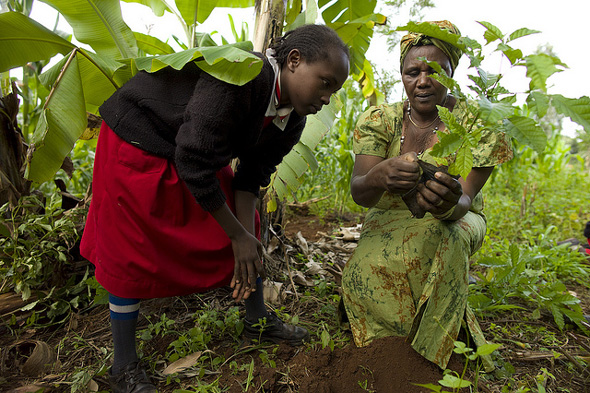
Beyond Carbon Credits: TIST Combines Reforestation, Health, and Livelihood Efforts
›
Carbon offsets have fallen in and out of favor since they were established with the Kyoto Protocol in 1997. Critics say they allow wealthy organizations to placate consumers and claim their products are “green” without making any real, lasting changes. But, if the scheme works properly, some action is supposed to be taken somewhere, so what is it like at one of these credit-producing organizations?
-
World Bank Issues Dire Warning About “Four Degree World”
›December 10, 2012 // By Carolyn LamereWithout decisive action, global temperatures could rise by at least four degrees Celsius (seven degrees Fahrenheit) by the end of the century. A new World Bank report says that such a world would be “so different from the current one” that it would be difficult to even anticipate the challenges we would face.
-
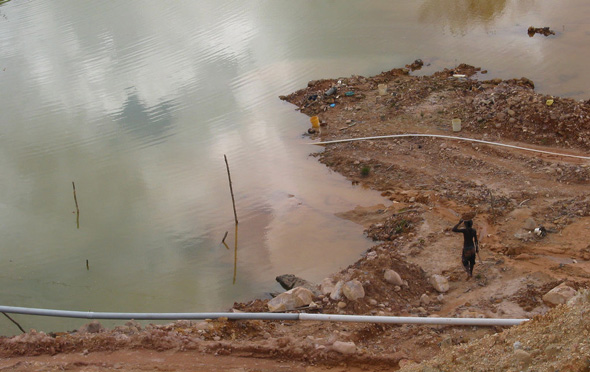
Artisanal Gold Mining Threatens Riverine Communities in Guyana
›August 14, 2012 // By Keenan Dillard“Sometimes we make sure that we catch enough rainwater to use or we would have to search out the creeks to for water clean enough to drink,” said Guyanese villager Fabian George in a June interview with the United Nations University. The negative effects of a mining boom fueled by surging gold prices have become so widespread in the small South American country, which is about the size of Idaho, that the government has temporarily stopped issuing new gold and diamond mining permits.
The ban, which was announced on July 6 and is still in effect, will last until officials are able to complete a review “of the current management/oversight arrangement of river and tributary mining.” A statement released by the Guyanese Ministry of Natural Resources and Environment explained that “damage caused by increasingly irresponsible mining in Guyana’s rivers and tributaries,” has been a cause of major concern for citizens who depend on them to survive.
Guyana, a former colony of both the Netherlands and the United Kingdom, has a population that is predominantly split between people of African and East Indian descent who were recruited as indentured servants for the tea industry during the 19th century. Amerindians – indigenous Guyanese people – made up just nine percent of the population, as of the most recent census in 2002. A vast majority of Guyanese (71.5 percent) live in rural villages, most of which are located near the coastline. The remaining population resides in the capital, Georgetown, or one of four other urban centers.
While mining is responsible for just nine percent of the country’s GDP, it accounts for almost 60 percent of exports. Gold, bauxite (the precursor to aluminum), and diamonds are extracted and exported to countries including the United States, Canada, and the United Kingdom. In 2011 Guyana produced 363,000 ounces of gold, which represents a 23 percent increase since 2009 and can be attributed “to consistently active mining by small- and medium-scale miners that benefited from the continued increase in gold prices on the international market,” according to the U.S. Geological Survey. The Communities and Small Mining Initiative reports that more than 15 percent of Guyanese citizens economically depend on small-scale mining to support themselves.
Dredging the Jungle
These small-scale operations, also known as artisanal mines, generally employ rudimentary methods to extract and process minerals, as opposed to large scale industrial operations. As of 2011 there were less than 10 industrial-scale companies with any sort of presence in Guyana, while the number of licensed artisanal miners is more than 14,000, according to the government. Although the latter usually consists of just a few workers, they are also incredibly environmentally destructive.
The methods used most by artisanal miners in Guyana begin in one of two ways, according to the Blacksmith Institute: either large water hoses are used to quickly erode a plot of land or barges are used to dredge up sediment from the bottom of a river. Then, they “combine mercury with gold-laden silt to form a hardened amalgam that has picked up most of the gold metal from the silt. The amalgam is later heated with blow torches or over an open flame to evaporate the mercury, leaving small gold pieces.”
The environmental impacts of artisanal mining in Guyana are well-documented and include “drastic increases in the sediment content of river water, increased levels of mercury in river water, creation of artificial sandbars in rivers, deforestation and degradation of land fertility, and mosquito infestation and malaria,” according to a Harvard Human Rights Program study.
A report issued by the Guyanese Ministry of Natural Resources and the Environment last month noted that current environmental problems associated with mining operations include, “widening of the river channel[s] and weakening of soil at river banks resulting in toppling of trees into the river course, blockages and changes to the main river channels resulting in un-navigable channels in the dry seasons.” High levels of turbidity, which is a measure of water clarity, have resulted in the deaths of some fish species that serve as a primary food source for riverine Guyanese communities.
The health of Guyanese rivers and streams is of particular concern to the Amerindians who make up the majority of the population in Guyana’s hinterlands where most artisanal mining occurs. The Harvard Human Rights Program report points out that indigenous people, most of whom survive on subsistence agriculture, are disproportionately affected due to their dependence on waterways for food, transportation, communication, and sanitation.
Adapting to a “Changing World”
Over the past few months the environmental, social, and health effects caused by gold mining in Guyana has become serious enough to warrant a temporary governmental halt to the issuance of any new licenses. In the meantime, scientists employed by the Guyana Geology and Mines Commission are attempting to find a viable alternative to using mercury – the most damaging practice of artisanal miners – amid increasing pressure from the international community. In addition to polluting waterways and contaminating fish, mercury releases highly toxic vapors when it is burned away from gold, which can damage both internal organs and unborn children.
Damages from the run-away mining sector aren’t limited to the environment. The Amerindian Peoples’ Association in Guyana blames increases in prostitution, drug trafficking, and human trafficking on the country’s gold rush. According to the UN, “interior police investigated nearly 50 bush murders last year, about 40 more than normal, many from fights over gold and women or from drunken rum sprees by miners on time off.” Unlicensed mines and illegal aliens who cross the border from Brazil, compounded with a large smuggling operation that bypasses Guyanese gold taxes via Suriname, have left the government struggling to “enforce regulations, hire enough trained jungle mines inspectors, qualified geologists and other personnel to keep pace, and generally maintain order,” according to the UN.
On July 28, the Guyana Geology and Mines Commission issued a statement regarding the future of mining, and stressed the need to create a “holistic plan to have the industry adapt to a changing world.” For now it seems that complaints from Amerindian groups and other Guyanese citizens are the driving force in affecting change within the country, but opposition from interest groups such as the Guyana Gold and Diamond Miners Association is intense. The government has acknowledged international pressure too as a factor in its decision to suspend new permits and recently began a partnership with the United Nations Development Programme to develop a natural resource management plan. It remains to be seen exactly what measures will be taken to address the serious problems facing the Guyanese people as a result of gold mining, but given the strong economic imperative for artisanal miners and the severity of environmental and human health effects, action must be taken soon.
Keenan Dillard is a cadet at the United States Military Academy at West Point and an intern with the Woodrow Wilson Center’s Environmental Change and Security Program.
Sources: Amerindian Peoples Association, Blacksmith Institute, Bureau of Statistics (Guyana), Center for International Forestry Research, Central Intelligence Agency, Communities and Small-Scale Mining, The Daily Herald, Demerara Waves, Environmental Protection Agency, Guyana News and Information, Harvard Law School, Inter Press Service, Ministry of Natural Resources and the Environment (Guyana), National Communications Network (Guyana), Stabroek News, United Nations, U.S. Geological Survey, USAID.
Photo Credit: “Gold Mine (Mahdia, Guyana),” courtesy of flickr user caribbeanfreephoto (Georgia Popplewell). -
Pop at Rio+20: Reproductive Rights Missing From Outcome Document – Assessing the Disappointment
›June 22, 2012 // By Sandeep BathalaAs heads of state get ready to sign on to the outcome document here in Rio, all eyes are on next steps – especially for the reproductive health and integrated development communities, which have seen their hopes of mainstreaming their issues with the sustainable development agenda dashed.
The final outcome document can be found here. USA Today reports that opposition from a group of countries in the 11th hour stripped the text of critical reproductive rights language:An initial draft of this conference’s outcome document stated, “We are committed to ensure the equal access of women and girls to education, basic services, economic opportunities, and health care services, including addressing women’s sexual and reproductive health and their reproductive rights.”
Absent entirely is any explicit connection between reproductive rights, population dynamics, and sustainable development.
In the final draft, the stronger wording “We are committed to ensure the equal access” was switched to the weaker “We are committed to promote the equal access.” The reference to reproductive rights was deleted altogether, after opposition from the G-77, a negotiating bloc of developing countries at the United Nations, and the Holy See.
But others, as we have heard repeatedly throughout the conference, insist that gender issues and reproductive rights have a strong and vital connection to sustainable development. Yesterday, USAID, the Aspen Institute, and the Center for Environment and Population held a discussion in the U.S. tent on this very issue, titled “Making Population Matter: The Demographic Dividend and Sustainable Development.”
As Vicky Markham of the Center for Environment and Population reports on RH Reality Check, the side-event aimed to demonstrate the effects of population dynamics, both positive and negative:We have the largest youth demographic ever in the history of the world, and most developing nations have a “youth bulge.” This can be seen as a challenge, or opportunity, particularly if the focus is on providing development programs for child survival, family planning, reproductive health, and education. The importance of women’s empowerment was also central. But it’s not a given; it’s an opportunity only if we pay attention to these issues to increase the benefits of the “demographic dividend.”
The demographic dividend, as described by USAID Deputy Administrator and panelist Donald Steinberg in blog post earlier this week, “is an opportunity that arises when a country transitions from high to low rates of fertility and child and infant mortality.” But it’s not just about ensuring access to family planning and reproductive health; youth-focused economic and education policies are also needed: “Maximizing the dividend requires social and economic policies that reinforce inclusion, equity, and opportunity across the entire population,” he writes. USAID is making a point of creating youth-focused policies for this reason, he said in Rio.
Carmen Barroso, regional director of the International Planned Parenthood Federation’s Western Hemisphere Region, pointed out that Latin American countries could not take advantage of the demographic dividend before recent societal changes occurred, including decreased fertility, increased urbanization (which leads to smaller families), and greater schooling and employment of women.
Seventy percent of world population growth is likely to be generated by Africa this century, said Eliya Msiyaphazi Zulu, executive director of the African Institute for Development Policy – and it is the only continent projected to continue to grow in the next century, he said. He called for redefining growth as more than GDP as that measure does not consider environmental degradation and its costs: “We must have other means to measure development.”
As heads of state and negotiators consider their positions at this conference – which many were hoping would make a much stronger statement – they might do well to ponder today’s comments from Secretary of State Hillary Clinton:While I am very pleased that this year’s outcome document endorses sexual and reproductive health and universal access to family planning, to reach our goals in sustainable development we also have to ensure women’s reproductive rights. Women must be empowered to make decisions about whether and when to have children. And the United States will continue to work to ensure that those rights are respected in international agreements.
Sources: RH Reality Check, UN, U.S. Department of State, USA Today, USAID.
Now none of this is an abstract discussion. There is just too much at stake, too much still to be done. And many of you visited the U.S. Center here in Rio and saw practical solutions related to some of the work I’ve discussed and other goals we hold in common. We believe solutions require action by all of us. Governments, yes; let’s do our part. Let’s do more than our part.
Photo Credit: YouthPolicy.org. -
Pop at Rio+20: Text Finalized, Population-Sustainable Development Links Left Out?
›June 21, 2012 // By Sandeep BathalaWhile I was visiting with youth peer educators yesterday with the Brazilian Society for Family Welfare in the Cachoeirinha favela (see Vicky Markam’s post for details – we were on the same trip), UN member states reached consensus in the Rio+20 negotiations. But, according to reports, although the outcome document includes some mention of reproductive health, gender equality, and women’s empowerment, it fails to explicitly recognize the link between reproductive rights and sustainable development.
Many women’s rights and health observers have, from the start, encouraged this link.
Karen Newman, speaking to ECSP in April during the Planet Under Pressure conference – a precursor to Rio – said she hoped this week would offer an opportunity to look at “sustainable development in the round” and “re-identify family planning as a core development priority,” given its human rights and health implications and relationship to population growth.
Jenny Shipley (Former Prime Minister of New Zealand) wrote just yesterday on CNN that “we are at a moment in history where we still have time to make a difference. It is essential that the global discussion in Rio not be blind to the potential solutions that access to voluntary family planning could offer to many of the world’s problems.”
“We can no longer afford this outrageous oversight, driven by old-fashioned tradition, discrimination, and pure ignorance,” said Gro Harlem Brundtland (Former Prime Minister of Norway and Former Head of the World Health Organization) at a side event on Monday. “Now is the time to agree to unleash the largest untapped potential for sustainable development and stop all discrimination against women and girls.”
But now that preliminary agreement on the outcome text has been reached, reports have filed in that the connection many were hoping for is absent. Zonibel Woods, blogging on RH Reality Check, wrote:From the start of the negotiations, gender equality and women’s human rights, including reproductive rights, have continuously been challenged by a few governments, claiming that [these] had “nothing to do with sustainable development.”
The lack of consensus among the wider international community may also undercut efforts to highlight reproductive rights in the post-2015 Millennium Development Goals/Sustainable Development Goals framework and as governments ready for the follow-on to the International Conference on Population and Development in 2014. A concrete link to “sustainable development,” whatever form that takes, would help ensure that reproductive health is not side-lined.
This debate continued until the last few hours of the negotiations. In the end, the text includes a re-affirmation of both the Cairo and Beijing agreements, but it falls short by failing to recognize that reproductive rights are also critical to the achievement of sustainable development. If a woman cannot decide if and when to have children and if she is not provided with the reproductive health care that is her human right, it is challenging to contribute to sustainable solutions for the planet.
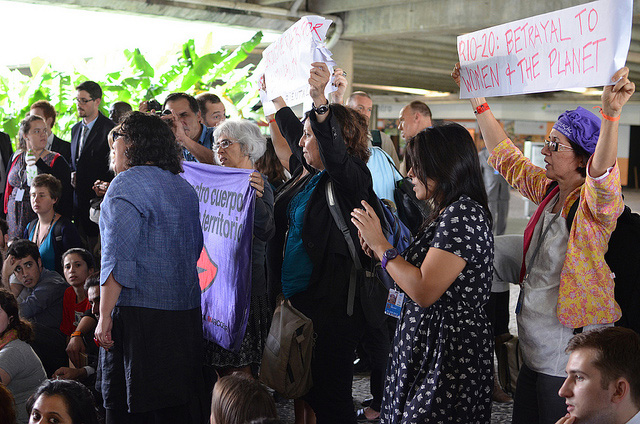
Immediately following the adoption of the text, women gathered and protested at Rio Centro, the main venue for the conference, and advocacy continues.
Heads of state will in all likelihood sign on to the outcome document by tomorrow (it could technically still be changed, but that appears unlikely). I will keep you posted on the final outcome and will be taking notes at a side-event this afternoon by USAID, the Aspen Institute, and Center for Environment and Population on the demographic dividend and sustainable development, which promises to be spirited given today’s news. You can tune in live to the webcast of that event at 2:30 EST on Ustream.
Sources: AllAfrica, Aspen Institute, CNN, IRIN, RH Reality Check, U.S. Department of State, USAID.
Photo Credit: United Nations Photo. -
Pop at Rio+20: Getting Women’s Rights on the Agenda
›June 19, 2012 // By Sandeep BathalaHere we are on my second day of side events at Rio+20 and the Aspen Institute, International Planned Parenthood Federation, and the United Nations Foundation convened a high-level moderated dialogue this morning to raise the profile of human development, gender, and reproductive health at the main conference.
Rio+20 is an unprecedented opportunity to draw attention to sustainable development and the role women’s rights and voices play in it. The Aspen/IPPF/UN Foundation event was timely as some negotiators are questioning the link between women and sustainable development in the 11th hour instead of reaffirming the commitments made 20 years ago at international conferences in Rio, Cairo, and Beijing.
High-level leaders, including Gro Harlem Brundtland (Former Prime Minister of Norway), Musimbi Kanyoro (President and Chief Executive Office of the Global Fund for Women), Tewodros Melesse (Director General of the International Planned Parenthood Federation), Mary Robinson (Former President of Ireland and President of the Mary Robinson Foundation – Climate Justice), and Tim Wirth (President of the United Nations Foundation), spoke to the role of women’s empowerment and family planning in the global discussion of sustainable development.
Some highlights from the meeting:
Brundtland noted that the next increment of economic growth could come fully from women’s empowerment. Family planning is a cross-cutting and cost-effective way to ensure this possibility.
Kanyoro further emphasized that for development organizations, women, more than any other partner, have the potential to enable sustainable growth.
Melesse discussed the role of addressing the special needs of young women. “If they are not met, we will have failed at sustainable development,” he said.
Robinson argued that family planning must be mainstreamed in international conferences, like Rio+20 and the annual UN climate COPs, as a human rights issue. Women’s issues cannot be add-ons in outcome documents – they have to be front and center. “We know what works,” she said, referring to effective reproductive health efforts and their ability to advance human rights and sustainable development
Wirth spoke passionately about the basic rules of diplomacy: do no harm and no backsliding. He remarked that hard earned gains from previous UN documents, although limited, must not be lost. They must be considered as statements from governments around the world and as resounding affirmation of the rights of women, he said.
For more, see Vicky Markham’s thoughts on the meeting at RH Reality Check too.
Stay tuned to see whether official negotiations in Rio – which start tomorrow – will heed these calls.
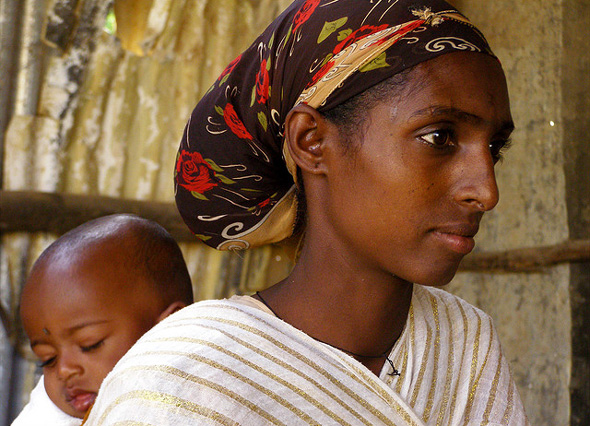
Photo Credit: “Etiopía,” courtesy of flickr user subcomandanta. -
Roger-Mark De Souza, Climate and Development Knowledge Network
Population-Climate Dynamics: From Planet Under Pressure to Rio
›May 11, 2012 // By Wilson Center StaffThe original version of this article, by Roger-Mark De Souza, appeared on the Climate and Development Knowledge Network (CDKN).
In late May, I presented research on population and climate dynamics in hotspots at the Planet Under Pressure conference in London, in a session organized by the Climate and Development Knowledge Network. As we prepare for the Rio+20 Earth Summit in June, I reflect on the roles of population dynamics and climate-compatible development for ensuring a future where we can increase the resilience of the most vulnerable to the impacts of climate change.- Improving our well-being and the future we can have is within our reach: We can take action to improve well-being through specific actions that can produce short term results. This is a key message encapsulated in the concept of climate-compatible development, reflected in many presentations and discussions that I heard at Planet Under Pressure. Even though others were not calling it “climate-compatible development,” the essence and the meaning behind the research was the same – small concrete discrete steps are possible, and taking action on population dynamics is one of them.
- Population is on the agenda: Population issues – growth, density, distribution, aging, gender – were a constant at Planet Under Pressure – and in more ways than just looking at population as a driver. It is clear that there is interest, and a need, to address population as a key component of climate-compatible development.
- But those concerns and issues must be location specific, and must be contextualized for the policy and programmatic environment: Population issues must be framed in the appropriate context – and must move beyond academic exploration. I attended one session where a paper presented an academic supposition of whether we should invest in consumption versus fertility reduction to produce short-term returns for climate, but the analysis was completely devoid of any political, policy, or programmatic truth-testing. We must factor in those considerations when making recommendations, if ultimately we are really looking to make the difference that we can.
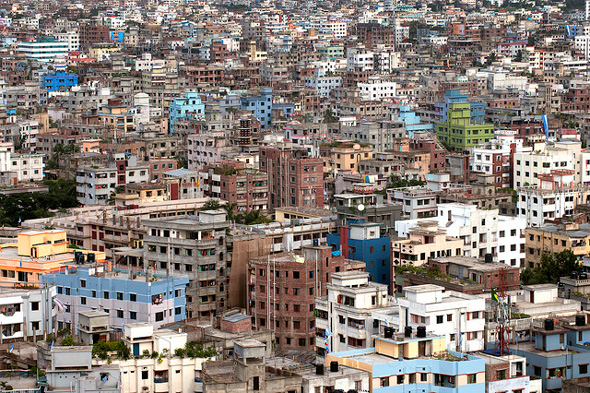
Photo Credit: “Urbanization in Asia,” courtesy of United Nations Photo.
Showing posts from category international environmental governance.