-
Uganda’s Demographic and Health Challenges Put Into Perspective With Newfound Oil Discoveries [Part One]
›April 26, 2012 // By Kate Diamond
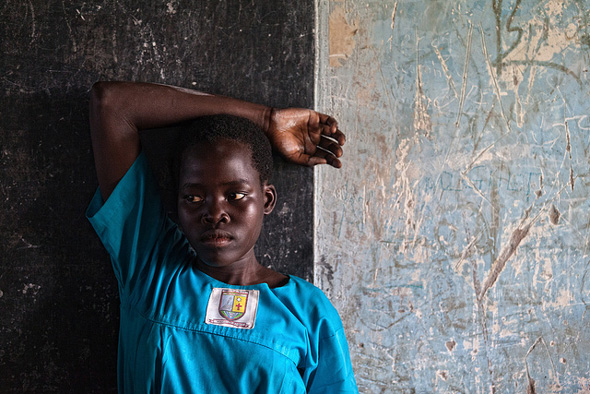
Uganda’s population is the second youngest in the world, with half of the country younger than 15.7 years old (just older than Niger’s median age of 15.5 years). In the past 10 years, the country – about half the size of France in land area – has added 10 million people, growing from 24 to 34 million. That growth, paired with other factors like poor governance and long-standing insecurity, has made providing basic services a difficult task for a government that is one of Africa’s most aid-dependent.
-
John Donnelly, Global Post
Aspen Institute on Women, Population, and Access to Safe Water
›April 24, 2012 // By Wilson Center StaffLoading the player…The original version of this article, by John Donnelly, appeared on the Global Post.
The U.S. Census Bureau’s World Clock says that the population of the world today is estimated at 7.008 billion people, while projections show that the world could reach the 9 billion marker by 2050.
In the last of its series called “7 Billion: Conversations That Matter,” Aspen Institute’s Global Health and Development hosted a panel of experts based in Africa and the United States on the interconnectedness of gender issues, family planning, population, and access to safe water.
The point of the series was to ask questions about why it mattered that the world was passing the seven billion mark, and the questions today in Washington were appropriately big: Will water wars replace oil wars? What are the solutions to expand water and sanitation to the 2.5 billion people who don’t have it? And just how many people can the world support in an equitable fashion?
An answer to the last question: You need a bigger pie, better manners, and fewer forks.
Borrowing from a book by Joel Cohen called How Many People can the Earth Support? (written in 1996 when the world supported a 5.7 billion population), Laurie Mazur, director of the Population Justice Project, said that the answer was “it depends on how we use resources.”
Continue reading on the Global Post.
Sources: U.S. Census Bureau. -
Loaded Dice and Human Health: Measuring the Impacts of Climate Change
›In a new article in the Proceedings of the National Academy of Sciences (PNAS), “Insights From Past Millennia Into Climatic Impacts on Human Health and Survival,” Anthony McMichael compares scientific literature that reconstructs past climates with epidemiological research and comes away with more than a dozen examples of the influence of climate on human health and survival. “Risks to health [as a result of climatic change] are neither widely nor fully recognized,” McMichael writes, but “weather extremes and climatic impacts on food yields, fresh water, infectious diseases, conflict, and displacement” have led to human suffering across the centuries. Some of the literature reviewed, for instance, links the Younger Dryas (a several centuries long period of cooling) to hunger in the Nile Valley between 11,000 and 12,000 years ago, climatic shifts that expanded the range of disease carrying rats and fleas to the “Black Death” during the mid-1400s, and unusually strong El Niño events to a series of late Victorian-era droughts during the late-1800s.“Climate Variability and Climate Change: The New Climate Dice,” a working paper from James Hansen, Makiko Sato, and Reto Ruedy recently submitted to PNAS, uses surface air temperature analysis from the Goddard Institute for Space Studies to examine the impact of global warming on the frequency of extreme weather events. Using measurements from 1951 to 1980 as a baseline, the study finds, first, that the planet has warmed by around half of a degree Celsius since the reference period, and second, that the global area affected by “extreme anomalies” (exceeding three standard deviations from the mean climate) has increased by a factor greater than 10. Affecting approximately 10 percent of global land surface in the last several years, these anomalies, such as the droughts and heat waves observed in Texas in 2011, Moscow in 2010, and France in 2003, “almost certainly would not have occurred in the absence of the global warming,” according to the authors.
The study uses this new evidence about the impact of climate change to update the concept of climate change as a “loading of the climate dice.” Where, the “climate of 1951-1980 [is represented] by colored dice with two sides red for ‘hot,’ two side blue for ‘cold,’ and two sides white for near average temperature,” and the dice themselves represent the chance of observing variations on mean temperature. Under this metaphor, today’s climate is best approximated by a dice with four sides red, one blue, and one white, according to the study.
As for the future, the data suggest that with just one full degree of warming, anomalies three deviations beyond the mean will be the norm, and five deviations beyond the mean will become more likely (the latest IPCC projections suggest between 1.8 and 4.0 degrees Celsius are likely). In essence, the red side of the die are not only multiplying, but becoming much more extreme. To put this into scale, the Moscow 2010 heat wave, an event that exceeded the three deviations mark, coincided with a doubling of the death rate in the Russian capital. -
In Building Resilience for a Changing World, Reproductive Health Is Key
›April 20, 2012 // By Laurie MazurChange is a constant in human (and natural) history. But today, we have entered an era in which the pace, scale, and impact of change may surpass anything our species has previously confronted.
-
‘Earth Focus’ Talks to PAI About Bringing Out Women’s Voices on Climate Change
›“We have got to build an increased desire for [and] interest in what happens outside of the United States,” said Suzanne Ehlers, CEO of Population Action International (PAI). She was joined by Vice President of Research, Roger-Mark De Souza, in an episode of Link TV’s Earth Focus, “Women and the Changing Environment,” to discuss the interconnections between women’s reproductive health and climate change.
The episode, built around PAI’s Weathering Change documentary, draws together footage from Ethiopia, Peru, and Nepal to construct messages about the role that reproductive health services can play in responding to the burden that climate change places upon women in the developing world.
“Women are at the forefront of climate change impacts [and] they are disproportionately affected by the negative impacts,” said De Souza. Empowering women by increasing access to voluntary family planning services that allow them to make choices about the timing and the spacing of their births is a way to help ensure that women have the resilience required to react to climate impacts, he continued.
“I want the American people to get out of their borders more often,” said Ehlers. “The U.S. is an unbelievable global leader on reproductive health,” but fluctuations in funding due to domestic politics have sometimes “forced closures of clinics throughout the world.” By listening to those voices that are too often marginalized in international decision making, especially women, we can build a desire for international engagement, she suggests.
“It’s got to be something that the American people see as development…how it links to diplomacy and it absolutely supports defense – that those three D’s are interchangeable,” she said. -
Megacities, Global Security, and the Map of the Future
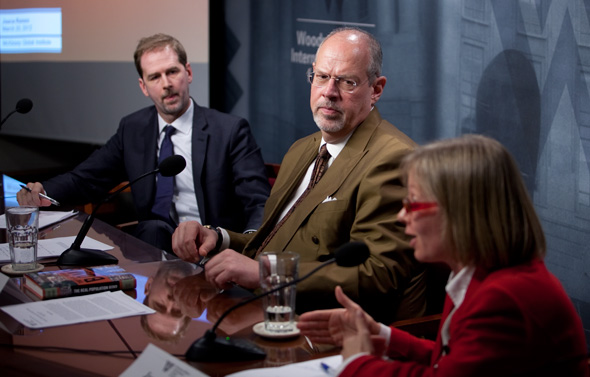
›“We’re in an urban century, there is no doubt,” said Peter H. Liotta, visiting scholar at the U.S. Military Academy West Point and co-author of The Real Population Bomb: Megacities, Global Security, and the Map of the Future, during a March 20 event at the Wilson Center. Liotta’s book focuses on the geopolitical impacts of poorly managed urbanization on the most vulnerable as well as the security issues such urbanization might create. He was joined by Jaana Remes of the McKinsey Global Institute, who painted a more promising picture of a globally rising, economically prosperous urban middle class, and Stimson Center visiting fellow Peter Engelke, who grappled with the contradictions between these alternative urban realities. [Video Below]
“Urbanization is key to economic development, but it has been, is now, and will continue to be into the future beset by a very large shadow side, wherein the marginalized face grinding poverty, squalor, and despair,” explained Engelke.
Although Liotta and Remes laid out very different “maps of the future,” Engelke suggested three commonalities. First, they both highlight the “unprecedented scale and speed of global change.” Second, they acknowledge that “a global demographic shift is well underway, and has been for some time.” And third, they accept that we have yet to fully integrate cities into the physical and mental maps by which we navigate the world, he said. Despite the economic dynamism of cities, “we live in a world that, I submit, has not yet grasped this reality even in conceptual terms, much less political and policy ones.”
The City as a Source of Vulnerability
People come to megacities “because there’s a chance,” said Liotta. “It looks like a nightmare to us, but people come because they’re waiting for a future.” This chance, however, is often slim, according to Liotta.
The sheer scale of modern urbanization (approximately 200,000 people move every day from rural to urban areas) produces myriad sources of vulnerability for the poorest and most marginalized, said Liotta. “World population growth will occur in the poorest, youngest, and often heavily Muslim states, which lack education, capital, and employment. And for the first time in history the world will be primarily urbanized, with most megacities in the poor states where you don’t have policing, sanitation, and health care.”
This urban shift concentrates young populations presumed to be unstable, exacerbates the risk of disease and climate change, and increases the threat of declining resource availability and food production, Liotta said. In states where “the lights are out” – that is, where urbanization is not met with sufficient economic development – our new urban century may feature significant security challenges, he argued. “Every single security problem we have today, and in the future – whether it’s human security, environmental security, or national security – is [in] the places where the lights are out.”
In The Real Population Bomb, Liotta links these sorts of security issues to what he terms “entangled vulnerability scenarios,” such as scarcity of water for drinking and irrigation, outbreak and rapid spread of disease, or lack of sufficient warning systems for natural disasters or environmental impacts. These scenarios, he argues, deserve a greater showing next to the traditional focus on hard security “threats.”
Fertility rates are generally declining, which will eventually dissipate the youth bulges being experienced by many countries, but the challenge is how to “manage that glide path,” said Liotta. It is about “doing it well collectively, because we are not thinking collectively well about how to do this and places in the world are in serious trouble.”
The City as a Center of Growth
Jaana Remes presented both a broader scale of analysis and a more positive outlook. Urbanization is “the most powerful positive economic force in today’s environment,” she asserted, drawing on the McKinsey Global Institute report, Urban World: Mapping the Economic Power of Cities.
Compared to the historical experiences of the Western world, change in the most rapidly urbanizing of today’s developing states is occurring at “100 times the scale, in one tenth of the time,” said Remes. This change is fundamentally shifting the economic profiles of states such as India and China, which are projected to account for approximately one third of global GDP by 2050.
This growth in economic prominence can be accounted for by the rise of urban populations of middle class consumers not just in megacities, but also in the rapidly growing “middleweight” cities (from 200,000 to 10 million people) explained Remes. The path that these cities take will be “very significant for…how our world is going to look like in the next few decades,” she said. They are where “the lion’s share of global investment is going to be made.”
Engaging Global Urbanization
“That we are seeing cities rise in their profile is nothing new in history,” said Remes, “in fact you can argue that cities are actually some of the longest-lasting assets in the world.” Today, 600 urban centers generate more than 60 percent of global GDP; 400 of these are in emerging markets. So, “even though the scale of the change we expect to see is very dramatic, from the cities perspective, it is probably going to be more evolution than revolution.”
Taking advantage of this growth will require some significant global re-posturing. In terms of commercial diplomacy for instance, most nations continue to distribute their people more according to the “geopolitical power of the 20th century than the economic opportunity of the 21st,” said Remes. She points out, for example, that the city of Wuhan in China is expected to generate 10 times the GDP growth of Auckland, New Zealand, yet the number of foreign service officials stationed in each city is in the opposite proportion.
Policymakers looking to adapt should also look more closely at opportunities to re-develop existing, or “brownfield,” infrastructure. The challenge of accommodating the tremendous pace of urbanization may be great, she said, but “we have not yet seen one piece of infrastructure where you can’t make substantial improvements.”
Summing up the need to work on what he argued has been a shortfall in policy engagement, Engelke concluded that, “we are indeed quite a ways from acknowledging the enormous challenges, but also the opportunities, that global urbanization presents to us.”
Event ResourcesSources: UN Population Division.
Photo Credit: David Hawxhurst/Wilson Center. -
Yemen: Revisiting Demography After the Arab Spring
›April 17, 2012 // By Elizabeth Leahy MadsenAlong with other countries where the Arab Spring caught hold, Yemen has been gripped by major upheaval over the past year. Although President Ali Abdullah Saleh finally ceded power in February after his administration’s violent reprisals failed to deter protesters, the country remains at a crossroads. As its political future continues to evolve, the new government must also address a range of deep-seated economic and social challenges. In addition to claiming more than 2,000 lives, the crisis has undermined Yemenis’ livelihoods and even their access to food. A recent World Food Program survey found that more than one-fifth of Yemen’s population is living in conditions of “severe food insecurity” – double the rate measured three years ago – and another fifth is facing moderate difficulty in feeding themselves and their families.
-
Invest in Women’s Health to Improve Sub-Saharan African Food Security, Says PRB
›“Future food needs depend on our investments in women and girls, and particularly their reproductive health,” says the Population Reference Bureau’s Jason Bremner in a short video on population growth and food security (above). Understanding why, where, and how quickly populations are growing, and responding to that growth with integrated programming that addresses needs across development sectors, are crucial steps towards a food secure future, he says.
Reducing Food Insecurity by Meeting Unmet Needs
In sub-Saharan Africa, where nearly one-fourth of the population lives with some degree of food insecurity, persistently high fertility rates help drive population growth, according to the policy brief that accompanies Bremner’s video.
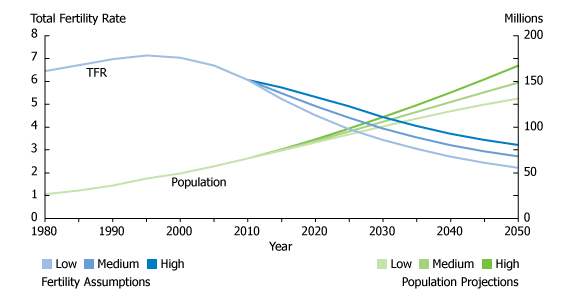
On average, women in the region have 5.1 children, more than twice the global average total fertility rate (TFR) of 2.5. The United Nation’s medium-variant projections (which Bremner notes are often used to predict future food need) show the region more than doubling in size by 2050, but that projection rests on the assumption that the average TFR will drop to three by mid-century.
As many as two-thirds of sub-Saharan African women want to space or limit their births, but do not use modern contraception. While the reasons for not using modern contraception are many, ranging from cultural to logistical, the lack of funding for family planning and reproductive health services remains a serious impediment to improving contraceptive prevalence and, in turn, lowering fertility rates.
“Current levels of funding for family planning and reproductive health from donors and African governments fail to meet current needs, much less the future needs,” writes Bremner.
Almost 40 percent of the region’s population is younger than 15 years old and has “yet to enter their reproductive years,” writes Bremner. “Consequently, the reproductive choices of today’s young people will greatly influence future population size and food needs in the region.”Fertility Assumptions and Population Projections in the Democratic Republic of Congo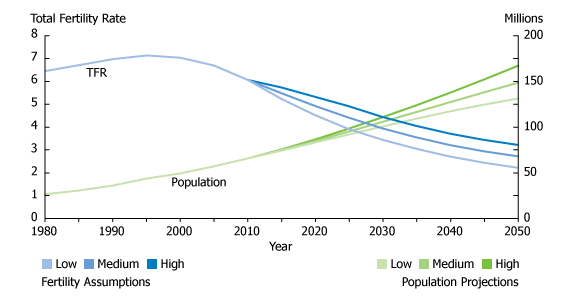
Family Planning Is One Piece of an Integrated Puzzle
Increasing funding for family planning services would be a boon to the region, but Bremner cautions that viewing sub-Saharan Africa’s rapid population growth solely from a health perspective and in isolation from other development needs would be inherently limiting.
“Slowing population growth through voluntary family planning programs demands stronger support from a variety of development sectors, including finance, agriculture, water, and the environment,” Bremner writes. A multi-sector approach that addresses population, health, livelihood, and environment challenges could mitigate future food insecurity more effectively than single-track programming that addresses sub-Saharan Africa’s various development needs in isolation from one another.
Improving women’s role in agriculture, for example, could help minimize food insecurity on a regional scale, Bremner writes. Women make up, on average, half the agricultural labor force in sub-Saharan Africa, and yet it is more difficult for them to own arable land, obtain loans, and afford basic essentials like fertilizer that can help boost agricultural productivity. Furthermore, women’s traditional household responsibilities, like fetching water, often cut into the amount of time they are able to give to farming. With those limitations lifted, women could offer enormous capacity for meeting future food needs.
Given the complex and interconnected nature of the development challenges facing sub-Saharan Africa, integrated cross-sector programming, with an emphasis on meeting family planning needs, is essential to reducing total fertility rates while improving food security over the long-term, according to Bremner.
“Investments in women’s agriculture, education, and health are critical to improving food security in sub-Saharan Africa,” he writes.
“Improving access to family planning is a critical piece of fulfilling future food needs,” he adds, “and food security and nutrition advocates must add their voices to support investments in women and girls and voluntary family planning as essential complements to agriculture and food policy solutions.”
Sources: Population Reference Bureau.
Video Credit: Population Reference Bureau.
Showing posts from category global health.