

-
‘DotPop:’ Copenhagen’s Collapse: An Opportunity for Population?
›December 22, 2009 // By Gib ClarkeWhile the negotiators failed to reach a comprehensive agreement in Copenhagen, the population and reproductive health community might find a silver lining in the stormclouds that derailed COP-15.
Developing countries’ strong protests of their lack of culpability for the climate problem, on one hand, and the dramatic examples of their vulnerability on the other, have focused the world on the problems of poor people—and on potential solutions, including family planning.
The Case of the Missing “P”
The New York Times’ Andrew Revkin complained that population was the “The Missing ‘P’ Word in Climate Talks,” but PAI’s Kathleen Mogelgaard argues in New Security Beat that “there is encouraging evidence that voices of those advocating for increased attention to the role of population and reproductive health and rights in climate change responses are being heard” in Copenhagen, including new funding from the Danish government for family planning.
At a breakfast last week, luminaries including Gro Harlem Brundtland and IPCC Chairman Rajendra K. Pachauri discussed UNFPA’s latest report, Facing a Changing World: Women, Population and Climate in Copenhagen.
According to lead author Robert Engelman, the report is “helping many more people to see population and climate in a more hopeful light, linked as they are through the right of women to equal standing with men and access to reproductive health care for all.”
Women, Population, and Climate
“Climate change is ultimately about people,” declared Congresswoman Carolyn Maloney at the recent Washington, DC, launch of the report. Though the issues are complex and multi-faceted, Engelman said that the report’s message is “stark and optimistic”: that “women in charge of their own lives” can have positive impacts on change climate mitigation and adaptation.
“Women are more sustainable consumers,” said UNFPA’s José Manuel Guzmán at the launch, noting that in many cases women make buying decisions for their families, so empowering them with information and tools is a wise approach to combating climate change.
Inequitable Impacts
Women – especially poor women – contribute fewer greenhouse gas emissions than men, yet are more vulnerable to the impacts of climate change. Unfortunately, this fundamental inequality is difficult to quantify, since most data sources are not disaggregated by gender. The report recommends improving data quality to better informing policy decisions.
Tim Wirth, president of the UN Foundation and the Better World Fund, noted that women face a “double whammy”: they are already less likely to go to school and to have access to paying livelihoods, and more likely to have HIV. Climate change will only increase the inequity.
People Power
PAI’s Karen Hardee called on the population community to focus their efforts on the next phase of negotiations – adaptation. A recent PAI report found that while 37 of 41 National Adaptation Plans of Action say that population pressures exacerbate the effects of climate change, only six include slowing population growth or addressing reproductive health and family planning as a key priority.
“The focus has been on where and what the impacts of climate change will be,” said Guzman, but the conversation needs to shift to who will be affected, and an analysis of their vulnerabilities and their capacities to adapt.
For real progress to occur, said Engelman, “climate needs to be seen through a more human lens.” -
Integrating HIV/AIDS and Maternal Health Services
›
Integrating maternal health and HIV/AIDS services “includes organizing and providing services that meet several needs simultaneously…focusing not only on the condition, but also the individual,” argued Dr. Claudes Kamenga, Senior Director of Technical Support and Research Utilization at Family Health International, during the first event of the Advancing Policy Dialogue on Maternal Health series co-convened by the Wilson Center’s Global Health Initiative, Maternal Health Task Force (MHTF), United Nations Population Fund (UNFPA), and technical support from U.S. Agency for International Development (USAID). Joined by Michele Moloney-Kitts, assistant coordinator at the Office of the U.S. Global AIDS Coordinator, and Harriet Birungi, a program associate with the Population Council in Kenya, the panelists discussed how integration of HIV/AIDS and maternal health services not only improves health outcomes, but also increases program efficiencies, strengthens health systems, and saves money.
-
VIDEO – Integrating Population, Health, and Environment (PHE) in Ethiopia
›December 4, 2009 // By Sean Peoples“Incorporating environment, population, and health is a timely issue. Unless we focus on integrated approaches, our Ethiopian Millennium Development Goals cannot be achieved,” says Negash Teklu, executive director of the Consortium for Integration of Population, Health, and Environment (CIPHE), in this short video.
I interviewed Teklu and three other members of CIPHE in Yirgalem, Ethiopia, where they spoke of the importance of PHE integration; why it is vital to involve the community in development projects; and practical steps for implementing integration at the grassroots level.
Everyone agrees that Ethiopia faces serious challenges. Much of the economy is based on agriculture, but drought is all too common, and the land is exacerbated by continual overuse. High rates of population growth coupled with limited resources and uncertain crop yields leaves many people vulnerable to hunger and malnutrition. In addition, the country’s health system struggles to provide comprehensive care.
To combat these interconnected problems, the members of CIPHE truly believe that an integrated PHE approach that uses multi-sectoral interventions will best serve the needs of their fellow Ethiopians.
“If we follow the integrated PHE approach, economically we can be beneficial,” Mogues Worku of LEM Ethiopia told me. “We can share a lot of resources among the different sectoral organizations. At the same time with limited resources we can attain our goal by integrating the different sectoral offices and organizations, even at the grassroots level.”
This video will be the first of many on population, health, and environment problems and solutions in Ethiopia. Subscribe to our ECSP YouTube channel or the New Security Beat blog to see the latest videos. -
Start With A Girl: A New Agenda For Global Health
›November 16, 2009 // By Calyn OstrowskiThe Center for Global Development’s latest report, Start With A Girl: A New Agenda For Global Health, sheds light on the risks of ignoring the health of adolescent girls. Like other reports in the Girls Count series, it links broad social outcomes with adolescent health. “Adolescence is a critical juncture for girls. What happens to a girl’s health during adolescence determines her future–and that of her family, community, and country,” state coauthors Miriam Temin and Ruth Levine.
Between childhood and pregnancy, adolescent girls are largely ignored by the public health sector. At the same time, programs and policies aimed at youth do not necessarily meet the specific needs of girls. Understanding the social forces that shape girls’ lives is imperative to improving their health.
Like recent books by Michelle Goldberg and Nicholas Kristof, the report argues for increased investment in girls’ education to break down the social and economic barriers that prevent adolescent girls from reaching their full potential. Improving adolescent girls’ health will require addressing gender inequality, discrimination, poverty, and gender-based violence.
“For many girls in developing countries, well-being is compromised by poor education, violence, and abuse,” say Temin and Levin. “Girls must overcome a panoply of barriers, from restrictions of their movement to taboos about discussion of sexuality to lack of autonomy.” The report points to innovative government and NGO programs that have successfully changed negative social norms, such as female genital cutting and child marriage. However, the authors urge researchers to examine the cost-effectiveness and scalability of these programs.
In the last five years, the international community has become increasingly aware of the importance of youth to social and economic development. Some new programs are focused on investing in adolescent girls, such as the World Bank’s Adolescent Girls Initiative and the White House Council on Women and Girls, but significant additional investment and support is needed.
“Big changes for girls’ health require big actions by national governments supported by bilateral and multilateral donor partners, international NGOs…civil society and committed leaders in the private sector,” maintain Temin and Levin. They offer eight recommendations:
1. Implement a comprehensive health agenda for adolescent girls in at least three countries by working with countries that demonstrate national leadership on adolescent girls.
2. Eliminate marriage for girls younger than 18.
3. Place adolescent girls at the center of international and national action and investment on maternal health.
4. Focus HIV prevention on adolescent girls.
5. Make health-systems strengthening and monitoring work for girls.
6. Make secondary school completion a priority for adolescent girls.
7. Create an innovation fund for girls’ health.
8. Increase donor support for adolescent girls’ health.
“We estimate that a complete set of interventions, including health services and community and school-based efforts, would cost about $1 per day,” say the authors of Start With a Girl. There is no doubt in my mind that this small investment would indeed have a high return for the entire global community. -
Traffic Jam: Gender, Labor, Migration, and Trafficking in Dubai
›November 16, 2009 // By Calyn Ostrowski“All trafficking is not sex trafficking,” argued Woodrow Wilson Center Fellow Pardis Mahdavi, at a recent Middle East Program event. Drawing on her ethnographic research in the United Arab Emirates, Mahdavi analyzed the policy implications of the latest Trafficking in Persons (TIP) report by the United Nations Office on Drugs and Crime. The TIP report offers information on modern day slavery–human trafficking–and includes comprehensive data on policies and enforcement in 155 countries and territories.
The TIP report paradoxically hurts the people it tries to protect, claimed Mahdavi, by placing too much emphasis on sex trafficking and failing to take into consideration other types of abuse, such as those against men and migrant labor workers. Mahdavi pushed for a “breakthrough of the labeling and politicizing of sex traffickers as women and children,” which depicts women as passive and helpless, while excluding male victims.
According to Mahdavi, in Dubai, 80 percent of the population are migrant laborers. Often, these foreign workers do not trust the government to protect them against trafficking abuses, particularly if they are working in the host country illegally. Thus, civil society organizations, and not the state government, serve as the major source of protection and recourse for abused migrant workers. In the Persian Gulf region, Mahdavi argued that the “TIP report needs to be rewritten…to include increased labor inspectors and police training,” and called for the increased “accountability and transparency” of civil society organizations.
Mahdavi cautioned countries against using the TIP report to enact policies that make migration illegal. Tightening borders forces workers into the informal economy, she maintained, where it becomes difficult to track and protect these individuals.
Although the TIP report has weaknesses, it does pressure countries to act, as Mahdavi has witnessed in the United Arab Emirates, where it has provided opportunities for dialogue on the various aspects of trafficking. -
Is the White Ribbon the New Black? Making Maternal Health Fashionable
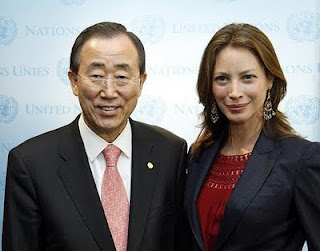
›Celebrity philanthropists such as Bono, Angelina Jolie, and George Clooney have shined their star power on global issues like AIDS, genocide, and refugees. In last month’s Vogue, supermodel Christy Turlington turned the light on one of the most overlooked problems: maternal mortality.
-
Half the Sky, All the Promise: The Personal is Political in NYT Special Issue
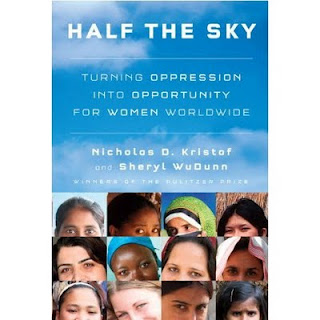
›“The world is awakening to a powerful truth: Women and girls aren’t the problem; they’re the solution,” write Nicholas Kristof and Sheryl WuDunn in the lead article of this Sunday’s The New York Times Magazine.
In this special issue devoted to “Saving the World’s Women,” five articles document global failures and personal horrors, but also offer forward-looking solutions from the individual to the institutional. As the subtitle says—“changing the lives of women and girls in the developing world can change everything”— this vital effort can help us not only improve the lives of women, but meet larger goals including international security, global health, and economic development.
In “The Women’s Crusade,” Pulitzer Prize-winners Kristof and WuDunn, whose new book Half the Sky will be published on September 8, outline the ways in which the world’s women and girls are abused, neglected, and overlooked. They use devastating data to detail how women around the world suffer from lack of education, maternal mortality, sexual violence, trafficking, and economic and political oppression, and then bring these figures to life with women’s personal stories.
They argue that elevating women is not a “soft” issue, but rather has the power to transform economies and address security threats—a point echoed in an interview with Hillary Clinton, in which she calls women and girls “a core factor in our foreign policy.”
“I happen to believe that the transformation of women’s roles is the last great impediment to universal progress,” says Clinton, long an informed and passionate advocate for global women’s issues. She encouraged President Obama to create a new ambassadorship for global women’s issues, and filled the opening with Melanne Verveer, a respected activist and former head of the Vital Voices Global Partnership.
Clinton most strongly emphasizes the connection between women’s issues and national security, calling it “an absolute link”: “If you look at where we are fighting terrorism, there is a connection to groups that are making a stand against modernity, and that is most evident in their treatment of women.” She goes so far as to agree that spending taxpayer money on education and healthcare for girls and women in Pakistan would be more effective than military aid to the country.
“A woman who is safe enough in her own life to invest in her children and see them go to school is not going to have as many children. The resource battles over water and land will be diminished,” she says. “And it’s an issue of how we take hard power and soft power, so called, and use it to advance not just American ends but, in advancing global progress, we are making the world safer for our own children.”
Also in the magazine:
The New York Times’ website adds a slide show of Katy Grannan’s portraits of women in South Asia and Africa, and launches a contest soliciting personal stories from the field. Submit your photos and blog posts to Kristof’s blog by September 19.- Dexter Filkins investigates the acid attacks on girl students in Afghanistan in the horrifyingly vivid storytelling he displayed in his best-seller, The Forever War.
- Lisa Belkin takes note of an emerging generation of female philanthropists using their money to “deliberately and systematically to aid women in need,” spurred by the Hunt sisters’ “Women Moving Millions” campaign.
- Tina Rosenberg describes how sex-selective abortion and inadequate health care for young girls has led to a “daughter deficit” in China and India, where, somewhat paradoxically, “development can worsen, not improve, traditional discrimination.”
- Africa’s first female President, Liberia’s Ellen Johnson-Sirleaf, tells NYT that if women ran the world, it would be “better, safer and more productive.”
To me, such vital voices are the most powerful, proving that the personal is political. The quotes in the lead article from academic studies, local NGO personnel, and women themselves map the way forward:- “When women command greater power, child health and nutrition improves” – Esther Duflo of MIT, on micro-finance.
- “Girls are just as good as boys” – An unidentified man who once beat his wife for not having sons, but changed his mind when a micro-loan turned her into the family breadwinner.
- “Gender inequality hurts economic growth” – Goldman Sachs, Global Economics Paper, 2008
- “I can’t talk about my children’s education when I’m not educated myself … If I educate myself, then I can educate my children” – Terarai Trent, a Zimbabwean woman now completing a PhD in the United States.
-
How Family Planning Meets Development Goals
›“Knowing is not enough; you must act and let your government know that family planning is a right and saves lives,” said Maurice Middleberg of the Global Health Council at a recent event in Chapel Hill.
The other panelists at “How Can Family Planning Efforts Help Us Achieve the Millennium Development Goals?” (Dr. Martha Carlough of UNC, Dr. Ward Cates of Family Health International, and Pape Gaye of IntraHealth International) all provided compelling statistics demonstrating the effectiveness of family planning as an intervention that addresses the Millennium Development Goals (MDGs).
MDGs 4, 5, and 6 – reducing child mortality; improving maternal health; and combating HIV/AIDS, malaria, and other diseases, respectively – all have obvious connections to health and woman’s reproductive health. An unmet need for family planning, which is measured as the percentage of women of reproductive age who desire to space or limit their births but are not using contraception, can undermine the achievement of these goals.
For example, very early motherhood not only increases the risk of dying in childbirth, it also jeopardizes the well-being of surviving mothers—and their children, too. A child born to an adolescent mother has a greater risk of dying in infancy or childhood.
“Contraception is the best-kept secret in HIV prevention,” said Dr. Cates, who cited research that found that “current contraceptive use in sub-Saharan Africa prevents an estimated 577,200 unplanned births to HIV-infected mothers” and thus prevents the birth of an estimated 173,000 HIV-infected infants each year.
Family planning can help meet the other MDGs, including ending poverty and hunger (Goal 1); providing universal primary education (Goal 2); and promoting gender equity (Goal 3). Young mothers frequently miss out on education and socio-economic opportunities. Being able to make their own decisions about family planning and reproductive health can empower women and improve gender equity. When women are given equal opportunities for education, health, and employment, they are more likely to invest in the education and care of their children. This helps them break the cycle of poverty, hunger, and disease.
Although the MDGS don’t include any formal targets for sexual and reproductive health, the UN Millennium Project has stated that the MDGs cannot be achieved in low-income countries without access to sexual and reproductive health services, including family planning. The panelists agreed that family planning is a cost-effective intervention that provides broader positive benefits for development.
But the real strength of their presentations lay in the personal stories behind the statistics. Middleberg closed the discussion with a story about a woman in Latin America who told him that she loves her husband but was afraid of him every time he touched her. Now, after having undergone sterilization, she no longer worries and can love her husband with no fear of becoming pregnant.
A mother of six interviewed in a 2009 news article about the Philippines’ new family planning bill said, “How can one keep on having children? We don’t earn enough to feed them, much less send them to school.” New York Times columnist Nicholas Kristof interviews a Haitian woman with 10 children in a dramatic video interview, “Saving Lives with Family Planning.”
Underlying all of these facts and stories is the belief that one’s health and well-being, including access to family planning, is a right. But as Middleberg said, believing is not enough.
EngenderHealth, an international reproductive health organization working to improve the quality of health care in the world’s poorest communities, is asking Americans to create a video explaining why we should care about international family planning. Contribute your thoughts on YouTube’s Video Volunteers project.
Lisa Basalla, MPH, is a research associate with the Carolina Population Center. She graduated from Case Western Reserve University with a MPH focusing on reproductive and adolescent health. She has worked with Johns Hopkins University’s Center for Communications Programs on its reproductive health knowledge management project as well as a HIV-prevention behavior change communication project in Malawi.
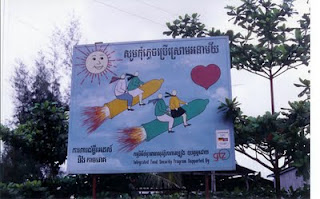
Photo: A billboard promoting family planning in Phnom Pehn, Cambodia. Courtesy flickr user olerousing.
Showing posts from category gender.
 “Knowing is not enough; you must act and let your government know that family planning is a right and saves lives,” said Maurice Middleberg of the Global Health Council at a recent

