

-
As Somalia Sinks, Neighbors Face a Fight to Stay Afloat
›May 14, 2010 // By Schuyler NullThe week before the international Istanbul conference on aid to Somalia, the UN’s embattled envoy to the country, Ahmedou Ould-Abdallah, warned the Security Council that if the global community “did not take the right action in Somalia now, the situation will, sooner or later, force us to act and at a much higher price.”
The UN High Commission for Refugees (UNHCR) also issued strong warnings this week. Deputy High Commissioner Alexander Aleinikoff said in Geneva, “The displacement crisis is worsening with the deterioration of the situation inside Somalia and we need to prepare fast for new and possibly large-scale displacement.”
But the danger is not limited to Somalia. The war-torn country’s cascading set of problems – criminal, health, humanitarian, food, and environmental – threaten to spill over into neighboring countries.
A Horrendous Humanitarian Crisis
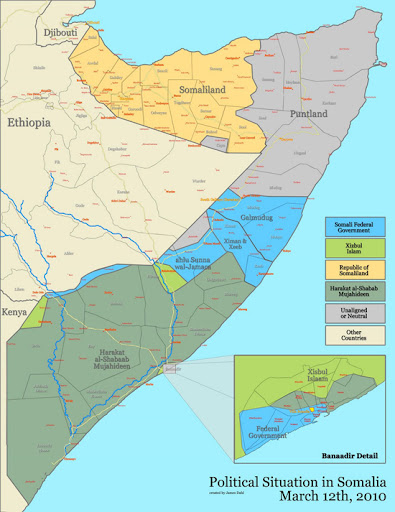
The UN- and U.S.-backed Transitional Federal Government (TFG) controls only parts of Mogadishu and small portions of central Somalia, while insurgent group Al Shabab controls nearly the entire south. The northern area is divided into semi-autonomous Somaliland and Puntland, which also fall outside of the transitional government’s control.
But the civil war is only one part of what Ould-Abdallah called a “horrendous” humanitarian crisis.
According to the UN, 3.2 million Somalis rely on foreign assistance for food – 43 percent of the population – and 1.4 million have been internally displaced by war. Another UN-backed study finds that approximately 50 percent of women and 60 percent of children under five are anemic. Most distressing, the UN Security Council reported in March that up to half of all food aid sent to Somalia is diverted from people in need by militants and corrupt officials, including UN and government employees.
Because of the country’s large youth bulge – 45 percent of Somalia’s population is under the age of 15 – food and health conditions are expected to get much worse before they get better. In the 2009 Failed States Index, Somalia ranks as the least stable state in the world and, along with Zimbabwe, has the highest demographic pressures.
Islamic Militants and the Battle for the High Seas
Yet the West continues to focus on the sensational pirate attacks on Somalia’s coast. The root cause of these attacks is not simply lawlessness say Somali officials, instead, they began partly as desperate attempts to stop foreign commercial fleets from depleting Somalia’s tuna-rich, lawless shores. A 2006 High Seas Task Force reported that at any given time, “some 700 foreign-owned vessels are engaged in unlicensed and unregulated fishing in Somali waters, exploiting high value species such as tuna, shark, lobster and deep-water shrimp.”
The transitional government opposes the fishermen-turned-pirates, but can do little to stop them. Al Shabab has thus far allowed pirates to operate freely in their territory. Their tacit approval may be tied to reports that the group has received portions of ransoms in the past.
Another hardline Islamist group, Hizbul Islam, recently took over the pirate safe haven of Haradhere, allegedly in response to local pleas for better security, but the move may simply have been part of an ongoing struggle with Al Shabab for control of pirate ransoms and port taxes – one of the few sectors of the economy that has remained lucrative.
“I can say to you, they are not different from pirates — they also want money,” Yusuf Mohamed Siad, defense minister with Somalia’s TFG, told Time Magazine.
A Toxic Threat
Initially the pirates claimed one of their goals was to ward off “mysterious European ships” that were allegedly dumping barrels of toxic waste offshore. UN envoy Ould-Abdallah told Johann Hari of The Independent in 2009 that “somebody is dumping nuclear material here. There is also lead, and heavy metals such as cadmium and mercury – you name it.” After the 2005 tsunami, “hundreds of the dumped and leaking barrels washed up on shore. People began to suffer from radiation sickness, and more than 300 died,” Hari reports.
Finnish Minister of Parliament Pekka Haavisto, speaking to ECSP last year, urged UN investigation of the claims. “If there are rumors, we should go check them out,” said the former head of the UN Environment Program’s Post-Conflict Assessment Unit:I think it is possible to send an international scientific assessment team in to take samples and find out whether there are environmental contamination and health threats. Residents of these communities, including the pirate villages, want to know if they are being poisoned, just like any other community would.
To date, there has been no action to address these claims.
Drought, Deforestation, and Migration
While foreign entities may have been exploiting Somalia’s oceans, the climate has played havoc with the rest of the country. Reuters and IRIN report that the worst drought in a decade has stricken some parts of the interior, while others parts of the country face heavy flooding from rainfall further upstream in Ethiopia.
Land management has also broken down. A 2006 Academy for Peace and Development study estimated that the province of Somaliland alone consumes up 2.5 million trees each year for charcoal, which is used as a cheaper alternative to gas for cooking and heating. A 2004 Somaliland ministry study on charcoal called the issue of deforestation for charcoal production “the most critical issue that might lead to a national environmental disaster.”
West of Mogadishu, Al Shabab has begun playing the role of environmental steward, instituting a strict ban on all tree-cutting – a remarkable decree from a group best known for their brutal application of Sharia law rather than sound governance.
The result of this turmoil is an ever-increasing flow of displaced people – nearly 170,000 alone so far this year, according to the Washington Post – driven by war, poverty, and environmental problems. The burden is beginning to weigh on Somalia’s neighbors, says the UNHCR.
The Neighborhood Effect
One of the largest flows of displaced Somalis is into the Arabian peninsula country of Yemen – itself a failing state, with 3.4 million in need of food aid, 35 percent unemployment, a massive youth bulge, dwindling water and oil resources, and a burgeoning Al Qaeda presence.
In testimony on Yemen earlier this year, Assistant Secretary of State Jeffrey Feltman said that the country’s demographics were simply unsustainable:Water resources are fast being depleted. With over half of its people living in poverty and the population growing at an unsustainable 3.2 percent per year, economic conditions threaten to worsen and further tax the government’s already limited capacity to ensure basic levels of support and opportunity for its citizens.
Other neighboring countries face similar crises of drought, food shortage, and overpopulation – Ethiopia has 12 million short of food, Kenya, 3.5 million, says Reuters. UNHCR reports that in Djibouti, a common first choice for fleeing Somalis, the number of new arrivals has more than doubled since last year, and the country’s main refugee camp is facing a serious water crisis.
A Case Study in Collapse
The ballooning crises of Somalia encompass a worst-case scenario for the intersection of environmental, demographic, and conventional security concerns. Civil war, rapid population growth, drought, and resource depletion have not only contributed to the complete collapse of a sovereign state, but could also lead to similar problems for Somalia’s neighbors – threatening a domino effect of destabilization that no military force alone will be able to prevent.
Speaking at a naval conference in Abu Dhabi this week, Australian Vice Admiral Russell Crane told ASD News that, “The symptoms (piracy) we’re seeing now off Somalia, in the Gulf of Aden, are clearly an outcome of what’s going on on the ground there. As sailors, we’re really just treating the symptoms.”
Sources: Academy for Peace and Development, AP, ASD News, Carnegie Endowment for International Peace, Christian Science Monitor, Foreign Policy, High Seas Task Force, Independent, IRIN, New York Times, Population Action, Population Reference Bureau, Reuters, Telegraph, Time, UN, US State Department, War is Boring, Washington Post.
Photo Credits: “Don’t Swim in Somalia (It’s Toxic)” courtesy of Flickr user craynol and “Somalia map states regions districts” courtesy of Wikimedia Commons. -
Population and Environmental Challenges in Rwanda
›“Population, Health and Human Settlements” is the second chapter in the Rwandan government’s Rwanda State of Environment and Outlook. The chapter highlights the Rwandan government’s recognition of the interconnections between population, health, and environment, noting that population “can influence the state of the environment” and pose strains “on available public infrastructure, limited land, and natural resources.” The chapter examines Rwanda’s population growth and distribution, the state of “environmental health” in rural and urban areas, and health indicators relating to child and maternal health and HIV/AIDS. It goes on to describe government strategies to “improve settlements and human welfare.” “As population pressure is one of the key drivers of environmental degradation and poverty,” the chapter’s authors write, “the implementation of the population policy, especially aspects that address high fertility rates, gender and reproductive health, migration and human settlements” is increasingly important.The Des Moines Register‘s “Renewal in Rwanda” site hosts a series of articles by IRP Fellow and former Wilson Center Public Policy Scholar Perry Beeman “examining Rwanda’s efforts to build an eco-friendly economy.” Accompanied with interactive maps, photos, and videos, the materials highlight government efforts, share the country’s successes, and describe the vast challenges that lay ahead.
“Renewal in Rwanda” is particularly focused on Gishwati Forest, an area Beeman visited while in Rwanda, and the impacts of its ongoing conservation program on local communities. “Gishwati Area Conservation Program has as much to do with saving the lives of villagers—by sparing them from deadly mudslides and providing them jobs—as it does restoring a once-mighty forest,” writes Beeman in the article “Fighting for an African Forest.” Beeman also calls attention to the program’s more controversial aspects, noting that reforestation efforts would require relocating an estimated 5,000 families. -
Population, Health, and Environment
›The WWF and Equilibrium Research released a report on the interplay between the environment and human health. Vital Sites: The Contribution of Protected Areas to Human Health documents the environmental-human health connection, provides case studies from both the developed and developing worlds, and offers recommendations to enhance the health outcomes that can be gained from environmental good governance. “[P]rotected areas are not a luxury but are key sites to protect not only biodiversity, but also ecosystem services and our wider well-being,” the World Bank’s Kathy MacKinnon writes in the foreword.“Family Planning and the Environment: Connected Through Human and Community Well-Being,” part of PATH‘s Outlook series, details the importance of family planning-environmental projects to communities living in remote and ecologically vulnerable areas. Designed for practitioners, the article aims to promote cross-discipline dialogue and offers case studies from the Philippines and Uganda. The article concludes that “more collaborative family planning and environmental efforts aimed at reducing inequities would better ensure sustainable community development as well as the right of individuals to achieve what they value.” -
Guerrillas vs. Gorillas in the Congo Basin
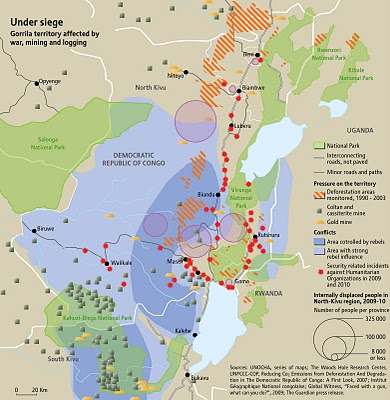
›Gorillas could disappear from the Congo basin in the next 10-15 years, according to a new report issued by the United Nations and Interpol. The Last Stand of the Gorilla – Environmental Crime and Conflict in the Congo Basin places responsibility for the decline of gorilla populations in the Democratic Republic of the Congo and its surrounding region squarely on the shoulders of resource-hungry militants, who poach gorilla bushmeat to feed hungry soldiers and mine workers and sell in local markets. Militants extract timber, charcoal, diamonds, and other resources to raise funds for arms, reducing gorilla territory.
Yet another rationale is retaliation against park rangers who attempt to limit their illegal activities within national parks. In the process, park rangers have found themselves, their parks, and their endangered charges targets of militant groups seeking to plunder and traffic goods through protected areas. “In Virunga Park alone, 190 park rangers have been killed in the last 15 years,” notes the report, which is also available in an interactive e-book edition.
Conflict with local communities also frequently leads to the slaughter of the gorillas and loss of their habitats. Displaced people and refugees also compete with gorillas for land. In several cases, gorillas facing shrinking natural domains have satisfied their appetites in banana plantations, and local farmers have struck back.Strengthening Law Enforcement
Not all, however, is dire. The report finds several success stories stemming out of transboundary law enforcement collaboration and recommends increased training and support for local and international law enforcement groups. “The gorillas are yet another victim of the contempt shown by organized criminal gangs for national and international laws aimed at defending wildlife,” said David Higgins, Interpol’s Environmental Crime Programme Manager. “The law enforcement response must be internationally coordinated, strong, and united, and Interpol is uniquely placed to facilitate this.”
Law enforcement in the Congo Basin faces an uphill battle, in part due to conditions present in peace agreements between guerillas and the Congolese government. Removing vehicle checkpoints from important border crossings was key to the insurgents agreeing to peace. While these agreements reduced violence, they have created a highway for illegal exports. This trade props up the militant groups and undercuts the chances for peace on a regional scale. It is an example of how large remaining quantities of automatic weapons and turns to poaching by ex-militants can render post-conflict environments even more damaging to local wildlife than war itself.
Toward Coexistence
In some locations, conflicts between gorillas and local farmers are disappearing with the construction of natural barriers and as local populations realize the potential of ecotourism to generate greater revenue from thriving gorilla populations than collapsing ones. Greater international coordination and local commitment, however, are necessary. Turning threatening competition into beneficial cooperation is possible.
Tara Innes is a PhD student at the University of Maryland, studying conflict-environment linkages.
Photos: Gorilla, courtesy Flickr user mrflip; Gorilla Territory Affected by War, Mining, and Logging courtesy UNEP/GRID-Arendal. -
World Bank Data Visualization
›Yesterday Google and the World Bank expanded their data-sharing partnership, first initiated last fall, to include a subset of 54 World Development Indicators and enhanced visualization tools. Users can now interact with data—spanning a range of both environmental and population statistics, from forest coverage area to contraceptive prevalence—using line graphs, bar graphs, maps, and xy-plots. Each option also offers users the ability to follow the data changes over time.
An alternative to Google’s Public Data Explorer is the World Bank’s Data Visualizer. Although limiting data output to an xy-plot, the customization options go beyond those offered by the Public Data Explorer and achieve a good balance between flexibility and ease of use. Table colors and groupings are fully customizable, scales are adjustable, and the chart can be quickly printed or exported as a jpeg. -
Urbanization and Deforestation
›The journal Nature Geoscience recently published a study comparing the impacts of rural and urban population growth on deforestation. “Deforestation Driven by Urban Population Growth and Agricultural Trade in the Twenty-First Century” finds deforestation is positively correlated with urban population growth and agricultural exports to international markets. In rural areas, however, the link between deforestation and population growth was absent, indicating that urbanization and agricultural export-oriented economies were the primary drivers for forest loss. The study concludes that, rather than focusing on the activities of rural populations, deforestation reduction efforts should target “industrial-scale, export-oriented agricultural production, concomitant with efforts to increase yields in non-forested lands.” (SUBSCRIPTION ONLY)
“The Population, Agriculture, and Environment Nexus in Latin America: Country-Level Evidence from the Latter Half of the Twentieth Century,” a study published in the journal Population & Environment, examines the relationship between land use and population shifts in Latin America between 1961 and 2001. The paper focuses on deforestation, which was found to be spurred by both Malthusian and Boserupian demographic drivers. It concludes that population growth, urban consumption patterns, and land-use constraints will continue to pose challenges for Latin American policymakers trying to achieve a sustainable equilibrium. (SUBSCRIPTION ONLY) -
Land Grab: Sacrificing the Environment for Food Security
›January 27, 2010 // By Wilson Center StaffAccording to the United Nations, 74 million acres of farmland in the developing world were acquired by foreign governments and investors over the first half of 2009 – an amount equal to half of Europe’s farmland. -
New Tool Maps Deforestation
›A new tool from the Center for Global Development, Forest Monitoring for Action (FORMA) tool, uses satellite data to monitor tropical deforestation on a monthly basis. Using publicly available feeds from NASA and other sources, FORMA detects the spread of deforestation in areas as small as 1 square kilometer. The video above uses FORMA to animate the rapidly growing damage in Indonesia over the last four years.
CGD hopes FORMA will help countries monitor the success of forest preservation efforts, as well as verify that those receiving payments to maintain forest cover are, in fact, doing so. Currently limited to Indonesia, FORMA will soon cover the rest of the global tropics.
The tool can be combined with third-party content, such as overlay maps of demographic and forest carbon content data, for additional applications.
Showing posts from category forests.




 According to the United Nations, 74 million acres of farmland in the developing world were acquired by foreign governments and investors over the first half of 2009 – an amount equal to half of Europe’s farmland.


