-
ECSP Weekly Watch | June 24 – 28
›
A window into what we are reading at the Wilson Center’s Environmental Change and Security Program
Renewable Energy Needs a Social Vision (Mongabay)
The Zapotec of the Isthmus of Tehuantepec have accused energy giant EDF (Électricité de France) of causing human rights abuses while building wind farms in Oaxaca state. They also claim the company intimidated and harassed social movements who opposed this construction on their ancestral lands. The Zapotec are indigenous peoples of Mexico who call themselves Bën Za or “The People”—and after three years of struggle and stalling tactics by EDF’s legal representatives, French courts have authorized their civil case filing at last.
-
Climate, Conflict, and Changing Demographics Command Attention in New Global Health Security Report
›
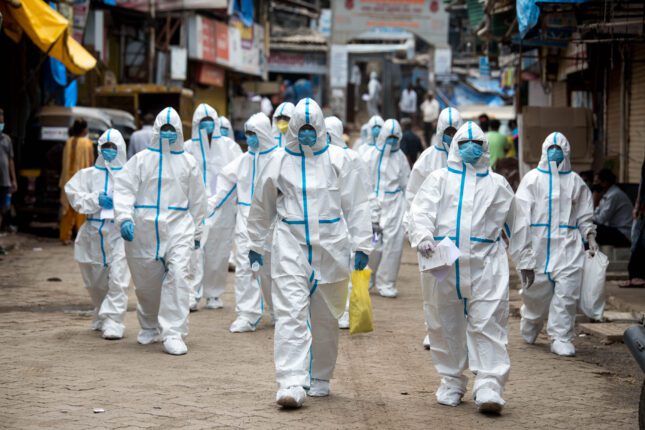
A new report by the US Intelligence Community highlights what the world stands to lose if it fails to cooperate on global health. The National Intelligence Estimate (NIE) “Dynamics Shaping Global Health Security In the Next Decade” outlines the dire effects of climate change, changing demographics, and the erosion of trust in institutions on global health security. The NIE on Global Health Security was made publicly available in April 2024, on the heels of the Biden-Harris Administration’s launch of a new Global Health Security Strategy.
-
Tackling Food Waste in China’s Restaurants
›China Environment Forum // Cool Agriculture // Guest Contributor // May 2, 2024 // By Shiyang Li & Sam GrayBack in 2020, Shiyang Li at Rare visited restaurants across China to interview over 30 different owners and staff about the attitudes, beliefs, and everyday behaviors that contribute to food waste. Similar to global trends, food waste in China remains a significant challenge. A 2020 survey found restaurants in Chinese cities wasted at least 34 million tons of food every year, which can feed as many as 49 million people.
-
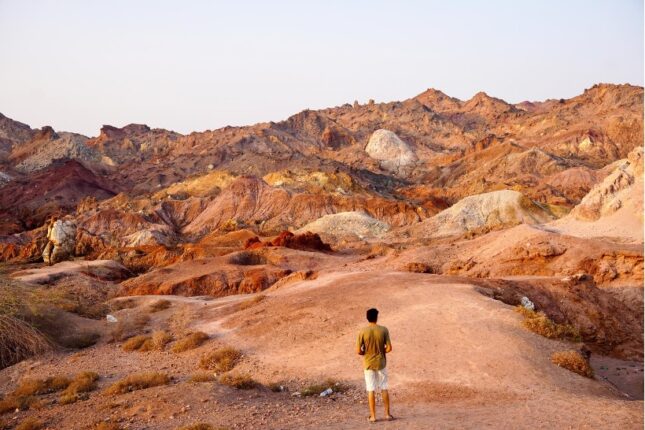
Heat, Oil, and Dust: The State of Iran’s Lakes and Its Climate Future
›Iran’s southeastern province of Khuzestan—which borders Iraq—was already a dry and dangerous place. It was the site of the fiercest battles in the Iraq-Iran war which followed the Iranian Revolution in 1979, and to this day, the region still has many unexploded landmines.
Yet this legacy of violence is not the only issue facing its residents. As climate impacts mount in Khuzestan, the future looks bleak for both the region’s ecosystems and the people already living on this borderline.
-
The Arc | Climate, Conflict, and Women’s Resilience: A Recent Women for Women International Report
›
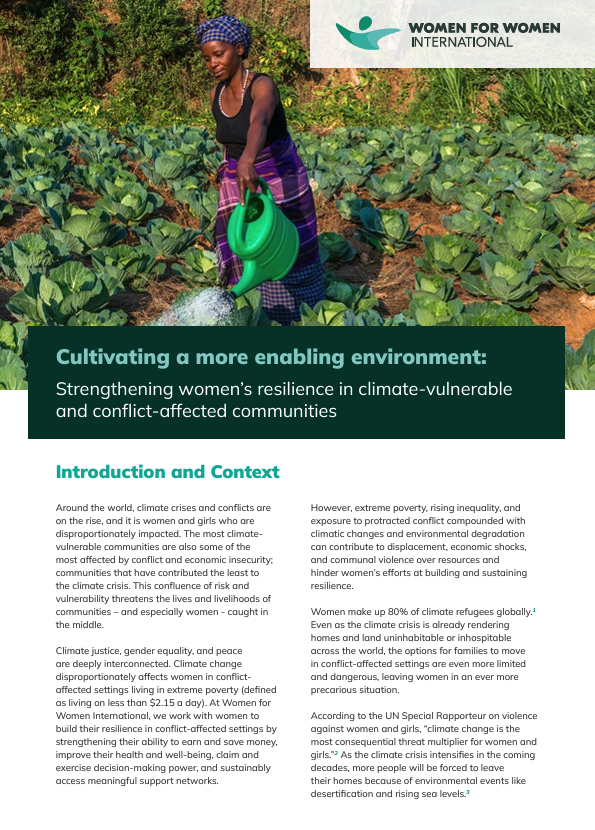
In today’s episode of The Arc, ECSP’s Angus Soderberg and Claire Doyle interview Nisha Singh and Kavin Mirteekhan from Women for Women International. We dive into the organization’s recent report, “Cultivating a more enabling environment: Strengthening women’s resilience in climate-vulnerable and conflict-affected communities,” to hear how women around the world are disproportionately impacted by conflict and climate shocks—and what we can learn from their solutions.
-
ECSP Weekly Watch: March 4 – 8
›A window into what we are reading at the Wilson Center’s Environmental Change and Security Program
Climate Change Disproportionately Impacts Rural Women (U.N. Food and Agriculture Organization)
A recent report by the U.N. Food and Agriculture Organization analyzed data from 24 low- and middle- income countries (LMICs) across five regions and over 100 thousand rural households to measure the impacts of climate change on rural women, youth, and people living in poverty. It found that climate change’s impacts disproportionately impact households headed by women, with income losses due to extreme heat (8% income loss) and flooding (3% income loss), relative to households led by men. The income gap between men and women was also widened as a result.
-
Food Waste: A Low-Hanging Fruit for Methane Reductions
›China Environment Forum // Cool Agriculture // February 8, 2024 // By Jennifer Nguyen, Jennifer Turner & Karen ManclThis blog is modified from the Wilson Center-OSU “Cultivating US and Chinese Climate Leadership on Food and Agriculture Roadmap” publication.
“Waste is something that most of us just don’t see,” stressed Pete Pearson, Senior Director, Food Loss and Waste, WWF, at a recent Wilson Center event. Though people are “conditioned” to be blind to food waste, continued Pearson, this not-so-invisible problem wastes a third of food grown around the world. When this wasted food decomposes, it emits methane, accounting for 8 to 10% of global greenhouse gas (GHG) emissions.
-
Weakened Infrastructure and Climate Change: The Threat to Water Security in Nineveh
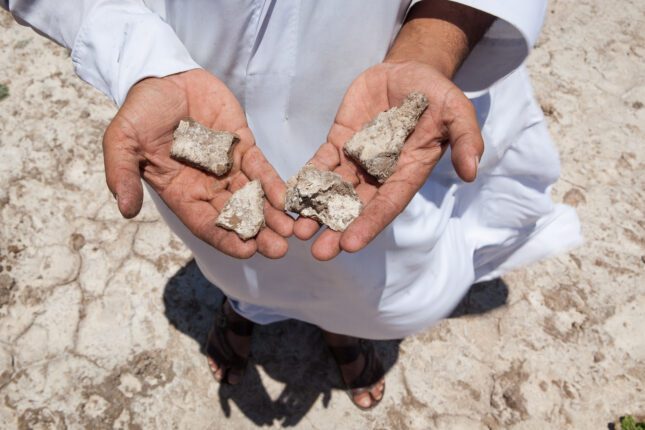
›Iraq is incredibly vulnerable to the impacts of climate change. Temperatures are increasing, rainfall is decreasing, and the country experiences prolonged periods of drought. These conditions, as well as the destruction of wells and irrigation systems in the Islamic State’s (IS) targeted 2014-2017 campaign to destroy agricultural livelihoods, have created a growing water problem in Iraq’s Nineveh Plains. Indeed, water levels there have dropped low enough to subject crops to drought stress, endangering drinking water systems and affecting the ability to grow crops and raise livestock.
Showing posts from category food security.