• woodrow wilson center
  • ecsp

New Security Beat

Subscribe:
  • rss
  • mail-to
  • Who We Are
  • Topics
    • Population
    • Environment
    • Security
    • Health
    • Development
  • Columns
    • China Environment Forum
    • Choke Point
    • Dot-Mom
    • Friday Podcasts
    • Navigating the Poles
    • Reading Radar
  • Multimedia
    • Water Stories (Podcast Series)
    • Backdraft (Podcast Series)
    • Tracking the Energy Titans (Interactive)
  • Films
    • Water, Conflict, and Peacebuilding (Animated Short)
    • Paving the Way (Ethiopia)
    • Broken Landscape (India)
    • Scaling the Mountain (Nepal)
    • Healthy People, Healthy Environment (Tanzania)
  • Publications
  • Events
  • Contact Us

NewSecurityBeat

The blog of the Wilson Center's Environmental Change and Security Program
Showing posts from category disaster relief.
  • Without Water, No Sustainable Development: World Water Week 2015

    ›
    Guest Contributor  //  August 12, 2015  //  By Anders Jägerskog
    Little Girls Carry Water Containers

    The World Economic Forum recently named water crisis the world’s number one risk for the next 10 years for its potential impact on people and industry. Indeed, as the global community grapples with climate change – and environmental change of all kinds – understanding the fundamental nature if water to human society is crucial. The input report for this year’s World Water Week, released yesterday by the Stockholm International Water Institute, in fact argues that getting water management right is a prerequisite for sustainable development.

    MORE
  • Karachi’s Heat Wave a Sign of Future Challenges to Pakistan’s Fragile Democracy

    ›
    Guest Contributor  //  July 8, 2015  //  By Tim Kovach
    A man cools off under a public tap, while others wait to fill their bottles, during intense hot weather in Karachi

    Karachi, the world’s second largest city by population, is emerging from the grips of a deadly heatwave. A persistent low pressure system camped over the Arabian Sea stifled ocean breezes and brought temperatures in excess of 113°F (45°C) to the city of 23 million people in June. The searing heat disrupted electricity and water service, making life nearly unbearable. All told, officials estimate the heatwave killed at least 1,200 Pakistanis, more than twice as many as have died in terrorist attacks this year.

    MORE
  • The Lancet Commission’s Latest Findings on Climate Change, Health, and Policy Responses

    ›
    July 1, 2015  //  By Francesca Cameron
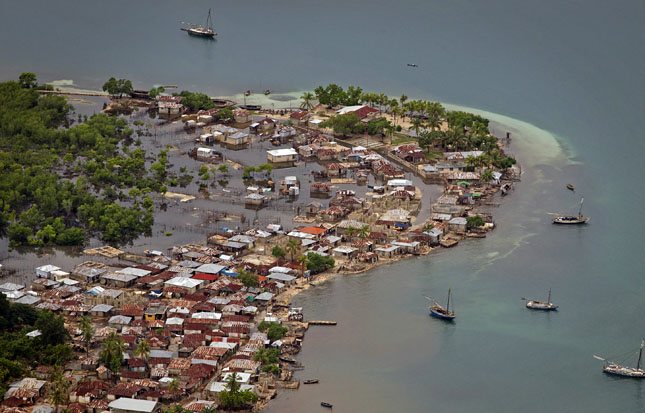
    Cap Haitian Flooding

    “Tackling climate change could be the greatest global health opportunity of the 21st century,” asserts the newest report by the Lancet Commission on Health and Climate Change.

    MORE
  • Lukas Rüttinger, Adelphi

    Thailand and Sri Lanka Show How Disasters Can be Catalysts of Fragility or Opportunities for Peace

    ›
    June 26, 2015  //  By Wilson Center Staff
    Bangkok-floods

    The original version of this article, by Lukas Rüttinger, appeared on the Resilience Compass blog as part of a series of posts corresponding with the launch of ‘A New Climate for Peace.’

    In 2011 Thailand was hit by unprecedented monsoon rains far above the average rainfall of the previous 30 years. Two million people across 26 provinces were affected. During the crisis, hundreds of civilians took it to the streets to protest discrimination by the Flood Response Operation Center and the unfair distribution of water, electricity supply, shelter, and food. Civilians were so angry that they broke a sandbag wall in Bangkok which was protecting a wealthy district from water surges. Public unrest and discontent with the government continued until a military coup in 2013.

    MORE
  • How to Create a New Climate for Peace: Preventing Climate Change From Exacerbating Conflict and Fragility

    ›
    June 19, 2015  //  By Lauren Herzer Risi
    Pressures-and-shocks1

    When the leaders of the G7 countries – Canada, France, Germany, Italy, Japan, the United Kingdom, and the United States – met earlier this month, they agreed to make fossil fuels a thing of the past by 2100. At the same time the G7 is also taking steps to make climate change’s connection to conflict a priority in the present.

    MORE
  • Adapting to Global Change: Climate Displacement, Mega-Disasters, and the Next Generation of Leaders

    ›
    From the Wilson Center  //  June 16, 2015  //  By Theo Wilson
    050102-N-9593M-040

    The world is more connected than ever before, but also more complex. Big, transnational trends like climate change, urbanization, and migration are changing the calculus of geopolitics, while local-level inequalities persist. “[Change] seems to be spinning around us so fast,” said John Hempelmann, president of the Henry M. Jackson Foundation, which honors the legacy of the late senator from Washington State. How can today’s and tomorrow’s leaders adjust to global trends? [Video Below]

    MORE
  • Alice Thomas: Climate Change Effects and Responses Profoundly Undermine Human Rights

    ›
    Friday Podcasts  //  June 12, 2015  //  By Linnea Bennett
    Thomas-small

    After Typhoon Haiyan ripped across the Philippines in 2014 leveling nearly every building in sight, 4 million people – mostly poor and from coastal regions – were displaced. In response, the government set up “no build” zones in vulnerable areas and worked to move people to new land. But many of the newly relocated people discovered this land came with no access to water, electricity, or other services.

    MORE
  • For Next Edition of Influential Global Trends Report, National Intelligence Council Looks to Expand Its Audience

    ›
    Guest Contributor  //  June 1, 2015  //  By Steven Gale
    SXSW

    Between sessions on the value of creating a physical expression of digital brands (Evernote socks) and Bitcoin, this year’s South by South West (SXSW) in Austin, Texas, featured newcomers from a different background: the U.S. National Intelligence Council.

    MORE
Newer Posts   Older Posts
View full site

Join the Conversation

  • RSS
  • subscribe
  • facebook
  • G+
  • twitter
  • iTunes
  • podomatic
  • youtube
Tweets by NewSecurityBeat

Trending Stories

  • unfccclogo1
  • Pop at COP: Population and Family Planning at the UN Climate Negotiations

Featured Media

Backdraft Podcast

play Backdraft
Podcasts

More »

What You're Saying

  • Volunteers,At,The,Lagos,Food,Bank,Initiative,Outreach,To,Ikotun, Pan-African Response to COVID-19: New Forms of Environmental Peacebuilding Emerge
    Rashida Salifu: Great piece 👍🏾 Africa as a continent has suffered this unfortunate pandemic.But it has also...
  • A desert road near Kuqa An Unholy Trinity: Xinjiang’s Unhealthy Relationship With Coal, Water, and the Quest for Development
    Ismail: It is more historically accurate to refer to Xinjiang as East Turkistan.
  • shutterstock_1779654803 Leverage COVID-19 Data Collection Networks for Environmental Peacebuilding
    Carsten Pran: Thanks for reading! It will be interesting to see how society adapts to droves of new information in...

What We’re Reading

  • Rising rates of food instability in Latin America threaten women and Venezuelan migrants
  • Treetop sensors help Indonesia eavesdrop on forests to cut logging
  • 'Seat at the table': Women's land rights seen as key to climate fight
  • A Surprise in Africa: Air Pollution Falls as Economies Rise
  • Himalayan glacier disaster highlights climate change risks
More »
  • woodrow
  • ecsp
  • RSS Feed
  • YouTube
  • Twitter
  • Facebook
  • Home
  • Who We Are
  • Publications
  • Events
  • Wilson Center
  • Contact Us
  • Print Friendly Page

© Copyright 2007-2021. Environmental Change and Security Program.

Woodrow Wilson International Center for Scholars. All rights reserved.

Developed by Vico Rock Media

Environmental Change and Security Program

Woodrow Wilson International Center for Scholars

Ronald Reagan Building and International Trade Center

  • One Woodrow Wilson Plaza
  • 1300 Pennsylvania Ave., NW
  • Washington, DC 20004-3027

T 202-691-4000