-
The Year Ahead in Political Demography: Top Issues to Watch
›June 8, 2012 // By Elizabeth Leahy Madsen2011 and the first half of 2012 have been a remarkable period for political demography, with theories about the relationships between age structure and governance validated in real time by the events of the Arab Spring. Although such game-changers are rarely predictable, the year ahead promises to be eventful as well, with new demographic research and major policy initiatives on the horizon. Below are brief assessments of some of the top issues to watch between now and next summer.
1. The Evolving Story of the Arab Spring
The Arab Spring was anticipated by few observers, but for a handful of political demographers it was a watershed of sorts. As readers of this blog know, political demography research shows that countries with very young age structures are prone both to higher incidence of civil conflict and – most relevant to the outcomes of the Arab Spring – to undemocratic governance. This nuance escaped many observers of the region’s drama. Violence and conflict erupted not from raging citizens in the streets but from military and militia forces unleashed by autocrats unwilling to cede their grip on power. Young people, and their fellow protestors of all ages, were acting as a force for positive change in their demonstrations against corrupt and unrepresentative leadership. The difference in outcomes across the region, according to Richard Cincotta, can be attributed to the fact that as age structures mature, elites become less willing to trade their political freedoms to autocratic leaders in exchange for the promise of security and stability.
When considered with this important distinction in mind, the initial events following the uprising in Tunisia that quickly spread across the region played out in a neatly linear fashion. Among the five countries where revolt took root, those with the earliest success in ousting autocratic leaders also had the most mature age structures and the least youthful populations.
In Tunisia, with a median population age of 29, one month passed between a fruit seller’s self-immolation and Zine El Abedine Ben Ali’s flight to exile. In Egypt and Libya, where median age is close to 25 years (identified by Cincotta as a threshold when countries are at least 50 percent likely to be democratic), Hosni Mubarak and Moammar Gaddafi took three weeks and eight months, respectively, to lose their titles. Ali Abdullah Saleh in Yemen (median age 17), took one year to be convinced to formally resign, while in Syria (median age 21), the 15-month uprising continues to be brutally repressed by Bashar Assad’s forces.
Of course, overthrowing a dictator, while inspiring and liberating to those whose rights have been repressed, is only the first step in achieving democracy. In the coming year, the countries that have already taken steps toward solidifying regime change will face continued tests as internal tensions surface. Even in Tunisia, recent clashes signal that political divisions and economic uncertainty have not been resolved. With potentially divisive elections ahead in Egypt and Libya, a holdover from the Saleh regime leading Yemen, and Syria’s fate unknown, the coming year should offer political demographers further evidence of the soundness of the age structure and democracy thesis.
2. New Commitments to Family Planning
Reproductive health and demography go hand-in-hand, and two milestones for family planning advocates are fast approaching: the 20th anniversary of the 1994 International Conference on Population and Development in Cairo, and the 2015 endpoint of the Millennium Development Goals.
These historic commitments by governments will be joined by a major initiative to generate new funding and political will this summer at an international family planning summit in London on July 11. The summit will be co-hosted by the Bill and Melinda Gates Foundation (Melinda made an impassioned TEDxChange speech in support of the issue in April), and the UK’s Department for International Development, for whom family planning is a priority in efforts to reduce maternal and child mortality.
Details of the summit have yet to be finalized and publicly released, but financial commitments from donors and developing countries are anticipated toward meeting a new and ambitious goal of generating $4 billion to fund contraceptives for 120 million women in developing countries by 2020. Assuming these are new users, rather than those who would be expected by projecting recent growth in contraceptive use forward, this would represent more than half of the estimated 215 million women with an unmet need for family planning.
Why does new family planning funding matter for political demography? Rates of contraceptive use are lowest and fertility highest in countries with youthful age structures. Such population dynamics exacerbate the challenges governments face in providing education, health, and basic infrastructure services, as well as supporting an economic climate conducive to industry diversification and job creation. In turn, the likelihood of civil conflict and undemocratic governance is higher in such countries.
While policies that recognize the benefits of family planning may be solid, funding and implementation often fall woefully short. In the least developed countries, less than one-third of reproductive-age women are using any contraception, and the rate has grown by just 0.4 percentage points annually over the past decade. Meanwhile, funding from all sources is less than half the amount required to meet unmet need. If the July summit motivates a new groundswell of financial support, 2012 could incite major strides toward improvements in individual health and well-being as well as demographic momentum in the remaining high-fertility countries.
3. Demographic Diversity in Sub-Saharan Africa
The current era of global demographic diversity has been distinguished by both record-low fertility rates in parts of Europe and eastern Asia and persistently high fertility across most of western, central, and eastern Africa. More than one-quarter of women in sub-Saharan Africa would like to postpone or avoid pregnancy, but are not using contraception, demonstrating a large unmet need for family planning.
The U.S. government-funded Demographic and Health Survey (DHS) program is the largest single source for detailed data on health status and behavior in high-fertility developing countries, and in turn informs estimates and projections of demographic trends. Recently, DHS reports have been released showing that contraceptive use over the past five years is growing much faster than the regional average in Ethiopia, Malawi, and Rwanda. In turn, fertility rates have dropped, ranging from a relatively modest 0.3 children per woman in Malawi and an unprecedented 1.5 children per woman in Rwanda.
These findings suggest that the pattern of demographic stagnation in sub-Saharan Africa may be shifting, perhaps due to governments’ and donors’ investments in family planning. However, newer survey results for Mozambique, Uganda, and Zimbabwe present a more mixed picture, with modest gains in contraceptive use in Uganda, offset by declines in the other two countries.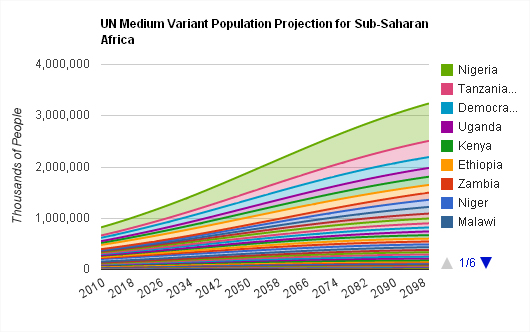
Click here for the interactive version (non-Internet Explorer users only).
Additional recent survey results show that use of modern contraceptive methods has barely increased in Senegal (from 10 percent in 2005 to 12 percent in 2010-11). And while modern contraceptive use increased in the Republic of Congo from 13 percent in 2005 to 20 percent currently, fertility also rose slightly, from 4.8 to 5.1 children per woman.
Approximately 10 countries in sub-Saharan Africa are slated for DHS fieldwork this year, including one of the continent’s giants, the Democratic Republic of the Congo, and several of the highest-fertility countries in the region. (Outside of sub-Saharan Africa, the demographic heavyweights in this year’s group of DHS reports are Bangladesh, Indonesia, and Pakistan.)
The upcoming surveys will provide greater clarity about whether the promising signs of family planning adoption and the potential for progress through the demographic transition in Ethiopia, Malawi, and Rwanda are initiating widespread change across the continent, or whether the need for commitments such as those generated by the London summit is even stronger.
4. New Population Projections
DHS reports are critical inputs for the world’s most comprehensive and readily accessible set of demographic data, the UN Population Division’s World Population Prospects. This database is fully updated and revised biannually, in large part due to the steady stream of newly available estimates from the DHS and related sources, such as national censuses. The next revision of World Population Prospects, based on estimates for mid-year 2012, is expected to be published in spring 2013.
The previous revision of World Population Prospects was notable for its methodological overhaul. In addition to extending the projections until 2100, the Population Division shifted to a probabilistic technique (as opposed to assuming convergence at a single fertility rate of 1.85 children per woman) that generates 100,000 possible fertility trajectories for each country and selects the median as the medium fertility variant, commonly cited as the most likely projection. Still, the basic parameters remain the same: With fertility rates the strongest driver of population projections, low, medium, and high fertility variants are constructed around the assumption that countries will converge towards replacement level fertility, around 2.1 children per woman.
In some cases, this results in projections that are vastly at odds with recent trends. For example, in Japan, fertility has fallen by 38 percent, from replacement level in the early 1970s to 1.3 children per woman in 2010, but the UN projects it to immediately reverse course and begin rising to 1.8 by mid-century. If the projection holds, Japan’s population will decline relatively modestly, from 127 million to 109 million. But if fertility stays constant at current levels, the population will fall below 100 million. For low-fertility countries like Japan, all UN scenarios assume constant or rebounding fertility rates, even though continued decline may be a plausible outcome in some cases.
When next year’s projections are released, a cluster of media articles will report the projected world population for 2050. In last year’s revision, the medium fertility variant resulted in a projection of 9.3 billion, an increase from the 9.1 billion projected two years earlier based on higher projected fertility in the future. Such reports often overlook the range of population totals possible depending on fertility paths: If the global fertility rate varies by 0.5 children per woman in either direction, the total population could be more than one billion higher or lower in 2050, with an even wider range possible by 2100.
Most of the projected growth in world population, and its potential range, will be driven by the high-fertility countries concentrated in sub-Saharan Africa. Population projections for these countries vary tremendously based on fertility scenarios informed by the recent DHS results described above.
In Nigeria, Africa’s most populous country, fertility has fallen over the past 40 years, but by a gradual 15 percent. The UN projects it to drop more than twice as fast, by more than two children per woman (39 percent), in the next four decades. In any scenario, Nigeria is on track for rapid population growth, but the potential range based on fertility outcomes is wide. If fertility declines as projected in the medium variant, the country would grow from 158 million to 390 million. And although unlikely, the constant fertility projection of 504 million Nigerians in 2050 should be kept in mind given the slow pace of fertility decline to date.
Population projections are highly wonky, but their careful production and regular revision are essential for accurate planning of economic and social needs in countries around the world. While governments with dedicated census agencies, such as those in the U.S., Japan, or India, rely on internally-generated estimates, the UN projections serve as the primary indication of population trends in countries with spottier data coverage and have tremendous utility in gauging future needs for infrastructure, housing, health care across the life cycle, education, jobs, and other investments.
By no means is this an exhaustive list of factors that will affect political demography research and policy over the coming year. Other events to watch for include the Rio+20 conference on sustainable development in June, where the priority issues of jobs, energy, infrastructure, and resources will be shaped by demographic trends, and continued attention to prospects for the demographic dividend in Africa. Political demography is inherently cross-disciplinary, and the field’s researchers and practitioners will be engaged on multiple fronts in the year ahead.
Elizabeth Leahy Madsen is a consultant on political demography for the Wilson Center’s Environmental Change and Security Program and senior technical advisor at Futures Group.
Sources: Al Jazeera, Bongaarts (2008), Cincotta (2008), Cincotta (2012), Cincotta and Leahy (2006), Grist, Guttmacher Institute, MEASURE DHS, The New York Times, NPR, Population Reference Bureau, UN Population Division, The Washington Post.
Image Credit: “The Face of a Tyrant,” courtesy of flickr user freestylee (Michael Thompson); video courtesy of TED; chart created by Schuyler Null, data from UN Population Division. -
Comparing Urban Governance and Citizen Rights in China and India
›Today, according to Xuefei Ren, 129 cities in China and 45 in India have populations of over a million people. Such large-scale urbanization has created major governance challenges. Speaking at a May 23 Asia Program event co-sponsored with the Kissinger Institute on China, United States Studies, and the Comparative Urban Studies Project, Ren, a Wilson Center Fellow, examined two case studies of urbanization-driven governance in China and India and their effect on citizen rights.
Her first case study involved housing demolitions and urban re-development in Shanghai and Mumbai. In Shanghai, nearly a million households were relocated between 1995 and 2008 to make way for hotels, airports, and luxury apartments. City regulations in 1991 and 2001 legalized forced demolitions, and no prior consent from residents was needed.
However, Ren noted that displaced residents “are not quite powerless.” She highlighted the case of a woman who sued the city government after being relocated and was eventually granted the compensation she had requested. In 2003, China’s central government ordered a freeze on large-scale demolitions. Several years later, it passed a “landmark” property rights law.
Meanwhile, in Mumbai, local officials in the early 2000s had their own re-development plans. The Indian city is rife with overcrowded, low-income housing; slums are populated by seven million citizens (40 percent of the city’s total population), and comprise up to 10 percent of Mumbai’s total land area.
In 2004, aware that most of the slums were located in desirable areas – near airports or in central business districts – city planners recognized a major development opportunity. Over the next two years, officials launched a demolition campaign that left 400,000 people homeless. According to Ren, certain categories of residents were theoretically entitled to compensation, but with “legal protections carrying little weight,” most of them received nothing.
Yet, as in Shanghai, Mumbai’s city dwellers successfully fought back. Housing activists staged acts of “direct agitation,” including a series of street protests and road blockages. Such tactics, said Ren, were “disruptive but effective.” The Mumbai courts sided against the activists in 2006, but India’s Supreme Court later issued a ruling in their favor.
Fighting Land Acquisitions: A Comparison
Ren’s second case study compared land acquisition efforts outside the slums.
Last year, residents in Wukan, a village along China’s southeast coast in the province of Guangdong, launched a protest movement against land seizures. They alleged that government officials had sold their land to developers and failed to provide residents with appropriate compensation. The protestors made two demands: the return of their land and the holding of local elections.
Notably, Ren said, protestors in Wukan affirmed their support for the Communist Party, and never framed their movement as an anti-government effort. In March 2012, local elections were in fact held, with two leaders of the protest movement voted into office (one as village chief, the other as his deputy).
Ren also discussed an attempt by India’s Tata Motors corporation to acquire land in Singur, a village about 100 miles from Calcutta in the state of West Bengal. The company wanted to use this land to construct a factory for the Nano, a small, cheap car marketed to India’s urban middle class. In 2005, the West Bengal government, which had been controlled by the Communist Party of India-Marxist (CPI-M) for nearly 30 years, actively wooed the firm. State authorities “went overboard” in offering Tata Motors subsidies and highly fertile land, said Ren. Small landowners were obliged to surrender their plots at low prices, and in 2006 the corporation formally took over the land (nearly 1,000 acres altogether), despite heavy opposition from peasants.
However, violent protests continued and after several months, Tata Motors was forced to pull out of West Bengal. Then, in a state election in May 2011, the Trinomool Congress Party, led by the populist leader Mamata Banerjee, swept the CPI-M from power. Banerjee had run her campaign on a promise to restore the land to Singur’s farmers.
Just weeks after the new government assumed power, West Bengal passed a law that would allow for about 400 acres from the Tata Motors project to be returned to farmers who had refused government compensation for their land.
Ren acknowledged that in both countries, citizenship rights are not enjoyed by all and tend to be unevenly distributed across social groups. Still, she concluded, Chinese and Indian cities “have become strategic sites for reassembling citizen rights.” By asserting their land and housing rights, city denizens “are becoming active citizens.”
Michael Kugelman is a program associate with the Wilson Center’s Asia Program. He can be reached at michael.kugelman@wilsoncenter.org and on Twitter @michaelkugelman.
Photo Credit: Mumbai pipes, courtesy of flickr user lenskap. -
Poor Land Tenure: A Key Component to Why Nations Fail
›The murder of five land rights campaigners during the last two months – one in Colombia, three in Brazil, and one in Cambodia – have not captured many headlines, but they are a reminder of the central role land tenure plays not just in rural economic development but also in sparking broadly distributed economic gains throughout a society.
-
Valerie Hudson and Chad Emmett: Women’s Well-Being Is the Best Predictor of State Stability
›May 22, 2012 // By Kate Diamond“The best predictor of a state’s stability and security is the level of violence against women in society,” said Texas A&M University’s Valerie Hudson in this interview with ECSP. That link is “based on rigorous empirical analysis,” she said. “There’s something to it. It’s not just political correctness.”
-
Jack Goldstone on Post-Cold War Trends in Armed Conflict and Challenges for the World’s Youth
›“Global trends in armed conflict have really come down since the end of the Cold War,” said George Mason University’s Jack Goldstone in this talk adapted from a presentation at the Wilson Center last fall. This drop is a reflection of decreased proxy conflicts between the Soviet Union and United States and increased interventionism from the international community. But another thing we can point to is that the world’s youth population has also declined, he said.“Global trends in armed conflict have really come down since the end of the Cold War,” said George Mason University’s Jack Goldstone in this talk adapted from a presentation at the Wilson Center last fall. This drop is a reflection of decreased proxy conflicts between the Soviet Union and United States and increased interventionism from the international community. But another thing we can point to is that the world’s youth population has also declined, he said.
“There seems to be a reasonably strong connection, between the drop-off in post-Cold War conflicts” and a decline in the proportion of youth in global population. This ageing, however, has been uneven across the globe and risks remain, said Goldstone.
“Ninety percent of all children under the age of 15 in the world today are growing up outside of North America, Europe, and the wealthy countries of East Asia,” he said, and in four or five decades time, “90 percent of the workforce of the world will be workers that have grown up outside of the rich countries.” It is this population’s “future productivity [that] will go far to determining whether quality of life gets better or worse.”
Demography and State Fragility
States across sub-Saharan Africa, South Asia, and the Middle East that perform poorly in indexes of state fragility also tend to have the youngest populations. “This could be just an unhappy coincidence,” said Goldstone, “but I don’t think that’s what’s going on. I think what we’re seeing is a kind of virtuous and vicious circle.”
“Where government is weak, ineffective, doesn’t provide education, doesn’t provide security, it’s advantageous both for individuals and for groups to have larger families,” he said. “However, as population grows, it’s more difficult for the government to provide adequate education and security for the larger, more youthful population.”
“On the other hand, if you can get on the track for a stronger, more legitimate government – a government that’s able to provide education, provide security of property, [and] encourage investment…fertility tends to drop quickly.” “This in turn re-enforces the ability of governments to direct resources to education and economic growth,” said Goldstone.
Critical Role of Governance
“Mobilization for political conflict draws heavily on youthful populations,” said Goldstone. As research by Henrik Urdal has shown, a bulge in the population of youth does appear to increase the risk of conflict. However, this relationship is strongly mediated by regime type. While strong democracies and autocracies are considered relatively stable, there is a “risk zone” in between, where instability is more likely.
“We live in a world where the countries with weak, fragile governments [are] about a third of the global population. But in another 30 years, if things remain as they are in terms of governance, you’re looking at closer to half the world’s population living in those more difficult circumstances,” he said.
“If the democracy is not well established, if rule of law is not well regulated, than people don’t necessary trust the outcome of peaceful electoral competition,” said Goldstone. “If people don’t like the outcome of an election, or they feel they’re being excluded, or things are one sided, they may mobilize.” This lack of political trust can result in instability and violence such as the recent protests by Thailand’s “red shirts.”
Although many Latin American and Asian states are heading towards “voluntary reduced fertility, strong economic growth, and stronger and more stable governments,” a real risk remains, he asserted. Africa, for instance, is “liable to gain a billion out of the next two billion in global population growth.”
Challenges for the Future
“For me, there are two big challenges posed by global demography,” opined Goldstone.
First, “given that 90 percent of today’s youth are in developing nations, providing them with opportunities to become productive adults through education, stable environment, [and] socialization is crucial.”
And second, in order to deliver those services, “strengthening governance in the countries where those youth live, in order for those education, security, and social services to be provided,” is absolutely necessary for economic development and reducing political instability.
While incidences of conflict have declined, the effects of those intractable conflicts that remain – in particular the sharp increase in the number of refugees and displaced populations uprooted by conflict – are solid arguments for continuing to address this risk. -
Yemen: Revisiting Demography After the Arab Spring
›April 17, 2012 // By Elizabeth Leahy MadsenAlong with other countries where the Arab Spring caught hold, Yemen has been gripped by major upheaval over the past year. Although President Ali Abdullah Saleh finally ceded power in February after his administration’s violent reprisals failed to deter protesters, the country remains at a crossroads. As its political future continues to evolve, the new government must also address a range of deep-seated economic and social challenges. In addition to claiming more than 2,000 lives, the crisis has undermined Yemenis’ livelihoods and even their access to food. A recent World Food Program survey found that more than one-fifth of Yemen’s population is living in conditions of “severe food insecurity” – double the rate measured three years ago – and another fifth is facing moderate difficulty in feeding themselves and their families.
-
Youth, Aging, and Governance: A Political Demography Workshop at the Monterey Institute of International Studies
›April 5, 2012 // By Schuyler Null“Demography is sexy – it’s about nothing but sex and death (and migration),” said Rhodes College Professor Jennifer Sciubba at the Monterey Institute of International Studies during a workshop on March 30.
Jack Goldstone of James Madison University, Richard Cincotta of the Stimson Center, and ECSP’s Geoff Dabelko joined Sciubba in a workshop for students and faculty on key developments in political demography. Sciubba and Cincotta were contributors to Goldstone’s recently released edited volume, Demography: How Population Changes Are Reshaping International Security and National Politics.
“Demography is changing the entire economic and strategic divisions of the world,” Goldstone told the room. “We’ve had a 15 year increase in life expectancy just in the last half century,” and today, “90 percent of children under 10 are growing up in developing countries.”
Many countries, said Goldstone, are caught in a difficult race between growth and governance, with governments struggling to provide services and opportunity to their growing populations. This challenge is especially acute in cities, which for the first time in human history are home to the majority of all people.
At the same time, aging is a phenomenon that will affect many developed countries. In the United Sates, the baby boomers are becoming “the grayest generation,” Goldstone said, and similar imbalances between the number of working age people and their dependent elders will soon affect Western Europe, Japan, Korea, Russia, and others.
Re-Examining the Aging Narrative
Some have predicted this “graying of the great powers” will have disastrous consequences for many of the G8, as state pension costs blunt economic growth and innovation, military adventurousness, and global influence, but Jennifer Sciubba presented a case for why fears may be overblown.
When discussing the aging phenomenon in developing countries, many analysts focus too closely on the fiscal environment, argued Sciubba. This creates tunnel vision that ignores the potential coping mechanisms that states have at their disposal. Alliances, for example, are under-accounted for, she said, and closer European Union and even NATO integration could help ameliorate the individual issues faced by aging countries like Germany, France, and Italy.She also pointed to evidence that the developing world’s declining fertility may be have been “artificially depressed” by large proportions of women that delayed pregnancy starting in the 1990s. But now the average age of childbearing has stopped rising. The UN total fertility rate projections for industrialized states for the period 2005 to 2010 was revised upward from 1.35 children per woman in 2006 to 1.64 in 2008 and 1.71 in 2010.
This brings into focus a key leverage point for many developed countries that is not often discussed in traditional conversations about aging: making the workplace friendlier for women. Offering money to couples to have children does not work, said Sciubba – women do not make a simple monetary cost-benefit analysis when they decide to have children. Much more likely is a calculation about the cost to their professional career. Therefore, instituting more liberal leave policies and making it harder for employers to fire both men and women for taking maternity or paternity leave is more likely to have a real impact on fertility rates.
The growing efficiency – and retirement age – of today’s workers can blunt the effect of older workforces on developed economies, said Sciubba. And the stability, strong institutions, and legal protections for innovation are all advantages that will continue to attract the best and the brightest from developing countries.
The competing phenomena of aging in the developed world and continued growth in the developing – which some have dubbed the “demographic divide” – will likely make immigration a very important, possibly friction-inducing issue in the coming decades. Goldstone pointed to the challenges Europe is having today coping with immigrants from North Africa and the Middle East as a possible harbinger of things to come.
Applying Demographic Theory: The Age Structural Maturity Model
While many regions will continue to experience population growth for the next two decades, including sub-Saharan Africa, the Middle East, and parts of East and South Asia and Latin America, the overall global trend is towards older populations. This is good news for democracy, according to Richard Cincotta.
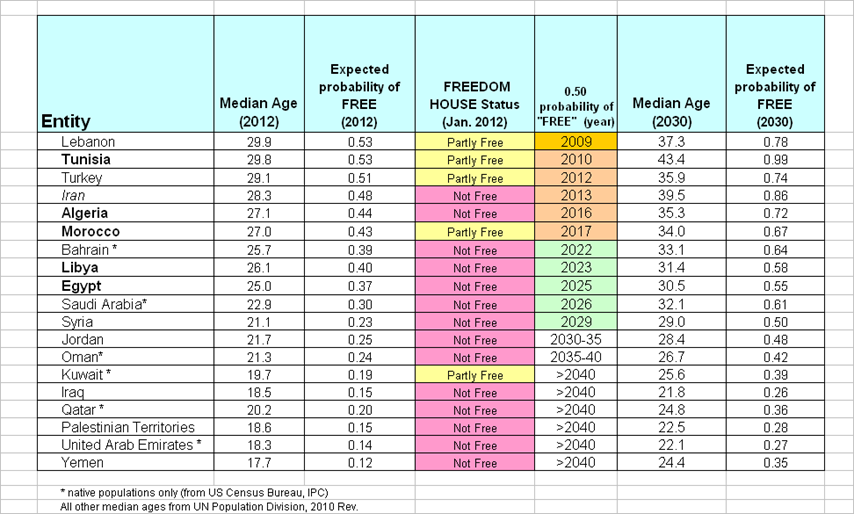
Cincotta, who consults with the National Intelligence Council on demographic issues, explained his “age structural maturity” model, which finds a historical correlation between the median age of countries and their Freedom House scores (an annual global assessments of political rights and civil liberties). Older populations tend to have more liberal regimes, while the opposite is true in younger populations. Combining this model with demographic projections, one can predict when it will become likely for democracy to emerge as a country ages. Before the Arab Spring – to some disbelief at the time – Cincotta used the model to predict that Tunisia would reach a 50/50 chance of achieving liberal democracy in 2011 (see more on this in his posts about Tunisia and the Arab Spring).
For those youthful countries that do achieve some level of liberal democracy, the model predicts they have a high likelihood of falling back towards authoritarianism (Mali is a tragic recent example).
This model, said Cincotta, can be a useful tool for analysts to challenge and add to their assessments. For example, it paints a bleak picture for democracy in Afghanistan (median age 16.6 years old), Iraq (18.5), or Yemen (17.7) and a comparatively rosier one for Tunisia (29.8), Libya (26.1), and Egypt (25.0). Some other observations may useful as well: no monarch has survived without some limits of power being introduced after countries reach a median age of 35, and military rulers too never pass that mark.
The age structural maturity model is, however, not perfect, Cincotta said. The most common outliers are autocracies (Freedom House score of “not free”) and partial democracies (“partly free”) with one-party regimes (China, North Korea), regimes led by charismatic “founder figures” (Cuba, Singapore), or those that where the regime is either supported or intimidated by a nearby autocratic state (Belarus).
Like all analyses, the model has its limitations, said Cincotta, but if used as a tool to generate “alternative hypotheses,” it can help predict dramatic political changes, like the Arab Spring. The research also suggests that the “third wave” of democratization is not over and will in fact continue to expand as countries with younger populations mature.
In conclusion, the panelists recommended the students find ways to include political demography in their work moving forward. “Consider it an alternative tool that may be useful,” said Geoff Dabelko. Policymakers today are overburdened with information and conventional analyses can sometimes become stuck in familiar lines of thought – demography can supplement these or shake them up by providing alternative narratives.
Sources: UN Population Division.
Photo Credit: Schuyler Null/Wilson Center; chart courtesy of Richard Cincotta. -
The Middle East Program
Reflections on Women in the Arab Spring
›The Arab Spring has fascinating and powerful demographic and gender undercurrents. Last year, demographer Richard Cincotta counseled observers to pay close attention to the demonstrations: if they featured young women – as opposed to being dominated by young men and boys – it’s a sign that democracy may be on its way. To mark the occasion of International Women’s Day last week, the Wilson Center’s Middle East Program gathered observations from a cross-section of regional voices on how women have fared thus far.
Excerpted below is the entry from Moushira Khattab, former Egyptian ambassador to South Africa and the Czech and Slovak Republics, and former minister of family and population:As the global community celebrates International Women’s Day, we must hail the heroic and pivotal role Egyptian women played to make the January 25th Revolution an inspiration for the world. They joined men and took to Tahrir Square calling for freedom, dignity, and social justice. They rallied around the cause of pushing the train of political change. One year later, Egyptian women find that the train of change has not only left them behind, but has in fact turned against them. It is ironic that the revolution that empowered a country, and made every Egyptian realize the power of their voice, stopped short of women’s rights. Sadly, the only march that was kicked out of Tahrir Square was that of women celebrating 2011 International Women’s Day. Women were beaten, subjected to virginity tests, and stripped of their clothes in the very same Tahrir Square.
Download the full set of reflections from the Wilson Center’s Middle East Program.
Dormant conservative value systems are being manipulated by a religious discourse that denies women their rights. Calls for purging the sins of the old regime necessitate a reminder of the positive outcomes of laws that, although enacted under that old regime, have liberated and enhanced women’s status, including prohibiting female genital mutilation and child marriage. We also need a reminder that such gains are only a step towards these rights, and are the outcome of collective hard work along generations. Against the background of parliamentary elections, defenders of women’s rights have backed down, while young revolutionaries don’t have women’s rights on their agendas. The most telling indicator is the shameful and meager representation of women in Egypt’s post-revolution parliament. Among a handful of elected female MPs, one declared that her top priority is to repeal the law granting women the right to seek divorce.
With religious parties controlling it, the question becomes: Will this parliament be willing and able to produce a constitution that guarantees equal rights to all Egyptians regardless of gender or religion? Dare we dream that Egyptians in 2012 could have a constitution equal to that put in place by South Africans in 1996?
Showing posts from category democracy and governance.