

Showing posts from category cooperation.
-
Mind the Gap: Forging a Consensus on Security and Climate Change in EU and US Foreign Policy
›March 5, 2009 // By Will Rogers “There are political and economic vulnerabilities that are in fact more important—or seem more important—to the participants of conflict than the physical vulnerability to climate change,” said Clionadh Raleigh at the February 19, 2009, event, “Climate Security Roundtable: U.S. and EU Research and Policy.” Raleigh, a lecturer at Trinity College Dublin, was joined by Nick Mabey, founding director and chief executive of E3G, and Sharon Burke, a senior fellow at the Center for a New American Security, to discuss climate change’s impact on conflict and how the United States and European Union (EU) have begun to adapt their foreign and security policies to the threat of climate change.
Ecological Change, Migration, and Conflict: A Complex Story
“The lack of access to power for certain communities, certain ethnic groups in sub-Saharan Africa, and basic access to resources among the most vulnerable populations has led to people misinterpreting the relationship that ecological change plays in their decision to either participate in conflict or to migrate,” Raleigh said. Although Raleigh’s research, which examined civil conflicts from 1990 to 2004, found that population density and growth were related to higher risks of conflict, “environmental pressures were not more likely to cause conflict in poor states—and not more likely during periods of instability,” she concluded. “Social, political, and economic factors are the most important determinants of civil war within developing countries,” she emphasized. “Poverty and unequal development come up time and time again.”
According to Raleigh, fears of mass international migration in response to climate change are overplayed. “Individuals and communities have quite a lot of coping mechanisms to deal with ecological difficulty,” including migration from rural to urban areas in the same country, she explained. Most migration, including labor and distress migration, “is temporary, internal, and circular,” she emphasized. “There is very little to no evidence that there will be an increase in international migration” in response to ecological change, although “there is evidence that there will be an increase in internal migration.”
Climate Change and Security: Perspectives from the EU“Climate change is serious,” emphasized Mabey. “It’s a threat multiplier, it will make unstable places less stable—it’s going to change strategic interests, alliances, borders, threats, economic relationships, comparative advantages, the nature of international relations, and the legitimacy of the UN.” In the future, “security policy will need to get more preventive and risk-based because climate change just injects a huge bolt of uncertainty into the future,” said Mabey. He urged the expansion of forward-looking information systems that provide policymakers with the data they need to make decisions at the geopolitical, strategic, and operations levels. He also said security experts should strive to communicate the potential consequences of climate change to decisionmakers.
The EU has taken steps to integrate climate change into its security strategy; Great Britain, Germany, and Denmark have taken the lead. The Arctic has been a particular focus, with security experts examining trade routes, maritime zones, and new access to resources. Climate change “is not all about instability” in fragile, impoverished states, Mabey explained. “The Arctic is by far the most important climate security issue in the minds of traditional foreign-policy types in Europe.”
Environmental Security Gets a New Tool: The Climate War GameLast year, Burke helped conduct a climate change war game based on a scenario of extreme weather events like droughts, wildfires, and cyclones. “Every country sort of hewed to what you would expect,” said Burke of the high-profile participants from China, India, Europe, and the United States. “The EU team spent the first two hours debating whether they could really be a country; the Indian team instantly came up with a negotiating strategy that sounded cooperative and brilliant but was completely impossible to execute; the Chinese team was, ‘No, we’re not going to do anything unless you pay us’; and the American team was keen to lead, only nobody was following.” One of the key lessons from the game, Burke explained, was that “everything comes down to what China is prepared to do.”
In developing the game, Burke and her colleagues discovered “that there’s a vast poverty of the kinds of information that you need to make decisions.” As Burke explained, policymakers need specific data “to obligate large amounts of money and personnel,” and the game revealed that “policymakers don’t have the information they need to make decisions.”
Photos: From top to bottom, Clionadh Raleigh, Nick Mabey, and Sharon Burke. Courtesy of Dave Hawxhurst and the Woodrow Wilson Center. -
VIDEO: Kent Butts on Climate Change, Security, and the U.S. Military
›February 5, 2009 // By Wilson Center Staff“Climate change is an important issue that can be addressed by all three elements of the national security equation: defense, diplomacy, and development,” says Kent Butts, in this short expert analysis from the Environmental Change and Security Program. Kent Butts, professor of political-military strategy at the Center for Strategic Leadership, U.S. Army War College, makes the case for considering global climate change a nontraditional threat to security and discusses how the U.S. military is reacting to a changing climate.
-
Head of AFRICOM Discusses Civilian-Military Cooperation
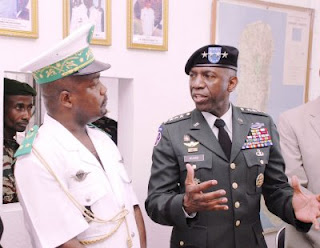
›January 28, 2009 // By Rachel WeisshaarCritics have warned that the new unified U.S. Africa Command (AFRICOM) could threaten the sovereignty of African nations and encroach on the portfolios of other U.S. agencies like the U.S. Agency for International Development (USAID). But in an interview with USAID newsletter FrontLines, General William E. “Kip” Ward, head of AFRICOM, went out of his way to dispel these fears. Some of the most interesting parts of the interview:
On AFRICOM’s humanitarian efforts:
“We know that our piece is only a very small part of the totality of humanitarian assistance that’s being performed by USAID and other agencies. We would not look to take those roles over.”
On civilian-military cooperation:
“We are learning to understand one another better and truly, as [USAID] Administrator [Henrietta] Fore and [Defense] Secretary [Robert] Gates said, we are seeing with greater clarity the importance of all these efforts working as cohesively together as they can. Security and development go hand-in-hand to produce stability that we all seek.”
On coordinating with USAID and host countries:
“We would get involved where those development projects complemented the work being done by developmental agencies, USAID, in very close coordination with the country team, the ambassador, and representatives from USAID that are there on the ground. We want to ensure that we don’t do things that conflict with the work being done by others. This might include a school being built so we can complement each other’s efforts. Or, at the request of a country, we might conduct an exercise and we may need to build a road to get to a training area. And if building the road in one place or another could help the population, then we would look to work with the country team and the ambassador so it provides benefits to the population.”
Photo: Comoran Defense Chief of Staff Salimou Mohamed Amiri (left) talks with General William E. Ward, commander of U.S. Africa Command (right), on January 21, 2009. Ward met with Comoran government officials as part of his first official visit to the island nation. Courtesy of by Kenneth Fidler, U.S. Africa Command. -
‘miniAtlas’ Misses Opportunity to Map Environmental Causes of Conflict
›January 7, 2009 // By Will Rogers“Former UN Secretary-General Kofi Annan said that there can be no development without security—and no security without development,” says the miniAtlas of Human Security, a global atlas illustrating international and civil conflicts, as well as human rights abuses. The atlas explains that human security comprises the broader pillar of freedom from want (for basic necessities like food, water, shelter, education, employment, and health care) and the narrower pillar of freedom from violence. Although freedom from want is vital to sustainable development and long-term security, the atlas only maps instances where freedom from violence has been marred by inter- or intrastate conflict.
While the atlas openly admits its exclusion of the broader pillar of human security—which notably includes environmental issues—it nevertheless misses the opportunity to acknowledge that the environment can span both pillars of human security. Though the atlas notes that the environment can be used as a weapon of violence—by poisoning wells, for instance—it never explains the role of the environment as a cause of violent conflict—in land disputes, local conflicts over water, or by spurring climate change-induced migration.
The authors of the miniAtlas of Human Security argue that today, most violent conflicts are rooted in poverty and politics. “Poor countries, unlike rich ones, lack the resources to address the grievances that can spark armed uprisings,” the report explains, and “poor countries tend to have weak security forces and so find it difficult to deter rebellions and to crush those that cannot be deterred.” In addition, dictatorships and “anocracies—regimes that are neither dictatorships nor full democracies—are the most prone to armed conflict” and human rights abuses. Though generally speaking, both of these statements are true, there are other causes of violent conflict that are just as important and have serious implications for human security.
For instance, the environment has helped spark conflict in many parts of the world. Competition over natural resources—whether diamonds in Angola and Sierra Leone, timber in Liberia, or coltan in the eastern Democratic Republic of the Congo—has been a source of violent conflict between warlords, governments, and civilian populations. Getting policymakers to recognize that the environment is a cause of violent conflict is an essential step to preventing conflict, as well as conducting successful post-conflict environmental and disaster management. Until we recognize that the environment can increase the risk of violence, global security itself will suffer.
Photo: The Zambezi (Chobe) River borders eight African states: Angola, Botswana, Namibia, Malawi, Mozambique, Tanzania, Zambia, and Zimbabwe. In an effort to improve governance and prevent violent conflict from erupting, these eight states are working for the establishment of a commission to govern this vital water resource. Courtesy of Flickr user Mara 1. -
VIDEO: Crisis Management and Natural Resources Featuring Charles Kelly
›December 19, 2008 // By Wilson Center Staff“Governance is key. If you don’t have a competent government after the war, you’re not going to solve the problems that weren’t solved before the war because of incompetent governance,” said Charles Kelly at “Sustaining Natural Resources and Environmental Integrity During Response to Crisis and Conflict,” a November 12 event.
In this latest video from the Environmental Change and Security Program, Kelly discusses the importance of carefully planning and executing post-conflict environmental assistance, which can lead to renewed conflict if not implemented properly. He highlights ongoing post-conflict and disaster management operations in Sudan and Haiti, offering suggestions for the way forward. -
PODCAST – Jean-Yves Pirot on PHE Integration and Environmental Management
›November 17, 2008 // By Wilson Center Staff“Time is pressing, and we need all hands on deck,” says Jean-Yves Pirot, an ecologist with the International Union for Conservation of Nature (IUCN), on the urgent need for conservationists to look outside their sector for help in improving sustainable environmental management in developing countries. In a podcast with ECSP’s Gib Clarke, Pirot, who coordinated the “Healthy People, Healthy Environment” stream at the recent World Conservation Congress, discusses the challenges of integrating population and health into environment programs. He urges conservationists to forge synergies with health and development specialists in order to scale-up small, short-term projects and provide long-term health and environmental benefits to the poor. -
Protecting the Soldier From the Environment and the Environment From the Soldier
›The end of the Cold War coincided with a decline in the total number of armed conflicts around the world; moreover, according to the UN Peacekeeping Capstone Doctrine, civil conflicts now outnumber interstate wars. These shifts have given rise to a new generation of peace support operations in which environmental issues are playing a growing role. The number of peace support operations launched by non-UN actors—including the EU and NATO—has doubled in the past decade.
The environment can harm deployed personnel through exposure to infectious diseases or environmental contaminants, so preventive measures are typically taken to protect the health of deployed forces. However, because environmental stress caused by climate change might act as a threat multiplier—increasing the need for peace support operations—it is ever more necessary for the international community to conduct crisis management operations in an environmentally sustainable fashion. But can the deployed soldier, police officer, or search-and-rescue worker really act as an environmental steward?
I believe important steps are being taken to ensure the answer to this question is “yes.” The UN Department of Peacekeeping Operations recently drafted environmental protection policies and guidelines for UN field missions and started to implement them through the UN Department of Field Services and the UN Mission in Sudan. Various pilot projects are underway, including an environmental awareness and training program and sustainable base camp activities, such as alternative energy use. These projects are coordinated by the Swedish Defence Research Agency and funded by the Swedish Ministry for Foreign Affairs.
Within NATO, Environmental Protection Standardization Agreements increase troop-contributing nations’ ability to work together on environmental protection. The NATO Science for Peace and Security Committee is also funding a set of workshops on the “Environmental Aspects of Military Compounds.”
Furthermore, defense organizations in Finland, Sweden, and the United States have cooperated to produce an Environmental Guidebook for Military Operations. The guidebook, which may be used by any nation, reflects a shared commitment to proactively reduce the environmental impacts of military operations and to protect the health and safety of deployed forces.
While the United Nations, NATO, and individual contributing nations are trying to reduce the environmental impact of their peacekeeping operations, the EU is lagging behind. In theory, the EU should find it easy to incorporate environmental considerations into its deployments. Most EU members are also NATO members, so if they can comply with NATO environmental regulations in NATO-led operations, they should be able to do the same with similar EU regulations in EU-led operations. Yet comparable regulations do not exist, even though the EU is often considered environmentally proactive—for instance, in its regulation of chemicals. Therefore, for the EU, it is indeed time to walk the walk—especially in light of its growing contribution to peace support operations, with recent operations conducted in Bosnia and Herzegovina and Chad, and an upcoming intervention slated for Somalia.
Clearly, no single organization can conduct all of the multifaceted tasks required to support and consolidate the processes leading to a sustainable peace; partnerships between military and civilian actors are indispensable to achieving global stability. We must do a better job mainstreaming environmental considerations into foreign policy and into the operations of all stakeholders in post-conflict settings, with the understanding that the fallout from a fragile environment obeys no organizational boundaries. One small step in this direction is an upcoming NATO workshop, “Environmental Security Concerns prior to and during Peace Support and/or Crisis Management Operations.” If militaries continue to contribute to climate change and other forms of environmental degradation, they will be partially to blame when they are called in to defuse or clean up future conflicts over scarce, degraded, or rapidly changing resources.
Annica Waleij is a senior analyst and project manager at the Swedish Defence Research Agency’s Division of Chemical, Biological, Radioactive, and Nuclear Defence and Security. The views expressed in this article are those of the author and do not reflect the official policy or position of the Swedish Ministry of Defence. -
Netting the Most From Improved Fisheries Governance
›October 7, 2008 // By Will Rogers“Frequently, we forget that environmental management is all about institutions and governance, and the decisions and trade-offs that we make,” said the University of Washington’s Patrick Christie at “Governance of Marine Ecosystem-Based Management: A Comparative Analysis,” a September 29, 2008, event sponsored by the Wilson Center’s Environmental Change and Security Program (ECSP). “And of course they need to be informed by ecological principles as well. But when it comes down to it, you’re managing individuals, institutions, [and] budgets.” Christie believes that as more and more marine species move dangerously close to extinction—whether from overfishing, pollution, or habitat destruction—ecosystem-based management (EBM), which governs ecosystems according to ecological rather than political boundaries, offers the best approach to marine conservation. This meeting was the final event in ECSP’s “Fishing for a Secure Future” series.
Decentralizing EBM
For Alan White of The Nature Conservancy, the Coastal Resource Management Project (CRMP), initiated by the U.S. Agency for International Development in 1996, exemplifies EBM’s success. Working in 111 coastal municipalities in the Philippines and covering approximately one-sixth of the country’s coastline, CRMP helped managers of municipal fisheries and marine protected areas (MPAs) collaborate with coastal law enforcement agencies to restore fish populations. EBM can be achieved, argued White, by allowing local municipalities to control simple regulatory schemes—so long as they are simultaneously sharing information with larger-scale networks. However, “the local governments have to be the ones to pay for this; they can’t be dependent on foreign donor projects or even large NGOs. It’s got to be sustained through the mechanism of governance and governments in those areas,” he said.
The Coral Triangle Initiative (CTI) regional action plan, drafted by the CTI’s six members—Indonesia, East Timor, the Philippines, Malaysia, Papua New Guinea, and the Solomon Islands—is designed to make ecosystem-based fisheries management “more mainstream in the region,” said White. Among the many factors decreasing fish populations in the region are illegal and commercial fishing, chemical poisoning, industrial pollution, coral bleaching, typhoons, and aquarium fishing, he noted, and to effectively address these problems, local municipalities and larger-scale actors must coordinate their strategies.
Curbing Illegal Fishing in the Philippines
Tetra Tech’s Nygiel Armada explained that the Fisheries Improved for Sustainable Harvests (FISH) Project in the Philippines’ Danajon Bank ecosystem demonstrates how improving control mechanisms can combat illegal and commercial fishers’ activities. The FISH Project focuses on improving control mechanisms, including the network of MPAs; species-specific management; gear restrictions; size limits on fish; registration and licensing; and zoning of fishing and water activities. Strengthening these mechanisms and combining them with cross-cutting initiatives such as information, education, and communication campaigns; better policies; and collaboration with law enforcement agencies led to more fish.
“Governance is only as strong as your weakest link,” emphasized Armada. The weakest municipalities—those that allowed illegal fishing practices to continue and failed to enforce control mechanisms—weakened overall gains. To sustain fish stocks and improve governance, all localities must work together to enforce control mechanisms.
Marine Governance, Large and Small
“As scale increases, and complexity increases, and control and potential for coordination become less feasible, there’s really [a] need to pay increasing attention to the context within which governance is taking place,” maintained Robin Mahon of the University of the West Indies, who studies the Caribbean large marine ecosystem. As Mahon argued, “policy cycles at all levels are important because different types of decisions take place at each level.”
Video of the event and PowerPoint presentations are posted on the Woodrow Wilson Center website.
Photo: Patrick Christie. Courtesy of Dave Hawxhurst and the Woodrow Wilson Center.
 “There are political and economic vulnerabilities that are in fact more important—or seem more important—to the participants of conflict than the physical vulnerability to climate change,” said Clionadh Raleigh at the February 19, 2009, event, “
 “Climate change is serious,” emphasized Mabey. “It’s a threat multiplier, it will make unstable places less stable—it’s going to change strategic interests, alliances, borders, threats, economic relationships, comparative advantages, the nature of international relations, and the legitimacy of the UN.” In the future, “security policy will need to get more preventive and risk-based because climate change just injects a huge bolt of uncertainty into the future,” said Mabey. He urged the expansion of forward-looking information systems that provide policymakers with the data they need to make decisions at the geopolitical, strategic, and operations levels. He also said security experts should strive to communicate the potential consequences of climate change to decisionmakers.
 Last year, Burke helped conduct a
  Critics have warned that the new unified U.S. Africa Command (
 “
“ “Frequently, we forget that environmental management is all about institutions and governance, and the decisions and trade-offs that we make,” said the University of Washington’s

