Showing posts from category conservation.
-
Geoff Dabelko on Finding Common Ground Among Conservation, Development, and Security at the 2011 WWF Fuller Symposium
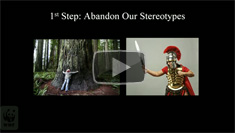
› Bridging the divide between the conservation and security communities “requires that we check some stereotypes at the door,” said ECSP’s Geoff Dabelko at the World Wildlife Fund’s Conservation Forward: Ideas That Work and How Science Can Effect Change symposium. Changes in global climate, as well as environmental threats more local in origin, require us to “find ways to minimize threats [and] maximize opportunities…from the dialogue between these different communities – and get out of our silos to do that,” said Dabelko.
However, this dialogue faces real challenges and concrete trade-offs. “There are big imbalances in terms of the resources that these different communities have,” and this often cuts the conversation short, he said. The conservation and security communities are also orientated towards some very different objectives and toolsets. But “given the levels of stress that our natural systems are under, given the level of dysfunction that are political systems are exhibiting, to me, it suggests that it’s a call for all hands on deck,” asserted Dabelko.
“The relationship between environment, natural resources, and violent conflict” is not the “only part of the story,” he said. Conservation goals can be achieved by preserving biodiversity on military sites and demilitarized zones, and through the Department of Defense’s new focus on reducing energy consumption. In the past, Russian-Norwegian-U.S. cooperation around de-commissioning Soviet-era nuclear submarines protected fragile Arctic habitats, prevented potentially dangerous technology from reaching world markets, and built confidence between recent adversaries. The dual potentials of “peace parks” in fragile and insecure borders across the Middle East have also garnered attention.
Environmental Peacebuilding
“Too often…natural resources are viewed as luxury items – what you worry about once you get rich, democratic, and peaceful,” yet, the environment is an “essential ingredient” for peace, Dabelko said. It is often “key to restoring livelihoods and jump-starting the economy” in conflict affected countries.
“Under a rubric or umbrella that we’re calling ‘environmental peacebuilding’ we have systematic efforts to…break those links with conflict,” he said. The future “concern is that because of environmental change, growth in population, growth in consumption,” and rampant inequities, climate change will act as a “threat multiplier.” “A risk analysis frame” is required to think through not only the risk of failing to act but also the risk of acting in ways that have the potential to create conflict if done poorly.
“We’re talking about changing access to resources and introducing money into uncertain political contexts – who gets it for what. That can be done well and that can be done poorly, and if you are talking to the folks in the conflict community, that’s often an inflection point for when conflict is a potential,” Dabelko said. In the context of potentially troublesome adaptations such as biofuel production, hydropower projects, and REDD+, this means taking seriously the well-worn, but apt, mantra of “do no harm” and working to maximize the “triple bottom line” of development, peace, and climate stability.
A question and answer period, moderated by USAID’s Cynthia Gill, followed the presentation with fellow speakers Anne Salomon of Fraser University, Michael Jenkins of Forest Trends, and Martin Palmer from the Alliance of Religions and Conservation (available below). -
More People, Less Biodiversity? The Complex Connections Between Population Dynamics and Species Loss
›March 8, 2012 // By Laurie Mazur“For if one link in nature’s chain might be lost, another and another might be lost, till this whole system of things should vanish by piece-meal.”
~ Thomas Jefferson, 1799This much is clear: As human numbers have grown, the number of species with whom we share the planet has declined dramatically. While it took about 200,000 years for humanity to reach one billion people around 1800, world population has grown sevenfold since then, surpassing seven billion last year.
-
The Ramsar Convention: A New Window for Environmental Diplomacy?
›In seeking ways to connect conservation with peacemaking, the Institute for Environmental Diplomacy and Security (IEDS) has released a study that examines an expanded role for the international wetlands treaty, the Ramsar Convention.
The Ramsar Convention: A New Window for Environmental Diplomacy? describes the wetlands convention, its place within the international environmental treaty world, and its potential to enhance environmental security during this dynamic time of increasingly insecure water supplies and climate change. With more than 40 years of work, the treaty has been quietly and effectively conserving wetlands and increasing recognition of the need to build international cooperation around them. The treaty has also helped define wetlands within greater biogeographic regions and led to formal identification of transboundary wetlands.
In the article, we set out to combine information from the convention’s 234 listed wetlands (13 of which have formal transboundary plans) with the Global Peace Index, which ranks countries using 23 indicators, such as number of conflicts, conflict deaths, military expenditures, and relations with neighboring countries. The result is a prioritized list of countries most in need of tools of conflict resolution.
Working within the framework of the convention builds capacity between high-conflict-risk nations and has potential to develop otherwise-difficult-to-establish trust because the process is transparent and all stakeholder voices are heard. This can be important even when the existing conflict has nothing to do with international wetlands.
The convention is active in many countries with ongoing conflicts, such as Afghanistan, the Democratic Republic of the Congo, Iran, Iraq, and Sudan, and efforts there may help inform the ongoing debate as to the efficacy of conservation as a tool for peacemaking.
As environmental conditions continue to evolve rapidly, the need for institutions that can work in the transboundary environment will increase. The established international infrastructure of the convention has the potential to be a greater force in peacemaking. Further research may help focus on the strengths and weaknesses of the current system and reveal ways for more effective peacemaking efforts.
Suggestions for ways to enhance the convention’s role in environmental diplomacy include working more closely with researchers and practitioners directly involved in the environmental peacemaking field, increased focus on developing capacity for increased flexibility to react to dynamic conditions, and more active promotion of formal transboundary agreements.
Pamela Griffin is an independent scholar at IEDS where she focuses on the diplomatic potential of transboundary wetlands. -
Assigning Value to Biodiversity, and the 2011 Human Development Report
›New research in the journal BioScience reports the aggregate economic benefits of conserving high priority biodiversity areas outweigh the opportunity costs of alternative land uses by a multiple of three (where priority is assigned according to a global index of the mapped distributions of 4,388 threatened terrestrial species). The authors of “Global Biodiversity Conservation and the Alleviation of Poverty,” led by Will Turner, estimate the value of highly diverse habitats to the global poor in terms of direct benefits and potential external payments for ecosystem services. They find these environmental flows in excess of $1 per person, per day, for 331 million of the world’s poorest individuals and conclude by arguing that, “although trade-offs remain…results show win-win synergies…and suggest biodiversity conservation as a fundamental component of sustainable economic development.” (For further discussion of development around biodiversity hotspots, see Population Action International’s work on population growth.)The 2011 UNDP Human Development Report, Sustainability and Equity: A Better Future for All, builds from the understanding that a “failure to reduce…grave environmental risks and deepening social inequalities threatens to slow decades of sustained progress by the world’s poor majority.” A resilient thread in the report highlights the importance of working to ensure women’s equality and reproductive rights for sustainability, claiming that “meeting unmet need for family planning by 2050 would lower the world’s carbon emissions an estimated 17 percent below what they are today.” The report closes with a wide range of policy suggestions that work towards the goal of equating sustainability and equity, including a supportive discussion of a currency transaction tax as a novel and feasible method of providing climate financing.
These pieces address contradictions between environmentally sustainable behavior and the development imperative. Though both acknowledge that the traditional development model of high intensity economic growth has imperiled the environment upon which the livelihoods of many hundreds of millions depend, they suggest practical ways forward. The Human Development Report in particular adopts some of the strongest language yet, claiming that, “the message is clear: our development model is bumping up against concrete limits.” This honest attempt to work through, rather than around, the tension between development and sustainability is perhaps an indication that we are at last beginning to take seriously the concept of sustainable development. -
The Unconquered: In Search of the Amazon’s Last Uncontacted Tribes
›In the far west of the Brazilian Amazon reside some of the last indigenous tribes on Earth untouched by modern society. In 2002, writer and photographer Scott Wallace, on assignment for National Geographic magazine, undertook a three month journey through the Javari Valley Indigenous Land on an expedition to map and protect the territory of the flecheiros, or Arrow People, named for the poison-tipped arrows they use. Wallace turned the chronicles of his adventure into a book while in residence as a Public Policy Scholar at the Wilson Center.
On November 21, Wallace returned to the Center to present his finished book, The Unconquered: In Search of the Amazon’s Last Uncontacted Tribes.
Over the past 40 years, Brazil’s policies towards indigenous tribes have changed dramatically, said Wallace – from initially wanting to “civilize” tribes through contact, to a modern hands-off approach. He explained that globalization and demand for rubber in the twentieth century meant more contact with indigenous tribes and, ultimately, more upheaval. As a result, many tribes took up hostile attitudes towards outsiders and retreated as far into the wilderness as possible.
Today, the Brazilian Department of Isolated Indians is attempting to map out the extent of uncontacted peoples’ lands in order to better protect them from intrusion. Over the last eight years since the book was written, the official number of uncontacted tribes has increased from 17 to 26. Javari Valley alone hosts eight distinct ethnic groups, making it the largest concentration of uncontacted tribes in the world.
The leader of Wallace’s expedition, Sydney Possuelo, is an explorer who was formerly the head of the Department of Isolated Indians and once one of Brazil’s most famous sertanistas (“agents of contact”). Possuelo is now a champion of the vision that we should no longer contact tribes, said Wallace, but only “identify them and get legal protection for [their] lands and erect control posts to keep intruders out.”
Old Tensions, New Threats
Although Wallace holds up Brazil as one of the countries with the most enlightened policies for native Indians in the Americas, he said there is cause for concern as intrusions continue. As Wallace notes on his blog, isolated Indians are known to travel extensively by foot during the dry season, appearing along the riverbanks as they search for turtle eggs buried in nests along the sandy beaches of the western Amazon. Mounting pressure from logging crews, wildcat gold prospectors, and seismic teams exploring for oil and gas are flushing these isolated indigenes out of the forests.
During their trek to map the flecheiros, Wallace’s group ran into an illegal gold mining operation, and, although they managed to take the dredge to the local authorities, Wallace said he fears corruption may have stymied justice.
Rights-Based Conservation
On the positive side, Wallace pointed out that by protecting indigenous tribes, the government is also protecting tens of thousands of acres of virgin rainforest in what is a mutually beneficial intersection of conservation and human rights. “Indians are the rightful owners of the land and the most efficacious guardians of the rainforest,” he said.
While there are many obstacles threatening the survival of uncontacted tribes, Wallace said that the situation is not hopeless and that conservation through protecting indigenous-rights in Brazil is a good starting point. “When there is a commitment to do something and resources are made available,” he said, “what seems like inevitable development, like the overrunning of forests, can be stopped.”
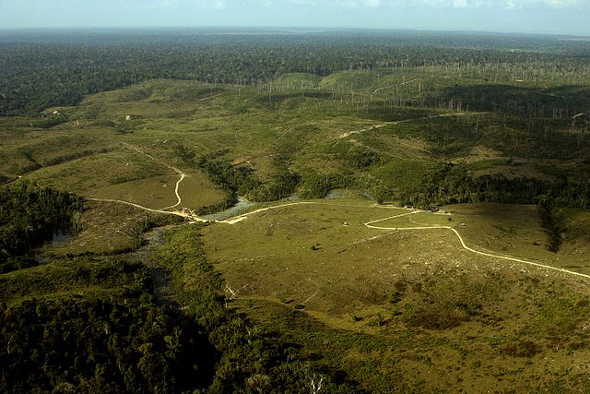
Event ResourcesPhoto Credit: “Brazil Amazon adventure,” courtesy of jonrawlinson. -
IRP Editors Cover Rwanda’s Population, Health, and Environment Challenges
›The original version of this article appeared on the International Reporting Project website.
The International Reporting Project (IRP) and 12 senior editors and producers from across the United States traveled to Rwanda this year to learn about issues affecting Rwanda and other countries in Africa and to help them improve their news organizations’ international coverage. Some of the editors focused on Rwanda’s extensive population, health, and environmental challenges:
Nicholas Aster, founder and publisher of San Francisco’s Triple Pundit, covered sustainable development in Kigali, coffee’s empowerment potential, and eco-tourism sites like Volcanoes National Park. Aster also became interested in Rwanda’s efforts to avert disaster by corralling Lake Kivu’s CO2 reserves into a power supply. At the close of his trip, Aster reflected on Rwanda’s sustainability goals in a photo essay.
Tom Paulson, host and reporter for KPLU’s Humanosphere, discovered the positive side of aid and development in Rwanda, including girls’ education initiatives and coffee farming improvements. Moreoever, Paulson documented the Gatekeepers’ trip to Volcanoes National Park, including a visit from a mountain gorilla who became a little too friendly. Paulson has also posted several questions the Gatekeepers asked President Paul Kagame when they met with him, including his policies on restricting free speech, curbing population growth, and preventing another genocide. At the close of the trip, Paulson composed a photo slideshow that shows a growing, vibrant Rwanda, and he also outlined 10 reasons why the complex and sometimes contradictory country can’t be described in a sound-bite.
Sue Horton, op-ed and Sunday Opinion editor of the Los Angeles Times, began chronicling her trip with a survey of Rwanda’s history on genocide, governance, and gorillas. On the road to meet Rwanda’s famed gorillas, Horton noted Rwanda’s strengths and challenges: its ambitious vision for the future encourages a growth in infrastructure and the country has showed impressive gains in healthcare provision and access, but Kigali is relocating residents who don’t fit the image.
The deputy managing editor of Global Post, Andrew Meldrum, also found a note of optimism in witnessing how far Rwanda has come since the genocide, particularly after hearing the testimonies of the genocide’s youngest victims: children born of sexual violence during the genocide. And his Global Post colleague Jon Rosen delves into the country’s population growth and the government’s approach to family planning.
In addition to the Gatekeeper Editor Trips, the IRP offers individual Fellowships to U.S. reporters to travel overseas on five-week reporting trips. In 2009, IRP Fellow Perry Beeman discovered a Rwanda similar to that which the Gatekeepers encountered: a country that has made much progress, but still has many challenges ahead. Beeman, who also was a public policy scholar at the Woodrow Wilson Center, created a multimedia series, “Renewal in Rwanda”, for The Des Moines Register; his reporting garnered him an Overseas Press Club citation for Best Reporting in 2010.
Rwandans, Beeman found, are dedicated to conservation. President Kagame is committed to the environment and is driven to develop clean, sustainable power and to convert from subsistence agriculture to a stronger, more diversified economy. But everyone has a hand in this effort, including schoolchildren who report on conservation in song, dance, and dramatic arts. Beeman also examined efforts to preserve the Gishwati Forest, including gorilla and chimpanzee preservation efforts from villagers to businessmen to researchers. Beeman emphasized the importance of immersing oneself in an environment in order to report on it, and he did so by, among other things, tracking wild chimpanzees in the forest.
For more information about IRP’s Fellowships and Gatekeeper Editor trips, visit their website at InternationalReportingProject.org.
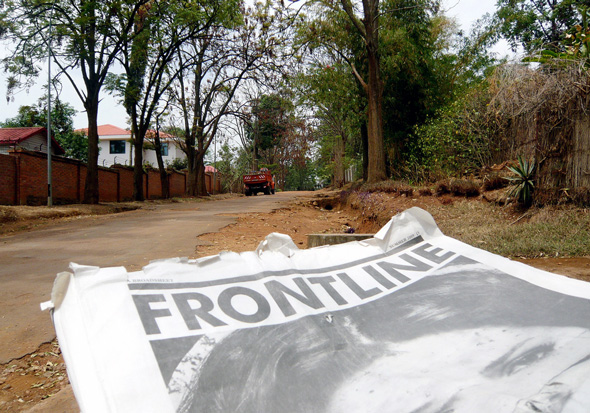
Photo Credit: “The Broadsheet in Kyovu, Kigali,” courtesy of flickr user noodlepie (Graham Holliday). -
From Dakar: Explaining Population Growth and Family Planning to Environmentalists
›December 19, 2011 // By Sandeep Bathala“There is a growing recognition that population is a key driver of environmental, development, governance, and security challenges; however, family planning is not a traditional tool, nor is it often considered an ‘appropriate’ one, for responding to food, water, climate, or conflict,” said Roger-Mark De Souza at a November 30 panel discussion at the 2011 International Conference on Family Planning in Dakar, Senegal. “This presents a challenge for us: How can we change perceptions of family planning so that it becomes part of the solution to wider problems, including natural resource scarcity, lack of economic development, gender inequity, and instability?”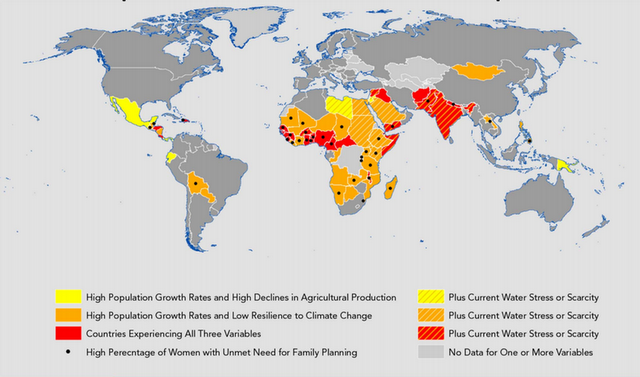
De Souza, vice president of research and director of the climate program at Population Action International (PAI), was joined by Sandeep Bathala, program associate with the Wilson Center’s Environmental Change and Security Program; Robert Engelman, president of Worldwatch Institute; and Daisy Magaña, fellow with the GoJoven Program, for a session on “Reaching Out at Rio: Explaining Population Growth and Family Planning to Environmentalists.”
Population Dynamics Part of Climate Vulnerability
“Advocates…need to communicate that empowering women to make their own reproductive choices will improve both their individual well-being and our collective environment,” said Engelman. According to research conducted on behalf of Americans for UNFPA, messages that focus on women – their health or empowerment – resonate well with American environmentalists, as they do with broader audiences.
PAI’s interactive mapping website shows that high levels of unmet need for family planning and rapid population growth rates are common in countries with low levels of resilience to climate change and high levels of projected decline in agricultural production, said De Souza. “Family planning services can be one element of a multi-pronged strategy to reduce especially women’s vulnerability to these interlocking vulnerabilities,” he said.
“Currently, population growth is viewed as a challenge to addressing climate change-related vulnerabilities, but family planning services are commonly left out of conversations about ways to reduce these vulnerabilities.” This is a lost opportunity, said De Souza: “We can integrate family planning into wider environmental, development, and peace-building efforts.”
At the recent UN Climate Change Conference in Durban, a side event on reproductive health and climate was well-attended. However, as panelist Esther Agbarakwe of the Africa Youth Initiative on Climate Change noted, population was not part of the conference‘s official discussion, due to lack of knowledge and fears of population control. PAI is currently working with UNFPA to produce a series of training modules on population and climate change that will help environmentalists, climate change activists, and researchers better understand and explore these connections.
Tapping the Youth Base
Bathala, formerly the Sierra Club’s Global Population and Environment Program director, discussed how the Sierra Club, one of the only major grassroots conservation organizations with a population program, uses youth outreach to raise awareness on the links between the environment, reproductive health, and women’s rights.
Because young people constitute over half of the world’s population, the Sierra Club focuses on empowering youth leaders to make the connection between environmental issues and sexual and reproductive health and rights. The Population and Environment Program reaches youth directly by organizing summits and multi-state campus tours featuring young people from around the world sharing compelling stories with their peers.
“The program provides youth and adult activists with materials, communication strategies, and leadership training,” Bathala said. “With these tools, the activists then educate their community members, campus, and decision-makers about the need for measures that increase access to family planning while addressing poverty, women’s empowerment, and environmental protection.”
In April, fellow panel member and Belize-native Daisy Magaña joined one of the Sierra Club’s U.S. tours to discuss the GoJoven program, which convenes and support youth reproductive health champions throughout Latin America. Through GoJoven, Magaña has worked to expand adolescent reproductive and sexual health choices, services, policies, and programs in Belize.
In a blog post, Magaña discussed how her message was simple: Don’t give up. “If you think being active on environmental and sexual rights issues is hard to do here, imagine doing it in a deeply conservative [Catholic] country like mine,” she told U.S. students.
Sierra Club also leads story tours to functioning population, health, and environment programs in the field, including a 2009 trip to Guatemala and Belize in conjunction with GoJoven. Through visits to 10 project sites, two U.S.-based youth advocates witnessed first-hand the challenges and opportunities associated with community-based sexual and reproductive health programs, significantly enhancing their ability to be pro-active messengers in their own communities. The tour helped the Sierra Club build an international network of young people committed to social and policy change in their countries.
Looking Forward: Finding Ways To Highlight Integration
While recognition of the connections between population growth and environmental impacts is growing, the experience of the panelists shows that it takes innovative methods to reach both the environmental and family planning communities. A similar panel later this winter at the Wilson Center will include representatives of Americans for UNFPA discussing their research on talking to environmentalists about reproductive health and population growth.
With the UN Conference on Sustainable Development (Rio+20) coming in June of next year, highlighting successful strategies is crucial in order to pave the way for better integration in the future.
Event ResourcesImage Credit: Roger-Mark De Souza/Population Action International. -
Watch: Dr. Vik Mohan on Integrating Family Planning and Conservation in Madagascar
›The integration of population, health, and environment programming “enables us to create synergies that mean we are more effective at achieving both health and conservation goals,” said Dr. Vik Mohan, director of sexual and reproductive health programming for Blue Ventures, in an interview with ECSP at the 2011 International Conference on Family Planning.
After Blue Ventures established their first clinic in 2007 in the village of Andavadoaka, on Madagascar’s southwest coast, “we felt immense pressure to scale up our intervention,” said Mohan. “We started with one clinic in one village, and now we have a multi-site service covering all 40 villages that we partner with for our community-based conservation work,” he said.
According to data compiled by Blue Ventures, the average total fertility rate in the region is 6.7 children per woman. The London-based eco-tourism-turned health and environment NGO offers a variety of family planning services to meet local demand, including mobile outreach clinics and community-based distribution of contraceptives. They also partner with Marie Stopes International to offer long-acting and permanent methods of contraception for those that want it.
“This Model Can Be Taken to Scale”
By integrating conservation and reproductive health messaging and service delivery, “we are getting greater buy-in from the community because they all see the added value of the breadth of things that we offer them,” Mohan said. “Men who came to hear about fisheries management get to hear about family planning technologies, practically for the first time in their lives.”
The fishermen are able to see the links between food security and population growth through their own experience, he added. “We believe very passionately this model can be taken to scale,” Mohan said. “This is something that could be easily replicated in other regions. Definitely in other coastal regions, but almost certainly in other remote areas – perhaps areas of high biodiversity where there are existing projects, perhaps conservation projects – but where there is an unmet need for healthcare and family planning in particular.”
“My advice to other organizations, whether you are doing healthcare or whether you are doing conservation, is just think holistically,” said Mohan. “If you are a conservation organization that recognizes that there is an unmet healthcare need for the communities that you work with, then…don’t be afraid to ask those questions, and don’t be afraid to build capacity to meet the need, if you find one. Or, don’t be afraid to partner with health NGOs to enable that need to be met.”
For more on Blue Ventures’ integrated efforts, see also ECSP FOCUS Issue 23, “To Live With the Sea: Reproductive Health Care and Marine Conservation in Madagascar,” co-authored by Vik Mohan.