-
Shape of Things to Come: Uganda’s Demographic Barriers to Democracy
›
In March, Uganda’s cultural landmark, the Kasubi Tombs, were destroyed in a suspicious fire. Tensions spilled over when Ugandan President Yoweri Museveni paid a visit to the Bugandan site and found his entrance blocked by an angry crowd. According to an independent newspaper, soldiers accompanying the president opened fire, killing three civilians.
With ethnic-tinged unrest and student protests in Kampala, as well as cross-border conflicts in the north and east, Museveni, who has led Uganda since 1986, is facing a potentially serious test as elections approach early next year. The country’s demographic profile, and in particular the lack of opportunities for growing numbers of young people, will add to the country’s challenges, as I argue in a new case study of Uganda’s demography.
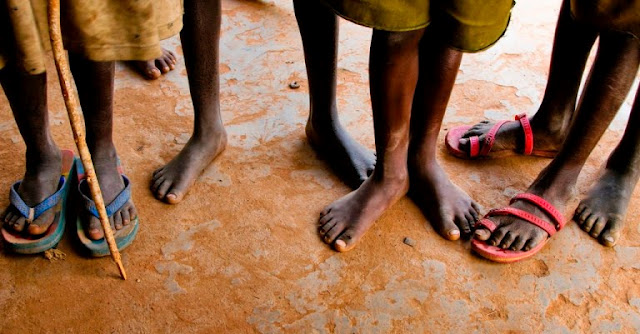
Uganda has the youngest population in the world, with 77 percent of its people younger than age 30. Women in Uganda have an average of 6.7 children each and 41 percent of married women have an unmet need for family planning. The population of Uganda is currently growing by about one million people per year, and given the force of its demographic momentum, Uganda’s population is likely to almost double by 2025 even if fertility declines.
Population Action International has found that countries with age structures like Uganda’s are the most likely to experience internal strife and autocratic governance. Between 1970 and 2007, 80 percent of outbreaks of civil conflict occurred in countries in which 60 percent or more of the population was younger than age 30.During that same period, 90 percent of countries with an age structure like Uganda’s had autocratic or only partially democratic governments.
Demography alone does not cause conflict. Most governments, even those with youthful populations, do not become entrenched in internal violence and upheaval. But age structure affects a country’s vulnerability to conflict, due to the demands a government faces in providing for its growing numbers.
In Uganda, young people face diminishing prospects in agriculture, the primary industry, as plot sizes shrink with each successive generation. At projected population growth rates, land density may increase 350 percent by 2050, from 122 inhabitants per km2 to a possible 551 inhabitants per km.
Only one-quarter of students who enroll in primary school reach the final grade, and even those with university degrees find few jobs. A reported youth unemployment rate of 22 percent is even higher in urban areas.
After 25 years in power, President Museveni will stand for a fourth official term in 2011. Despite growing dissent among his constituents, he appears confident of keeping his seat. Regardless of what happens next year,Uganda’s leaders must firmly commit to addressing their country’s demographic issues.
Age structure can become a window of opportunity if youth are engaged in society and couples can choose the number of children they can support. But in Uganda, that window remains far out of reach.
Three new case studies from Population Action International on Haiti, Yemen and Uganda examine the challenges specific to countries with very young age structures and recommend policy solutions.
Elizabeth Leahy Madsen is a senior research associate at Population Action International (PAI). She is the primary author of the 2007 PAI report The Shape of Things to Come: Why Age Structure Matters to a Safer, More Equitable World.
Photo Credits: “Atanga.pater.uganda,” courtesy of flickr user Kcarls. -
Demobilized Soldiers Developing Water Projects – and Peace
›Can demobilized ex-combatants help improve water resources in post-conflict countries? Last fall, the Global Water Institute (GWI) held a symposium in Brussels to find out.
Seventy representatives from the African Union, the United Nations, civil society, research institutes, and EU water policy advisors discussed ways in which former soldiers could be employed in the water sector to create peace dividends, bridge divided societies, and improve water security in countries recovering from conflict.
GWI, which is headquartered in Brussels and led by Valerie Ndaruzaniye, formerly of the Institute of Multi-Track Diplomacy’s Global Water Program, hopes to use the water sector development to meet multiple objectives in post-conflict reconstruction, such as:- increasing environmental security,
- reducing the likelihood of future conflict over water,
- enhancing security and stability, and
- employing demobilized ex-combatants to create peace dividends.
While disarmament, demobilization, and reintegration (DDR), is a fairly new process in post-conflict settings (the first program took place only 15 years ago), it has progressed rapidly in recent years, moving from a primarily military exercise to one focused on reintegration. Reintegration has also shifted from its exclusive focus on the ex-combatants, which often caused resentment in conflict-affected communities, to include women, children, youth, and the elderly and disabled, as well as the affected communities.
Reintegration is still the most difficult stage of any DDR program, not only for budgetary and political reasons, but also due to the processes of transitional justice and reconciliation. Through experience in the field, practitioners have realized that such programs are not simply technical exercises and must be better linked to wider recovery efforts and development programs for more sustainable results.
By supporting sustainable development in the water sector, and simultaneously contributing to reconciliation and peace dividends by involving ex-combatants in community development work, GWI can offer a substantial contribution to the reintegration process.
“Making the link between water management and DDR is a novel idea. GWI is a good example of integration of policy areas in order to build peace in some countries,” said Catherine Woolard, the director of the European Peacebuilding Liaison office.
Adrienne Stork is currently working on natural resource management and disarmament, demobilization, and reintegration programs jointly with the UNDP Bureau for Crisis Prevention and Recovery and the UNEP Disasters and Conflicts Unit in Geneva, Switzerland.
Photo Credits: Flickr User ISAFMEDIA, 080816-N-8726C-019 -
Book Review: ‘Global Warring: How Environmental, Economic, and Political Crises Will Redraw the World Map’ by Cleo Paskal
›April 9, 2010 // By Rachel PosnerAs record-breaking snowstorms blanketed Washington, D.C. this winter, I took advantage of the citywide freeze to read Cleo Paskal’s new book, Global Warring: How Environmental, Economic, and Political Crises Will Redraw the World Map. In it, Paskal makes a compelling case for why the West should care about the geopolitical shifts—already underway—that will be exacerbated by climate change.
Paskal eloquently explains the science behind climate change in layman’s terms, breaking down incredibly complex issues and drawing connections across seemingly disparate challenges, such as rising food prices, degrading energy infrastructure, and growing water scarcity. She is a skilled storyteller, using memorable vignettes (and at times even humor) to effectively illustrate these climate-related complexities.
But what truly sets Paskal’s book apart from a number of recent works on this topic is her ability to elucidate the major power shifts that are directly related to today’s climate and resource stresses. “Environmental change is the wild card in the current high-stakes game of geopolitics,” she writes (p. 249). Such natural resource stresses will only become more pronounced in the future.
Global Warring highlights a number of key challenges and opportunities that could take the United States and other Western nations by surprise if they don’t change policies now to secure their positions as major global powers.
Impacts of Environmental Change: Like the developing world, the United States and other Western nations will suffer from extreme weather events and the broader effects of environmental change. However, the United States has “institutional, regulatory, political, and social” weaknesses that affect its “ability to absorb the stress of repeated, costly, and traumatic crises,” including its expensive, aging infrastructure, writes Paskal (p. 40). For example, while the country will face more Hurricane Katrinas, the U.S. military is still not adequately prepared to address such domestic environmental disasters.
Transportation Routes and Trade: The Northwest Passage—the sea route that connects the Atlantic and Pacific Oceans through North American waterways—is a highly coveted trade route that will become all the more valuable as Arctic ice continues to melt in the years ahead. Already the United States, Canada, Russia, China, and even the European Union are engaged in a geopolitical chess game for control of the Arctic. Each is staking a claim to the natural resources below the surface, new shipping routes, and strategic chokepoints. According to Paskal, if the West wants to remain “a major force in the twenty-first century,” the United States and the EU should help Canada secure its claim to the Northwest Passage. This way, Canada could protect its borders and “talk to other countries, including Russia, on a more equal basis about creating and jointly using facilities like search, rescue, and toll stations, and on methods of speeding legitimate, safe shipping and exploration in the northern waters,” she writes (p. 125).
New Power Dynamics and Partnerships for China, India, and the West: China and India are two of the world’s fastest growing economies and each are taking on new roles in Asia and beyond. But could climate change and environmental challenges stem their growth, or will these “powerhouse” countries prove resilient? As the global power balance begins to shift toward Asia, Paskal sees India as the “swing vote” that might shape the future of geopolitics for the next long while” by aligning itself with Russia and China and potentially marginalizing the West (p. 185). Alternatively, the West could finally acknowledge India as an equal partner—for example, by strengthening civilian nuclear cooperation—and thus help foster stability over the long term. Stresses on natural resources, now and in the future, will only increase the importance of strong alliances and geopolitical partnerships.
Rising Sea Levels in the Pacific Ocean: Most Americans and other Westerners are not terribly concerned about the welfare of the small-island nations in the Pacific whose entire existence is threatened by sea-level rise. Paskal rightfully draws our attention to the ambiguous state of the international law of the sea, which leaves much of this region up for grabs when sea levels rise and coastlines change. “At stake is access to fisheries, sea-lanes in relatively calm waters, control over regional security, unknown underwater resources, geostrategic advantage, and geopolitical political leverage,” she writes (p. 214). China has already gone to great lengths to secure its control over the Pacific, and if it continues to be successful, the United States will risk losing influence in the region.
Throughout all of these cases, Paskal weaves in a discussion of the growing and strategically significant practice of “nationalistic capitalism.” For example, she describes how China’s state-owned companies work with their government to “advance national strategic interests,” often signing bilateral deals that “cut out the open market and overtly link much-needed resources to wide-ranging agreements on other goods and services, including military equipment” (p. 94-5). As China and other nationalistic capitalist countries expand their reach into the resource-rich regions of Africa and Latin America, fewer resources (like food and fuel) will be available in the open market. For the United States and other “free market” nations, this practice could lead to higher prices and increased competition for business and political alliances.
Overall, Global Warring is an excellent read that I would recommend to friends and colleagues, especially those tracking long-range global trends and promoting farsighted policies. I appreciated Paskal’s recurring call for abandoning short-term expediency in U.S. decision-making in favor of a longer-term approach. Paskal shows how over time the United States’ short-term interests are creating major vulnerabilities that will be worsened by environmental stresses in the future.
The book’s only notable shortcoming is its skewed geographic scope. Paskal focuses heavily on North America and Asia, particularly China and India, and only briefly mentions Africa, Latin America, the Middle East, and Australia. Obviously, a book about the shift of major world powers would concentrate on the most influential players, but these other regions are worthy of greater consideration given their critical natural resources, demographic trends, and ongoing climate adaptation efforts.
Regardless of how the climate changes, the environmental trends described in Global Warring are already manifesting as geopolitical realities that will dramatically affect the United States. As Paskal says, “Countries that want internal stability, influence over allies, control over sea-lanes, and access to critically important resources better start planning now (p. 235).
Rachel Posner is a fellow in the Energy and National Security Program at the Center for Strategic and International Studies (CSIS). Previously, she has served as the assistant director of the CSIS Global Water Futures Project; research associate with the CSIS Global Strategy Institute; and Brent Scowcroft Award Fellow with the Aspen Strategy Group. -
A Tough Nut to Crack: Agricultural Remediation Efforts in Afghanistan
›April 5, 2010 // By Julien Katchinoff“It was pretty much a normal day in Afghanistan on Monday.
Though only earning a glancing mention in The New York Times, it is heartening to see a response to the environmental and economic loss of Afghanistan’s once abundant wild pistachio forests. As a result of wide-spread environmental mismanagement and war, the past 30 years have seen a dramatic decline in the wild pistachio woodlands native to Northwestern Afghanistan.
“A couple of civilian casualties caused by insurgents. More investigations into corrupt former ministers. The opening of six new projects in Herat Province by the Italians and the Spaniards, which are the NATO countries in the lead in western Afghanistan. All right, not six, projects, but two or three, and the Spanish announced a pistachio tree-growing program to replace poppies. Pistachios, poppies… maybe pine nuts will be next.”
— At War: An Airborne Afghan Folk Tale, Alissa J. Rubin, New York Times, April 1, 2010
In a 2009 survey of Afghanistan’s environmental challenges, UNEP found that, while in 1970 “the Badghis and Takhar provinces of northern Afghanistan were covered with productive pistachio forests and earned substantial revenue from the sale of nuts,” few remain as the forests have since succumbed to mismanagement, war, and illegal logging.
In this video by the Post-Conflict and Disaster Management Branch of UNEP, scenes of dusty and denuded hillsides clearly show that rural Afghan farmers in search of sustainable livelihoods have few options remaining.
The project mentioned in the New York Times is a recent foray into remediation efforts by a Spanish Provincial Reconstruction Team (PRT) that targets communities previously involved in the production of illegal drugs. In conjunction with the Spanish Agency of Coordination and Development (AECID), the Spanish PRT is working in over 13 sites in Baghdis province–a region once covered in pistachio trees–to help farmers transition to legal crops and restore the traditional pistachio forests to their former prominence. AECID joins the Afghan Conservation Corps (ACC), USAID, NATO and additional partners in promoting remediation projects to reverse deforestation.
Unfortunately, these programs face daunting obstacles, as pistachio and other traditional Afghan cash crops –such as raisins, figs, almonds and other nuts– require substantial re-investments of time, money, and infrastructure development. Furthermore, convincing desperate rural farmers to transition to nearly untested alternative crops is difficult when they are currently counting the days to the spring opium harvest.
Recently, eradication efforts targeting small-scale farms have abated, and increased attention is being paid to facilitating shifts toward new products through free seeds, loans, technical assistance, and irrigation investments. If successful, these projects will grant rural Afghan communities the ability to sustainably and legally provide for their families, providing long-term employment and returns for a region lacking in both money and hope for the future.
Video Credit: UNEP Video, “UNEP observes massive deforestation in Afghanistan” . -
Conflict and Peacebuilding in Africa
›“Political Marginalization, Climate Change, and Conflict in African Sahel States,” authored by Clionadh Raleigh and appearing in the March 2010 issue of International Studies Review, examines the relationship between political status, economic status, and conflict among African communities threatened by climate change. “[T]he risk of conflict depends largely on the size and political importance of ethnic groups,” Raleigh finds. “Small, politically insignificant ethnic groups experience most conflicts related to environmental pressures.” The work is geared toward helping practitioners predict where high levels of vulnerability and conflict may occur in the face of climate change. (SUBSCRIPTION ONLY)The Initiative for Peacebuilding and Adelphi Research‘s Peacebuilding Across Lake Albert: Reinforcing Environmental Cooperation Between Uganda and the Democratic Republic of Congo uses the case study of Lake Albert to explore the possibilities for, and limits of, peacebuilding initiatives around natural resources and the environment. Looking specifically at protected areas, water and fisheries, and energy and oil, the study finds that resources can serve as “entry points for improving trust-building between and within countries,” even amidst heightened competition. Peacebuilding Across Lake Albert concludes that local stakeholder participation is integral to success and recommends that donor efforts focus on strengthening communal ties, creating opportunities for “benefits-sharing from sustainable resource management,” and increasing inclusiveness throughout the development process. -
On the Air With Arab Demographics
›A recent radio interview on the “Demographics of the Arab World” should be a must listen for those in the World Bank, where discussions of the Arab youth bulge are largely off the table.
The interview with Magda Abu-Fadil of the American University of Beirut and Bernard Haykel of Princeton University suggests that scholars of the Arab world are not so timid, as also evidenced by UNDP’s 2009 Arab Human Development Report.
However, during the interview with Abu-Fadil and Haykel, Worldfocus’ Martin Savidge falls victim to two significant misconceptions that are worth mentioning for their pervasiveness among political science and economics communities:- Savidge believes that countries tend to risk political violence when their percentage of young adults is above 35 percent. This is close, but not quite correct. It’s the proportion of young adults in the adult population – i.e., the working-age population, as opposed to the population in general – that indicates a risk of fractious politics. Children (those below the age of 14) should not be counted in this indicator, yet in much of the literature they mistakenly are.
- Savidge believes that large numbers of youth are an economic “good deal.” Here, Abu-Fadil and Haykel set him straight, noting that a bulge among the young adult population produces a demographic bonus only when fertility has significantly declined; the childhood cohorts are small and the subject of increased investment; and the youth moving into adulthood are educated.
Big changes could occur along the edges of the Arab world in the coming decade. Fertility decline, more recently, has made its way to the Gulf Cooperation Council (GCC) states, although they still need a champion for women’s rights. Turkey had Ataturk, Iran had Reza Shah, and Tunisia had Habib Bourguiba. It’s no accident that these countries were the first to experience fertility decline and age structural changes—their leaders laid the groundwork decades ago.
Can a leader, however, with that amount of political guts and conviction emerge from the Saudi royal family? I’m doubtful.
Richard Cincotta is demographer-in-residence at the H.L. Stimson Center in Washington, DC.
Photo: Yemeni children courtesy Flickr user kebnekaise. -
Guerrillas vs. Gorillas in the Congo Basin
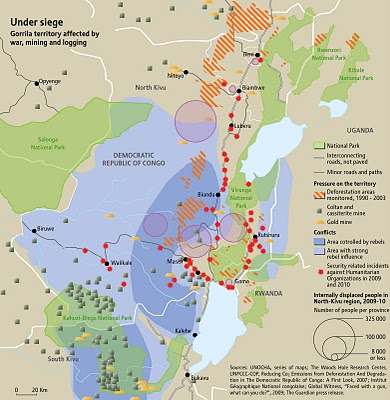
›Gorillas could disappear from the Congo basin in the next 10-15 years, according to a new report issued by the United Nations and Interpol. The Last Stand of the Gorilla – Environmental Crime and Conflict in the Congo Basin places responsibility for the decline of gorilla populations in the Democratic Republic of the Congo and its surrounding region squarely on the shoulders of resource-hungry militants, who poach gorilla bushmeat to feed hungry soldiers and mine workers and sell in local markets. Militants extract timber, charcoal, diamonds, and other resources to raise funds for arms, reducing gorilla territory.
Yet another rationale is retaliation against park rangers who attempt to limit their illegal activities within national parks. In the process, park rangers have found themselves, their parks, and their endangered charges targets of militant groups seeking to plunder and traffic goods through protected areas. “In Virunga Park alone, 190 park rangers have been killed in the last 15 years,” notes the report, which is also available in an interactive e-book edition.
Conflict with local communities also frequently leads to the slaughter of the gorillas and loss of their habitats. Displaced people and refugees also compete with gorillas for land. In several cases, gorillas facing shrinking natural domains have satisfied their appetites in banana plantations, and local farmers have struck back.Strengthening Law Enforcement
Not all, however, is dire. The report finds several success stories stemming out of transboundary law enforcement collaboration and recommends increased training and support for local and international law enforcement groups. “The gorillas are yet another victim of the contempt shown by organized criminal gangs for national and international laws aimed at defending wildlife,” said David Higgins, Interpol’s Environmental Crime Programme Manager. “The law enforcement response must be internationally coordinated, strong, and united, and Interpol is uniquely placed to facilitate this.”
Law enforcement in the Congo Basin faces an uphill battle, in part due to conditions present in peace agreements between guerillas and the Congolese government. Removing vehicle checkpoints from important border crossings was key to the insurgents agreeing to peace. While these agreements reduced violence, they have created a highway for illegal exports. This trade props up the militant groups and undercuts the chances for peace on a regional scale. It is an example of how large remaining quantities of automatic weapons and turns to poaching by ex-militants can render post-conflict environments even more damaging to local wildlife than war itself.
Toward Coexistence
In some locations, conflicts between gorillas and local farmers are disappearing with the construction of natural barriers and as local populations realize the potential of ecotourism to generate greater revenue from thriving gorilla populations than collapsing ones. Greater international coordination and local commitment, however, are necessary. Turning threatening competition into beneficial cooperation is possible.
Tara Innes is a PhD student at the University of Maryland, studying conflict-environment linkages.
Photos: Gorilla, courtesy Flickr user mrflip; Gorilla Territory Affected by War, Mining, and Logging courtesy UNEP/GRID-Arendal. -
Climate Change and Energy in Defense Doctrine: The QDR and UK Defence Green Paper
›March 30, 2010 // By Dan Asin“The Department of Defense is not the U.S. government lead for climate change, but we certainly can show leadership in this area,” Deputy Assistant Secretary of Defense for Strategy Amanda Dory recently told an audience at the Woodrow Wilson Center. “That’s true of energy as well.”
Showing posts from category conflict.