• woodrow wilson center
  • ecsp

New Security Beat

Subscribe:
  • rss
  • mail-to
  • Who We Are
  • Topics
    • Population
    • Environment
    • Security
    • Health
    • Development
  • Columns
    • China Environment Forum
    • Choke Point
    • Dot-Mom
    • Friday Podcasts
    • Navigating the Poles
    • Reading Radar
  • Multimedia
    • Water Stories (Podcast Series)
    • Backdraft (Podcast Series)
    • Tracking the Energy Titans (Interactive)
  • Films
    • Water, Conflict, and Peacebuilding (Animated Short)
    • Paving the Way (Ethiopia)
    • Broken Landscape (India)
    • Scaling the Mountain (Nepal)
    • Healthy People, Healthy Environment (Tanzania)
  • Publications
  • Events
  • Contact Us

NewSecurityBeat

The blog of the Wilson Center's Environmental Change and Security Program
Showing posts from category community-based.
  • Imelda Abano on the Challenges of Reporting on Population and the Environment in the Philippines

    ›
    Friday Podcasts  //  March 22, 2013  //  By Carolyn Lamere

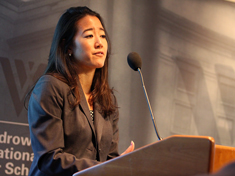
    In this podcast, Imelda Abano, who writes for Eco-Business in the Philippines, discusses her experiences reporting on population and environmental issues.

    “It’s a very tough job for us to be reporting on these issues, but we have the responsibility to raise awareness…and we have to push for government action,” Abano says.

    MORE
  • In Uganda, Integrating Population, Health, and Environment to Meet Development Goals

    ›
    Beat on the Ground  //  Guest Contributor  //  March 13, 2013  //  By Gladys Kalema-Zikusoka

    Fifty years after independence, Uganda has one of the highest population growth rates in the world at 3.3 percent – a rate which puts the country on track to nearly double in population over the next two decades. More than 50 percent of the population is under the age of 18. This large youth cohort will ensure that the country continues to grow for decades to come, even if couples choose – and are able – to have smaller families. And according to the State of Uganda Population Report 2011, “with more than one million people added to the population every year, the quality of [health] service delivery will suffer.”

    MORE
  • Sam Eaton Describes Population-Food-Environment Links in Rural Philippines

    ›
    Friday Podcasts  //  March 1, 2013  //  By Carolyn Lamere

    In this podcast, journalist Sam Eaton describes the process of producing two pieces that aired on Marketplace and NewsHour last year on the connection between population, the environment, and food security in the Philippines. Eaton visited the rural village of Humayhumay where PATH Foundation Philippines, Inc., has a pilot program distributing contraceptives and teaching community members about conservation and sustainable livelihoods. Although Eaton said he was at first hesitant to tackle such an “abstract concept” as integrated population, health, and environment development, he found on the ground that it had “all the elements of a good story” and there were tangible benefits visible within the community. Eaton discussed his reporting at the Wilson Center on January 28.

    MORE
  • Sam Eaton on Food Security, Family Size, and Family Planning in the Philippines

    ›
    February 13, 2013  //  By Graham Norwood

    “We chose the Philippines because we really wanted to do a story that looked at population growth,” reporter Sam Eaton says of his two-part contribution to the Food for Nine Billion project, which aired last year on PBS’ NewsHour and American Public Media’s Marketplace. Eaton recently visited the Wilson Center to discuss his experiences in the Philippines, describing the heavy toll overcrowding and poor resource management is taking on the country’s ecosystems and highlighting how access to family planning may hold the key to a better future.

    MORE
  • Fishing for Families: Reporting on Population and Food Security in the Philippines

    ›
    From the Wilson Center  //  On the Beat  //  February 11, 2013  //  By Carolyn Lamere

    “My income is just right to feed us three times a day,” Jason Bostero told Sam Eaton in the rural Philippine village of Humayhumay. “It’s really, really different when you have a small family.” Eaton traveled to the Philippines to report on the connections between food security and population for Homelands Productions, creating a short film and radio piece that ran on NewsHour and Marketplace as part the Food for Nine Billion series last year. [Video Below]

    MORE
  • Kagondu Njagi, AlertNet

    In Kenya, Water Stress Also Breeds Cooperation Between Competing Groups

    ›
    January 29, 2013  //  By Wilson Center Staff

    The original version of this article, by Kagondu Njagi, appeared on Thomson Reuters’ AlertNet.

    By the time the violence had died down, more than 80 people lay dead and hundreds were left homeless.

    Yet there was scarcely enough water – the resource the Maasai and Kikuyu tribes were fighting over – to wash away the blood that had stained this part of Kenya’s Rift Valley.

    MORE
  • Measuring Sustainable Development in Ethiopia’s Guraghe Zone

    ›
    Guest Contributor  //  January 11, 2013  //  By Alexon Ayele

    This miniseries focuses on the monitoring and evaluation of PHE projects in Ethiopia.

    Despite progress over the years, Ethiopia’s Guraghe zone, located in the Southern Nations, Nationalities, and People’s Region, faces many development challenges. As senior monitoring and evaluation officer in the Guraghe People’s Self-help Development Organization (GPSDO), I have been working in this region for more than five years trying to reduce poverty and improve socio-economic development. The organization as a whole has been here for more than 50.

    MORE
  • Five Questions for Population, Health, and Environment Projects in Ethiopia

    ›
    Guest Contributor  //  January 10, 2013  //  By Kristen Stelljes

    This miniseries focuses on the monitoring and evaluation of PHE projects in Ethiopia.

    Since the integrated population, health, and environment (PHE) approach is relatively new in international development, donors, partners, and implementers want to know how it’s improving people’s lives. In the PHE community, we believe that combining efforts to address natural resource management, reproductive health, and livelihoods is making a difference in places where rapid population growth combines with poverty and environment degradation. But to know for sure and be able to convince others, we need to have data to support those beliefs.

    MORE
Newer Posts   Older Posts
View full site

Join the Conversation

  • RSS
  • subscribe
  • facebook
  • G+
  • twitter
  • iTunes
  • podomatic
  • youtube
Tweets by NewSecurityBeat

Trending Stories

  • unfccclogo1
  • Pop at COP: Population and Family Planning at the UN Climate Negotiations

Featured Media

Backdraft Podcast

play Backdraft
Podcasts

More »

What You're Saying

  • Volunteers,At,The,Lagos,Food,Bank,Initiative,Outreach,To,Ikotun, Pan-African Response to COVID-19: New Forms of Environmental Peacebuilding Emerge
    Rashida Salifu: Great piece 👍🏾 Africa as a continent has suffered this unfortunate pandemic.But it has also...
  • A desert road near Kuqa An Unholy Trinity: Xinjiang’s Unhealthy Relationship With Coal, Water, and the Quest for Development
    Ismail: It is more historically accurate to refer to Xinjiang as East Turkistan.
  • shutterstock_1779654803 Leverage COVID-19 Data Collection Networks for Environmental Peacebuilding
    Carsten Pran: Thanks for reading! It will be interesting to see how society adapts to droves of new information in...

What We’re Reading

  • Rising rates of food instability in Latin America threaten women and Venezuelan migrants
  • Treetop sensors help Indonesia eavesdrop on forests to cut logging
  • 'Seat at the table': Women's land rights seen as key to climate fight
  • A Surprise in Africa: Air Pollution Falls as Economies Rise
  • Himalayan glacier disaster highlights climate change risks
More »
  • woodrow
  • ecsp
  • RSS Feed
  • YouTube
  • Twitter
  • Facebook
  • Home
  • Who We Are
  • Publications
  • Events
  • Wilson Center
  • Contact Us
  • Print Friendly Page

© Copyright 2007-2021. Environmental Change and Security Program.

Woodrow Wilson International Center for Scholars. All rights reserved.

Developed by Vico Rock Media

Environmental Change and Security Program

Woodrow Wilson International Center for Scholars

Ronald Reagan Building and International Trade Center

  • One Woodrow Wilson Plaza
  • 1300 Pennsylvania Ave., NW
  • Washington, DC 20004-3027

T 202-691-4000