-
PBS ‘NewsHour’ Reports on Reasons for Optimism Amid Niger’s Cyclical Food Crises
›Set in the middle of the arid region between the Sahara desert and the equatorial savannas of Africa known as the Sahel, Niger is no stranger to drought. In recent years, however, droughts have hit more often, started earlier in the season, and lasted longer, creating a cycle of food insecurity that is becoming more difficult to break.
-
Chaotic Climate Change and Adaptation in Fragile States
›In “Chaotic Climate Change and Security,” published in the June issue of International Political Sociology, Maximilian Mayer traces the transformation of climate change from a long-term problem to something that has taken on a new urgency in recent years. Understanding the non-linear nature of climate change – the “abrupt changes” that can come as environmental thresholds are crossed – has led to the securitization of the environment, writes Mayer. Unfortunately, the “doomsday rhetoric of scientists and campaigners about ‘tipping points’ has apparently failed to spur governments toward negotiating a meaningful agreement.” Climate change skepticism still exists, he points out, and even those who are convinced of the potential negative impacts of environmental change on state security have failed to reverse detrimental actions, choosing instead to focus on ameliorating the effects of change on their individual states. As a replacement for these failed frameworks, Mayer suggests that actor-network theory should be used as it better accounts for the interconnected nature of climate change. Katherine Houghton discusses the relationship between climate change and resilience in her article “Climate Change in Fragile States: Adaptation as Reinforcement of the Fabric of the State,” published in a collection of articles written by members of the United Nations University Summer Academy. Houghton writes that in fragile states, environmental issues can be “compounded by armed conflict and institutional failure,” which further destabilizes the country. She mentions cases in which the state lacks the authority to properly assist its citizens following natural disasters, like the flooding of the Indus Valley in Pakistan’s Federally Administered Tribal Areas. In these cases, failure of the government to meet citizens’ needs “fuels instability and fragility rather than fosters resilience.” Any action to reduce the effects of climate change on residents of vulnerable areas must thus begin with the state, she writes. “Without effective action to strengthen the state and thereby enable adaptation, climate-induced adverse effects and extreme events may lead to the further destabilization of already fragile states.”
 -
Urbanization and the Global Climate Dilemma
›Urbanization and climate change may be the two most important trends to shape global development in the decades ahead. On the one hand, urban cities have the potential to serve as engines of change, driving economic growth in some of the world’s least developed countries and pulling more people out of poverty than at any other time in history. On the other hand, climate change could undercut all of this by exacerbating resource scarcity and putting vulnerable communities at risk from sea level rise and more frequent and intense storms.
-
Tobias Feakin on the Debate in Europe About Climate Change and the Military
›“We established [the Climate Change Security Program] as a methodology of exposing the defense community in the U.K. and Europe to some of the more nuanced security debates that are going on around climate change, environmental change, and resource shortages,” said Tobias Feakin, senior research fellow at the Royal United Services Institute for Defense and Security Studies (RUSI) in an interview with ECSP.
What they found when they first approached the U.K. defense establishment in 2006, was surprising. “They opened [that] door wide open and said, ‘actually, you know what, we’ve been looking at this, we’ve been concerned about this for a long time, and we’ve already started including it in our long-term planning and strategic thinking.’”
“One of the reasons that the defense community has been looking at this issue is that they have a longer-term vision, if you like, than other departments,” Feakin said. “They have to think about procurement decisions which are going to be stretching out…up to 30 years into the future, so there are bigger demands on them to be thinking about these kinds of strategic issues.”
Feakin co-authored International Dimensions of Climate Change, a 2011 report for the British government which highlights the security threats and challenges, both internal and external, that the U.K. will face as result of climate change.
While the defense community acknowledged the need to include climate change in their planning processes, members of the policymaking community expressed concern that they did not, “have enough detailed understanding of what this [climate change] is going to mean in a security paradigm,” said Feakin. To meet that need, RUSI has been conducting regional and country-based studies in order to determine how things might play out.
Dialogue on the issue has transcended Great Britain and is now taking place among member states of the European Union, although Feakin notes that, “there’s perhaps more hesitancy in terms of framing the debate in the security paradigm and perhaps a slight perception that it might be leading us down the wrong path when mitigation efforts should be at the top of the order of play.”
Despite these ongoing debates, Feakin believes that the security aspect of climate change helps to “make a comprehensive case that we have a situation that does have to be dealt with and there are going to be multiple players in that.” Efforts to address climate change will be civilian-led, but the defense community will play an important supporting role in the future, he said.
“It’s something we have to plan for and we will be part of the response.” -
In Mongolia, Climate Change and Mining Boom Threaten National Identity
›July 23, 2012 // By Kate Diamond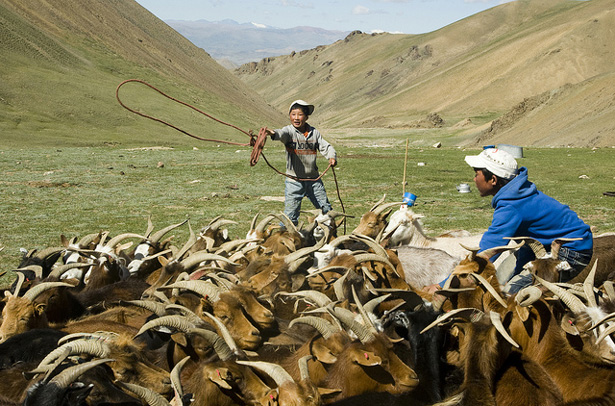
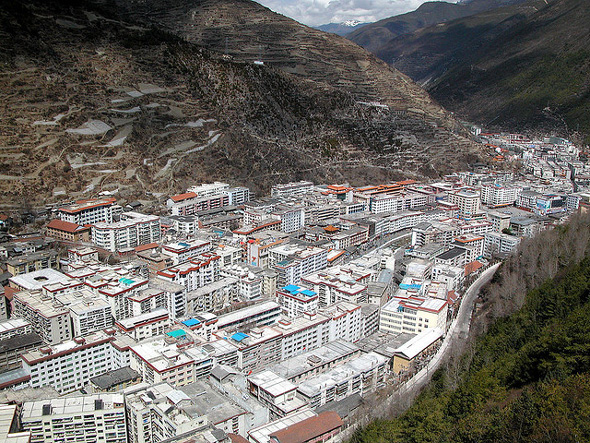
Mongolia, a vast, sparsely populated country almost as large as Western Europe, is at once strikingly poor and strikingly rich. Its GDP per capita falls just below that of war-torn Iraq, and Ulan Bator has some of the worst air pollution ever recorded in a capital city. At the same time, Mongolia sits atop some of the world’s largest mineral reserves, worth trillions of dollars, and its economy, already one of the world’s fastest growing, could expand by a factor of six by the end of the decade as those reserves are developed.
-
Visualizing Complex Vulnerability in Africa: The CCAPS Climate-Conflict Mapping Tool
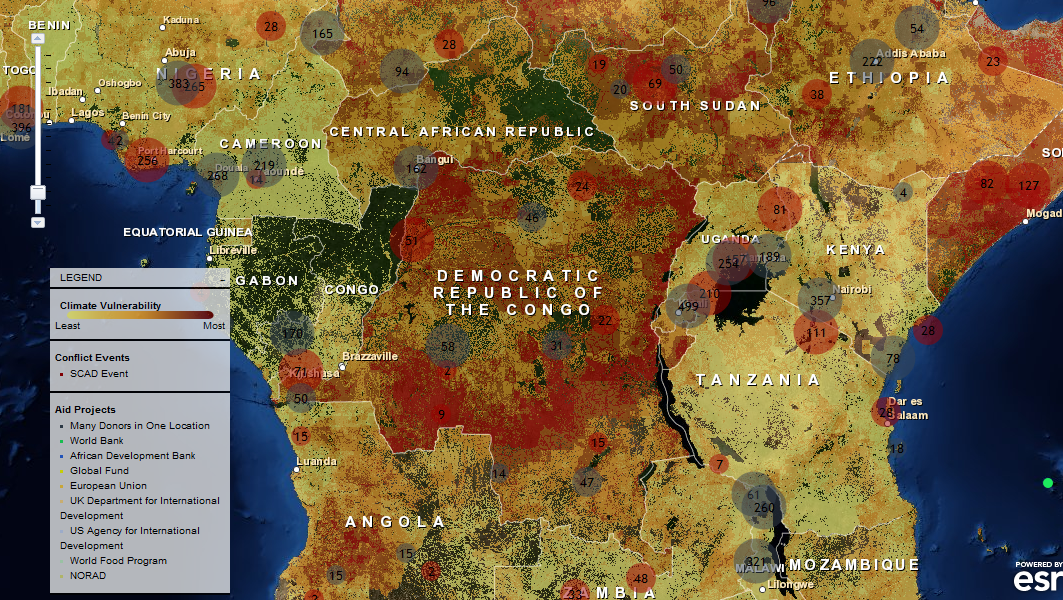
›“Every crisis is complex, and the Sahel is no exception,” wrote USAID Assistant Administrator Nancy Lindborg in a recent Huffington Post article that called for “smarter programming and a coordivenated response” to chronic crises. “A regional drought has been overlaid with instability stemming from the coup in Mali and conflict in the northern part of that country where armed militant groups have forced the suspension of critical relief operations” and led to refugee movement into neighboring countries simultaneously challenged by drought and crop infestation. Understanding the complexity of this type of crisis, let alone visualizing the multiple factors that come into play, is a growing challenge for policymakers and analysts.
Enter version 2.0 of a mapping tool created by the Climate Change and African Political Stability Program (CCAPS) housed in the Robert S. Strauss Center for International Security and Law, based at the University of Texas, Austin.
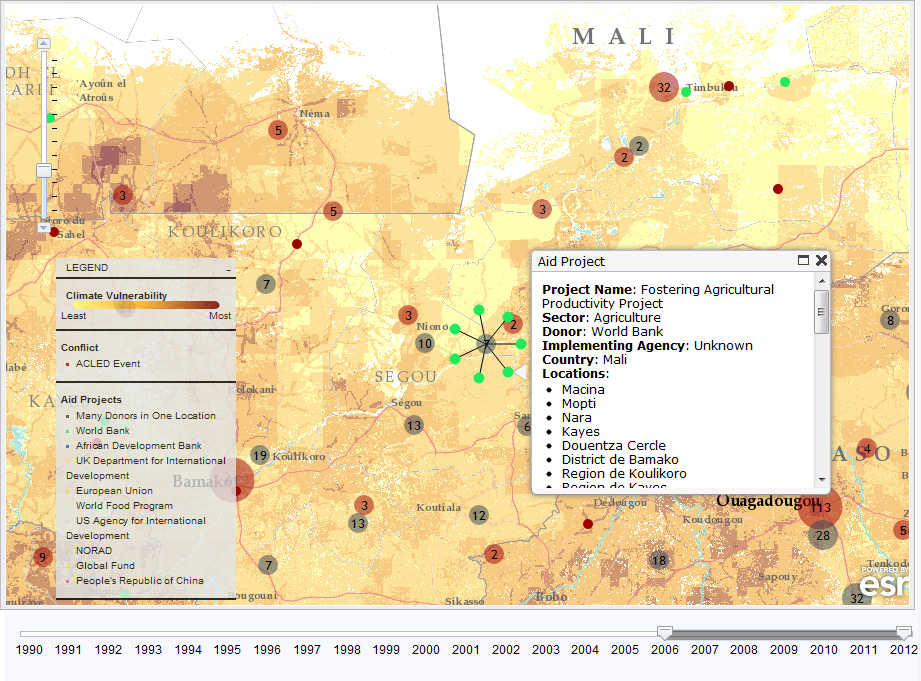
In collaboration with the College of William and Mary, Trinity College, and the University of North Texas, and with funding by the U.S. Department of Defense’s Minerva Initiative, CCAPS originally launched the mapping tool in March of this year. The map is powered by mapping and data tools from Esri and allows users to view any combination of datasets on international development projects, national governance indicators, incidences of conflict, and climate vulnerability data.
With an intuitive interface and compelling visuals, the mapping tool is a valuable resource for policy analysts and researchers to assess the complex interactions that take place among these environmental, political, and social factors. Advanced filters allow the user to identify a subset of conflicts and aid projects and there are nine base map styles from which to choose.The mapping tool is anything but static. The team is constantly working to refine and enhance it through the inclusion of additional indicators and improvement of the interface. The updated version now includes CCAP’s new Social Conflict in Africa Database, which tracks a broad range of social and political unrest, and their partners’ real-time conflict dataset, the Armed Conflict Location and Event Dataset (ACLED), which tracks real-time conflict data. Impressively, the ACLED data will be updated weekly.
I asked CCAPS program manager Ashley Moran to clarify how the governance indicators work in the model. She explained:The national governance indicators are included in one of four baskets that make up the climate vulnerability model…and represent four potential sources of vulnerability: physical exposure to climate-related hazards, population density, household and community resilience, and governance and political violence. They used the term “basket” since most include several indicators that reflect the full dimensions of that source of vulnerability. The fourth basket includes five national governance indicators and one indicator of political violence.
Moran also shared plans to add more detailed national governance data to the map:We are developing a mapping tool specifically for the climate vulnerability model, which will allow users to see the component parts of the model. It will allow users to re-weight the baskets (e.g. if a user thought governance should have more weight within the model since the government response to climate hazards is key), and it will also allow users to examine an area’s vulnerability to just one or two baskets of the user’s particular interest (instead of all four baskets combined as the tool does now). When we launch this, a user will essentially be able to see the vulnerability model disaggregated into its component parts, so they’ll be able to map just the governance data in the model, if they want.
In the coming months, the CCAPS team will add more detailed historical and projected data on climate vulnerability, data on disaster response capacity, as well as international aid projects coded for climate relevance.
Each of these datasets on their own are a wealth of vital information, but understanding how they intersect and the potential impact of their interactions is crucial to improving our understanding of them individually and collectively and creating responses that are timely and long-lasting.
If you’re in the San Diego area next week, check out Ashley Moran’s presentation of the mapping tool at the Esri International User Conference and the Worldwide Human Geography Data Working Group.
Sources: The Climate Change and African Political Stability Program, The Huffington Post.
Image Credit: CCAPS -
Center for American Progress Takes on Climate Change, Migration, and Why They Matter to U.S. National Security
›July 19, 2012 // By Kayly OberIn early 2012, the Center for American Progress (CAP) released Climate Change, Migration, and Conflict: Addressing Complex Crisis Scenarios in the 21st Century. Although generally in line with climate-migration pieces before it (“It is difficult to fully understand the detailed causes of migration and economic and political instability, but the growing evidence of links between climate change, migration, and conflict raise plenty of reasons for concern”), the report strays from the usual by focusing on U.S. national security interests and four particular sub-regions of concern.
Northwest Africa
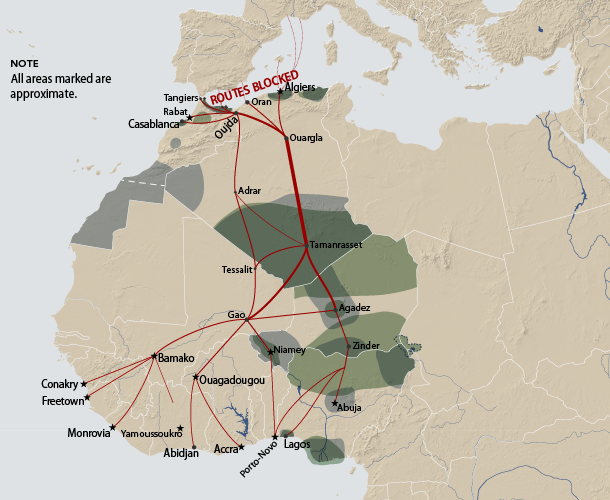
The first region examined – and the one perhaps most on the radar of security analysts at the moment – is Northwest Africa. Here the already-tenuous political stability left in the wake of the Arab Spring will most certainly be exacerbated by climate change, authors Michael Werz and Laura Conley write. “Northwest Africa is crisscrossed with climate, migration, and security challenges…rising coastal sea level, desertification, drought, and the numerous other potential effects of climate change have the potential to increase the numbers of migrants.” All of these factors combine to create what Werz and Conley define as an “arc of tension,” that will strengthen organizations that thrive on chaos, like Al Qaeda in the Islamic Maghreb, which has already taken advantage of the regional power vacuum left by Muammar Gaddafi’s ouster.
CAP investigates this arc of tension more fully in a more focused, separate brief on Northwest Africa, drilling down on Nigeria, Niger, Algeria, and Morocco. They find that these countries already grapple with a complex set of issues, including population pressures, drought, land degradation, large-scale migration, and natural resource conflicts. Climate change exacerbates all of these. Particularly worrying is the threat it poses to traditional pastoral and agricultural livelihoods, which could translate into “increasing numbers of disenfranchised youth, who security experts believe are more easily recruited to assist [terrorist groups] in return for money and food.”But environmental pressures and related conflict are not new in these areas, so how do we parse out the slow-onset climate change factors from the usual variety? That question is left unanswered and remains an open – and hotly debated – problem for researchers. The multi-faceted nature of migration, in particular, makes it hard to define the exact causes of movement.
On a larger scale, flagging the environment as the principal reason for migration has its problems, especially under the umbrella of “refugee” status. According to respected migration experts, using the term “refugee” in the case of environmental or climate scenarios is incorrect, since the environment is often simply one “push” factor, while economic opportunities make for a heavier “pull.” Furthermore, applying the term refugee in this case, they say, is misleading and undermines true political refugees.
CAP uses the less polarizing term “climate migrants” in their paper, saying “no universally accepted concepts, much less legal categories, exist to describe or define climate migrants. There is agreement, however, that factors such as drought, flooding, severe weather, and environmental degradation can cause human mobility in large numbers that are certain to increase in the near future.”
South Asia
In a case like Bangladesh and India, the second sub-region to be examined, the international community is preoccupied with rising sea levels, which is considered a more concrete example of climate change affecting migration. Ultimately, as CAP notes, it’s also a security issue:In December 2008 the National Defense University in Washington, D.C., ran an exercise that explored the impact of a flood that sent hundreds of thousands of refugees into neighboring India. The result: the exercise predicted a new wave of migration would touch off religious conflicts, encourage the spread of contagious diseases, and cause vast damage to infrastructure.
While true that India is “not in a position to absorb climate-induced pressures,” as Werz and Conley write, it’s not quite true that “foreign climate migrants” would be necessarily be an immediate problem, as they suggest.
India has a history of taking in Bangladeshi migration, with an estimated 10 to 20 million illegal Bangladeshis currently living in India, according to the Institute for Defence Studies and Analyses, an Indian think tank. Traditionally, Bangladeshis have migrated for a myriad of socioeconomic reasons, but most alluring are land availability and a stronger Indian economy. In any case, Bangladesh-India migration would not be new phenomenon.
The environment has also been a part of the equation, but in the case of large-scale sea level rise, its effect on migration can be a bit more nuanced. As the International Food Policy Research Institute noted in its study “Environmental Migrants: A Myth?,” Bangladeshis often have “risk-sharing and informal lending arrangements” to deal with idiosyncratic shocks, which include flooding. Instead, crop failure actually has the strongest effect on mobility. This suggests that it’s not just sea level rise that observers worried about environmentally-driven migration need to track in Bangladesh, but also drought and rain-induced flooding.
The Andes
The third region, the Andes of South America, also suffers from a slightly myopic security lens. Here, it’s all about melting glaciers and snowcaps. Retreating glaciers would spell disaster for countries which rely heavily on seasonal melt for agriculture and hydroelectric power. Most vulnerable are those with weak governance systems and infrastructure like Peru, Bolivia, Ecuador, and Colombia. For reference, hydropower supplies a whopping 80 percent of Peru’s electricity. However, there are more subtle impacts that could portend bigger trouble for the region.
Regional security experts concede that higher temperatures are already affecting crop production in rural Colombia, harming the ability to consolidate the security gains made by Plan Colombia over the last decade, for example. And a recent report from EUROCLIMA, the European Union’s program on climate change in Latin America, paints an even bleaker picture for agricultural production in the face of desertification and drought:Natural ecosystems, agriculture, water resources, and human health in Latin America have been impacted by unusual extreme weather events reported in the past years. For example, droughts related to El Niño impacts on the flows of the Colombia Andean region basins (particularly in the Cauca river basin), are causing a 30 percent reduction in the mean flow, with a maximum of 80 percent loss in some tributaries. Consequently, soil moisture, and vegetation activity are strongly reduced.
Perhaps more worrying is the impact on the biodiversity in the region. Considering that Latin America represents 16 percent of the world’s surface but 40 percent of its biodiversity this could have serious implications for the biomedical field and others. In a recent Nature study, scientists discovered that in situations where glacial coverage is reduced to the point where it only covers 30 to 50 percent of the drainage basin, several species begin to disappear. They calculated that the entire melting of the glaciers in these areas would result in a huge loss of biodiversity, where between 11 and 38 percent of animal and plant species could go extinct, including many of endemic species that can be found only in these areas.
China and the Third Pole
Finally, China is now in its fourth decade of ever-growing internal migration, some of it driven in recent years by environmental change. Today, across its vast territory, China continues to experience the full spectrum of climate change-related consequences that have the potential to drive migration. CAP finds that the consequences of climate change and continued internal migration in China include “water stress; increased droughts, flooding, or other severe events; increased coastal erosion and saltwater inundation; glacial melt in the Himalayas that could affect hundreds of millions; and shifting agricultural zones” – all of which will affect food supplies and the country’s seemingly relentless pace of development. Still, the most unique factor of migration in China is the power of the central government to be the main “push factor,” as in the case of the Three Gorges Dam.
Agreeing to Agree
Though they might sacrifice some nuance in the regional breakdowns, the core of CAP’s argument for why climate migration matters to U.S. national security is solid. The United States has a “vested interest in helping ensure that areas with weak or absent governance structures – where poverty, environmental degradation, and grievances over central governments and energy production coincide – do not become future recruiting grounds for extremists,” write Werz and Conley. “The possible impacts of climate-related migration in such fragile situations could be destabilizing.” Invest in people rather than just military might; invest in poverty reduction, economic development, and alternative livelihoods.Jon Barnett on migration as adaptation
In the context of climate change, this means accepting that migration is a form of adaptation. As Jon Barnett notes in an interview with ECSP:In some circumstances it might be appropriate to [invest in traditional adaptation projects like] infrastructure and hard options where we’re very certain about the nature of the risk…but in other cases, expanding the range of choices and freedoms and opportunities that people have to deal with climate change in the future is perhaps the better strategy.
This requires higher-level thinking by states to concede that migration will happen and it isn’t necessarily a bad thing. Migration bolsters origin communities through remittances and education and technology sharing. But this thinking has yet to permeate policymaking, with obvious political reasons. Until then, states that are committed to preventing migration are actually cutting off important community responses.
Ultimately, what we consider adaptation and development needs to evolve. By investing in an integrated, multi-sector development approach, we can prevent violent responses to migration at the source rather than relying on reactionary and military solutions. Or, as CAP’s Michael Werz and Laura Conley put it more boldly, “our security can no longer be guaranteed by military strength or economic clout alone, but only by our ability to compel collective action.”
Photo credit: “Villagers going to the local market in Bogoro walk past a Bangladeshi patrol unit of the United Nations Mission in the Democratic Republic of the Congo (MONUC) as the country prepares for the second round of elections. 12/Oct/2006. UN Photo/Martine Perret,” courtesy of United Nations Photo Flickr.
Sources: Center for American Progress, Institute for Defence Studies and Analyses, Inter-American Development Bank, International Food Policy Research Institute, Nature, The World Bank.
Video Credit: “The Nexus of Climate Change, Migration and Security,” courtesy of the Center for American Progress. Image: “The Arc of Tension,” courtesy of the Center for American Progress. -
Geoff Dabelko at the Aspen Environment Forum: “We Have to Find Ways to Do Things Differently”
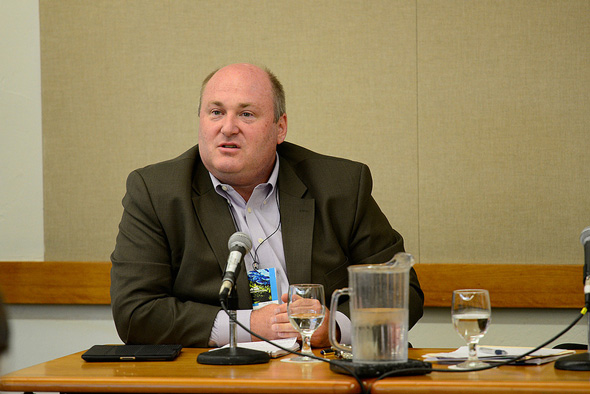
›July 9, 2012 // By Graham NorwoodECSP Director Geoff Dabelko was in Colorado last month to participate in the fifth annual Aspen Environment Forum, a three-day series of discussions about some of the world’s most vexing environmental concerns, hosted jointly by the Aspen Institute and National Geographic. Dabelko took part in two panel discussions, considering recent efforts to “green” the U.S. military in one and addressing the nexus of climate change and conflict in the other.
The U.S. Department of Defense is currently pursuing an ambitious strategy to minimize its dependence on oil, aiming to produce 25 percent of its power from renewable energy sources by 2025. During the 75-minute “Is the Military a Model?” panel, Dabelko joined Sharon Burke of the Department of Defense, Sherri Goodman of CNA, and U.S. Army Major General Joseph Anderson to discuss the extent to which the military’s embrace of more efficient and alternative technologies can spur wider innovation and adoption. Many have previously cited the military’s role in developing technologies like the Global Positioning System and the internet as a reason for optimism in this regard.
The “Climate and Conflict” panel, meanwhile, addressed how and to what degree climate change might affect future conflicts. According to Scientific American, “the consensus was that climate change per se will not cause conflict, armed or otherwise, but will exacerbate existing conflicts and instabilities.”
This was Dabelko’s third trip to the Aspen Environment Forum, and he spoke enthusiastically about the event in a brief interview with genConnect, which was covering the event. “The experience has been excellent,” he remarked, highlighting the diversity of participants as one of the forum’s greatest strengths.Dabelko acknowledged that much work remains to be done to achieve environmental and energy-related goals, but praised the realistic and grounded approach of attendees: “We have a tremendous set of challenges, and we’re not yet really succeeding in addressing them. So there’s a self-reflection that what we’ve been doing isn’t necessarily getting us where we want to get, and so we have to find ways to do things differently.”
One way to improve, according to Dabelko, is to work on communications. “[We need to have] conversations about complex issues, [and we] need to understand how to make them more accessible and more simple. But ‘simple’ does not mean ‘dumb’ or ‘incorrect’…we need to get smarter about how to have these conversations with wider and [more] diverse audiences.”
Photo Credit: Geoff Dabelko, courtesy of the Aspen Institute. Video: genConnect.
Showing posts from category climate change.