-
Managing the Planet: The World at Seven Billion
›
Population growth “is highly concentrated in what are today the poorest and least well-governed areas of the world,” said George Mason University professor Jack Goldstone at the Wilson Center on December 5.
Goldstone was joined by Suzanne Ehlers, president and CEO of Population Action International (PAI), and Matthew Erdman, population-health-environment technical advisor at USAID, to discuss the implications of seven billion people and counting for the environment as part of the joint Wilson Center-George Mason University Managing the Planet series. [Video Below]
-
Autumn Spanne, The Daily Climate
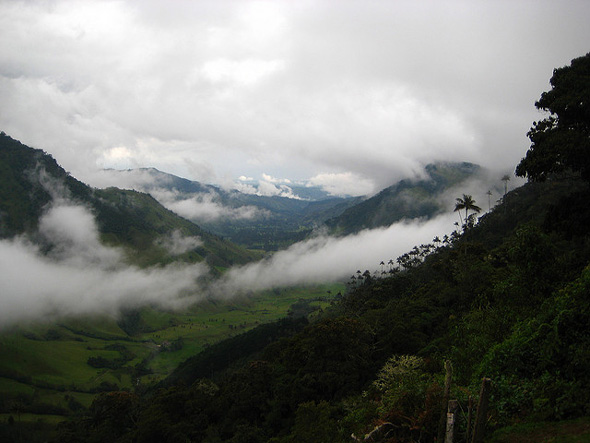
Colombia’s Unexplored Cloud Forests Besieged by Climate Change, Development
›December 13, 2012 // By Wilson Center Staff
The original version of this article, by Autumn Spanne, appeared on The Daily Climate.
Five hours by truck and mule from the nearest town, a rumbling generator cuts through the silent night to power large spotlights as botanists crouch and kneel on large blue tarps spread across a cow pasture. It’s nearly midnight, and the team works urgently to describe every detail of the dozens of colorful orchids, ferns, and other exotic plants they have collected that day in Las Orquídeas National Park, one of the single most biologically diverse places on the planet.
-
Climate Change’s Impact on Human Development
› One of the greatest challenges in addressing climate change is the uncertainty of outcomes. The world is warming and greenhouse gases are accumulating at an unprecedented rate – what does that mean for the future of human development? In Barry B. Hughes, Mohammod T. Irfan, Jonathan D. Moyer, Dale S. Rothman, and José R. Solórzano’s paper, “Exploring Future Impacts of Environmental Constraints on Human Development,” they describe three possible futures for the world (a base line scenario, an environmental challenge scenario, and an environmental disaster scenario) and their potential impact on the indicators of the Human Development Index (HDI). The environmental disaster projection features a flat-lining HDI starting around 2015, with global life expectancy at birth seven years shorter than the baseline in 2060. The report also notes that the future of the planet will be drastically different if the world population peaks “well before 2100,” as is the case in the base line scenario, or continues to grow, as it does in the other scenarios. -
National Intelligence Council Releases ‘Global Trends 2030’: Prominent Roles Predicted for Demographic and Environmental Trends
›“We are at a critical juncture in human history, which could lead to widely contrasting futures,” writes the chairman of the National Intelligence Council (NIC) Christopher Kojm in the council’s latest forward-looking quadrennial report, Global Trends 2030: Alternative Worlds, released yesterday.
This year, principal author Mathew Burrows and his colleagues focus on a series of plausible global scenarios for the next 20 years and the trends or disruptions that may influence which play out. Among the most important factors in these projections are demography and the environment.
-
World Bank Issues Dire Warning About “Four Degree World”
›December 10, 2012 // By Carolyn LamereWithout decisive action, global temperatures could rise by at least four degrees Celsius (seven degrees Fahrenheit) by the end of the century. A new World Bank report says that such a world would be “so different from the current one” that it would be difficult to even anticipate the challenges we would face.
-
CCAPS Looks to Map Climate-Related Aid in Africa
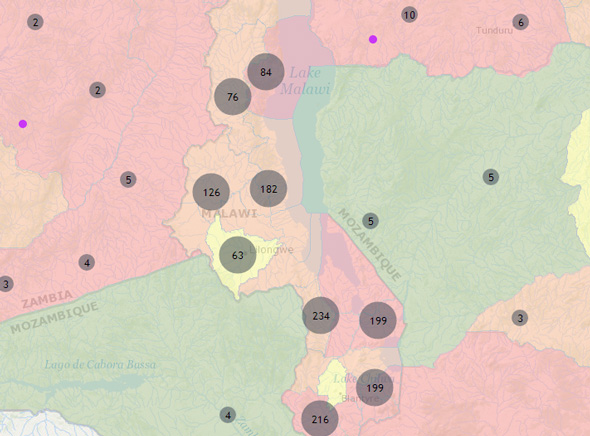
›Adapting to the effects of climate change is increasingly becoming an important component of many international development efforts. But how that integration occurs and what it looks like is an open question. To help answer that, the Climate Change and African Political Stability Program (CCAPS) at the University of Texas at Austin recently released a new database that for the first time tracks all the climate-related aid in one country – Malawi.
-
Climate Change’s Health Impacts, and the Rights-Based Argument for Family Planning
›UNFPA’s recently released State of World Population 2012 brings family planning to the center of the development debate. “There is indisputable evidence that when family planning is integrated into broader economic and social development initiatives, it can have a positive multiplier effect on human development and the well-being of entire nations,” the authors write. The report employs a rights-based approach to make the case for universal access to family planning – a goal which we are far from as 222 million women from the developing world currently have an unmet need for modern contraceptives. Meeting this need and improving quality of reproductive healthcare elsewhere would cost an additional $4.1 billion a year, but save approximately $5.7 billion in maternal and newborn health services. Other recommendations include increasing financial support and political commitment to ensure that family planning is of high quality, reducing the number of unintended pregnancies and abortions, including emergency contraception in family planning services, and engaging boys and men. -
Considering “Soft Geoengineering”
›Even as the climate debate has been paralyzed by politics, the concept of geoengineering has been in the news lately, most notably in October when Russ George dumped 120 tons of iron particles into the Pacific Ocean in a scheme to try and score carbon credits. Earlier this month, the Wilson Center’s Science and Technology Innovation Program hosted an event taking a look at “soft geoengineering” – techniques that might have low or minimal environmental side effects but still address or reverse climate change.
Showing posts from category climate change.