• woodrow wilson center
  • ecsp

New Security Beat

Subscribe:
  • rss
  • mail-to
  • Who We Are
  • Topics
    • Population
    • Environment
    • Security
    • Health
    • Development
  • Columns
    • China Environment Forum
    • Choke Point
    • Dot-Mom
    • Friday Podcasts
    • Navigating the Poles
    • Reading Radar
  • Multimedia
    • Water Stories (Podcast Series)
    • Backdraft (Podcast Series)
    • Tracking the Energy Titans (Interactive)
  • Films
    • Water, Conflict, and Peacebuilding (Animated Short)
    • Paving the Way (Ethiopia)
    • Broken Landscape (India)
    • Scaling the Mountain (Nepal)
    • Healthy People, Healthy Environment (Tanzania)
  • Publications
  • Events
  • Contact Us

NewSecurityBeat

The blog of the Wilson Center's Environmental Change and Security Program
Showing posts from category climate change.
  • Reaching for Resilience in East Africa

    ›
    From the Wilson Center  //  July 26, 2018  //  By Daniel Lohmann
    woman-PREPARED-Tetra-Tech

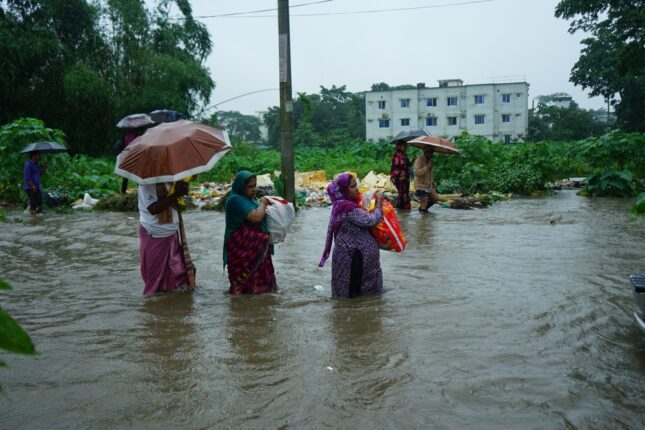
    “Resilience isn’t an outcome, it is a process—and capacity-building is crucial,” said Chelsea Keyser, Deputy Chief of Party for USAID’s PREPARED program, during a recent event at the Wilson Center marking the end of the five-year project. PREPARED (Planning for Resilience in East Africa Through Policy, Adaptation, Research, and Economic Development) developed 14 different tools to help communities adapt to the impacts of the changing environment in the East African region, including unreliable rainfall and rising temperatures.

    MORE
  • Mapping Climate Security: New Dashboard Tool Visualizes Complex Vulnerability in Asia

    ›
    Eye On  //  July 25, 2018  //  By Olivia Smith
    India-Map

    In many parts of South and Southeast Asia, high population density and vulnerability to climate change combine with low levels of household resilience and poor governance to increase security concerns and the potential for political instability. To help identify risks and hotspots in this critical region, the Complex Emergencies and Political Stability in Asia (CEPSA) program at the University of Texas-Austin recently launched the Complex Emergencies Dashboard, which integrates raw data and modeling with mapping technology, allowing users to visually analyze regional security issues. The project was funded by the Department of Defense’s Minerva Initiative, which also supported similar work by the university’s Climate Change and African Political Stability (CCAPS) program.

    MORE
  • Coastal Resilience on Capitol Hill: Protecting the United States’ Infrastructure, Economy, and Security

    ›
    On the Beat  //  July 24, 2018  //  By Rebecca Lorenzen
    RI-National-Guard

    Every dollar invested in preparing for natural disasters could save seven dollars, said Alice Hill, Research Fellow at the Hoover Institution, at a recent briefing on Capitol Hill. Catastrophic events like Superstorm Sandy present significant financial risks to U.S. businesses, the federal treasury, and the global economy. These complex emergencies have taught us that “everything is connected: our transportation system failed, our health sector failed,” said Hill, in the wake of these storms.

    MORE
  • Franklin Moore: Fostering Local Innovation Through Community Organization

    ›
    Friday Podcasts  //  July 20, 2018  //  By Benjamin Dills

    Franklin-Moore-235Africare’s work has been built on a “strong belief that community mobilization and local capacity building and innovation are the cornerstones of successful development, and that, for us, includes resilience,” says Franklin Moore, Chief of Programs for Africare, in a podcast from a recent Wilson Center event. “Community engagement, capacity building, and looking at locally driven behavior and social change is what empowers communities.”

    MORE
  • Energy Innovation in Remote Arctic Communities

    ›
    Friday Podcasts  //  June 29, 2018  //  By Grant Ackerman
    Energy

    Without connections to wider electrical grids, communities in the remote, rural Arctic depend on diesel generators for power—which makes electricity “ten times more expensive” than in the rest of Canada or the United States, said Martha Lenio of the World Wildlife Fund-Canada Arctic Team during a recent Wilson Center Ground Truth Briefing. In addition, spilled diesel “can harm wildlife, impact food and water security, and compromise permafrost integrity,” said Lenio. These challenges have led some communities in the Arctic to seek cheaper, safer, and more innovative energy solutions, said panelists during the briefing organized by the Wilson Center’s Polar Initiative and Canada Institute.

    MORE
  • Building Coastal Resilience to Protect U.S. National Security

    ›
    June 28, 2018  //  By Wilson Center Staff
    Atoll

    As the Atlantic hurricane season kicks off this month, some coastal communities in the United States and small-island nations in the Caribbean are still recovering from last year’s record-breaking damage. At the same time, the heavy rains pounding the East Coast this week are part of a long-term trend towards more severe heavy rainfall events that have led to deadly floods and threaten critical U.S. military bases. Even on sunny days, cities such as Norfolk and Manila contend with high tide or “nuisance” flooding—a phenomenon that has increased as much as nine-fold since the 1960s, according to NOAA.

    MORE
  • Engineering the Climate—or Deploying Disaster? Applying Just War Theory to Geoengineering

    ›
    Guest Contributor  //  June 25, 2018  //  By Elizabeth L. Chalecki & Lisa Ferrari
    Space_lens

    As the national security ramifications of climate change grow more pronounced, climate manipulation technologies, known as geoengineering, will become more attractive as a method of staving off climate-related security emergencies.  However, geoengineering technologies could disrupt the global ecological status quo, and could pose a potentially coercive (and very serious) threat to peace. Is it possible to obtain the potential benefits of these game-changing technologies, while avoiding spurring violence and conflict?  In a recent article in Strategic Studies Quarterly, we argue that just war theory—which defines the concepts of “right” and “wrong” in warfare—could provide ethical standards for security decision-makers as they consider whether or how geoengineering should be used to address the climate challenge.

    MORE
  • How to Advance the Monitoring of Climate Risk Insurance

    ›
    Guest Contributor  //  June 18, 2018  //  By Wilson Center Staff
    Arid-soils-in-Mauritania

    This article by Nikolas Scherer originally appeared on Climate Diplomacy.

    One of the most recent and promising tools to cope with the consequences of the rising number of disasters is climate risk insurance. In exchange for an annual premium, they quickly provide states and other actors (including individuals) with much-needed cash to cope with the impacts of natural hazards such as hurricanes, droughts, and floods.  Within certain parameters, policyholders are largely free to determine how they want to use the payouts. The African Risk Capacity (ARC), the Caribbean Risk Insurance Facility (CCRIF), and the Pacific Catastrophe Risk Insurance Facility (PCRAFI Facility) serve as cases in point. To date, they have made 44 payouts to 19 countries totaling about US$ 173 million. Simply put: they work.

    MORE
Newer Posts   Older Posts
View full site

Join the Conversation

  • RSS
  • subscribe
  • facebook
  • G+
  • twitter
  • iTunes
  • podomatic
  • youtube
Tweets by NewSecurityBeat

Trending Stories

  • unfccclogo1
  • Pop at COP: Population and Family Planning at the UN Climate Negotiations

Featured Media

Backdraft Podcast

play Backdraft
Podcasts

More »

What You're Saying

  • Volunteers,At,The,Lagos,Food,Bank,Initiative,Outreach,To,Ikotun, Pan-African Response to COVID-19: New Forms of Environmental Peacebuilding Emerge
    Rashida Salifu: Great piece 👍🏾 Africa as a continent has suffered this unfortunate pandemic.But it has also...
  • A desert road near Kuqa An Unholy Trinity: Xinjiang’s Unhealthy Relationship With Coal, Water, and the Quest for Development
    Ismail: It is more historically accurate to refer to Xinjiang as East Turkistan.
  • shutterstock_1779654803 Leverage COVID-19 Data Collection Networks for Environmental Peacebuilding
    Carsten Pran: Thanks for reading! It will be interesting to see how society adapts to droves of new information in...

What We’re Reading

  • Rising rates of food instability in Latin America threaten women and Venezuelan migrants
  • Treetop sensors help Indonesia eavesdrop on forests to cut logging
  • 'Seat at the table': Women's land rights seen as key to climate fight
  • A Surprise in Africa: Air Pollution Falls as Economies Rise
  • Himalayan glacier disaster highlights climate change risks
More »
  • woodrow
  • ecsp
  • RSS Feed
  • YouTube
  • Twitter
  • Facebook
  • Home
  • Who We Are
  • Publications
  • Events
  • Wilson Center
  • Contact Us
  • Print Friendly Page

© Copyright 2007-2021. Environmental Change and Security Program.

Woodrow Wilson International Center for Scholars. All rights reserved.

Developed by Vico Rock Media

Environmental Change and Security Program

Woodrow Wilson International Center for Scholars

Ronald Reagan Building and International Trade Center

  • One Woodrow Wilson Plaza
  • 1300 Pennsylvania Ave., NW
  • Washington, DC 20004-3027

T 202-691-4000