-
Wilson Center Roundtable on ‘Backdraft’: The Unintended Consequences of Climate Change Response
›As President Obama readies a new road map for addressing climate change in the United States, experts warn that poorly designed and implemented initiatives, especially in already-fragile parts of the world, could unintentionally provoke conflicts, rather than diffuse them.
-
The Farmer’s Dilemma: Climate Change, Food Security, and Human Mobility
›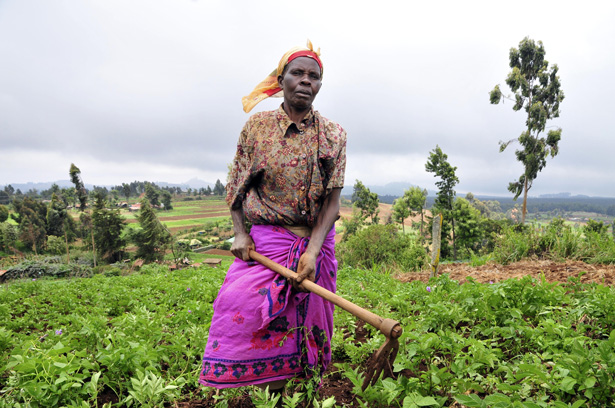
“Most of the world’s poor are farmers; they share the same profession and the same challenges,” said One Acre Fund’s Stephanie Hanson at a recent Wilson Center event on small-scale farming, climate change, food security, and migration. They are tasked with growing enough food to support their families with only tenuous access to land and natural resources, the most basic of tools, and increasingly unpredictable weather patterns to deal with. [Video Below]
-
Susan Bradley on Feed the Future: Solving Hunger Requires Cross-Cutting Development Initiatives
›
“Sustainable food security means that food production has to be climate smart,” says Susan Bradley in this week’s podcast. “In order to achieve climate smart food security, we are going to have to build resilience and adaptive capacity into agriculture.”
Bradley, division director for the USAID’s Bureau for Food Security, is working to implement the U.S. government’s Feed the Future Initiative. Unveiled by the Obama Administration in 2009, the $3.5 billion “whole of government” initiative aims to alleviate hunger and increase food security around the world.
-
From Dakar to Abidjan, Population Finally Finding Its Place in Food Security Assessments
›June 20, 2013 // By Kathleen MogelgaardA woman sat crouched on the side of a busy road in Dakar, a baby in a sling on her back and a basket of peanuts in front. I know only a little French, and no Wolof, but I decided to try anyway. “Bonsoir,” I said, and smiled at the toddler beside her. “Combien?” I asked, pointing at the peanuts.
She smiled back at me, we negotiated a sale, and in exchange for the coins in my pocket I walked away with a few bags of the small, tasty nuts that are grown throughout the “peanut basin” of central Senegal.
-
‘At the Desert’s Edge’ Gives a Glimpse of China’s Massive Desertification Challenge
›In may not be surprising that China, home to so many other superlatives, also faces desertification on a grand scale. According to China’s State Forestry Administration, over 27 percent of the country now suffers from desertification – more than 1,000,000 square miles, or about one-third of the continental United States – impacting the lives of more than 400 million people.
-
The Leopard in the Well: Wilson Center and Circle of Blue Launch ‘Choke Point: India’
›The original version of this article, by Keith Schneider, appeared on Circle of Blue. Choke Point: India is a research and reporting initiative produced in partnership between Circle of Blue and the Wilson Center’s China Environment Forum and Asia Program.
Perhaps because India is so big, so bewildering and chaotic, and so determined to update its elusive rural identity with sleek urban flare, Indians and the national press are fascinated by how the nation’s wild animals are faring amid the dizzying change. In many cases, not well.
-
Beyond Arctic Conflict: Prospects for Peace and International Cooperation
›Temperatures in the Arctic have increased at twice the global rate over the past 40 years, vaulting the region to international prominence as an emerging theater for maritime transportation and competition over newly uncovered resources.
The international community should start strategizing now to manage the ambitions of circumpolar states and minimize the potential for conflict, write authors Rob Huebert, Heather Exner-Pirot, Adam Lajeunesse, and Jay Gulledge in a report. Published by the Center for Climate and Energy Solutions, Climate Change and International Security: The Arctic as a Bellwether explores the geopolitical implications of climate change in the Arctic and puts forth several recommendations for policymakers to consider. Huebert et al. write that “maintaining security and peace in the Arctic will require adapting policies and institutions to the emerging environment there.” They recommend that Arctic states strengthen existing multilateral agreements by, for example, advocating the accession of the United States into the UN Convention on the Law of the Sea. Further, they propose that the Arctic Council lifts its ban on discussing security issues in order to become a forum for meaningful discussion. -
Is Resilience Too Accurate to Be Useful?
›Resilience is a wonderful metaphor. It somehow conveys in a single word the qualities of bending without breaking, of healing after an injury, of tensile rather than brittle strength. Oak and palm trees are resilient to the power of strong winds, before which they bend and then straighten again. Resilient people pick themselves up after being knocked down, draw on their reserves of ideas and strength to deal with difficult challenges, or hunker down until the gale has blown itself away. Resilient economies bounce back, and resilient ecosystems restore themselves after the fire or the flood has passed.
Showing posts from category climate change.