• woodrow wilson center
  • ecsp

New Security Beat

Subscribe:
  • rss
  • mail-to
  • Who We Are
  • Topics
    • Population
    • Environment
    • Security
    • Health
    • Development
  • Columns
    • China Environment Forum
    • Choke Point
    • Dot-Mom
    • Friday Podcasts
    • Navigating the Poles
    • Reading Radar
  • Multimedia
    • Water Stories (Podcast Series)
    • Backdraft (Podcast Series)
    • Tracking the Energy Titans (Interactive)
  • Films
    • Water, Conflict, and Peacebuilding (Animated Short)
    • Paving the Way (Ethiopia)
    • Broken Landscape (India)
    • Scaling the Mountain (Nepal)
    • Healthy People, Healthy Environment (Tanzania)
  • Publications
  • Events
  • Contact Us

NewSecurityBeat

The blog of the Wilson Center's Environmental Change and Security Program
Showing posts from category climate change.

  • Covering Climate: What’s Population Got to Do With It?

    ›
    November 9, 2009  //  By Dan Asin
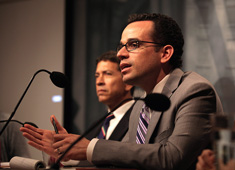
    “There’s a correlation between CO2 and population. And it’s that we live in a world of more people, more money and more things, and that all distills down to the need for more energy,” said Dennis Dimick, executive editor of National Geographic, at a Wilson Center event on the media’s coverage of climate change and population, co-sponsored by the Society of Environmental Journalists and the International Reporting Project.

    “Thinking about population and trends in population is a vital reality check for assessing policies you hear about on global warming,” said New York Times reporter Andrew Revkin, who joined Dimick and Nation Web Editor Emily Douglas via video conference. “When you start to think about that number—nine billion—a lot of cheery suppositions or assertions you’ve heard about how we’re going to de-carbonize the world without too much effort…[get] challenged in a hurry,” he said.

    The Inconvenient Truth of Population

    Despite these strong connections, the mainstream media has been reluctant to write about population growth, which Revkin called the “ultimate incremental story.”

    “We, I think, are guilty to some extent, in the media, of not paying adequate attention to this part of the whole issue,” he said, partly because there is the perception that “we kind of solved that problem. But, again, just run those numbers: Nine billion people does not solve the climate problem and it has to be considered in every stage of assessing solutions to the climate problem.”

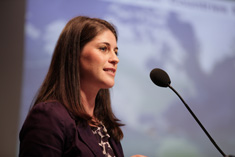
    “We need to talk about it so we understand this issue at a level beyond more people means more emissions,” said Douglas. Other factors like levels of consumption, urbanization, and household structure make the population-emissions relationship complex and difficult to explain.

    Revkin added that “consumption is even a tougher story to get at in print, because we’re a medium that advertises consumption, among other things.”

    The Population-Energy Challenge

    One-quarter of the world’s population lacks access to electricity. “We are in this sort of double-vise, trying to constrain our own [energy] demand while also trying to provide the opportunities for people who have little to none,” said Dimick.

    With fossil fuels currently providing 80 percent of global energy, and with energy demand estimated to increase dramatically to meet the needs of 2.3 billion more people by 2050, the “scale of the challenge before us . . . is immense,” he said. “To think that we’re somehow simply going to go to solar and wind—I think we’re deluding ourselves.”

    Nevertheless, Dimick insisted on the need “to de-carbonize at a tremendous scale.” He proposed sustainably addressing energy needs by improving energy efficiency, expanding mass transit systems, changing land use, and considering nuclear power.

    Reproductive Health Is Key

    Douglas, who previously edited the RH Reality Check blog, emphasized that population issues go far beyond climate change. “I’m encouraging us to look at population not only from the perspective of the environment, but also from the perspective of individual women and their human rights, their right to determine the number and spacing of their children, and not purely to depress fertility rates in service of mitigating climate change,” she said.

    According to Douglas, each year 60 million pregnancies—one-third of the global total—are unintended, and 200 million women worldwide have an unmet need for contraception. Family planning programs are “cheap to employ and deploy, and women and societies want them anyway,” said Douglas. A few recent studies have argued that universal access to family planning could be one of the most cost-effective ways to reduce greenhouse gas emissions.

    And not just mitigation, but adaptation as well: “Women with access to reproductive health services are healthier and they’re better able to deal with the impacts of climate change,” she said. “Poorer countries are going to need adaptation strategies, and one of those strategies is to allow women to better determine the size of their families.”

    However, “many political leaders–not only on the right—don’t like reproductive health programs,” said Douglas. Disagreements over abortion and birth control are part of the problem, as well as past instances of coercive contraceptive methods in some developing countries.

    Douglas cited a Population Action International survey that “found that 41 countries identified population growth as a factor that makes them more vulnerable to climate change, but only two of those countries proposed programs that address reproductive health.”

    Douglas decried the “significant gap between political leaders’ understanding that population growth makes it more difficult for them to respond to climate change, and political leaders being able to muster the political will that will empower women to better control their own fertility.”

    Close-Up on the Most Vulnerable

    “We also can’t talk about this as though all people added to the world population produce greenhouse gases in equal measure,” said Douglas. “The world’s richest half billion people, that’s 7 percent of the global population, are responsible for 50 percent of the world’s carbon dioxide emissions. Meanwhile, the poorest 50 percent are responsible for just 7 percent of emissions.”

    Revkin urged reporters to use a “close-up lens” when examining population trends impact on climate—especially in “areas of the world where there are significant risks that could be amplified by human-driven climate change, like urban severe flooding and severe rains, like we saw in Manila recently.”

    With rapid urbanization in the developing world, “you have to look at places where you have hugely increased numbers of people moving essentially into harm’s way—or being born in harm’s way, if you’re talking about sub-Saharan Africa,” said Revkin.

    A Thought Experiment

    “What if the whole world were equal in emissions?” Revkin asked. Suppose advanced industrial countries, such as the United States, reduce their annual emissions intensity from 20 tons of CO2 per person to 10 tons. At the same time, suppose rapidly developing countries, such as India, reach the same emissions intensity. In a world with nine billion people that equates to 90 billion tons—“three times today’s current annual emissions of CO2,” he said.

    “Probably the single most concrete and substantive thing a young American could to do to lower a carbon footprint is not turning of the lights or driving a Prius, but having fewer children,” said Revkin. “Eventually, should you get credit—if we’re going to become carbon-centric—for having a one child family when you could’ve had two or three? Obviously it’s just a thought experiment, but it raises some interesting questions.”

    Drafted by Daniel Asin and Meaghan Parker
    Edited by Meaghan Parker
    MORE
  • Climate-Security Gets “To the Point” Today

    ›
    On the Beat  //  November 5, 2009  //  By Meaghan Parker
    Today’s episode of NPR’s “To the Point” with Warren Olney will focus on “Global Warming and the Geo-Political Map,” seeking to answer the question, “What are the risks to natural resources, immigration, and political stability worldwide?”

    As one of the four panelists, ECSP Director Geoff Dabelko will draw on his recent article in the Bulletin of Atomic Scientists and ECSP’s climate-security resources.

    Climate security has been heating up the media for the last few months, although most news coverage has been rather thin. That’s understandable, given the complexity of the drivers involved, and the crushing constraints on environmental reporters’ time and budgets these days. But climate security is a politically powerful argument, one which advocates from all over the political spectrum have increasingly adopting, and it deserves a more thorough, thoughtful treatment.

    “Come to Attention,” a panel at this year’s SEJ annual conference (audio) moderated by ClimateWire’s Lisa Friedman, delved into some of the finer points of this often oversimplified connection. As part of the panel, Dabelko outlined seven cautions to keep in mind and suggestions for improving coverage of the difficult link.

    While Grist’s Robert McClure jokingly called the session “doom and gloom without the sense of humor,” Dabelko ended on a positive note, pointing out that by coming together to battle climate change, countries may build bridges to peace, rather than war–particularly if the militaries cooperate in the fight.

    In a recent op-ed, Dabelko and the U.S. Army War College’s Kent Butts argue that climate could be one of the most productive avenues for improving military relations with China, suggesting that “U.S. and Chinese militaries should jointly assess the security implications of climate change that concern both sides: rising sea levels, changing precipitation patterns, uncertain migration scenarios, and instability in resource-rich regions.”

    “To the Point” airs live online at 3 PM EST. In the Washington, DC, area listen to it at 10 PM EST tonight on WAMU 88.5.
    MORE
  • VIDEO: Cleo Paskal on How Climate Change Will Destabilize Energy Supplies

    ›
    October 26, 2009  //  By Wilson Center Staff
    “Climate change is going to have a very large effect on the ability to extract, distribute, [and] refine energy—in every sector,” says Cleo Paskal, associate fellow for the Energy, Environment, and Development Programme at Chatham House. “You’re going to very likely see increasing instability,” she tells ECSP Director Geoff Dabelko in this video interview.

    When hydroelectric dams are built, Paskal explains, planners inspect the site to determine the river flow, precipitation levels, and similar measures. But with climate change, “those constants have now all become variables, so your hydro generation is going to be severely affected.”

    Last year, India “had an 8 percent decline in the ability to generate hydroelectricity because of changing precipitation patterns. This year…it looks like it’s going to be 12 percent because the monsoon is failing.”

    Coastal nuclear power plants will face rising sea levels, increasing storm surges, coastal erosion, while those on rivers will find their supply of cooling water declining and warming. “In the summer of 2003, over a dozen French nuclear plants, because it was so hot, had to power down or shut off,” greatly disrupting the country’s energy supply, Paskal explains. “The predictions are that the temperatures that we saw in 2003 will be a one-in-two year event by 2040.”

    Offshore oil and natural gas platforms in the Gulf of Mexico are now subject to increasingly strong hurricanes. “Katrina and Rita destroyed over 400 platforms, as well as refining capacity onshore. That creates a global spike in energy prices apart from having to rebuild the infrastructure.”

    Meanwhile, offshore rigs in the Niger Delta are vulnerable to sea-level rise and storm surges, while infrastructure built in the Arctic could be at risk as the permafrost continues to melt.
    MORE
  • Bringing the Climate Fight to New Battlefields

    ›
    October 23, 2009  //  By Geoffrey D. Dabelko
    This picture brings the 350 ppm carbon dioxide message to another kind of battlefield. It illustrates the increasing role of the military in bringing non-traditional voices to the political debates over action against climate change. There are plenty of ties, if one scratches the surface and gets into the climate-security field.

    The CNA Military Advisory Board, a group of distinguished retired flag officers, has been the most prominent manifestation, but this picture suggests it isn’t just the senior officers with an opinion on climate. President Barack Obama gave a shout out in his MIT speech to Operation Free, a group of Iraq and Afghanistan veterans currently on a bus tour campaigning for energy independence.

    Equally important, if not as prominent in this political season, are the present or anticipated impacts of climate on the availability of certain resources (sometimes too much, sometimes too little) and how they might affect economic and political stability. And there are a wide range of reasons for the military to adopt the precautionary principle approach to climate change.

    Right now, there is a strong focus on climate-security links in both the research and policy arenas. The challenge is to raise attention, perhaps most productively in a risk framework, without resorting to hyperbole that ultimately produces a backlash.

    Photo courtesy of 350.org and Agent Slim. Thanks to Andy Revkin for flagging the picture.
    MORE
  • If It Bleeds It Leads: Pop-Climate Hits the Blogosphere

    ›
    On the Beat  //  October 21, 2009  //  By Meaghan Parker
    Population and climate change get short shrift in the media—that is, until Rush Limbaugh urges you to commit suicide. It’s a disturbing sign that this extremely complex topic only gets play when the knives come out. And as this summer’s health care circus demonstrates, the blogosphere is often more interested in covering the shouting than the issues at hand.

    So what happened? At the Wilson Center last week, the New York Times’ Andrew Revkin (via Skype) mentioned a thought experiment he had put forward in a recent post on his blog: “Should you get credit — if we’re going to become carbon-centric — for having a one-child family when you could have had two or three. And obviously it’s just a thought experiment, but it raises some interesting questions about all this.”

    Limbaugh, picking up on a post on CNS.com, a conservative online news outlet, said Revkin and “militant environmentalists, these wackos, have so much in common with the jihad guys.” The furor was reported by a number of news blogs, including NYT’s Paul Krugman, the Guardian, and Politico.

    An earlier and more substantial account by Miller-McCune’s Emily Badger deftly hits the highlights, including some historical context from The Nation’s Emily Douglas. While earlier projections assumed population growth would decline following the dissemination of birth control in the West, “that assumption turned out to be false,” said Douglas, because women in developing countries have not received similar access to contraceptives.

    Indeed, as Worldwatch Institute’s blog post on the event points out, “an estimated 200 million women who want to avoid pregnancy are risking it anyway because they have inadequate access to contraception and related reproductive health services.”

    I’m disheartened that this kerfluffle follows a recent uptick in thoughtful coverage of the population-climate connection. At a standing-room-only panel (audio) on covering population and environment at the most recent SEJ conference, Baltimore Sun reporter Tim Wheeler (video) said that population “has those challenges of so, what do you do about it, how do you deal with it.” But he said it was reporters’ “constant challenge to continue to wrestle with these issues.”

    Moving the wrestling match into the center ring is bringing a new focus to the debate, which could be useful, as Suzanne Petroni writes in the ECSP Report: “A careful discussion of the ways in which voluntary family planning can further individual rights, community development, and, to some extent, climate change mitigation, could increase awareness not only of the outsized contribution of developed nations to global emissions, but also of their appropriate role in the global community.”

    As Revkin says at the end of his response to Limbaugh: “And of course there’s the reality that explosive population growth in certain places, particularly sub-Saharan Africa, could be blunted without a single draconian measure, many experts say, simply by providing access to family planning for millions of women who already want it, but can’t get it – whether or not someone gets a carbon credit in the process.”

    Family planning advocates—who have long been wary of linking contraception to climate mitigation—would mostly agree with that statement, although they would phrase it a little differently. Better reproductive health care is “an end in itself,” with climate mitigation being the “side effect,” rather than the primary goal, Barbara Crossette writes in The Nation.

    Population experts cautiously agree there is a link, but warn that quantifying it is not so simple. At a major conference of demographers in Marrakesh, researchers previewed forthcoming research described the potential for emissions “savings” brought by decreases in fertility.

    In the near term, it doesn’t look likely that all this attention will lead to policy action at Copenhagen. Population Action International reports that while almost all of the least developed countries’ adaptation plans mention population as a factor which increases their vulnerability to climate change, only a few state that investing in family planning should part of their strategy.

    I encourage you to watch the webcast of the event and add your own (thoughtful) comments to the dialogue below. No suicide threats, please.
    MORE
  • VIDEO: Alexander Carius on Climate Change and Security in Europe

    ›
    October 20, 2009  //  By Sean Peoples
    “The landscape has changed since 2007,” says Alexander Carius of the climate change and international security debates now taking place in Europe. In this short video, Carius, who is managing director at Adelphi Research, discusses the progress made by institutionalizing communication within the European Commission as well as the formal and informal channels between the four member states leading the debate, Germany, Britain, Sweden, and Denmark. “Whether this debate is driven by science, I have my doubts,” said Carius.

    Even though the climate-security debate is well underway, the current draft resolution for the United Nations climate conference in Copenhagen remains silent on the connections between security and climate change. Moreover, there is a lack of consensus among negotiators on basic issues. As December approaches, skepticism of the likelihood of a comprehensive treaty is growing.
    MORE
  • Population’s Links to Climate Change

    ›
    On the Beat  //  October 14, 2009  //  By Meaghan Parker
    “Covering Climate: What’s Population Got to Do With It?”—webcast live from the Wilson Center—will analyze the challenges facing science and environmental reporters as they prepare to cover what New York Times reporter Andrew Revkin calls “the story of our time.” Cosponsored by the Society of Environmental Journalists and the International Reporting Project, the panel—including Dennis Dimick of National Geographic and the Nation’s Emily Douglas—will discuss the significant barriers to nuanced reporting, including stovepiped beats, the shrinking news hole, and old-fashioned squeamishness.

    However, in the past month, there’s been a veritable baby boom of news coverage on climate change and population. Spurred by three high-profile reports—the study commissioned by the Optimum Population Trust, research in the Bulletin of the WHO, and an editorial in the Lancet—the mainstream media and some key bloggers finally got some condoms in their climate change.

    It’s gratifying to finally see this issue pop up in the media, almost a year to the day after the 2008 SEJ conference panel on population and climate change moderated by Constance Holden of Science that attracted a respectable (but not remarkable) audience of 40. The panelists decried the media’s relative silence on the impact of population growth and other demographic dynamics on environmental issues.

    NPR’s Steve Curwood pointed out that while it’s “something we don’t talk about at all in America,” U.S. population growth increases emissions faster than developing-country population growth, due to our larger per capita consumption. A lone AP article, “Population growth contributes to emissions growth,” reported on the discussion.

    In contrast, a population-climate panel at last week’s SEJ conference drew an overflow crowd of more than 100 people. Former SEJ President Tim Wheeler read off recent headlines demonstrating that the media does mention population. However, he noted that “most of the instances I cited are op-ed opinion pieces, not news coverage or feature stories.” In recent climate coverage, he said, “population gets mentioned as an undercurrent and afterthought; our attention intends to be on the immediate. And it has those challenges of so, what do you do about it, how do you deal with it.” But it is “our constant challenge to continue to wrestle with these issues.”


    Here’s a short list of recent coverage:

    Associated Press: “Birth control could help combat climate change”
    Reuters: “Contraception vital in climate change fight -expert”

    Bloomberg: “African Condom Shortage Said to Worsen Climate Impact”

    Matt Yglesias: “Population and Climate Change”

    The Nation: “Factoring People Into Climate Change”

    Inter Press Service: “POPULATION: Where’s Family Planning on Climate Change Radar? Zofeen Ebrahim interviews noted social demographer KAREN HARDEE”

    The New Republic’s The Vine: “Abortion: The Third Rail of Climate Policy?”

    Treehugger.com: Contraception Five Times Less Expensive Than Low-Carbon Technology in Combating Climate Change

    Washington Post: “When It Comes to Pollution, Less (Kids) May Be More”

    Inter Press Service: “CLIMATE CHANGE: Rising Seas Demand Better Family Planning”

    LA Times Booster Shots blog: “Can condoms combat climate change?”

    MORE
  • Steady Drum Beat for Climate and Security Linkages

    ›
    October 14, 2009  //  By Geoffrey D. Dabelko
    This week Sweden, the current holder of the European Union Presidency, will convene a conference for EU member states on environment, climate change, and security. The Ministry of Defence and the Swedish Defence Research Agency are serving as organizers, yet they are constructing the conference in broad and inclusive terms. The objective is to highlight and address the links between climate change and security in the “broadest sense of the term.” This framing is perhaps less surprising when one remembers the Swedes have been leaders in both lightening the military’s environmental bootprint and supporting international development through the Swedish International Development Agency’s investments in water, development, and peace. Right now it is the European Union, the UK, the Germans, the Finns, and the Danes joining the Swedes to drive policy action on climate and security links.

    The climate security topic remains on the edges of the Copenhagen process, according to Adelphi Research’s Alexander Carius, but there is a constant flow of conferences in Europe and the United States nevertheless.

    Committee Two of the UN General Assembly tackles it with a panel October 19th in New York (I’m fortunate enough to be making remarks). And the draft of the Secretary-General’s report on climate and security called for by this summer’s non-binding UNGA resolution is circulating for comment.

    The Danish Minister of Foreign Affairs speaks at Chatham House the next day, presumably covering some of the same threat multiplier themes he highlighted September 19th> in Copenhagen.

    The Holland-based Institute of Environmental Security brings its international group of military officers to engage Washington audiences October 29th after having had their European meetings in Brussels this past week.

    CNA follows in November, including roll-outs of country-specific work on Colombia and China, made possible with support from the UK Foreign Commonwealth Office.

    After that scholars convene at the University of Hamburg, and then on to Trondheim, Norway, next June for a PRIO -organized conference.

    And the beat goes on for climate and security. Critically important will be whether the interest in climate and security links extends beyond Copenhagen, demonstrating it is more than just a slogan from a non-traditional climate audience aimed at nudging the negotiations at COP15. No doubt it will, with other milestones including the February 2010 Quadrennial Defense Review from the US Department of Defense and other processes yet to come.
    MORE
Newer Posts   Older Posts
View full site

Join the Conversation

  • RSS
  • subscribe
  • facebook
  • G+
  • twitter
  • iTunes
  • podomatic
  • youtube
Tweets by NewSecurityBeat

Trending Stories

  • unfccclogo1
  • Pop at COP: Population and Family Planning at the UN Climate Negotiations

Featured Media

Backdraft Podcast

play Backdraft
Podcasts

More »

What You're Saying

  • Volunteers,At,The,Lagos,Food,Bank,Initiative,Outreach,To,Ikotun, Pan-African Response to COVID-19: New Forms of Environmental Peacebuilding Emerge
    Rashida Salifu: Great piece 👍🏾 Africa as a continent has suffered this unfortunate pandemic.But it has also...
  • A desert road near Kuqa An Unholy Trinity: Xinjiang’s Unhealthy Relationship With Coal, Water, and the Quest for Development
    Ismail: It is more historically accurate to refer to Xinjiang as East Turkistan.
  • shutterstock_1779654803 Leverage COVID-19 Data Collection Networks for Environmental Peacebuilding
    Carsten Pran: Thanks for reading! It will be interesting to see how society adapts to droves of new information in...

What We’re Reading

  • Rising rates of food instability in Latin America threaten women and Venezuelan migrants
  • Treetop sensors help Indonesia eavesdrop on forests to cut logging
  • 'Seat at the table': Women's land rights seen as key to climate fight
  • A Surprise in Africa: Air Pollution Falls as Economies Rise
  • Himalayan glacier disaster highlights climate change risks
More »
  • woodrow
  • ecsp
  • RSS Feed
  • YouTube
  • Twitter
  • Facebook
  • Home
  • Who We Are
  • Publications
  • Events
  • Wilson Center
  • Contact Us
  • Print Friendly Page

© Copyright 2007-2021. Environmental Change and Security Program.

Woodrow Wilson International Center for Scholars. All rights reserved.

Developed by Vico Rock Media

Environmental Change and Security Program

Woodrow Wilson International Center for Scholars

Ronald Reagan Building and International Trade Center

  • One Woodrow Wilson Plaza
  • 1300 Pennsylvania Ave., NW
  • Washington, DC 20004-3027

T 202-691-4000