-
New Report Launched: ‘The World’s Water’, Volume Seven
›“The water problem is real and it is bad,” said MacArthur “Genius” Fellow and founder of the Pacific Institute Peter Gleick at the October 18 launch of the seventh volume the institute’s biennial report on freshwater resources. “It’s not bad everywhere, and it’s not bad in the same way from place to place, but we are not doing what we need to do to address all of the different challenges around water.”
“The World’s Biggest Problem”
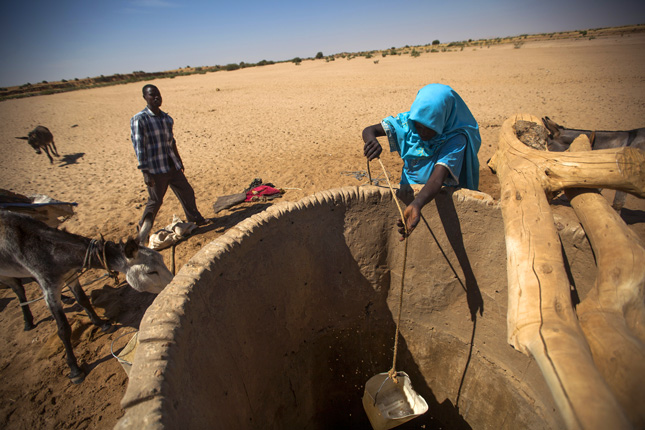
Worldwide, more than a billion people lack access to safe drinking water, while two and a half billion lack access to adequate sanitation services. “This is the world’s biggest water problem,” said Gleick, “the failure to meet basic human needs for water – it’s inexcusable.”
Gleick predicts that the world will fail to meet the Millennium Development Goals for water and sanitation by 2015, and noted that measures of illness for water-related diseases are rising, rather than falling.The World’s Water series provides an integrated way of thinking about water by exploring major concepts, important data trends, and case studies that point to policies and strategies for sustainable use of water. Volume seven includes chapters on climate change and transboundary waters, corporate water management, water quality challenges, Australia’s drought, and Chinese and U.S. water policy. The new volume also includes a set of side briefs on the Great Lakes water agreement, the energy required to produce bottled water, and water in the movies, as well as 19 new and updated data tables. An updated water conflict chronology looks at conflicts over access to water, attacks on water, and water used as a weapon during conflict.Peter Gleick on climate change and the water cycle.
Despite the added data, Gleick said that vast gaps remain in our knowledge and understanding about water. We lack accurate information on how much water the world has, where it is, how much humans use, and how much ecosystems need, he said. “So right off the bat, we are at a disadvantage.”
Focus on Efficiency, Infrastructure to Better Manage Water
One of the major concepts that has connected various volumes of The World’s Water is the concept of a “soft path for water” – a strategy for moving towards a more sustainable future for water through several key focus points: improved efficiency, decentralized infrastructure, and broadly rethinking water usage and supply.
Other cross-cutting themes include climate and water, peak water, environmental security, and the human right to water (formally recognized in a 2010 UN General Assembly resolution). “I would argue that all of these combined offer to some degree a different way of thinking about water, an integrated way of thinking about water,” Gleick said.
The China Issue
The role of China has been one of the most significant changes over the course of the series, said Gleick. The growth in the Chinese economy has led to a massive growth in demand for water (see the Wilson Center/Circle of Blue project, Choke Point: China), as well as massive contamination problems. The newest volume addresses these issues as well as China’s dam policies – internally, with neighboring countries, and around the world.
Gleick pointed out that China is one of the only nations (maybe the only) that still has a massive dam construction policy, and their installed capacity is already much larger than the United States, Brazil, or Canada. In addition, Chinese companies and financial interests are involved in at least 220 major dam projects in 50 countries around world. These projects have become increasingly controversial, for both environmental and political reasons, he said.
“My lens is typically a water lens,” Gleick said, but “none of us can think about the problems we really care about, unless we think about a more integrated approach.” Gleick emphasized the need for new thinking about sustainable, scalable, and socially responsible solutions. “We have to do more than we are doing, in every aspect of water,” he concluded.
Event Resources
Photo Credit: “Water,” courtesy of flickr user cheesy42. -
Seven Ways Seven Billion People Affect the Planet
›October 31, 2011 // By Geoffrey D. DabelkoSeven billion people now live on earth, only a dozen years after global population hit six billion. But the seven billion milestone is not about sheer numbers: Demographic trends will significantly impact the planet’s resources and peoples’ security.
Growing populations stress dwindling natural resource supplies while high levels of consumption in both developed countries and emerging economies drive up carbon emissions and deplete the planet’s resources. And neglected “youth bulges” could bolster extremism in fragile states like Somalia and destabilize nascent democracies like Egypt.
Here are seven ways seven billion people affect the planet, according to recent research:
Security: Nearly 90 percent of countries with very young and youthful populations had undemocratic governments at the end of the 20th century. Eighty percent of all new civil conflicts between 1970 and 2007 occurred in countries where at least 60 percent of the population is under age 30, says demographer Elizabeth Leahy Madsen. According to research by demographer Richard Cincotta, these countries may achieve democracy, but are less likely to sustain it.- Richard Cincotta: Tunisia Predicted: Demography and the Probability of Liberal Democracy in the Greater Middle East
- Elizabeth Leahy Madsen: Demographic Security 101
Water: By 2025, 1.8 billion people will be living in countries with water scarcity, and fully two-thirds will be living in conditions of water stress. People are using groundwater faster than it can be naturally replenished, putting us in danger of “peak water,” says MacArthur “Genius” Fellow Peter Gleick. “We cannot talk about water without also understanding the enormously important role of population dynamics and population growth.”- Peter Gleick: Population Dynamics Key to Sustainable Water Solutions
Forests: The growing demand for energy has helped devastate tropical forests, as more than two billion people depend on wood for cooking and heating, particularly in developing countries. Projects in Indonesia, Nepal, and Uganda are fighting deforestation by providing alternative energy and incomes along with health and family planning services.- Indonesia: Health in Harmony
- Nepal: Forests for the Future
- Uganda: Sharing the Forest
Future Growth: By 2050, the UN says global population could range anywhere from 8 billion to 11 billion – and where it ends up depends in large part on the status of women in developing countries. “Even if fertility rates remain constant at current levels (which is unlikely), developing regions would grow from 5.7 billion in 2010 to 9.7 billion in 2050, but the total population of developed countries would remain essentially unchanged,” writes Madsen.- Elizabeth Leahy Madsen: How Did We Arrive at 7 Billion – and Where Do We Go From Here? [Part One] [Part Two]
There are no quick solutions to these seven problems. But meeting the unmet need for contraception of more than 200 million women is an effective and inexpensive way to start.
Sources: Population Action International, UN, World Health Organization.
Image Credit: Used with permission courtesy of Scott Woods, The University of Western Ontario. -
Water and Poverty in a World of 9 Billion, Vulnerable Agriculture in the Niger Basin
›
In a two–part Water International special report on water, food, and poverty, examining 10 of the world’s major river basins, a team of researchers say that instead of worrying about having enough water to sustain the world’s growing demand, policymakers should be concerned with understanding how to manage what they already have.
Introducing the special report, Simon Cook, Myles Fisher, Tassilo Tiemann, and Alain Vidal note in “Water, Food and Poverty: Global- and Basin-Scale Analysis” that the vast majority of population growth over the next few decades is expected to happen in developing countries, “where the disjunct between poverty, water and food is particularly acute.” Gaining a better understanding of water – how much we have, who uses it, and how best to use it – is essential to improving development results in the face of this demographic explosion. Water is linked with poverty and development through issues like scarcity, access, and water-related hazards (like drought, flood, and disease). But the authors conclude that water productivity – the ease or difficulty in getting water from its source to agriculture – “is by far the most important water-related constraint to improved food, income and environmental security.”
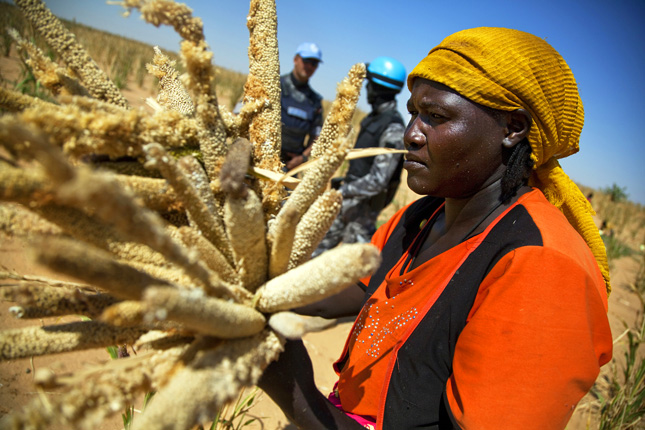
In “Water, Agriculture and Poverty in the Niger River Basin,” Andrew Ogilvie et al., paint a bleak picture of life in one of West Africa’s most important basins, writing that “[m]uch of the population in the basin suffers from extreme, chronic poverty and remains vulnerable to droughts and malnutrition.” Many of the Niger basin’s 94 million residents rely on subsistence agriculture, and most of that agriculture relies on rainwater rather than groundwater irrigation systems. Over time, the authors write, “there is little doubt that climate change will increase the strain on already-vulnerable agriculture.” Population growth will exacerbate this strain; the basin’s population is expected to increase as much as fourfold by 2050. In spite of this bleak picture, the authors conclude that “[i]mprovements in rainfed agriculture can have an important impact on poverty reduction and food security due to the large population dependent on it.” -
Roger-Mark De Souza, RH Reality Check
Sex and Sustainability: Reflections For My Son Nick
›October 20, 2011 // By Wilson Center StaffThe original version of this article, by Roger-Mark De Souza, appeared on RH Reality Check.
“Are we going to talk about sex again?!” screamed my 12-year old son, Nick, as he ran down the stairs, away from me. That was five years ago and I had just sat down with him to have one of our father-son talks, this time about sex and sustainability.
Now Nick, a rising senior, is preparing for college at the same time as the global community is preparing for an important landmark of its own: the United Nations predicts that by October 31, world population will reach 7 billion.
The confluence of these two events gives me reason to think about the world Nick is inheriting from my generation, and makes me consider what I can say to him as he heads off to college.
This World of 7 Billion
I try to get my head around it. It’s a world of 7 billion people. With greater connectivity than I could have ever dreamed possible. A world of widening disparities and growing environmental degradation. A world with a changing climate. A world of crashing economic markets and changing debt ceilings.
It’s also a world of finite resources and growing demand.
Continue reading on RH Reality Check.
Photo Credit: David Hawxhurst/Wilson Center. -
PHE Is One Great Idea That Won’t Be On the Rio Agenda, Says Roger-Mark De Souza
›October 17, 2011 // By Sean Peoples“I am now serving as an example to other women in the community because I am not having any more children. I have received training in sustainable agricultural practices, I’m generating income, and I’m educating others,” said Berhane Ferkade, an Ethiopian farmer, to Population Action International’s Roger-Mark De Souza earlier this year. The 39-year-old mother of 11 become one of the community’s model farmers after working with LEM Ethiopia – a local population, health, and environment (PHE) development organization.
-
Watch: Dennis Taenzler on Four Key Steps for REDD+ to Avoid Becoming a Source of Conflict
›The UN Program on Reducing Emissions from Deforestation and Forest Degradation (REDD) provides financial incentives to developing countries to conserve their forests and invest in low-carbon pathways to sustainable development. However, it may also be a potential new source of conflict, says Dennis Taenzler, a senior project manager at adelphi in Berlin, who works on climate and energy policies as well as peace and conflict issues.
-
El Niño, Conflict, and Environmental Determinism: Assessing Climate’s Links to Instability
›October 5, 2011 // By Schuyler NullA recent Nature article on climate’s impact on conflict has generated controversy in the environmental security community for its bold conclusions about links between the global El Niño/La Niña cycle and the probability of intrastate conflict.
-
Weathering Change: New Film Links Climate Adaptation and Family Planning
›“Our planet is changing. Our population is growing. Each one of us is impacting the environment…but not equally. Each one of us will be affected…but not equally,” asserts the new documentary, Weathering Change, launched at the Wilson Center on September 22. The film, produced by Population Action International (PAI), explores the devastating impacts of climate change on the lives of women in developing countries through personal stories from Ethiopia, Nepal, and Peru. Family planning, argue the filmmakers, is part of the solution.
Showing posts from category climate change.