Showing posts from category *Blog Columns.
-
NATO Says Don’t Fight the Planet
›Climate and security are under discussion today in Copenhagen at the Danish government’s side event, which brings together heavyweights such as NATO Secretary-General Anders Fogh Rasmussen, Swedish Foreign Minister Carl Bildt, African Union Chair Jean Ping, and Danish Foreign Minister Peter Stig Møller.
Fogh Rasmussen, the former prime minister of Denmark, delivered his remarks the new-fashioned way: today’s Huffington Post. He says NATO is ready to “do its part” by lowering its own carbon bootprint and responding to the increasing humanitarian challenges of a warmer world. He suggests the threat of climate change does not allow powerful institutions like NATO the luxury of sitting on the sidelines.
The post even includes this embedded “Climate Change and NATO” video with an unfortunate screen grab that reads “Fighting the Planet.” Not exactly a reassuring message for those who argue that framing climate change as a security issue will militarize the environment rather than green security (to paraphrase an excellent 1994 edited volume by Finn Jyrki Kakonen).
The video’s actual message is that some security threats can be fought and others shouldn’t be. Climate change will present a security threat, but “Fight the planet and we all lose,” says NATO. Even when the video makes all the right points, those pesky screen grabs can undermine your case! -
Tackling the Biggest Maternal Killer: How the Prevention of Postpartum Hemorrhage Initiative Strengthened Efforts Around the World
›On Friday, November 20th, 120 representatives from the maternal health community, the U.S. and around the world, gathered for an all day meeting at the Woodrow Wilson International Center for Scholars to discuss the report, Tackling the Biggest Maternal Killer: How the Prevention of Postpartum Hemorrhage Initiative Strengthened Efforts Around the World. This report describes the challenges and successes of the U.S. Agency for International Development (USAID) funded Prevention of Postpartum Hemorrhage Initiative (POPPHI).
The five-year POPPHI project was executed through the support of many partners whose main goal was to catalyze the expansion of active management of the third stage of labor (AMTSL) worldwide. The conference convened experts and advocates in the field of maternal health, to share best practices, new innovations, and future challenges for tackling maternal health’s leading killer: postpartum hemorrhage (PPH). Panelists included POPPHI field partners such as International Federation of Gynecology and Obstetrics, The International Confederation of Midwives, the World Health Organization, and international researchers.
Preventing Postpartum Hemorrhage: AMTSL
“We need to work on women postpartum–after birth we leave them,” argued Deborah Armbruster, POPPHI Project Director. Due to the fact that many women in the developing world give birth at home or in local clinics that lack the sufficient resources to prevent postpartum hemorrhaging, approximately 132,000 women die annually. Fortunately, effective and feasible interventions such as those established by POPPHI have been proven to save lives.
Active management of the third stage of labor (AMTSL) includes three factors that, when used together, can avert postpartum hemorrhage, including:1. Administration of uterotonic drugs (including oxytocin – the most preferred drug)
POPPHI’s “BOLD” Approach
2. Controlled cord contraction
3. Uterine massage after the delivery of the placenta
In collaboration with its partners, POPPHI implemented country-level and global programs to scale up AMTSL. Driven by the “BOLD” approach, Armbruster described how the initiative provided overall frameworks and approaches for strengthening PPH interventions by Building on evidence, Obtaining consensus, Linking partners, and Demonstrating to policymakers AMTSL’s feasibility.
Additionally, POPPHI provided learning materials such as toolkits, fact sheets, posters, and guides that were used to train providers and increase their use of AMTSL. A pilot project on Uniject (a single use needle pre-prepared with oxytocin) was also executed in Mali. Uniject was shown to be acceptable and successful with birth attendants there, and the study is now being replicated in Honduras.
Voices from the Field
Representatives from Argentina, Bangladesh, Ghana, Guatemala, Peru, and Mali presented their country results with the POPPHI project–concluding that the initiative served as a catalyst for upscaling AMTSL. Dr. Abu Jamil Faisel, Project Director and Country Representative of EngenderHealth in Bangladesh, discussed how the project helped to break through misperceptions that often prevented women from wanting to use misoprostol. In Ghana, policymakers worked with program managers and drug suppliers to register misoprostol in the country’s essential medicine list and updated guidelines to reflect best practices. While each country’s experiences were unique, the importance of partnerships was common to successfully upscaling AMTSL in all locations.
Partnerships: Critical to Success
Integrating maternal health indicators directly into program design is imperative to upscaling AMTSL, argued Niamh Darcy, Director of POPPHI Monitor and Evaluation. Additionally, Darcy argued that the success of POPPHI is due to the project’s emphasis in working with all levels of partners, particularly facility providers. Working with the supportive supervisors at facilities is necessary according to Darcy because this group is ultimately responsible for executing active management and recording project outcomes.
Identifying African experts who have taken leadership and ownership of the project has been instrumental in POPPHI successfully disseminating results at the regional, national and international levels argued Doyin Oluwole, Director, Africa’s Health in 2010. Partnering with local champions as well as policymakers has enabled many of the country projects to build capacity and upscale AMTSL.
Building on Lessons Learned
“A key lesson we have learned is that, when there is political commitment, AMTSL is rapidly scalable,” stated Lily Kak, Senior Maternal and Newborn Health Advisor, USAID. Changing behaviors and practices takes significant amount of resources and time commitment, however, POPPHI demonstrates that partnerships and research can be used to upscale AMTSL and change policies more efficiently.
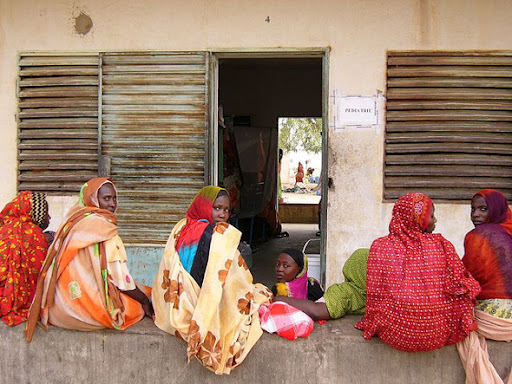
Photo: Women wait outside a maternity ward in Chad. Courtesy of Flickr user mknobil. -
Climate Reporting Awards Live From COP; Revkin To Quit NYT
›It’s a good news/bad news day for climate-media watchers. The Earth Journalism Awards honor some of the best climate coverage from around the world, while arguably the world’s most respected climate reporter announces he’s leaving journalism.
Earth Journalism Awards
Tune in now to watch the Internews Earth Journalism Awards webcast live from Copenhagen. The spectacularly impressive winning entries span the globe from Kenya, Brazil, Pakistan, and Papua New Guinea.
Two top-notch stories illustrate how nuanced, in-depth reporting can compellingly and accurately portray climate-security links: Lisa Friedman’s 5-part series on Bangladesh for ClimateWire untangles the knotty problem of climate-induced migration, while William Wheeler writes in GOOD Magazine about the increasingly difficult role of Indus Water Treaty in mitigating conflict between India and Pakistan.
The 15 winners are blogging from the summit, as well 40 reporters from 26 developing nations, as part of the Climate Change Media Partnership.
Revkin Frustrated With Journalism; Will Leave NYT
On the bad news side, Yale Forum on Climate Change and Media announced this morning that Andrew Revkin, the NYT’s climate reporter, will leave the paper on December 21. He cites “frustration with journalism,” but will continue writing his popular DotEarth blog.
Maybe Revkin’s frustration is with the disintegration of environmental coverage in the mainstream media? The Internews winners demonstrate the high quality of climate coverage at niche publications like ClimateWire or funded by non-profits like the Pulitzer Center on Crisis Reporting.
Let’s hope Revkin finds a more comfortable home and continues his pioneering work on DotEarth, specifically his efforts to cover population, poverty, consumption, and development connections to climate. -
Water Conflicts Enter the Fourth Dimension
›The Pacific Institute has just released an updated version of its renowned Water Conflict Chronology in a new interactive form. The online map depicts water conflicts from the Biblical flood to this year’s December 3 protest in Mumbai, pinpointing their location and chronological order. Pop-up text boxes provide the date, parties involved, basis for conflict, and hyperlinked references.
Since its founding in 1987, the project has continuously collected water conflict data “in an ongoing effort to understand the connections between water resources, water systems, and international security and conflict,” writes Pacific Institute President Peter Gleick in the San Francisco Chronicle.
But now, the data can also be visualized and manipulated in a table with citations, interactive timeline, or Google Earth map. Also of note is the project’s robust water and conflict bibliography search engine.
The Pacific Institute publishes The World’s Water, which offers a broad analysis of water resource trends, from conflict and scarcity, to implications for health and the impacts of climate change. At the Wilson Center launch of The World’s Water, Gleick talked to ECSP Director Geoff Dabelko about “peak water” (video). -
Interactive U.S. Map Shows Population, Energy, and Climate Data by State
›A new interactive map, developed by the Center for Environment and Population (CEP) and Clean Air-Cool Planet (CACP), lists state-level data on population, energy consumption, CO2 emissions, and vehicle-miles traveled. Accompanying the U.S. Population, Energy, & Climate Change report, the map depicts the sub-national, local level analysis necessary to help policymakers focus on the areas with the potential for the greatest gains.
Highlights:- New York has the “lowest state per-capita energy consumption, CO2 emissions, electricity consumption, and vehicle miles traveled,” and “it’s the only U.S. city where over half (about 75 percent) of the households don’t own a car.”
- Idaho “ranks fifth in growing population,” but “state per-capita CO2 emissions and electricity consumption are among the lowest in nation.” Most improved of all U.S. states in energy efficiency, Idaho “ranks fifth in renewable energy production and consumption per-capita.”
- Louisiana “ranked tenth in renewable energy production and consumption per-capita,” but still ranked “among [the] top ten states in energy consumption and CO2 emissions per-capita.” The state has a shrinking population and “is particularly vulnerable to sea level rise and severe coastal weather events.”
-
November’s Top 10 Blog Posts on the Beat
›1. The Campus Beat: Using Blogs, Facebook, to Teach Environmental Security at West Point
2. VIDEO: Peter Gleick on Peak Water
3. Guest Contributor James R. Fleming: Climate Engineering Is Untested and Dangerous
4. Guest Contributor Elizabeth Leahy Madsen: Pakistan’s Demographic Challenge Is Not Just Economic
5. Columbia University’s Marc Levy on Mapping Population and Geographic Data
6. Prostitution, Agriculture, Development Fuel Human Trafficking in Brazil
7. Reporting From Kenya: U.S. Editors Cover Health, Environment, and Security
8. Ethiopia: A Holistic Approach to Community Development Blossoms Two Years After Taking Root
9. On the Beat: Climate-Security Gets “To the Point” Today
10. Covering Climate: What’s Population Got to Do With It? -
New Tool Maps Deforestation
›A new tool from the Center for Global Development, Forest Monitoring for Action (FORMA) tool, uses satellite data to monitor tropical deforestation on a monthly basis. Using publicly available feeds from NASA and other sources, FORMA detects the spread of deforestation in areas as small as 1 square kilometer. The video above uses FORMA to animate the rapidly growing damage in Indonesia over the last four years.
CGD hopes FORMA will help countries monitor the success of forest preservation efforts, as well as verify that those receiving payments to maintain forest cover are, in fact, doing so. Currently limited to Indonesia, FORMA will soon cover the rest of the global tropics.
The tool can be combined with third-party content, such as overlay maps of demographic and forest carbon content data, for additional applications. -
Pakistan’s Demographic Challenge Is Not Just Economic
›In a meeting with business leaders in Lahore in late October, Secretary of State Hillary Rodham Clinton pointedly warned of the potential economic impacts of Pakistan’s rapidly growing population: “There has to be…in any plan for your own economic future, a hard look at where you’re going to get the resources to meet these needs. You do have somewhere between 170 and 180 million people. Your population is projected to be about 300 million as the current birth rates, which are among the highest in the world, continue,” she said.
Pakistan is ranked 141 (out of 182 countries) in the Human Development Index. High rates of unemployment are compounded by low levels of education and human capital. Clinton noted that Pakistani women are more vulnerable to poverty; only 40 percent are literate, compared to 68 percent of men.
The Secretary’s emphasis on the need to provide adequate education, jobs, and resources to motivate economic growth and improve well-being is welcome. But demography also has important political consequences. U.S. policymakers and the Pakistani government should consider the impact of population dynamics on the country’s intensifying instability.
As Pakistan’s population grows rapidly, it is maintaining a very young age structure: in 2005, two-thirds of its population was younger than age 30. Research by Population Action International has shown that countries with very young age structures are three times as likely to experience outbreaks of civil conflict than those with a more balanced age distribution.
The members of a “youth bulge” are not inherently dangerous, but when governments are unable to foster employment opportunities or the prospects of stability, a young age structure can serve to exacerbate the risks of conflict, as recently noted by John O. Brennan, assistant to the president for Homeland Security and Counterterrorism, in a speech on “A New Approach to Safeguarding Americans.”
As Secretary Clinton and her colleagues consider the complex barriers to achieving peace and stability for Pakistan’s people, their humanitarian and development strategies should include demographic issues. When couples are able to choose the number and timing of their children, very young age structures like Pakistan’s, can change.
Family planning and reproductive health services are fundamental human rights, but remain out of reach for many in Pakistan, where one-quarter of all married women (and 31 percent of the poorest) have an unmet need for family planning.
Greater access to family planning would lower fertility rates and increase the share of working-age adults in the population. In this transition, countries can harness the “demographic dividend”—a change that could turn Pakistan’s age structure into an economic opportunity.
However, funding from the United States—the world’s largest single donor for international family planning—has declined by one-third over the past 15 years. The foreign assistance funding priorities of the Obama administration should reflect this recognition of the linkages between population, development, and stability.
By addressing the high unmet need for family planning and reproductive health services of women in countries like Pakistan, the United States could help to create a more balanced age structure in future generations—and promote stability at the same time.
Elizabeth Leahy Madsen is a research associate at Population Action International (PAI). She is the primary author of the 2007 PAI report The Shape of Things to Come: Why Age Structure Matters to a Safer, More Equitable World..