Showing posts from category *Blog Columns.
-
Population and Environmental Challenges in Rwanda
›“Population, Health and Human Settlements” is the second chapter in the Rwandan government’s Rwanda State of Environment and Outlook. The chapter highlights the Rwandan government’s recognition of the interconnections between population, health, and environment, noting that population “can influence the state of the environment” and pose strains “on available public infrastructure, limited land, and natural resources.” The chapter examines Rwanda’s population growth and distribution, the state of “environmental health” in rural and urban areas, and health indicators relating to child and maternal health and HIV/AIDS. It goes on to describe government strategies to “improve settlements and human welfare.” “As population pressure is one of the key drivers of environmental degradation and poverty,” the chapter’s authors write, “the implementation of the population policy, especially aspects that address high fertility rates, gender and reproductive health, migration and human settlements” is increasingly important. The Des Moines Register‘s “Renewal in Rwanda” site hosts a series of articles by IRP Fellow and former Wilson Center Public Policy Scholar Perry Beeman “examining Rwanda’s efforts to build an eco-friendly economy.” Accompanied with interactive maps, photos, and videos, the materials highlight government efforts, share the country’s successes, and describe the vast challenges that lay ahead.
“Renewal in Rwanda” is particularly focused on Gishwati Forest, an area Beeman visited while in Rwanda, and the impacts of its ongoing conservation program on local communities. “Gishwati Area Conservation Program has as much to do with saving the lives of villagers—by sparing them from deadly mudslides and providing them jobs—as it does restoring a once-mighty forest,” writes Beeman in the article “Fighting for an African Forest.” Beeman also calls attention to the program’s more controversial aspects, noting that reforestation efforts would require relocating an estimated 5,000 families. -
New Research on Population and Climate: The Impact of Demographic Change on Carbon Emissions
›“Policies that have the effect…of leading to lower fertility and to slower population growth can be considered ‘win-win’ from the climate point of view,” said Brian O’Neill of the National Center for Atmospheric Research (NCAR) at a recent Wilson Center event on his latest research. Yet while the connection between demographic change and CO2 emissions is implicitly understood among both researchers and policymakers, it “has not really caught on,” he added.
In response to critiques of earlier studies looking at demographic change and CO2 emissions—which the climate research community has faulted for their lack of sophistication, use of unfamiliar analytic approaches, and failure to clearly demonstrate the magnitude of the connection—O’Neill is using a novel, more rigorous approach that he hopes will provide a clearer understanding of the links between demography and climate change.
The Population Factor
To generate CO2 emissions scenarios for the next 100 years, O’Neill’s team used the Population-Environment-Technology (PET) Model, originally created by Lawrence H. Goulder and Michael Dalton of Stanford. The PET Model takes its basic assumptions on regional economic growth, technological development, change in population characteristics, and other factors from the IPCC’s A2 and B2 scenarios, but replaces each scenario’s singular population growth curve with high and low alternatives from the United Nations Population Division.
Like other climate models, the PET Model divides the world into nine regions. “You don’t want to treat economies—or the demography, the consumption patterns, the energy system, and so on—of sub-Saharan Africa the same as you do for the U.S. or EU,” he said.What makes the O’Neill’s approach unique, however, is his attention to the sub-regional level. “Typically in these models…you break the world up into nine regions, but then you treat everyone in sub-Saharan Africa the same, everyone in China the same,” said O’Neill.
By drawing on data from detailed surveys of 800,000 households from 35 countries, O’Neill and his team demonstrated that the distinctions between urban and rural, older and younger, and smaller and larger households hold important implications for carbon emissions. This inclusion of demographic sub-factors allows a deeper degree of analysis than models that treat all households the same. They found that age structure, household size, and urbanization all altered emissions outputs.
Could Bending Population Growth Curves Reduce Emissions?
In the long run, the potential for demographic shifts to reduce CO2 emissions “is a big number,” said O’Neill. In the medium term, for example by the middle of the century, results are less clear. To compare population-related emissions reductions to other carbon-reduction opportunities, he evoked Socolow and Pacala’s “stabilization wedge” framework. The wedge framework posits 15 opportunities, or wedges, to eventually reduce CO2 emissions by 1 billion tons of carbon equivalent per year. They contend that implementing any 7 of the wedges could stabilize CO2 emissions by 2050 and, if followed by additional measures reducing emissions below today’s levels, would stabilize the atmospheric concentration of CO2 at 550 ppm and forestall the worst impacts of climate change.
Would reducing population growth equal a wedge? The full results, currently under review at a scientific journal, will seek to answer this question. “Slower population growth can’t solve the climate problem,” he concluded. “But it can certainly help.” -
Want to Model Climate Change? There’s an App for That
›C-Learn, developed by the coalition group Climate Interactive, is a three-region climate simulator that allows users to input targets for fossil fuels emissions, emissions from deforestation, and reductions from afforestation. The app then outputs the expected results for atmospheric CO2 concentrations and global temperature. The simulator is a free, public version of the more complicated C-ROADS, a tool designed to help policymakers compare the predicted effects of particular climate change mitigation policies.
Although interesting, C-Learn notably lacks the option to input assumptions regarding population growth rates, let alone those concerning more nuanced factors such as age structure, urbanization rates, or household size, the importance of which were recently discussed at the Wilson Center by the National Center for Atmospheric Research‘s Brian O’Neill. Population is a significant factor in determining what can be expected as reasonable emission targets and the failure to include space for demographic assumptions is a significant short-coming. -
The Food Security Debate: From Malthus to Seinfeld
›Charles Kenny’s latest article, “Bomb Scare: The World Has a Lot of Problems; an Exploding Population Isn’t One of Them” reminds me of a late-night episode of Seinfeld: a re-run played for those who missed the original broadcast. Kenny does a nice job of filling Julian Simon’s shoes. What’s next? Will Jeffrey Sachs do a Paul Ehrlich impersonation? Oh, Lord, help me; I hope not.
I’ve already seen the finale. Not the one where Jerry, George, and Kramer go to jail — the denouement of the original “Simon and Ehrlich” show. After the public figured out that each successive argument (they never met to debate) over Malthus’s worldview was simply a rehash of the first — a statement of ideology, rather than policy — they flipped the channel.
Foreign Policy could avoid recycling this weary and irrelevant 200-year-old debate by instead exploring food security from the state-centric perspective with which policymakers are accustomed. While economists might hope for a seamless global grain production and food distribution system, it exists only on their graphs.
Cropland, water, farms, and markets are still part and parcel of the political economy of the nations in which they reside. Therefore they are subject to each state’s strategic interests, political considerations, local and regional economic forces, and historical and institutional inefficiencies.
From this realistic perspective, it is much less important that world population will soon surpass 7 billion people, and more relevant that nearly two dozen countries have dropped below established benchmarks of agricultural resource scarcity (less than 0.07 hectares of cropland per person, and/or less than 1000 cubic meters of renewable fresh water per person).
Today, 21 countries—with some 600 million people—have lost, for the foreseeable future (and perhaps forever), the potential to sustainably nourish most of their citizens using their own agricultural resources and reasonably affordable technological and energy inputs. Instead, these states must rely on trade with–and food aid from–a dwindling handful of surplus grain producers.
By 2025, another 15 countries will have joined their ranks as a result of population growth alone (according to the UN medium variant projection). By then, about 1.4 billion people will live in those 36 states—with or without climate change.
For the foreseeable future, poor countries will be dependent on an international grain market that has recently experienced unprecedented swings in volume and speculation-driven price volatility; or the incentive-numbing effects of food aid. As demand rises, the poorest states spend down foreign currency reserves to import staples, instead of using it to import technology and expertise to support their own economic development.
Meanwhile, wealthier countries finding themselves short of water and land either heavily subsidize local agriculture (e.g., Japan, Israel, and much of Europe) or invest in cropland elsewhere (e.g., China, India, and Saudi Arabia). And some grain exporters—like Thailand—decided it might be safer to hold onto some of their own grain to shield themselves from a future downturn in their own harvest. All of this is quite a bit more complex than either Malthus could have imagined or Kenny cares to relate.
It hardly matters why food prices spiked and remained relatively high—whether it is failed harvests, growing demand for grain-fed meat, biofuels, profit-taking by speculators, or climate change. Like it or not, each has become an input into those wiggly lines called grain price trends, and neither individual states nor the international system appears able or willing to do much about any of them.
From the state-centric perspective, hunger is sustained by:1. The state’s inability or lack of desire to maintain a secure environment for production and commerce within its borders;
In some countries, aspects of population age structure or population density could possibly affect all three. In others, population may have little effect at all.
2. Its incapacity to provide an economic and trade policy environment that keeps farming profitable, food markets adequately stocked and prices reasonably affordable (whether produce comes from domestic or foreign sources); and
3. Its unwillingness or inability to supplement the diets of its poor.
What bugs me most about Kenny’s re-run is its disconnect with current state-centric food policy concerns, research, and debates (even as the U.S. administration and Congress are focusing on food security, with a specific emphasis on improving the lives of women.—Ed.).
Another critique of Malthus’s 200-year-old thesis hardly informs serious policy discussions. Isn’t Foreign Policy supposed to be about today’s foreign policy?
Richard Cincotta is a consultant with the Environmental Change and Security Program and the demographer-in-residence at the H.L. Stimson Center in Washington, DC.
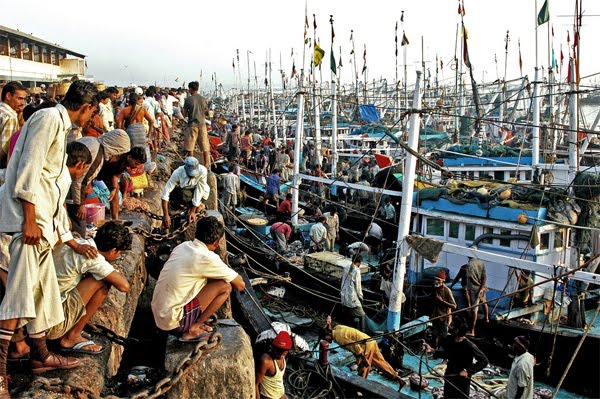
Photo Credit “The Bombay Armada” courtesy of Flickr user lecercle. -
Pop-Up Video: Cable News Covers PHE Connections
›It was a bit of a shock to hear population-environment connections being discussed on television, including the Most Trusted Name in News (aka Jon Stewart’s Daily Show), as well as CNN’s Amanpour, late last month.
-
Population and Sustainability
›“The MAHB, the Culture Gap, and Some Really Inconvenient Truths,” authored by Paul Ehrlich and appearing in the most recent edition of PLoS Biology, is a call for greater participation in the Millennium Assessment of Human Behavior (MAHB). MAHB was created, he writes, because societies understand the magnitude of environmental challenges, yet often still fail to act. “The urgent need now is clearly not for more natural science…but rather for better understanding of human behaviors and how they can be altered to direct Homo sapiens onto a course toward a sustainable society.” MAHB aims to create an inclusive global discussion of “the human predicament, what people desire, and what goals are possible to achieve in a sustainable society” in the hopes of encouraging a “rapid modification” in human behavior.The BALANCED Project, lead by the Coastal Resource Center at the University of Rhode Island, released its first “BALANCED Newsletter.” To be published biannually, the newsletter highlights recent PHE fieldwork, unpacks aspects of particular PHE projects, and shares best practices in an effort to advance the BALANCED Project’s goal: promoting PHE approaches to safeguard areas of high biodiversity threatened by population pressures. The current edition examines the integration of family planning and reproductive health projects into marine conservation projects in Kenya and Madagascar, a theater-based youth education program in the Philippines, and the combining of family planning services with gorilla conservation work in Uganda. The newsletter also profiles two “PHE Champions,” Gezahegh Guedta Shana of Ethiopia and Ramadhani Zuberi of Tanzania.“Human population growth is perhaps the most significant cause of the complex problems the world faces,” write authors Jason Collodi and Freida M’Cormack in “Population Growth, Environment and Food Security: What Does the Future Hold?,” the first issue of the Institute of Development Studies‘ Horizon series. The impacts of climate change, poverty, and resource scarcity, they write, are not far behind. Collodi and M’Cormack highlight trends in, and projections for, population growth, the environment, and food security, and offer bulleted policy recommendations for each. Offering greater access to family planning; levying global taxes on carbon; introducing selective water pricing; and removing subsidies for first-generation biofuels are each examples of suggestions advanced by the authors to meet the interrelated challenges. -
Philippines’ Bohol Province: Elin Torell Reports on Integrating Population, Health, and Environment
›For 10 years, I have been working on marine conservation in Tanzania with the University of Rhode Island’s Coastal Resources Center. As part of that effort, I’ve helped forge links between HIV/AIDS prevention in vulnerable fishing communities and marine conservation. However, family planning and reproductive health (FP/RH) were relatively new to me. But a recent study tour of an integrated Population, Health, and Environment (PHE) program in the Philippines helped me understand that combining family planning services and marine conservation can help reduce overfishing and improve food security.
Together with developing country representatives from seven African and Asian countries, I spent two weeks in February visiting three PHE learning sites and a marine protected area in Bohol province in the central Philippines, as part of a South-to-South study tour sponsored by the USAID-funded BALANCED Project, for which I work. The tour focused on the activities of the 10-year-old Integrated Population and Coastal Resource Management Initiative (IPOPCORM) project, which is run by PATH Foundation Philippines, Inc. (PFPI).
IPOPCORM has garnered a wealth of lessons learned and best practices to share with PHE newbies like me. Its integrated programs train people to be community-based distributers (CBDs) of contraceptives and PHE peer educators, as well as work with local and regional government officials to build support for family planning as a means to improve food security.
I was most impressed with the ways in which PFPI identifies and cultivates dynamic and motivated local leaders–men, women, and especially youth–to reach out to the members of their community who are highly dependent on marine resources for their survival. My Tanzanian colleagues and I would like to foster the volunteer spirit and “can do” attitudes we experienced through our work in East Africa. (Similar PHE peer educators are successfully working in Ethiopia’s Bale Mountains, as reported by Cassie Gardener in a previous edition of the “Beat on the Ground.”
My favorite part of the tour was a trip to the Verde Island Passage to see PFPI’s efforts in this fragile hotspot. The insights my Tanzanian colleagues and I gained from talking to the field practitioners in the Verde Islands helped us refine our ideas for translating some of the PHE techniques used in the Philippines to the Tanzanian cultural context, including an action plan for strengthening our existing PHE efforts with CBDs and peer educators.
Thanks to the study tour, I now have a better understanding of how to address population pressures in the context of conservation. Overall, my Tanzanian colleagues and I were inspired by the successes we saw firsthand and hope to emulate them to some degree in our own projects.
Elin Torell is a research associate at the Coastal Resources Center at the University of Rhode Island. She is the manager of CRC’s Tanzania Program and coordinates monitoring, evaluation, and learning within the BALANCED project. -
Family Planning in Fragile States
›“Conflict-affected countries have some of the worst reproductive health indicators,” said Saundra Krause of the Women’s Refugee Commission at a recent Wilson Center event. “Pregnant women may deliver on the roadside or in makeshift shelters, no longer able to access whatever delivery plans they had. People fleeing their homes may have forgotten or left behind condoms and birth control methods.”