Showing posts from category *Blog Columns.
-
Mapping World Bank-Funded Projects
›The World Bank recently released their interactive “Mapping for Results Platform” that allows users to see where and how World Bank funding is being spent. Users can view project costs and expenditures by sector at sub-national levels and overlay this with human development data such as poverty, population, and health indicators. In the current beta version, interactive maps and downloadable data are available for Kenya, Bolivia, and the Philippines.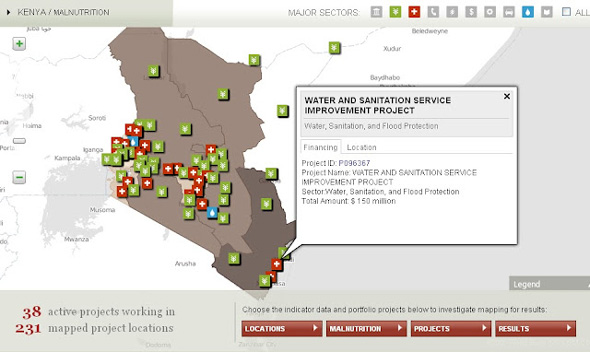
The example map shown above shows all of the World Bank’s 38 active water and sanitation, health, and agricultural projects in Kenya, as well as malnutrition rates by district. Clicking on any of the projects on the map displays the project name, financing amount, and exact location of the program.
Presumably, in the final version, all 2,669 active World Bank projects and 15,246 project locations – accounting for $136.91 billion – will be included.
Image Credit: World Bank Mapping for Results Platform. -
Tamara Kreinin on Women’s Empowerment, Population Growth, and Sustainability
› “We know that when that when we empower women – whether it’s giving them control over their bodies and access to family planning or whether it’s by including them in planning around climate change – their agency can make huge leaps for us,” said Tamara Kreinin, executive director of women and population at the UN Foundation, in this interview with ECSP.
Seventy percent of the world’s poor are women and they’re also the members of the household most likely to be responsible for food, water, and firewood collection.
“At the same time, we know that women are often not at the table,” she said. “They’re not at the table in country when countries are creating aid to adaptation strategies around the environment and climate change, and they’re not at the table at places like Copenhagen and some of the big climate change meetings.”
The “Pop Audio” series is also available as podcasts on iTunes. -
Mobile Phones for Maternal Health in the Developing World
›With rising use in the developing world, cell phones and mobile technologies can create “connected and coordinated health systems that save more lives,” said Josh Nesbit at the GHI event “New Applications for Existing Technologies to Improve Maternal Health,” on October 27. Capitalizing on these new technologies could increase efficiency, cost-effectiveness, and efficacy of public health programs. Nesbit, executive director of FrontlineSMS: Medic, was joined by Alain Labrique, assistant professor at the Johns Hopkins School of Public Health, and David Aylward, executive director of the mHealth Alliance at the United Nations Foundation, to discuss the role of Information and Communication Technologies (ICTs) in the prevention of maternal mortality.
Collaborations for mHealthWhile “cell phones can’t save lives, the lack of information does kill,” said Aylward. Using technology that many people already own and use, mobile technology is an appropriate tool for disseminating health data and information. Existing technologies such as mobile phones and SMS text messaging can revolutionize healthcare by improving data collection and disease tracking, expanding patient diagnostics, and advancing education and awareness among health workers and patients.
With 64 percent of all mobile phone users located in the developing world, the use of mobile devices to improve health services in low-income countries is especially promising.
Aylward hopes that mobile health technology (mHealth) will help combat maternal mortality in the developing world. With approximately 350,000 women dying in childbirth each year, and only marginal progresses towards achieving Millennium Development Goal 5, finding such innovative solutions to improve maternal health is crucial.
Public-private partnerships are particularly important when considering the long-term sustainability of mHealth programs. “This didn’t happen because of the World Bank, it happened because people who are very poor voted with their very limited funds to have access to information,” said Aylward.
Aylward is hopeful that government and donor support will continue to become more supportive of mobile technology and coordinated in their implementation of mHealth programs globally.
Mobile Health Solutions in the Developing World
“Through mobile tools, we can act as quickly as possible to improve access to skilled birth attendants, emergency obstetric care, and access to reproductive health commodities,” said Nesbit.Nesbit’s organization, FrontlineSMS: Medic, is working to eliminate barriers created by the lack of resources and infrastructure in the developing world using mobile health technology. Now working in 20 countries, the organization uses free software “that enables large-scale, two-way text messaging using only a laptop, a GSM modem, and inexpensive cell phones,” explained Nesbit.
“One of the best measures is whether people continue to use your tools, and they will if it impacts their lives positively and they won’t if it doesn’t—sometimes it’s as simple as that,” said Nesbit on why communities in the developing world are eagerly embracing mobile technology.
Moving forward, Nesbit hopes to “scale and replicate, both vertically and horizontally, models that we’ve shown can work, but also to build new tools” and work with the health community “to help identify the needs and the gaps in these systems.”
However, Nesbit stresses that “these are very much tools and not solutions; they become solutions when they are paired with people on the ground who use them.”
Compressing the Time Between Crisis and Care
“The opportunities for mobile phones to act synergistically with existing health systems in low- to middle-income countries are many,” said Labrique. The current challenge is to harness this technology to improve health outcomes in the developing world, where disease burden is disproportionately high.
In the developing world, “decisions influenced by the lack of resources, such as poverty, or lack of information have led to highly convoluted patterns of care-seeking,” said Labrique.“Delayed decision-making compounded by delayed transport can have tragic consequences for maternal mortality,” said Labrique, and the most immediate use of mobile technology is “getting the necessary care, on time, to where these deaths are taking place.” Cell phones can help women, their families, and local health workers to seek timely, appropriate medical help for an obstetric emergency.
“Addressing equity and access to phones when evaluating the impact or success of mHealth interventions is critical,” Labrique said. Although cell phone use is high and steadily increasing, social and cultural norms in some countries might prevent women from using them. Further, Labrique notes, in Bangladesh, cell phone use among the poorest families is noticeably less than those with higher socioeconomic status.
“ICT and mHealth solutions have tremendous promise to improve maternal health in resource limited settings; however, it’s important not to let the technology guide the public health agenda,” said Labrique. More data is needed to determine how these tools might strengthen and enhance health systems and a clearer research agenda can help ensure evidence-based solutions guide programming.
For more from David Aylward and mHealth, be sure to see “Watch: David Aylward on How Wireless Technology is Changing Global Health and Empowering Women.”
Sources: Lancet, United Nations Foundation.
Photo Credit: “‘SMS till you drop’ — mobile phone ad on van in Kampala, Uganda,” courtesy of flickr user futureatlas.com. -
Top 10 Posts for October 2010
›Nathan Yaffe and Laura Dismore’s post on a Ethiopian land-grab case study, Marc Levy’s response to Halvard Buhaug, and India and China’s thirst for resources topped the list last month:
1. The Beat on the Ground: Ethiopian Case Study Illustrates Shortcomings of “Land Grab” Debate
2. On the Beat: Climate-Security Linkages Lost in Translation
3. India’s Maoists: South Asia’s “Other” Insurgency
4. U.S. v. China: The Global Battle for Hearts, Minds, and Resources
5. VIDEO: Peter Gleick on Peak Water
6. Brian O’Neill: Population Is Neither a Silver Bullet Nor a Red Herring in Climate Problem
7. DRC’s Conflict Minerals: Can U.S. Law Impact the Violence?
8. On the Beat: New Study Finds Lower Population Growth Could Cut Carbon Emissions, Lead Author Presents at SEJ 2010
9. Latin America’s Future: Emerging Trends in Economic Growth and Environmental Protection
10. Welcome Back, Roger-Mark: A Powerful Voice Returns to PHE -
PATH Foundation’s ‘Population, Health, and Environment Leadership as a Way of Life’
›PATH Foundation Philippines, Inc. (PFPI) just released a short documentary, Population-Health-Environment (PHE) Leadership as a Way of Life in All Walks of Life. The video features interviews with peer educators and local government officials who have partnered with PFPI on integrated coastal resource management in the Philippines that combines family planning and reproductive health services with environmental services.
According to those interviewed, an integrated approach is the best way to alleviate food insecurity in the area. “We cannot separate population, health, and environment, they should be implemented hand in hand,” said Marlyn Alcanises, a Fisheries and Coastal Resource Management program officer. “Even if we manage our coastal resources well, if there are many children due to high fertility and population growth, many people are hungry.”
The comprehensive program has been successful in addressing the social and environmental problems in the Verde Island Passage of the Philippines, one of Asia’s most densely populated regions, as well as a marine biodiversity hotspot and sea lane for many commercial ships.
The program uses community-based distribution of contraceptives to increase access to family planning, micro-credit schemes to finance sustainable livelihoods and alleviate poverty, and advocacy campaigns to increase government support for integrated health and environment programs.
Municipal Planning and Development Coordinator Cecilia Zulueta praised the integrated approach, saying “it can slow down population growth, decrease the number of malnutrition cases, lessen the number of out-of-school youth, and it can also decrease the crime rate, because if one does not have a stable source of income it may force him to engage in illegal activities.”
In ECSP’s FOCUS Issue 15, “Fishing for Families: Reproductive Health and Integrated Coastal Management in the Philippines,” Joan Castro and Leona D’Agnes demonstrated that PFPI’s Integrated Population and Coastal Resource Management project (IPOPCORM) was more cost-effective and had a greater impact on the wellbeing of both human reproductive health and coastal resources than non-integrated programs. In a study measuring the impacts of integrated versus single-sector reproductive health (RH) or coastal resource management (CRM) programs, they found the integrated approach met or exceeded single-sector outcomes for 26 out of 27 indicators.
Reducing high fertility rates reduces pressure on natural resources, decreases high rates of malnutrition, crime and HIV/AIDS, and preserves local fisheries, “making life sustainable for both humans and nature,” as PFPI puts it in the documentary. The hope is that the community leaders featured in the documentary will inspire others in similar situations to take the lead on integrated issues in their communities.
“Even if we are doing environmental conservation through population management in our province but the others are not, it will still create conflict somehow,” said Alcanises. “I believe that whatever program is being done in one province should also be done in other provinces, in order to avoid conflict and promote balance in program implementation.”
Julio Lopez, president of the Galera Association of Managers and Entertainers said, “this land is ours, and we are responsible in taking care of it.”
PFPI, along with the University of Rhode Island’s Coastal Resource Center and Conservation International, is part of the BALANCED project, which last year launched the PHE Toolkit as a resource for PHE professionals. For more on PFPI’s IPOPCORM program, see ECSP’s interviews with Joan Casto and Leona D’Agnes on our YouTube channel: “Joan Castro – Integrated Population and Coastal Resource Management (IPOPCORM)” and “Leona D’Agnes on Population, Health, and Environment.”
Video Credit: “Population-Health-Environment (PHE) A Video Documentary,” courtesy of YouTube user PATHFoundationPhils.
Sources: Population Reference Bureau. -
Watch: David Aylward on How Wireless Technology is Changing Global Health and Empowering Women
›“We have millions of young children, babies, dying unnecessarily, hundreds of thousands of women dying in childbirth – most of them unnecessarily – in large part for lack of access to health, lack of access to health information,” said David Aylward, executive director of the UN Foundation’s mHealth Alliance. “And while wireless doesn’t solve any of those problems by itself, it is a conduit, a pathway to solve those problems.”
We spoke to Aylward before the Global Health Initiative (GHI) event “New Applications for Existing Technologies to Improve Maternal Health,” at the Wilson Center earlier this week.
“We’ve gone from a billion subscribers to five billion subscribers in the last six years, and 70 percent of those are in the developing world,” he said. “So almost everywhere you go a woman has a cellphone or has access to a cellphone.”
This access allows women in the developing world to do basic things those in the developed world take for granted, like call for help or set up reminders. The most important thing to think about in the future is to continue empowering women with the tools and knowledge to understand their own healthcare and supporting them with better care.
“All of which are possible in the very near term if we can get the different parties to get together and work on them together,” said Aylward, “and that’s what our mission is.”
Check out the the full event summary from GHI here. -
Energy and Climate Change in the Context of National Security
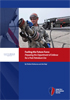
›“Climate Change and Security,” a short briefing by Paul Rogers of the Oxford Research Group, examines the recent trend of framing climate change in terms of a national security threat and presents some of the pros and cons of this viewpoint. Rogers says the recent uptick in interest by the military is expected – and welcomed – because military planners often perform more long-term analyses than other policymakers. However, Rogers also cautions that the military, in its role as protector of the state, will naturally focus on adapting to the effects of climate change rather than preventing them. Thus, while this willingness to think long-term is appreciated, work remains to convince the international security community of the importance of carbon-cutting measures as well.“Fueling the Future Force: Preparing the Department of Defense for a Post-Petroleum Era,” by Christine Parthemore and John Nagl of CNAS, is a comprehensive policy paper arguing for the U.S. military to aim for the ability to operate all its systems on non-petroleum fuels by 2040. Parthemore and Nagl outline a broad set of recommendations that address DOD’s consumption habits, leadership structure, finances, acquisition process, and mission goals. Notable, in the context of Paul Rogers’ warning, is that the authors’ argument is essentially one of supply and demand, rather than for cutting emissions to reduce the effects of climate change: “…while many of today’s weapons and transportation systems are unlikely to change dramatically or be replaced for decades, the petroleum needed to operate DOD assets may not remain affordable, or even reliably available, for the lifespans of these systems.” -
Christian Leuprecht on Demography, Conflict, and Sub-National Security
›“Demographics are going to be to the 21st century what class cleavages were to the 19th century,” said Christian Leuprecht in this conversation with the Environmental Change and Security Program. Leuprecht is an assistant professor at the Royal Military College of Canada and was one of the authors featured in ECSP Report 13.
“Specifically with regards to demography and security, the challenge that I see is at the sub-national level. That is to say that most of the conflict, if you look around the world – the intractable conflicts, the violent conflicts, the conflicts that have been dragging on for decades – tend to be at the sub-national level,” he said. “Yet much of the academic work and the way data are gathered are at the national level.”
The “Pop Audio” series offers brief clips from ECSP’s conversations with experts around the world, sharing analysis and promoting dialogue on population-related issues. Also available on iTunes.