Showing posts from category *Blog Columns.
-
Of Revolutions, Regime Change, and State Collapse in the Arab World
›The original version of this article, by David Ottaway and Marina Ottaway, was published by the Wilson Center’s Middle East Program.
With breath-taking speed, massive popular protests across the Arab world have swept away two Arab strongmen and shaken half a dozen monarchies and republics to their core. But the Arab world has yet to witness any fundamental change in ruling elites and even less in the nature of governance.
Libya now seems poised to be the first country to see a true change in governance, thanks to Muammar Qaddafi’s megalomania and his amorphous jamahiriya (state of the masses). But such change may not have a happy ending. The damage Qaddafi has inflicted on his country is likely to extend well past his demise because he leaves behind a weak state without functioning institutions.
The uprisings sweeping across the Middle East have similar causes and share certain conditions: authoritarian and ossified regimes, economic hardship, growing contrast between great wealth and dire poverty, all worsened by the extraordinarily large number of young people who demand a better future. But the consequences will not be the same everywhere.
Tunisia and Egypt: A System Still in Place
Pro-democracy protesters in Tunisia and Egypt have been quick to use the word “revolution” to describe their astounding achievement in forcing Presidents Zine el Abidine Ben Ali and Hosni Mubarak from power after decades of rule. Tunisia’s “Jasmine Revolution” and Egypt’s “January 25 Revolution” have certainly injected the long-silenced voice of the people into the autocratic politics of the region. But they have not brought to the fore a new ruling class, system of governance, or the profound social and economic changes associated with the classical meaning of revolution. And it remains to be seen whether they will succeed in doing so.
Continue reading at the Wilson Center’s Middle East Program.
Photo Credit: Adapted from “Libya-protests_025,” courtesy of flickr user Crethi Plethi. -
Joan Castro on Integrated Population and Coastal Resource Management in the Southern Philippines
› In the southern Philippines, the innovative IPOPCORM program “worked in areas where there is high…marine biodiversity, high population, and high population momentum, which means…about 40 percent of the population are 15 years and below,” Joan Castro told ECSP in this interview. Castro, the executive vice president of PATH Foundation Philippines, Inc., recently spoke at the Wilson Center on the state of integrated development efforts in her country and elsewhere.
From 2000-2006, IPOPCORM (which stands for “integrated population and coastal resource management”) sought to integrate population, health, and environment (PHE) development efforts in Philippine communities. They had four primary objectives, said Castro: 1) improve the reproductive health of the community members; 2) improve management of the coastal resources; 3) increase knowledge of the linkages between population, health, and the environment; and 4) increase the capacity of community leaders to advocate for these links.
“The aspect of livelihoods was very essential,” said Castro, especially for empowering women in the communities. Through family planning services and micro-credit finance initiatives, women were able to better space their pregnancies and contribute to household incomes, she said. In addition, by establishing locally managed, marine protected areas, IPOPCORM increased the protection of high biodiversity zones and improved the likelihood that there will be enough fish to feed future generations.
The “Pop Audio” series is also available as podcasts on iTunes. -
Carrying Capacity: Should We Be Aiming to Survive or Flourish?
›“In the eyes of many governments, population has, as we all know, been a rather uncomfortable topic for a number of years,” said Nobel Laureate Sir John Sulston, FRS, chair of the Institute for Science, Ethics, and Innovation at the University of Manchester and chair of the Royal Society’s People and the Planet working group. At an event at the Wilson Center on February 22, Sulston and his co-panelists, Martha Campbell, president of Venture Strategies for Health and Development, and Professor Parfait Eloundou-Enyegue of Cornell University, encouraged active debate on a range of population dynamics and their connections to economic, environmental, and political futures. [Video Below]
The Nexus of Population and Consumption
The dialogue between population and environmental communities has been pushed aside for many years but has lately been climbing its way back onto national agendas, said Sulston. However, the debate remains polarized. Scientists need to “sort out the facts as best we can” to help bring the communities together, he said. The Royal Society’s People and the Planet study, which will be completed by early 2012, will “provide policy guidance to decision-makers as far as possible” and “play our part in engendering constructive dialogue,” he said.
“What we should be aiming to do is to ensure that every individual on the planet can come to enjoy the same high quality of life whilst living within the Earth’s natural limits,” said Sulston. Instead of talking about the maximum number of people the Earth can hold, we should also focus on “the quality of life of those people,” he said. People are happier, healthier, and wealthier than ever before, according to human development indexes. But, Sulston said, 200 million women worldwide have an unmet need for family planning, ecosystems are degraded, biodiversity has decreased, and there are widespread shortages of food and water.
For centuries humanity has pursued a policy of “competitive growth,” both in population and consumption. But in preparation for the UN “Rio+20” summit on sustainable development in 2012, policymakers should be discussing “pathways to sustainability within the context of population,” said Sulston.
“Humanity needs to learn to act collectively and constructively in the face of these long-term and therefore rather elusive threats, just as we do rather well when we’re faced with immediate and tangible ones,” Sulston said. “So we need the best technology, but we need it in the context of a thoughtful society, and then we can both survive and happily flourish.”
A Demographic Crossroads
“No longer is population growth or population size the only issue of the day,” said Parfait Eloundou-Enyegue. “You have to worry about both population growth and population decline, you have to worry about immigration, you have to worry about aging, you have to worry about HIV and adult mortality, et cetera.”
Some people, Eloundou-Enyegue said, take this diversity of demographic issues as “grounds for complacency” by thinking they do not share in others’ problems. Yet, he said, population and ecology are areas where the risks are shared by all.
These challenges demand a “more comprehensive framework” that details the interactions between population, affluence, environment, technology, and inequality, said Eloundou-Enyegue. Tensions persist between these different areas, and breaking them will require “call[ing] on other qualities of the human spirit,” he said. The world is, Eloundou-Enyegue concluded, at a “demographic crossroads.”
The Timing of Declining Fertility
The key to ending the sensitivity to the issue of population growth is to “understand that this is about options: options for women and options for families,” said Martha Campbell. Strong attention and funding support can meet needs and lead to declining birth rates, as in the case of Kenya before the mid-1990s. But with the broader emphasis on reproductive health and concerns about coercion that followed the 1994 United Nations International Conference on Population and Development (ICPD) in Cairo, funding for family planning declined. As a result, Kenya’s fertility rates leveled off instead of continuing to decline, said Campbell, contributing to an upward revision of global population projections.Campbell illustrated the impact of delays in achieving replacement-level fertility on the overall population size of individual states. In the case of Pakistan, for example, analysis by Venture Strategies for Health and Development and the African Institute for Development Policy projects that the country will have a total population of 350 million if replacement-level fertility is reached by 2020, and a population of almost 600 million if that same mark is reached by 2060.
Looking ahead to the “Rio+20” summit in 2012, Campbell emphasized the need for continued discussion about population growth and family planning. The silence on these issues after Cairo in 1994 and the subsequent global impact should serve as a warning for future generations, she said: “It is important for this next generation and the current generation to understand what happened so that it will never, ever happen again. The silence on population must not occur.”
Photo Credit: “Rush hour,” courtesy of flickr user Jekkone, and Pakistan fertility chart, courtesy of Martha Campbell and Venture Strategies. -
Sam Rugaba, PHE Champion
Encouraging Childhood Education and Birth Spacing as an Approach to Conservation
›This PHE Champion profile was produced by the BALANCED Project.
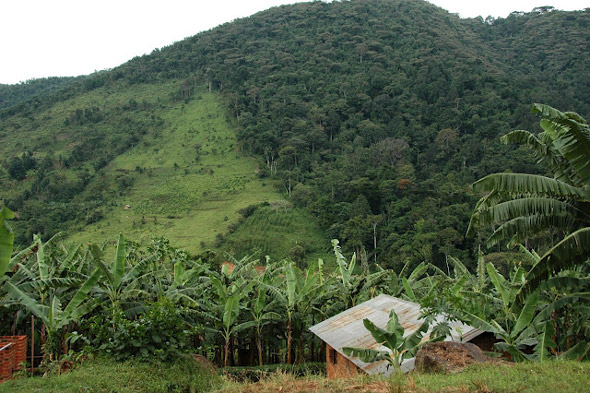
Fifty-one-year-old Sam Rugaba is a dedicated teacher who loves his job at the Bujengwe Community Primary School. The school is the result of a community-based project located in the Bujengwe Parish of the Kayonza subcounty in the Kanungu district of Uganda – just 18 kilometers from the Bwindi Impenetrable National Park (BINP). The biodiversity-rich BINP is home to many rare species including the endangered mountain gorilla. Sam is also a Conservation Through Public Health(CTPH) community volunteer and community conservation health worker. -
Top 10 Posts for February 2011
›Continuing turmoil in the Middle East helped keep Richard Cincotta’s political-demographic analysis on Tunisia’s chances of achieving democracy at the top this month, with Bryan McDonald’s piece on food price shocks, comments from demographers on “the age of revolution,” and a look at Pew’s latest iteration of its report on Muslim population growth following close behind:
1. Tunisia’s Shot at Democracy: What Demographics and Recent History Tell Us
2. Guest Contributor Bryan McDonald: Food Price Shocks and Instability Highlight Weaknesses in Governance and Markets
3. The Age of Revolution? Demography Experts Comment on Tunisia’s Shot at Democracy
4. Eye on Environmental Security: Mapping Muslim Population Growth
5. Book Preview: The Future Faces of War: Population and National Security6. Book Preview: Environmental Politics: Scale and Power, Shannon O’Lear, University of Kansas
7. Quantifying the Integration of Population, Health, and Environment in Development: When the Whole Is Greater Than the Sum of its Parts
8. India’s Maoists: South Asia’s “Other” Insurgency
9. Climate-Induced Migration: Catastrophe or Adaptation Strategy?
10. Guest Contributor Richard A. Matthew: Reading the QDDR: Civilian Power in a Complex, Uncertain World -
‘Dialogue’ Interviews International Reporting Project Fellows on Liberia
›Since 1998, the International Reporting Project has been a pioneer in the “non-profit journalism” movement that seeks to fill the gap left by much of the mainstream media’s reduction in international news coverage. IRP has provided opportunities to more than 300 U.S. journalists to travel to more than 85 countries to produce award-winning reports. This month on the Wilson Center’s Dialogue program, host John Milewski speaks with guests Sunni Khalid, Ed Robbins, and Teresa Wiltz. They recently participated in an intensive fact-finding visit to Liberia under the auspices of the International Reporting Project where they produced stories on the country’s ongoing development and women’s empowerment efforts (among other topics).
Sunni Khalid is managing news editor for WYPR in Baltimore, Maryland. Previously, he worked for Time, The Washington Times, USA Today, Voice of America, and NPR.
Ed Robbins is an independent, multi-award winning director, writer, producer, and videographer. Outlets for his work have included PBS, The Discovery Channel, National Geographic Channel, ABC, and the BBC.
Teresa Wiltz is a senior editor for The Root, where she helps oversee the production of the African-American web-magazine. She previously served as a staff writer for The Washington Post’s style section.
The full 30 minute interview is available at the Wilson Center.
To hear more about their projects, see The New Security Beat’s “A Lens Into Liberia: Experiences from IRP Gatekeepers.” -
Choke Point China: Escalating Confrontation Between Water Scarcity and Energy Demand Has Global Implications
›The original version of this article, by J. Carl Ganter, appeared on The Huffington Post. Visit Circle of Blue for the latest articles in the Choke Point: China series.
Water scarcity, rapid economic growth, and soaring energy demand are forming a tightening noose that could choke off China’s modernization.
Writes my colleague Keith Schneider in the first installment of the new report, Choke Point: China, from Circle of Blue:Underlying China’s new standing in the world, like a tectonic fault line, is an increasingly fierce competition between energy and water that threatens to upend China’s progress. Simply put, say Chinese authorities and government reports, China’s demand for energy, particularly for coal, is outpacing its freshwater supply.
The 12-part Choke Point: China series presents powerful evidence of the fierce contest between growth, water, and fuel that is virtually certain to grow more dire over the next decade. The project is produced in partnership with the Woodrow Wilson International Center for Scholars’ China Environment Forum.
Tight supplies of fresh water are nothing new in a nation where 80 percent of the rainfall and snowmelt occurs in the south, while just 20 percent of the moisture occurs in the mostly desert regions of the north and west. What’s new is that China’s surging economic growth is prompting the expanding industrial sector, which consumes 70 percent of the nation’s energy, to call on the government to tap new energy supplies, particularly the enormous reserves of coal in the dry north.
The problem, scholars and government officials told us, is that there is not enough water to mine, process, and consume those reserves and still develop the modern cities and manufacturing centers that China envisions for the region. “Water shortage is the most important challenge to China right now, the biggest problem for future growth,” said Wang Yahua, deputy director of the Center for China Study at Tsinghua University in Beijing. “It’s a puzzle that the country has to solve.”
The consequences of diminishing water reserves and rising energy demand have been a special focus of our attention for more than a year. In 2010, in our “Choke Point: U.S.” series, Circle of Blue found that rising energy demand and diminishing freshwater reserves are two trends moving in opposing directions across America. Moreover, the speed and force of the confrontation is occurring in the places where growth is highest and water resources are under the most stress – California, the Southwest, the Rocky Mountain West, and the Southeast.
Stripped to its essence, China’s globally significant choke point is caused by three converging trends:- Production and consumption of coal – the largest industrial consumer of water – has tripled since 2000. Government analysts project that China’s energy companies will need to increase coal production by 30 percent by 2020.
- Fresh water needed for mining, processing, and consuming coal accounts for the largest share of China’s industrial water use, a fifth of all the water consumed nationally. Though national conservation policies have helped to limit increases, water consumption nevertheless has climbed to record highs.
- China’s total water resource, according to the National Bureau of Statistics, has dropped 13 percent since the start of the century. In other words China’s water supply is 350 billion cubic meters (93 trillion gallons) less than it was at the start of the century. That’s as much water lost to China each year as flows through the mouth of the Mississippi River in nine months. Chinese climatologists and hydrologists attribute much of the drop to climate change, which is disrupting patterns of rain and snowfall.
We found a powerful narrative in China in two parts, and never before told: First is how effectively the national and provincial governments enacted and enforced a range of water conservation and efficiency measures that enabled China to progress as far as it has.
Second is that despite the extensive efforts to conserve water, and to develop water-sipping alternatives like wind and solar energy, China still faces an enormous projected shortfall of water this decade to its energy-rich northern and western provinces. How government and industry leaders respond to this critical and unyielding choke point forms the central story line of the next era of China’s unfolding development.
J. Carl Ganter is director and co-founder of Circle of Blue, a leading source of news, science, and data about water issues globally. Choke Point: China is produced in partnership with the Wilson Center’s China Environment Forum.
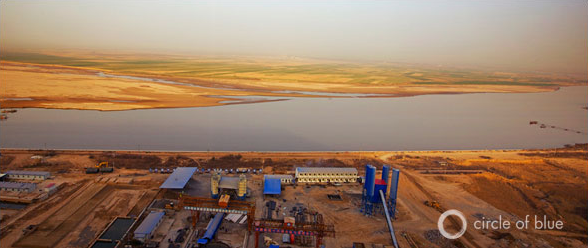
Image Credit: Two tunnels beneath the Yellow River to be completed by mid-decade that will transport more than 35 million cubic meters (9 billion gallons) of water a day from southern China to thirsty cities in the north. Courtesy of Aaron Jaffe and Circle of Blue. -
Deforestation, Population, and Development in a Warming World: A Roundtable on Latin America
›“Rural development and MCH [maternal child health] in the most remote, rural areas are going to largely explain the future of Latin American conservation, development, population, and urbanization,” said David Lopez-Carr, associate professor of geography at the University of California, Santa Barbara, at a recent Wilson Center roundtable on “Deforestation, Population, and Development in Latin America.”
Nearly 80 percent of Latin America’s people live in urban areas, yet the continent’s rural populations have a disproportionate effect on its forests. Panelists Liza Grandia, assistant professor of international development and social change at Clark University, and Jason Bremner, director of population, health, and environment at the Population Reference Bureau, argued that meeting the needs of these communities is therefore key to conserving Latin America’s forests. [Video Below]
Rural Populations Have Disproportionate Impact on Deforestation
“There are two Latin Americas,” said Carr. Countries like Argentina, Chile, and Uruguay are 90 percent urban, while countries like Guatemala, Ecuador, and Bolivia are about 50 percent urban. However, despite this rapid urbanization and declining population growth at the national level, rural areas in Latin America are still experiencing high fertility rates and significant forest loss. So how are these trends related?
In his analysis of more than 16,000 municipalities in Latin America, Carr found “no statistical significance between population change at the municipal level and woody vegetation change at the municipal level.” Yet this lack of connection does not mean population growth and deforestation are unrelated, but instead indicates “a problem of place and scale,” he said. Within countries or even within municipalities, there are huge variations in fertility rates. Rural areas, which generally have larger families, more agricultural expansion, higher population growth, and lower population density, account for higher impact per capita on forests.
“Less than one percent of the population of Guatemala moves to any rural frontier at all,” said Carr, “yet that small, tiny fraction of the population has a disproportionate impact on the forests, and that is true throughout Latin America.” Carr also distinguished between the private sector primarily converting secondary forest for corporate agriculture and subsistence farmers clearing old growth forest.
Indigenous Lands Are Key to the Future
There are generally two groups of people on the frontier: indigenous people and “colonists,” who move in to take advantage of undeveloped land. Indigenous people, by and large, act as “stewards of the forests,” exhibiting lower rates of deforestation and forest fragmentation then colonists, Bremner said. “They do have a very protective effect, largely because they are excluding others from those lands.”
Indigenous communities tend to be “common property institutions” with an informal or cultural set of rules and traditions facilitating land use, said Bremner. They are “really good at mobilizing against external threats,” he said, which results in a protective effect over the forest. In the Amazon, for example, “indigenous lands, in the context of all of this colonization and deforestation that is happening, are now seen as key to the future,” he said.
However, as indigenous population growth and growing agricultural and industrial expansion change indigenous communities and livelihoods, more formal rules must be developed to govern land use. If indigenous communities “are the protective factor, then we need to know how to protect them,” said Bremner.
There are few demographic surveys of rural communities, but one of nearly 700 women in the Ecuadorian Amazon found the total fertility rate of indigenous women to be seven to eight children per woman. “Fifty percent of indigenous women didn’t want to have another child…of that 50 percent, 98 percent were not using a modern method of contraception,” Bremner said. “Responding to these women’s needs, I think, would go a long way in terms of changing the future of these communities.”
Guatemala: Reducing Fertility By Thinking Outside the Box
Grandia, with support from Conservation International and ProPeten, conducted a study of population and environment connections as part of the Demographic and Health Survey (DHS) of Peten, a sparsely populated and highly biodiverse municipality of Guatemala. The 90,000 people living in the protected area in this park had “literally no family planning services,” said Grandia, and their population was on track to double within 20 years.
Using the DHS data, Grandia and ProPeten created a “somewhat eclectic population and environment program” that integrated many of the concerns of indigenous Maya communities in Peten, called Remedios. Remedios focused on a diverse set of issues, including agriculture, education, maternal and child health, family planning, and gender issues, and included projects like a “traveling education-mobile” and Between Two Roads, a bilingual radio soap opera in Spanish and Q’eqchi’ Maya, which used the story of a conflict between midwife and cattle rancher in a frontier community “to touch on a whole range of social and environmental issues.”
“As a result of our efforts…the total fertility rate dropped from 6.8 in 1999 to 5.8 in 2002, and in the most recent DHS it had fallen to 4.3,” said Grandia. She credited this success in part to the fact that the programs were “so cross-cutting across many of those schools of thought.” Yet the integration of a diverse range of issues also caused a split between the field-based ProPeten and the DC-based Conservation International, who wanted a more “narrow focus” on family planning and conservation, she said.
“Sometimes working outside the box can have unexpected results,” said Grandia. The population-environment movement could learn from the American environmentalist movement’s evolution from “an elite movement” into a “broader-based socially dynamic movement that involved new constituencies,” she said.
“Population and environment has often begged the articulation of a third field,” said Grandia. “How you fill in that blank often reflects the kind of development interventions you deem appropriate.” Perhaps “justice” should be considered “a new critical third paradigm,” she said.
Sources: Population Reference Bureau, World Bank.
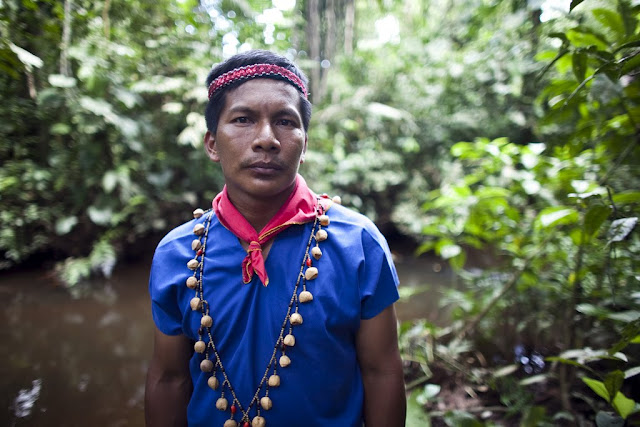
Photo Credit: “Chevron’s Toxic Legacy in Ecuador’s Amazon,” courtesy of flickr user Rainforest Action Network.