-
Pascal Gakwaya Kalisa, PHE Champion
Coffee Farmer and Extension Manager Promotes Improved Health and Livelihoods in Rwandan Coffee Communities
›
This PHE Champion profile was produced by the BALANCED Project.
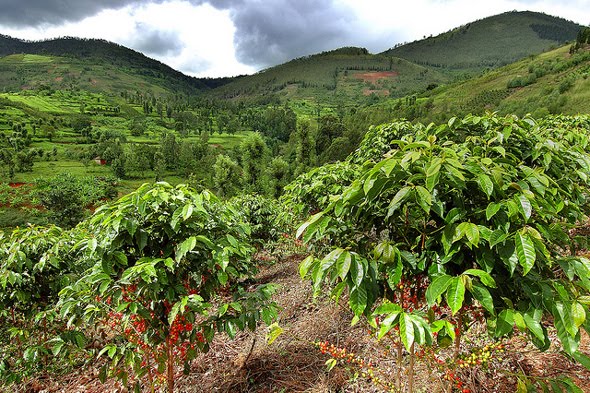
Mr. Pascal Gakwaya Kalisa has produced coffee in the densely populated country of Rwanda for the past nine years. A proud member of the 1,200 member Maraba Coffee Cooperative in Huye District in the Southern Province of Rwanda, Kalisa knows that a larger income alone does not ensure a better quality of life for his fellow coffee farmers and their families. He also knows that a successful coffee growing/exporting enterprise depends on preserving the fragile Rwandan soils, as well as on the health and well-being of farming families and communities. Therefore, Kalisa and other cooperative members treat the land and trees with a level of personal care that is necessary for optimum organic production and soil preservation.
Kalisa and the community have set up small, garden-sized coffee farms that are more productive than usual. Cooperative washing stations have enabled the small-scale farmers to improve product quality, and the cooperatives themselves are learning to negotiate better coffee prices with international buyers. Through such efforts and the support of many international donors and industry partners, Rwanda has become a producer of high quality specialty coffee since 2005, and its coffees are being marketed through renowned coffee roasters and importers in the United States, Europe, and Japan. In just six short years, Rwandan farmers have doubled their incomes and created 2,000 jobs, and the first renowned specialty coffee competition Cup of Excellence in Africa was held in Rwanda in 2008.
SPREAD: A Community Partnership
Recognizing the broad-based health, social, and economic needs of coffee farmers and their families in this part of East Africa, the U.S Agency for International Development initiated the Sustaining Partnerships to Enhance Rural Enterprise and Agribusiness Development project (SPREAD) to provide rural cooperatives and enterprises involved in high-value commodity chains with both appropriate technical assistance and access to health-related services and information. It is this combination of technical assistance and health-related outreach and services that has resulted in increased and sustained incomes and improved livelihoods.
Kalisa and other members of various cooperatives that SPREAD supports recognize that not only should farmers and their families preserve the land, but they must also preserve their own health in order to perform the labor needed to farm the crop that will produce the steady stream of high quality coffee upon which their livelihoods depend. Initiating community dialogues around issues such as protected sex, gender roles, and how coffee revenue is spent within households has also been crucial to project success among both youth and adults.
In his role as coffee zone coordinator for the SPREAD project, Kalisa works with coffee cooperatives to implement improved agricultural practices that improve the quality of their crop. This includes using cleaner environmental practices during coffee processing, such as introducing composting of coffee cherry pulp. Kalisa also helps disseminate integrated health and coffee messages through a weekly coffee talk-show produced by the National University of Rwanda’s Radio Salus, called Imbere Heza (“Bright Future”). In one show, for example, a man explained to a fellow farmer that to get good coffee cherries, he should thin his trees to renew his plantation.
Integrating Healthy Lives
Kalisa has also helped the SPREAD project’s health team deliver integrated messages on family planning, maternal and child health, alcohol, nutrition, gender issues, and the linkages between these. He uses examples such as the one about tree thinning to explain that families that space their children tend to be healthier, as they can plan the number of children to better fit with the financial and natural resources at hand.
Kalisa sees the benefits of using community agents to deliver integrated health, environment, and livelihood messages. This includes training extension agents to discuss environmental and human health issues in the context of coffee growing. Also, having coordinators from the coffee program and the health program go hand-in-hand to the field saves time, fuel, and other project costs. Kalisa believes that this campaign to educate coffee farmers and their families on the linkages between human health, a healthy environment, and strong livelihoods will lead to long-term change in their behavior, attitudes, and knowledge – change that will help them live better lives today and into the future.
This PHE Champion profile was produced by the BALANCED Project. A PDF version can be downloaded from the PHE Toolkit. PHE Champion profiles highlight people working on the ground to improve health and conservation in areas where biodiversity is critically endangered.
Photo Credit: “Rwanda photos 060,” courtesy of David Dewitt/counterculturecoffee. -
STATcompiler: Visualizing Population and Health Trends
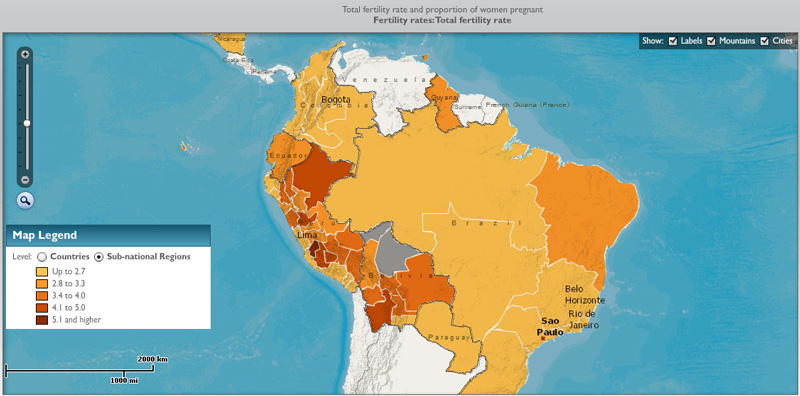
›World population is growing – earlier this week, the global community symbolically marked the arrival of the seven billionth person. But the unprecedented growth in global population over the last few decades has not affected everyone equally – in 1950, 68 percent of the world’s population lived in developing regions; today that number is 82 percent. MEASURE’s latest version of their STATcompiler tool helps visually highlight areas simultaneously experiencing the most demographic change and poor health indicators.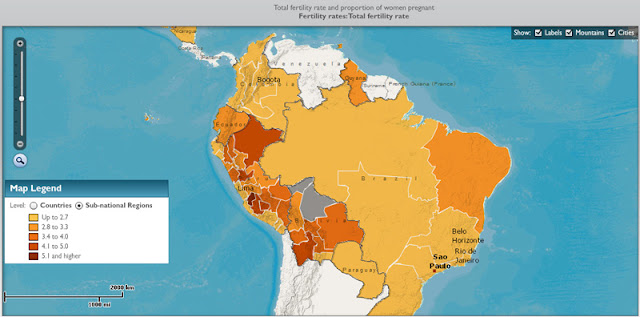
The revised STATcompiler – released in September – provides new ways for users to visualize data by generating custom data tables, line graphs, column charts, maps, and scatter plots based on demographic and health indicators for more than 70 countries. Users can select countries or regions of interest, and relevant indicators, including for family planning, fertility, infant mortality, and nutrition. Tables can be further customized to view indicators over time, across countries, and by background characteristics, such as rural or urban residence, household wealth, or education. In some cases, sub-national data is available. User-created tables and images are then exportable so that they may be easily used in papers or presentations.
Since STATcompiler is still in active development, certain functions are still being added. HIV data has not yet been integrated into the program, nor has the express viewer function, with customizable, ready-made tables for quick access. Additionally, updated information is not available for all countries, in all categories – for instance, the most recent data available for Mexico comes from a 1987 survey. If preferred, the legacy version remains available to users in the meantime.
MEASURE DHS – the Monitoring and Evaluation to Assess and Use Results Demographic and Health Surveys project – provides technical assistance for data collection on health and population trends in developing countries. Their demographic and health surveys, funded by USAID, provide data for a wide range of monitoring and impact evaluation indicators at the household level in the areas of population, health, and nutrition. They have become a staple data source for researchers, and the addition of better analysis functions and dissemination tools, via STATcompiler, will hopefully help advance understanding of demographic and health trends.
Image Credit: Map from STATcompiler, arranged by Schuyler Null. -
New Report Launched: ‘The World’s Water’, Volume Seven
›“The water problem is real and it is bad,” said MacArthur “Genius” Fellow and founder of the Pacific Institute Peter Gleick at the October 18 launch of the seventh volume the institute’s biennial report on freshwater resources. “It’s not bad everywhere, and it’s not bad in the same way from place to place, but we are not doing what we need to do to address all of the different challenges around water.”
“The World’s Biggest Problem”
Worldwide, more than a billion people lack access to safe drinking water, while two and a half billion lack access to adequate sanitation services. “This is the world’s biggest water problem,” said Gleick, “the failure to meet basic human needs for water – it’s inexcusable.”
Gleick predicts that the world will fail to meet the Millennium Development Goals for water and sanitation by 2015, and noted that measures of illness for water-related diseases are rising, rather than falling.The World’s Water series provides an integrated way of thinking about water by exploring major concepts, important data trends, and case studies that point to policies and strategies for sustainable use of water. Volume seven includes chapters on climate change and transboundary waters, corporate water management, water quality challenges, Australia’s drought, and Chinese and U.S. water policy. The new volume also includes a set of side briefs on the Great Lakes water agreement, the energy required to produce bottled water, and water in the movies, as well as 19 new and updated data tables. An updated water conflict chronology looks at conflicts over access to water, attacks on water, and water used as a weapon during conflict.Peter Gleick on climate change and the water cycle.
Despite the added data, Gleick said that vast gaps remain in our knowledge and understanding about water. We lack accurate information on how much water the world has, where it is, how much humans use, and how much ecosystems need, he said. “So right off the bat, we are at a disadvantage.”
Focus on Efficiency, Infrastructure to Better Manage Water
One of the major concepts that has connected various volumes of The World’s Water is the concept of a “soft path for water” – a strategy for moving towards a more sustainable future for water through several key focus points: improved efficiency, decentralized infrastructure, and broadly rethinking water usage and supply.
Other cross-cutting themes include climate and water, peak water, environmental security, and the human right to water (formally recognized in a 2010 UN General Assembly resolution). “I would argue that all of these combined offer to some degree a different way of thinking about water, an integrated way of thinking about water,” Gleick said.
The China Issue
The role of China has been one of the most significant changes over the course of the series, said Gleick. The growth in the Chinese economy has led to a massive growth in demand for water (see the Wilson Center/Circle of Blue project, Choke Point: China), as well as massive contamination problems. The newest volume addresses these issues as well as China’s dam policies – internally, with neighboring countries, and around the world.
Gleick pointed out that China is one of the only nations (maybe the only) that still has a massive dam construction policy, and their installed capacity is already much larger than the United States, Brazil, or Canada. In addition, Chinese companies and financial interests are involved in at least 220 major dam projects in 50 countries around world. These projects have become increasingly controversial, for both environmental and political reasons, he said.
“My lens is typically a water lens,” Gleick said, but “none of us can think about the problems we really care about, unless we think about a more integrated approach.” Gleick emphasized the need for new thinking about sustainable, scalable, and socially responsible solutions. “We have to do more than we are doing, in every aspect of water,” he concluded.
Event Resources
Photo Credit: “Water,” courtesy of flickr user cheesy42. -
Top 10 Posts for October 2011
›October brought plenty of talk about population – the UN estimates that the seven billionth person alive today was born on the 31st and that brought a flurry of media coverage from all corners. Elizabeth Leahy Madsen broke down how we got to that number and where we’re going. Peter Gleick explained “peak water,” Jon Foley impressed at the first South by Southwest Eco conference, and we highlighted some of the debate around Solomon Hsiang et al.’s article about El Niño and conflict. Here are the top 10, measured by unique pageviews:
1. How Did We Arrive at 7 Billion – and Where Do We Go From Here?
2. Jon Foley: How to Feed Nine Billion and Keep the Planet Too
3. India’s Maoists: South Asia’s “Other” Insurgency
4. Tunisia’s Shot at Democracy: What Demographics and Recent History Tell Us
5. Weathering Change: New Film Links Climate Adaptation and Family Planning
6. El Niño, Conflict, and Environmental Determinism: Assessing Climate’s Links to Instability
7. Watch: Peter Gleick on Peak Water
8. Peter Gleick: Population Dynamics Key to Sustainable Water Solutions
9. In Search of a New Security Narrative: The National Conversation Series Launches at the Wilson Center
10. Food Security and Conflict Done Badly…, via Edward Carr, Open the Echo Chamber -
Bring the Water-Energy Nexus to Rio+20
›Global demand for energy will increase 30 percent by 2030, according to estimates, but in regions that are experiencing rapid economic growth, the increased demand for energy will lead to increased demand for water. The conflicting nature of achieving both water and energy security is exacerbated by a lack of institutional policy frameworks that integrate both concepts. However, the upcoming UN Rio+20 Sustainable Development Conference could provide an opportunity to change that.
Breaking Down Sustainability
Despite its emerging importance as an international relations concept, sustainability has been fragmented to reflect different economic, environmental, social, and cultural agendas. The lack of a common framework is reflected in the disjointed understanding of the water and energy nexus. More often than not, water-basin committees are only consulted when energy decisions are related to hydropower, and they are left out of consultations about alternative energy sources and land planning, even though such decisions have a direct impact on water resources.
Other examples of energy decisions impacting the water sector include the Canadian oil sands, where extraction techniques can consume 20 times more water than conventional oil drilling; irrigated first-generation and soy- and corn-based biofuels, which consume thousands times more water than traditional oil drilling; and solar thermal electricity, as opposed to photovoltaic electricity, which consumes twice as much water as a coal power plant. According to the Wilson Center/Circle of Blue Choke Point project, China will need perhaps 20 billion cubic meters of water a year (5.3 trillion gallons) over the next decade to meet its expanding coal power needs. Meanwhile, from 2000 to 2009, China’s total water reserves fell 1.5 percent annually.
Bring It to Rio
Is this a zero-sum, Kobayashi Maru-like scenario then? It doesn’t have to be if we expand our understanding of sustainability.A holistic understanding of the water-energy nexus is already present in regional documents such as the Organization of American States’ Declaration of Santa Cruz+10. The declaration recognizes that to be sustainable, every aspect of a nation – its energy matrix, water resource management, emergency planning, forest management, and governance – needs to be addressed to reach true sustainability. The nexus is also discussed in other documents such as the Stockholm Statement, but what is truly needed is a place on the agenda of the UN sustainable development conference next year in Rio de Janeiro.OnEarth Magazine’s Ben Jarvey at SXSW Eco.
Most of the major groups of the UN Division for Sustainable Development have released statements supporting the incorporation of the water-energy nexus within the Rio+20 discussions; these groups represent children and youth, women, free trade unions and businesses, scientists, and indigenous communities. The European Union has already established the water and energy nexus as one of the main challenges for the green economy. However, many of the key players within the negotiation process, including the United States, Brazil, India, and China, have not included the water-energy nexus in their official position papers.
To gather the support of these remaining actors, representatives of the Major Groups must advocate for the proposal at the national level. For example, the U.S. Senate is reviewing the Water and Energy Integration Act of 2011 (S.1343). If this bill were to be approved, it will be easier to push for the inclusion of the nexus approach in the official U.S. position paper for Rio+20. Civil society must aim to build domestic support for the inclusion of the water-energy nexus and a whole system approach before the third UNCSD Preparatory Committee Meeting, where the overall agenda for Rio+20 will be set. The inclusion of the nexus in the final agenda will only be possible if true engagement and dialogue between state and non-state actors is developed prior to the conference.
Although it is only one step, the incorporation of the water-energy nexus in the Rio agenda would help to expand our understanding of sustainability, in as official a way as possible, to encompass its truly cross-sectoral reach. Given the importance that the previous Earth Summit had for developing sustainable development goals, global leaders need to take this opportunity to incorporate the water and energy nexus into new discussions to validate its importance as a sustainability concept. This is essential to promote and deliver comprehensive frameworks at a local and regional level that account for the intricacies of an interconnected world.
Olimar Maisonet-Guzman is a 2011 Boren Fellow to Brazil and a member of the SustainUS Youth Delegation that will participate in the Rio+20 Earth Summit.
Sources: Council of the European Union, GovTrack.us, Organization of American States, UN Development Programme, UN Environment Programme, World Economic Forum, World Policy Institute, World Water Week.
Image Credit: Adapted from UNSCD 2012 official logo. -
Day of 7 Billion Puts Future Generations in Spotlight
›This month, our small planet’s population will hit seven billion. Reproductive health and environmental groups worldwide are raising awareness about the exact day – the “Day of Seven Billion” – when we’re estimated to hit that number next week, calling for sustainability and women’s empowerment. But the future trajectory of the world’s population projections – and all that they entail for human and environmental wellbeing – depends on decisions we make now.
Let’s start with the more than 215 million women worldwide – including many in our home countries, the United States and Kenya – who do not want to get pregnant but are not using modern contraception. Our world looks very different in 2050 if these women’s needs are met.
Research from the Futures Group shows that meeting women’s needs results in a significantly slowed population trajectory, with world population topping out at eight billion in 2050. According to recently revised UN estimates, without this intervention population could rise to 10 or even 12 billion by century’s end. Meeting this need is also a smart investment: Our research estimates that access to modern contraception for all who want it would cost $3.7 billion per year. Others have estimated the savings in health care costs of providing contraception to all who want it at $5.1 billion per year. Family planning is cost-effective; it has been estimated that a dollar spent on family planning can save between $15 and $20 in education, health, housing, and other socio-economic support costs, making the achievement of the Millennium Development Goals cheaper for developing countries.
The health and environmental benefits are also enormous: a one-third reduction in maternal mortality; a one-fifth reduction in child mortality; a major reduction in the greenhouse gas emissions. Recent research shows that carbon emissions slow when we slow our population trajectory in an effect similar to increasing the world’s use of wind power forty-fold. In Nigeria it was recently estimated that providing universal access to family planning would result in a reduction of carbon emissions equivalent to eight years from current sources.
These investments also provide more than big numbers: By enabling couples and women to choose when and how many children they’ll have, women can continue their educations longer, participate more in the workforce, and contribute to household decisions that benefit the family.
Giving women what they want and need to plan their pregnancies is one of the most obvious, yet most overlooked solutions to many of the most pressing problems we face, from maternal and child mortality to climate change. International family planning funding has stagnated for over 10 years and the results have been predictable: In Kenya, and in many countries, unmet need – with all its human costs – has increased.
Today, the largest generation of young people ever is coming of age. The aspirations and health of the millennial generation – as well as all those in the future – are on the line.
Pamela Onduso, MPH, is a Kenyan reproductive health advocate and program adviser with Pathfinder International’s Kenya office based in Nairobi. Dr. Scott Moreland is a senior researcher at the Futures Group, and leads demographic work in countries around the world.
Sources: African Institute for Development Policy, Futures Group, Guttmacher Institute, Health Policy Initiative, PNAS, Population Services International, UN Population Division, World Health Organization.
Photo Credit: Adapted from “Tea picker and son,” courtesy of flickr user ROSS HONG KONG. -
Robert Draper, National Geographic
People and Wildlife Compete in East Africa’s Albertine Rift
›The original version of this article, by Robert Draper, appeared on National Geographic.
The mwami remembers when he was a king of sorts. His judgment was sovereign, his power unassailable. Since 1954 he, like his father and grandfather before him, has been the head of the Bashali chiefdom in the Masisi District, an undulating pastoral region in eastern Democratic Republic of the Congo (DRC). Though his name is Sylvestre Bashali Mokoto, the other chiefs address him as simply doyen – seniormost. For much of his adult life, the mwami received newcomers to his district. They brought him livestock or other gifts. He in turn parceled out land as he saw fit.
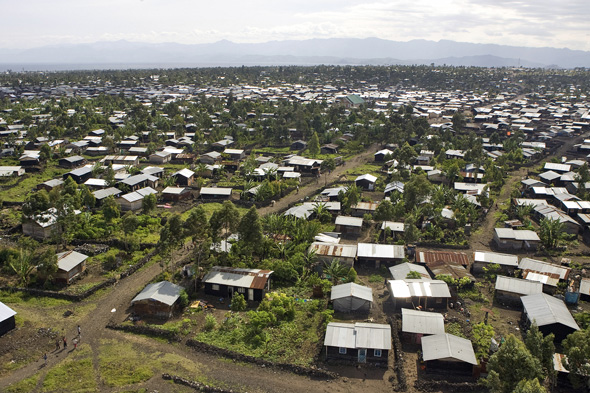
Today the chief sits on a dirty couch in a squalid hovel in Goma, a Congolese city several hours south of Masisi. His domain is now the epicenter of a humanitarian crisis that has lasted for more than a decade yet has largely eluded the world’s attention. Eastern Congo has been overtaken by thousands of Tutsi and Hutu and Hunde fighting over what they claim is their lawful property, by militias aiming to acquire land by force, by cattlemen searching for less cluttered pastures, by hordes of refugees from all over this fertile and dangerously overpopulated region of East Africa seeking somewhere, anywhere, to eke out a living. Some years ago a member of a rebel army seized the mwami’s 200-acre estate, forcing him, humiliated and fearing for his safety, to retreat to this shack in Goma.
The city is a hornet’s nest. As recently as two decades ago Goma’s population was perhaps 50,000. Now it is at least 20 times that number. Armed males in uniform stalk its raggedy, unlit streets with no one to answer to. Streaming out of the outlying forests and into the city market is a 24/7 procession of people ferrying immense sacks of charcoal on bicycles or wooden, scooter-like chukudus. North of the city limits seethes Nyiragongo volcano, which last erupted in 2002, when its lava roared through town and wiped out Goma’s commercial district. At the city’s southern edge lies the silver cauldron of Lake Kivu – so choked with carbon dioxide and methane that some scientists predict a gas eruption in the lake could one day kill everyone in and around Goma.
The mwami, like so many far less privileged people, has run out of options. His stare is one of regal aloofness. Yet despite his cuff links and trimmed gray beard, he is not a chief here in Goma. He is only Sylvestre Mokoto, a man swept into the hornet’s nest, with no land left for him to parcel out. As his guest, a journalist from the West, I have brought no gifts, only demeaning questions. “Yes, of course my power has been affected greatly,” the mwami snaps at me. “When others back up their claims with guns, there is nothing I can do.”
Continue reading on National Geographic.
Photo Credit: “Aerial View of Goma,” courtesy of UN Photo/Marie Frechon. -
Water and Poverty in a World of 9 Billion, Vulnerable Agriculture in the Niger Basin
›In a two–part Water International special report on water, food, and poverty, examining 10 of the world’s major river basins, a team of researchers say that instead of worrying about having enough water to sustain the world’s growing demand, policymakers should be concerned with understanding how to manage what they already have.Introducing the special report, Simon Cook, Myles Fisher, Tassilo Tiemann, and Alain Vidal note in “Water, Food and Poverty: Global- and Basin-Scale Analysis” that the vast majority of population growth over the next few decades is expected to happen in developing countries, “where the disjunct between poverty, water and food is particularly acute.” Gaining a better understanding of water – how much we have, who uses it, and how best to use it – is essential to improving development results in the face of this demographic explosion. Water is linked with poverty and development through issues like scarcity, access, and water-related hazards (like drought, flood, and disease). But the authors conclude that water productivity – the ease or difficulty in getting water from its source to agriculture – “is by far the most important water-related constraint to improved food, income and environmental security.”In “Water, Agriculture and Poverty in the Niger River Basin,” Andrew Ogilvie et al., paint a bleak picture of life in one of West Africa’s most important basins, writing that “[m]uch of the population in the basin suffers from extreme, chronic poverty and remains vulnerable to droughts and malnutrition.” Many of the Niger basin’s 94 million residents rely on subsistence agriculture, and most of that agriculture relies on rainwater rather than groundwater irrigation systems. Over time, the authors write, “there is little doubt that climate change will increase the strain on already-vulnerable agriculture.” Population growth will exacerbate this strain; the basin’s population is expected to increase as much as fourfold by 2050. In spite of this bleak picture, the authors conclude that “[i]mprovements in rainfed agriculture can have an important impact on poverty reduction and food security due to the large population dependent on it.”
Showing posts from category *Blog Columns.