Showing posts from category *Blog Columns.
-
Nigeria Beyond the Headlines: Demography and Health [Part One]
›
“Nigeria is a country of marginalized people. Every group you talk to, from the Ijaws to the Hausas, will tell you they are marginalized,” said Peter Lewis, director of the African Studies Program at the Johns Hopkins University School of Advanced International Studies. Lewis spoke at an April 25 conference on Nigeria, co-hosted by ECSP and the Wilson Center’s Africa Program, assessing the country’s opportunities for development given its demographic, governance, natural resource, health, and security challenges. [Video Below]
-
A Northern View: Canada’s Climate Claims and Obligations
›Reneging on Kyoto, Keystone pipeline drama, pain at the pump, re-aligned Arctic sovereignty, melting outdoor hockey rinks – all these aspects of climate change are being discussed in Canada.
However, Canadians, as potential citizens of the next energy superpower, need a more comprehensive and enriching debate. Climate change adaptation measures, at home and abroad, are inevitable, but the issue has largely been ignored by the federal government thus far.
To many Americans, it may seem that Canada has equated energy production with national prosperity, but Canadians are increasingly concerned about the human security and eco-justice implications of ongoing climate change as well. Lack of leadership at the federal level on Kyoto-related energy efficiency and emissions mitigation has been partially offset by actions at the provincial and municipal levels, but climate change is occurring now and it demands a coordinated response from the federal government, the only political apparatus capable of channeling the resources necessary for making a solid contribution to global climate change adaptation.
A moderate predictive scenario suggests that the regional impacts of climate change will be very expensive: the UN projects the global Green Climate Fund will require up to $100 billion a year by 2020. Water stress – too little, too much, or the perception of either – may be the most common theme. Coastal flooding, shoreline erosion, glacier retreat, chronic water shortages, loss of biodiversity and habitat, increased spread of invasive species, extreme weather events; taking preventive action against these (beyond the obvious call for reduced emissions) will be prohibitively expensive for most communities around the globe, including the coastal and northern regions of Canada.
The UN Convention to Combat Desertification has become a conduit for the argument that drought and land degradation related to climate change justifies southern demands for northern investment in initiatives in Africa and elsewhere. As a high emissions per capita nation, Canada has an obligation to contribute to such international efforts.
But I also don’t see why the indigenous peoples of the circumpolar north should be denied claims as permafrost thaws and ice-cover vital for subsistence hunting disappears. Citizens of small island states, to whom adaptation may well mean the abandonment of their homeland, have charged willful ignorance or purposeful negligence of their plight; so too might riparian communities along Canada’s many ocean shorelines, lakes, and rivers. Farmers, fishers, First Nations communities: all will need to adapt. We need to start seriously planning ahead to meet climate change scenarios, instead of burying the issue under the tar sands.
Of course, people will adapt to shifting conditions; such is the imperative of survival. And there are many ingenious ways this will materialize. Indeed many mitigation and adaptation strategies blend together as hybrids today. Building more effective alternative energy systems can be seen as much as responses to climate change as preventive measures and involve both public and private sector funding, for example.
However, paying for adaptation is another matter, and here it is vital in my view to stress the potential role of infrastructure spending by the federal government. Much of Canada’s current fiscal restraint is indeed a welcome development if the government cuts back on waste and redundancy, but not if it serves as a veil for sacrificing principles of eco-justice – the idea that those who made the least contributions to and benefit the least from environmental problems should not bear disproportionately higher risks.
Of course there will be nasty disputes ahead about the accounting, accountability, legitimacy, and purpose of climate change adaptation funding for Canada, in or out of the UNFCCC process, but let me draw just a few general conclusions at this stage:- There is an ethical imperative to contribute to international adaptation funding, perhaps just as great an imperative as traditional efforts to help former colonized countries. It’s not just about money, at least not directly: Canadian technical, policy, and financial expertise should be harnessed for this purpose as well.
- Unlike in other policy areas, there is no way to unload or pass the buck on climate change adaptation efforts: they demand the utilization of centralized resources redistributed throughout the country and through multilateral funding mechanisms.
- Adaptation funding should not, however, supplant more traditional emergency, humanitarian, or environmental funding. It should be seen as a supplement, albeit one with increasing importance, but not as a new form of dependency or gold-rush of aid-with-obligations opportunities. The current government is right to worry about accountability issues.
- But accountability goes both ways: we need at least to get the accounting and communications right on this, thus the need for open dialogue and ongoing consultation. Killing the well-respected National Roundtable on the Environment and the Economy, which consulted various Canadian stakeholders on key environmental questions, was not a good start.
Peter Stoett is the Fulbright Research Chair in Canada-U.S. Relations at the Wilson Center’s Canada Institute and professor in the Department of Political Science at Concordia University, Montreal.
Sources: CBC, The Catholic Register, The Huffington Post, International Institute for Sustainable Development, UNFCCC.
Photo Credit: “City, Suburb, Ocean, Mountain,” courtesy of flickr user ecstaticist (Evan Leeson). -
Learning From Success: Ministers of Health Discuss Accelerating Progress in Maternal Survival
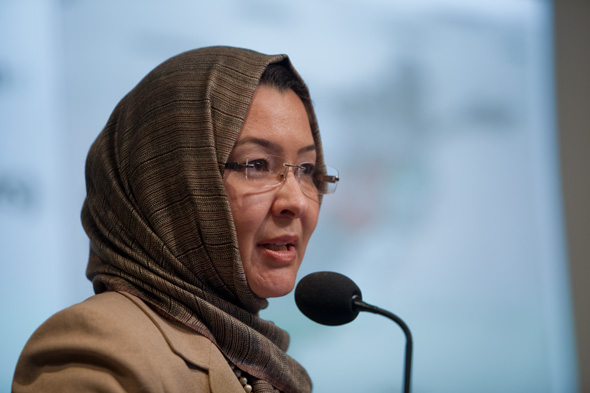
›“The gains we have made [in reducing maternal mortality rates] are remarkable; however, gains are fragile and donor resources are declining. Substantial investments must be maintained to safeguard these hard-wins,” said Afghan Minister of Health Suraya Dail at the Wilson Center on April 23. [Video Below]
As part of the Wilson Center’s Global Health Initiative, the Advancing Dialogue to Improve Maternal Health series partnered with the U.S. Agency for International Development to co-host Minister Dail, along with Honorable Dr. Mam Bunheng, Minister of Health, Cambodia; Honorable Dr. Bautista Rojas Gómez, Minister of Health, Dominican Republic; and Dr. Fidele Ngabo, Director of Maternal and Child Health, Ministry of Health, Rwanda.
These ministers spoke about the lessons learned in countries where there has been tremendous progress under challenging circumstances.
In the Dominican Republic, Bautista Rojas Gomez said the first challenge was to address the “Dominican paradox,” where maternal mortality rates were high despite the fact that 97 percent of women received prenatal care and delivered in hospitals. The government created a zero tolerance policy that included a comprehensive surveillance system, mandatory maternal death audits, and community oversight of services, which assured better quality services.
Similar political commitment improved indicators in Cambodia, where maternal mortality rates dropped from 472 to 206 per year from 2005 to 2010. “It takes a village…and the prime minister has inspired the country to act,” said Mam Bunheng. Through increased access to contraception the number of children per woman went from seven to three and commitment to family planning, education, technology, infrastructure, and community have been the key drivers of success.
“In Rwanda, the big challenge we are having is education,” said Fidele Ngabo. “Many of the maternal health indicators depend on education.” When women and girls are educated they are twice as likely to utilize modern contraception. The efforts of Rwanda’s government have been instrumental in facilitating positive change, he said, particularly the efforts of First Lady Jeannette Kagame, who he called a “champion” for women and girl’s health.
As witnessed throughout the Advancing Dialogue to Improve Maternal Health series – and reiterated by the ministers of health – the interventions to improve maternal mortality rates exist, what’s left is to generate the needed political willpower.
Event Resources
Photo Credit: David Hawxhurst/Wilson Center. -
Nicholas Eberstadt, Wilson Quarterly
Population Changes Set to Remake Japanese Society
›The original version of this article, by Nicholas Eberstadt, appeared in the Wilson Quarterly.
In 2006, Japan reached a demographic and social turning point. According to Tokyo’s official statistics, deaths that year very slightly outnumbered births. Nothing like this had been recorded since 1945, the year of Japan’s catastrophic defeat in World War II. But 2006 was not a curious perturbation. Rather, it was the harbinger of a new national norm.
Japan is now a “net mortality society.” Death rates today are routinely higher than birthrates, and the imbalance is growing. The nation is set to commence a prolonged period of depopulation. Within just a few decades, the number of people living in Japan will likely decline 20 percent. The Germans, who saw their numbers drop by an estimated 700,000 in just the years from 2002 to 2009, have a term for this new phenomenon: schrumpfende Gesellschaft, or “shrinking society.” Implicit in the phrase is the understanding that a progressive peacetime depopulation will entail much more than a lowered head count. It will inescapably mean a transformation of family life, social relationships, hopes and expectations – and much more.
But Japan is on the cusp of an even more radical demographic makeover than the one now under way in Germany and other countries that are in a similar situation, including Italy, Hungary, and Croatia. (The United States is also aging, but its population is still growing.) Within barely a generation, demographic trends promise to turn Japan into a dramatically – in some ways almost unimaginably – different place from the country we know today. If we go by U.S. Census Bureau projections for Japan, for example, there will be so many people over 100 years of age in 2040, and so few babies, that there could almost be one centenarian on hand to welcome each Japanese newborn. Population decline and extreme population aging will profoundly alter the realm of the possible for Japan – and will have major reverberations for the nation’s social life, economic performance, and foreign relations. Gradually but relentlessly, Japan is evolving into a type of society whose contours and workings have only been contemplated in science fiction. It is not clear that Japan’s path will be a harbinger of what lies ahead in other aging societies. Over the past century, modernization has markedly increased the economic, educational, technological, and social similarities between Japan and other affluent countries. However, Japan has remained distinctive in important respects – and in the years ahead it may become increasingly unlike other rich countries, as population change accentuates some of its all-but-unique attitudes and proclivities.
Continue reading in the Wilson Quarterly.
Sources: U.S. Census Bureau.
Photo Credit: Japanese woman enjoying some free soup for breakfast, courtesy of flickr user USAFA87. -
Avoiding Adding Insult to Injury in Climate Adaptation Efforts
›Climate change is expected to produce winners and losers – for example, melting ice-caps may open up new economic opportunities for Greenland at the same time as sea-level rise threatens Asia’s bourgeoning coastal mega-cities. The same can be said about plans to address climate change, from both the mitigation and adaptation perspectives. A special issue of Global Environmental Change, “Adding Insult to Injury: Climate Change, Social Stratification, and the Inequalities of Intervention,” takes on this topic, with two case studies providing particularly compelling evidence.Betsy Beymer-Farris and Thomas Bassett argue in their contribution, “The REDD Menace: Resurgent Protectionism in Tanzania’s Mangrove Forests,” that efforts to ensure REDD readiness in Tanzania have placed local communities at risk of forced evictions, shattered livelihoods, and persecution by both the state and conservation community. Contrary to dominant narratives that “portray local resources users, the Warufiji, in negative terms as recent migrants who are destroying the mangrove forests,” the authors say that they in fact depend upon “allow[ing] the mangroves to regenerate naturally while preparing new rice fields.” “To carbon traders, however, an uninhabited forest greatly simplifies the logistical tasks of monitoring and paying for ecosystem services,” assert the authors. This has resulted in declaration of local communities as squatters, illegally invading the forest. Government officials have repeatedly voiced threats of eviction. As well as increasing the potential for social tension, the study concludes that, “it is difficult to reconcile Tanzania REDD’s participatory and benefit sharing goals with the rhetoric, practices, and plans of the Tanzanian state.”In “Accessing Adaptation: Multiple Stressors on Livelihoods in the Bolivian Highlands Under a Changing Climate,” Julia McDowell and Jeremy Hess present evidence about how specifically-tailored adaptations to climate change risk increasing vulnerability to a complex web of other, less obvious stressors. The study draws evidence from the livelihoods of historically marginalized indigenous farmers in highland Bolivia. The authors, who see “adaptation as part of ongoing livelihoods strategies,” use the case to “explore the tradeoffs that households make when adjustments to one stressor compromise the ability to adjust to another.” For instance, socio-economic stressors have forced many farmers to more closely couple their livelihoods with the market economy by growing more cash crops, intensifying land use, participating in off-farm laboring, and relying on irrigated agriculture. However, the shift to more market-orientated livelihoods has also increased their sensitivity to climatic stress. “As stressors compounded, the ability to mobilize assets became constrained, making adaptation choices highly interdependent, and sometimes contradictory,” the authors write. Avoiding these sorts of lose-lose situations, requires “ensuring sustained access to assets, rather than designing interventions solely to protect against a specific stressor.” -
Jack Goldstone on Post-Cold War Trends in Armed Conflict and Challenges for the World’s Youth
›“Global trends in armed conflict have really come down since the end of the Cold War,” said George Mason University’s Jack Goldstone in this talk adapted from a presentation at the Wilson Center last fall. This drop is a reflection of decreased proxy conflicts between the Soviet Union and United States and increased interventionism from the international community. But another thing we can point to is that the world’s youth population has also declined, he said.“Global trends in armed conflict have really come down since the end of the Cold War,” said George Mason University’s Jack Goldstone in this talk adapted from a presentation at the Wilson Center last fall. This drop is a reflection of decreased proxy conflicts between the Soviet Union and United States and increased interventionism from the international community. But another thing we can point to is that the world’s youth population has also declined, he said.
“There seems to be a reasonably strong connection, between the drop-off in post-Cold War conflicts” and a decline in the proportion of youth in global population. This ageing, however, has been uneven across the globe and risks remain, said Goldstone.
“Ninety percent of all children under the age of 15 in the world today are growing up outside of North America, Europe, and the wealthy countries of East Asia,” he said, and in four or five decades time, “90 percent of the workforce of the world will be workers that have grown up outside of the rich countries.” It is this population’s “future productivity [that] will go far to determining whether quality of life gets better or worse.”
Demography and State Fragility
States across sub-Saharan Africa, South Asia, and the Middle East that perform poorly in indexes of state fragility also tend to have the youngest populations. “This could be just an unhappy coincidence,” said Goldstone, “but I don’t think that’s what’s going on. I think what we’re seeing is a kind of virtuous and vicious circle.”
“Where government is weak, ineffective, doesn’t provide education, doesn’t provide security, it’s advantageous both for individuals and for groups to have larger families,” he said. “However, as population grows, it’s more difficult for the government to provide adequate education and security for the larger, more youthful population.”
“On the other hand, if you can get on the track for a stronger, more legitimate government – a government that’s able to provide education, provide security of property, [and] encourage investment…fertility tends to drop quickly.” “This in turn re-enforces the ability of governments to direct resources to education and economic growth,” said Goldstone.
Critical Role of Governance
“Mobilization for political conflict draws heavily on youthful populations,” said Goldstone. As research by Henrik Urdal has shown, a bulge in the population of youth does appear to increase the risk of conflict. However, this relationship is strongly mediated by regime type. While strong democracies and autocracies are considered relatively stable, there is a “risk zone” in between, where instability is more likely.
“We live in a world where the countries with weak, fragile governments [are] about a third of the global population. But in another 30 years, if things remain as they are in terms of governance, you’re looking at closer to half the world’s population living in those more difficult circumstances,” he said.
“If the democracy is not well established, if rule of law is not well regulated, than people don’t necessary trust the outcome of peaceful electoral competition,” said Goldstone. “If people don’t like the outcome of an election, or they feel they’re being excluded, or things are one sided, they may mobilize.” This lack of political trust can result in instability and violence such as the recent protests by Thailand’s “red shirts.”
Although many Latin American and Asian states are heading towards “voluntary reduced fertility, strong economic growth, and stronger and more stable governments,” a real risk remains, he asserted. Africa, for instance, is “liable to gain a billion out of the next two billion in global population growth.”
Challenges for the Future
“For me, there are two big challenges posed by global demography,” opined Goldstone.
First, “given that 90 percent of today’s youth are in developing nations, providing them with opportunities to become productive adults through education, stable environment, [and] socialization is crucial.”
And second, in order to deliver those services, “strengthening governance in the countries where those youth live, in order for those education, security, and social services to be provided,” is absolutely necessary for economic development and reducing political instability.
While incidences of conflict have declined, the effects of those intractable conflicts that remain – in particular the sharp increase in the number of refugees and displaced populations uprooted by conflict – are solid arguments for continuing to address this risk. -
Updates to African Conflict Database Give Researchers Access to Comprehensive, Near Real-Time Information
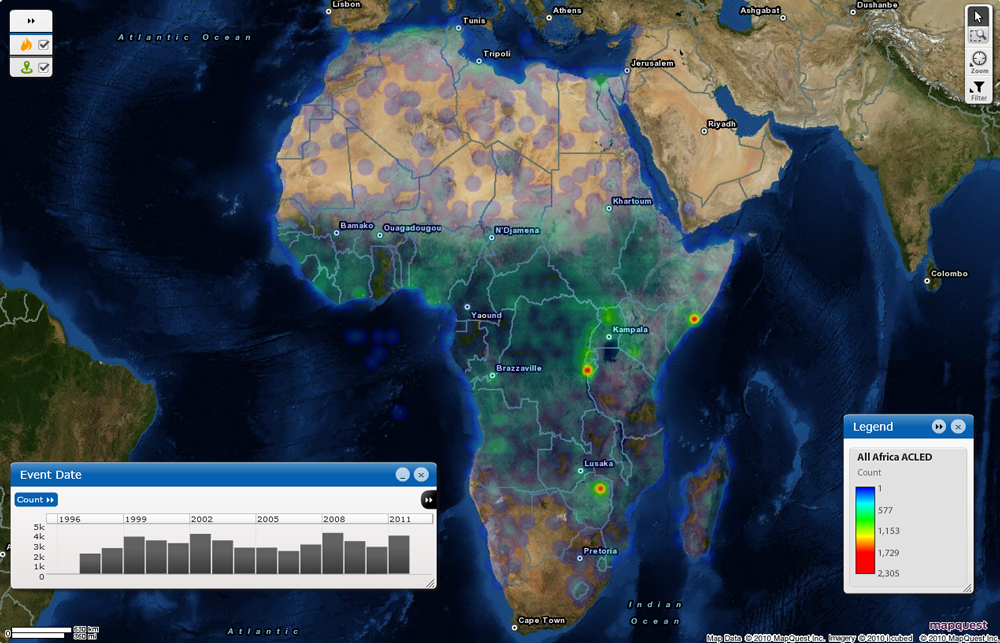
›Despite the end of Cold War-era civil wars, political violence rates in Africa remain remarkably high. However, this broad statement hides an important qualification: the types of violence that have persisted in recent years have changed significantly, shifting from rebel and government activity towards violence against civilians, riots, protests, and battles by armed groups other than rebels.
The only way researchers can track this activity is through political violence data disaggregated by type, location, and time. The Armed Conflict Location and Event Dataset (ACLED) project aims to provide that service. We recently released updated information on political violence across Africa from January 1997 to December 2011 (see above for a hotspot map and timeline of violence over this period).
New to the ACLED project are real time data and trend reports on monthly conflict patterns throughout the continent. It is now perhaps the comprehensive and representative depiction of political violence as it occurs throughout Africa.
The data captures an array of actions including battles, looting, rioting, protesting, violence against civilians, and non-violent activity (such as arrests, recruitment drives, troop movements) by a variety of actors such as governments, rebels, militias, rioters and protestors.
Each event is geo-referenced by location and time-stamped by day. In our recently released version, we also included fatalities by event; distinguished conflict groups by their type (government, rebel, political militia, communal militia, rioters, protesters, civilians etc.); and specified the type of interaction between actors (e.g. government-rebel battle; rebel-civilian attack). These changes make ACLED data flexible for multiple uses.
Several new findings on conflict patterns are found using ACLED data:- Violence against civilians accounts for approximately half of all conflict events.
- Generally, where they occur, civil wars intensely affect 19 percent of a state’s territory, yet rebel actions have drastically decreased since 2005.
- Militia activity has significantly increased since 2005 and is especially high during election periods in new democracies.
- Communal violence patterns are more widespread but affect fewer people than civil war violence.
- Civil war patterns are not strongly affected by climate changes, but communal conflict decreases during periods of local scarcity and increases on the cusp of rainy seasons.
- Political violence increases in the period from peace talk announcements to negotiations. This violence is directed towards overtaking territory and civilians are frequently the main victims.
Fine-grained data on the range of political violence in the developing world is important as it provides the opportunity to ask and potentially answer certain questions about a range of issues related to governance, economic development, and conflict dynamics themselves.
For example, ACLED data shows that violence is increasingly occurring in villages, towns, and cities across Africa. In other words, political violence may be “urbanizing.” This has important implications for how we understand the practice of politics, the geography of marginalization, and the role of trigger patterns in explaining conflict. But there are many competing theories that could explain this trend.
Using data that disaggregates by violence type allows us to probe deeper: If the environmental security framework is correct, political violence in towns may be a response to high in-migration from rural areas to cities. Violence therefore is due to competition between urban people and migrant populations.
An alternative explanation is that the poor conditions of African urban life, high rates of informal employment, and under-representation of urban communities in government might explain an increase in violence. In this case, violence is a populist response, in that civilians riot and protest in favor of government reform.
Finally, the advantages of densely populated urban areas – easier access to resources, recruits, infrastructure, and power – may attract more organized groups to contest these spaces. If this explanation were correct, we would expect higher rates of rebel activity against government forces in cities, with a clear drive to overtaking the capital.
We have not been able to address these questions before with credible and comprehensive data, but now we can. Indeed, such data is crucial for interrogating the climate-security debate.
For example, Clionadh recently co-authored an article in the Journal of Peace Research’s special issue on climate and conflict, which used ACLED data for East Africa. In that piece, she and her co-author argued that different conflict groups use their environment in accordance with their overall goals. While much of the conflict activity studied had an environmental signal, the climate signal was much weaker.
We hope that these studies and other work with disaggregated data spur more theories and explanations of conflict patterns in developing states, and that the breadth and form of the data allows for new directions within conflict research.
Clionadh Raleigh is an assistant professor in the Department of Geography at Trinity College, Dublin, external researcher at the Peace Research Institute Oslo (PRIO), and director of the ACLED project. Caitriona Dowd of Trinity College and Andrew Linke of the University of Colorado are senior researchers for ACLED.
Image Credit: ACLED. -
Top 10 Posts for April 2012
›Interest in the environment and conflict nexus is high: Posts on the Journal of Peace Research’s climate and conflict special issue; special profiles on India’s and Uganda’s environment, development, and security challenges; and March’s global water intelligence assessment all made the top 10 last month (measured by unique pageviews). The remaining newcomers hit on demography and gender issues, with a guest contribution on Rio+20 from the President of the Global Fund for Women, Musimbi Kanyoro, and a re-examination of Yemen’s prospects after the Arab Spring by Elizabeth Leahy Madsen.
1. Global Water Security Calls for U.S. Leadership, Says Intelligence Assessment
2. India’s Maoists: South Asia’s “Other” Insurgency
3. Responses to JPR Climate and Conflict Special Issue: François Gemenne (Sciences Po)
4. Guest Contributor Nils Petter Gleditsch: Much Ado About Conflict? Climate’s Links to Violence Reexamined
5. Uganda’s Demographic and Health Challenges Put Into Perspective With Newfound Oil Discoveries
6. Responses to JPR Climate and Conflict Special Issue: Solomon Hsiang (Princeton University) and Todd G. Smith (University of Texas, Austin)
7. Tunisia’s Shot at Democracy: What Demographics and Recent History Tell Us
8. Yemen: Revisiting Demography After the Arab Spring
9. In Search of a New Security Narrative: The National Conversation Series Launches at the Wilson Center
10. Guest Contributor Musimbi Kanyoro: Women’s Rights and Voices Belong at Rio+20