-
Aqueduct Water Risk Atlas Shows Detailed View of Global Water Vulnerability
›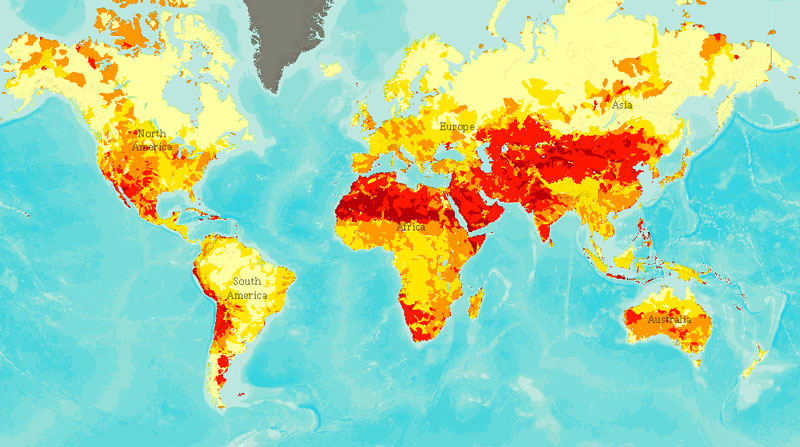
As world population pushes towards nine billion by mid-century and millions are elevated to the global middle class every year, demand for water continues to grow as well. More people need more water for drinking and household use, but also for agriculture, mining, energy, and industry. With water often cited as a limit to growth and potential crisis point, the World Resources Institute has released the Aqueduct Water Risk Atlas, which details various types of water stress around the world in impressively detailed fashion.
-
‘Dialogue’ Interviews Caryle Murphy & John Sullivan: Saudi Arabia’s Demography & 2013’s Big Environment Stories
›Dialogue at the Wilson Center tackled demography and the environment last week, interviewing Pulitzer Prize-winning journalist and former Wilson Center public policy scholar Caryle Murphy about her new book, A Kingdom’s Future: Saudi Arabia Through the Eyes of Its Twentysomethings, followed by John Sullivan, director of the Environment and Health and Safety News Division for Bloomberg BNA, on the most important energy and environmental issues of 2013.
-
After the Arab Spring, Challenges Intensify for Women in the Middle East and North Africa
›
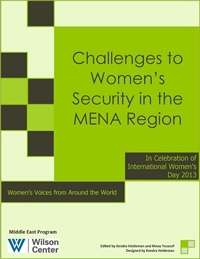
Excerpted below is the introduction, by Haleh Esfandiari, to Challenges to Women’s Security in the MENA Region. The full report is available for download from the Wilson Center’s Middle East Program.
On the occasion of International Women’s Day 2013, the Middle East Program at the Wilson Center invited a cross-section of women activists, politicians, academics, and entrepreneurs to give us their views on the challenges women face to their security. This publication, “Challenges to Women’s Security in the MENA Region,” includes pieces from 42 women from 20 countries, including the United States, Malaysia, Indonesia, and countries in the Middle East and North Africa (MENA) shared with us their concerns, disappointments, and hopes for women in the region.
-
Jack Goldstone Discusses Future Demographic Trends: The Old, the Young, and the Urban
›In this podcast, Jack Goldstone of George Mason University discusses the world’s demographic stresses in the coming years. In parallel to a growing trend of population aging in developed countries, much of the world will remain young, growing, and urbanizing, he said. The choices these growing countries make over the next few decades will have reverberating effects for the rest of the world, from conflict potential to the spread of stable democracies.
-
Breaking Out of the Green House: Indian Leadership in Times of Environmental Change (Book Preview)
›The 2009 Copenhagen summit was a watershed moment in the history of climate change negotiations, especially from an Indian perspective. Brazil, South Africa, India, and China – the “BASIC” group – asserted their position, which led to a virtual collapse in talks, ostensibly marking the ascent of the global “south” and relative descent of the “north.”
-
Rebecca Fishman, WASH Advocates
New Water and Women’s Health Series by MHTF and WASH Advocates
›The original version of this article, by Rebecca Fishman, appeared on the WASH Advocates and Maternal Health Task Force blogs.
Access to clean water is not only one of the world’s most urgent health issues, but it is also a key to boosting progress in developing countries. Women and children are disproportionately affected by inadequate water, sanitation, and hygiene (WASH), and they shoulder the largest burden in collecting drinking water. What is more, when the needs of women and girls are not taken into account, the effects are felt far and wide, reaching across the education, health, security, and economic sectors. On the other hand, improving WASH can have positive impacts throughout a girl’s life and can even extend across generations. As we know, when women thrive, so do their communities.
-
Top 10 Posts for February 2013
›The National Intelligence Council’s Global Trends 2030 report maintained its grip as the top post last month (measured by unique pageviews). But it was also joined by new posts on natural resources, conflict, and development with a look at the UN’s “year of water cooperation,” East Africa’s coming natural gas boom, China’s massive west-east electricity transfer infrastructure, the relationship between oil and war, and the changing context of Nile basin negotiations. Chad Briggs also weighed in on the U.S. Air Force’s Minerva Project and how it’s helping the military plan for complex risks.
-
Sam Eaton Describes Population-Food-Environment Links in Rural Philippines
›
In this podcast, journalist Sam Eaton describes the process of producing two pieces that aired on Marketplace and NewsHour last year on the connection between population, the environment, and food security in the Philippines. Eaton visited the rural village of Humayhumay where PATH Foundation Philippines, Inc., has a pilot program distributing contraceptives and teaching community members about conservation and sustainable livelihoods. Although Eaton said he was at first hesitant to tackle such an “abstract concept” as integrated population, health, and environment development, he found on the ground that it had “all the elements of a good story” and there were tangible benefits visible within the community. Eaton discussed his reporting at the Wilson Center on January 28.
Showing posts from category *Blog Columns.