• woodrow wilson center
  • ecsp

New Security Beat

Subscribe:
  • rss
  • mail-to
  • Who We Are
  • Topics
    • Population
    • Environment
    • Security
    • Health
    • Development
  • Columns
    • China Environment Forum
    • Choke Point
    • Dot-Mom
    • Friday Podcasts
    • Navigating the Poles
    • Reading Radar
  • Multimedia
    • Water Stories (Podcast Series)
    • Backdraft (Podcast Series)
    • Tracking the Energy Titans (Interactive)
  • Films
    • Water, Conflict, and Peacebuilding (Animated Short)
    • Paving the Way (Ethiopia)
    • Broken Landscape (India)
    • Scaling the Mountain (Nepal)
    • Healthy People, Healthy Environment (Tanzania)
  • Publications
  • Events
  • Contact Us

NewSecurityBeat

The blog of the Wilson Center's Environmental Change and Security Program
Showing posts from category On the Beat.
  • Robert Draper, National Geographic

    People and Wildlife Compete in East Africa’s Albertine Rift

    ›
    On the Beat  //  October 24, 2011  //  By Wilson Center Staff
    The original version of this article, by Robert Draper, appeared on National Geographic.

    The mwami remembers when he was a king of sorts. His judgment was sovereign, his power unassailable. Since 1954 he, like his father and grandfather before him, has been the head of the Bashali chiefdom in the Masisi District, an undulating pastoral region in eastern Democratic Republic of the Congo (DRC). Though his name is Sylvestre Bashali Mokoto, the other chiefs address him as simply doyen – seniormost. For much of his adult life, the mwami received newcomers to his district. They brought him livestock or other gifts. He in turn parceled out land as he saw fit.

    Today the chief sits on a dirty couch in a squalid hovel in Goma, a Congolese city several hours south of Masisi. His domain is now the epicenter of a humanitarian crisis that has lasted for more than a decade yet has largely eluded the world’s attention. Eastern Congo has been overtaken by thousands of Tutsi and Hutu and Hunde fighting over what they claim is their lawful property, by militias aiming to acquire land by force, by cattlemen searching for less cluttered pastures, by hordes of refugees from all over this fertile and dangerously overpopulated region of East Africa seeking somewhere, anywhere, to eke out a living. Some years ago a member of a rebel army seized the mwami’s 200-acre estate, forcing him, humiliated and fearing for his safety, to retreat to this shack in Goma.

    The city is a hornet’s nest. As recently as two decades ago Goma’s population was perhaps 50,000. Now it is at least 20 times that number. Armed males in uniform stalk its raggedy, unlit streets with no one to answer to. Streaming out of the outlying forests and into the city market is a 24/7 procession of people ferrying immense sacks of charcoal on bicycles or wooden, scooter-like chukudus. North of the city limits seethes Nyiragongo volcano, which last erupted in 2002, when its lava roared through town and wiped out Goma’s commercial district. At the city’s southern edge lies the silver cauldron of Lake Kivu – so choked with carbon dioxide and methane that some scientists predict a gas eruption in the lake could one day kill everyone in and around Goma.

    The mwami, like so many far less privileged people, has run out of options. His stare is one of regal aloofness. Yet despite his cuff links and trimmed gray beard, he is not a chief here in Goma. He is only Sylvestre Mokoto, a man swept into the hornet’s nest, with no land left for him to parcel out. As his guest, a journalist from the West, I have brought no gifts, only demeaning questions. “Yes, of course my power has been affected greatly,” the mwami snaps at me. “When others back up their claims with guns, there is nothing I can do.”

    Continue reading on National Geographic.

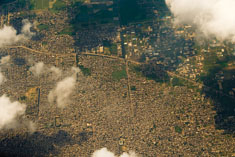
    Photo Credit: “Aerial View of Goma,” courtesy of UN Photo/Marie Frechon.
    MORE
  • Lisa Hymas on Envisioning a Different Future With Family Planning in Ethiopia

    ›
    On the Beat  //  October 12, 2011  //  By Theresa Polk
    ECSP caught up with Lisa Hymas, senior editor at Grist, last week during the first South by Southwest (SXSW) Eco conference and she spoke about her recent visit to Ethiopia to see the country’s community health extension program in action. “Ethiopia has a big challenge around population,” Hymas said, “but the government is committed to bringing that down.”

    The government extension program places health-workers – young women, for the most part, who have received basic training – directly into each community, where they are able to give out immunizations, provide advice on nutrition, teach families how to properly hang bed nets to prevent mosquito-borne illnesses, and provide family planning services and advice.

    Thanks to the program, these health workers and those in the communities they service can “envision very different lives for themselves than their mothers had,” Hymas explained. For instance, one woman recounted that her mother gave birth to 10 children, “and almost died giving birth to the last one, because there was no access to birth control, and there was no good access to health care.” In contrast, she is now able to have a career and to use family planning to delay and space her own childbearing.

    For more on Ethiopia’s health extension program, see Schuyler Null’s report on visiting a village health clinic near the town of Fiche last spring.
    MORE
  • Babatunde Osotimehin Answers Seven Questions on Population

    ›
    On the Beat  //  September 19, 2011  //  By Schuyler Null
    PSI’s Impact magazine has an interview up with UNFPA Executive Director Babatunde Osotimehin asking him seven questions about population. It’s not likely this will be the last seven-something-themed story as we approach October and the expected seven billion mark for global population, but Karl Hofmann, president and CEO of PSI, asks some good questions, including on the prospect of harnessing the “demographic dividend” and about the barriers facing more integrated development efforts – a critical topic in population, health, and environment (PHE) circles.

    On the demographic dividend:
    Karl Hofmann: Demography can be a key to progress with the right policy environment in place, but it can also be a burden when we don’t have the right framework in place to take advantage of growing populations. Some have described this as the demographic dividend – growing populations as a potent driver of economic growth and development. Give us your perspective on that.

    Babatunde Osotimehin: I spoke at the 17th African Union Summit this year and one of my messages was that we have the opportunity right now to take advantage of the demographic dividend of young people. It’s important for African governments to understand that they have a youthful population. Most of Africa is under the age of 35. If 85 percent of the African population is under 35, the implication is that you have to have education, social services, housing, all of that, tailored to meet the needs of this population.

    Beyond that, given what we’ve seen with the Arab spring uprising and others in many parts of the developing world, young people who are out of work want education and economic opportunities. We want to appeal to member states to provide skills appropriate to development and also ensure that we have continuing conversations with young people about their reproductive health and rights so they can make the choices that will ensure they plan for their families.
    And on integrated development:
    KH: There are lots of conversations going on in global health circles these days around the synergy of integration. From your perspective, what are the barriers to this integration?

    BO: I think it’s bipolar. Some countries are satisfied with vertical programs. Others are resistant to changing their system at the request of a donor. One argument for integration is that you can have the one-stop shop situation where one, two, three trained providers can deliver services at the same time. These include integration of HIV counseling, testing and treatment with family planning, with health education for non-communicable diseases, with immunization for children or with maternity services.

    When you look at the components of an integrated system, it is very easy to sell. In terms of investment, it makes sense for the governments to build and put this together. The supervision becomes a lot easier, and the training of health workers would then capture all of the skill sets that would be required. Some countries, like India, Ethiopia and Nigeria have started this kind of integration.
    Read the full interview on Impact.

    Sources: PSI.

    Image Credit: Adapted from UNFPA.
    MORE
  • Edward Carr, Open the Echo Chamber

    Food Security and Conflict Done Badly…

    ›
    On the Beat  //  September 16, 2011  //  By Wilson Center Staff
    The original version of this article, by Edward Carr, appeared on Open the Echo Chamber.

    Over at the Guardian, Damian Carrington has a blog post arguing that “Food is the ultimate security need.” He bases this argument on a map produced by risk analysts Maplecroft, which sounds quite rigorous:
    The Maplecroft index [represented on the map], reviewed last year by the World Food Programme, uses 12 types of data to derive a measure of food risk that is based on the UN FAO’s concept. That covers the availability, access and stability of food supplies, as well as the nutritional and health status of populations.
    I’m going to leave aside the question of whether we can or should be linking food security to conflict – Marc Bellemare is covering this issue in his research and has a nice short post up that you should be reading. He also has a link to a longer technical paper where he interrogates this relationship…I am still wading through it, as it involves a somewhat frightening amount of math, but if you are statistically inclined, check it out.

    Instead, I would like to quickly raise some questions about this index and the map that results. First, the construction of the index itself is opaque (I assume because it is seen as a proprietary product), so I have no idea what is actually in there. Given the character of the map, though, it looks like it was constructed from national-level data. If it was, it is not particularly useful – food insecurity is not only about the amount of food, but access to that food and entitlement to get access to the food, and these are things that tend to be determined locally. You cannot aggregate entitlement at the national level and get a meaningful understanding of food insecurity – and certainly not actionable information.

    Continue reading on Open the Echo Chamber.

    Image Credit: “Estimated food security conditions, 3rd Quarter 2011 (August-September 2011),” courtesy of the Famine Early Warning Systems Network (FEWS NET) and USAID.
    MORE
  • Deborah Mesce, Behind the Numbers

    Kenya’s New Data Website Puts the Ball in Media’s Court

    ›
    On the Beat  //  August 18, 2011  //  By Wilson Center Staff
    The original version of this article, by Deborah Mesce, appeared on PRB’s Behind the Numbers blog.

    The Kenya government took a bold step toward transparency a few weeks ago when it fired up its Open Data website and posted loads of data in a format that makes the information easily understood by the average person. The data sets include national census statistics as well as government spending, and the government promises more data to come. This is a boon for journalists willing to wade into the numbers to examine what’s going on in their country and hold their government accountable. I’m waiting now to see how they will use this new tool.

    We always hear that information is power, but that works only if the information is used. Lots of information begins as numbers, statistics, and data sets, with lots of good stories tucked away in there to be found by the journalist willing to go the extra mile, examine the numbers, and do the math. In many developing countries, the information – numbers, statistics, data sets – isn’t easily accessible, if it is available at all. Governments keep a tight hold on it, or if it’s made available, the average person would be hard pressed to make heads or tails out of it.

    Continue reading on Behind the Numbers.

    Image Credit: Open Data.
    MORE
  • Farahnaz Zahidi Moazzam on the Population Reference Bureau’s “Women’s Edition” Trip to Ethiopia

    ›
    On the Beat  //  July 26, 2011  //  By Wilson Center Staff
    The original version of this article, by Farahnaz Zahidi Moazzam, appeared on the Population Reference Bureau’s Behind the Numbers blog.

    My name is Farahnaz Zahidi Moazzam, and I’m a freelance journalist, writer, and editor from Pakistan. My passion is writing about human rights with a special focus on gender issues and reproductive health. Blogging is a personal joy to me, as I put my heart into my writing and blogging allows for a more personalized style. Digital journalism is a sign of evolution – one I happily accept. My pet peeve is marginalization on any grounds. I am a mother of a teenage daughter and live in Karachi.

    As part of the Population Reference Bureau’s (PRB) group of journalists in Women’s Edition 2010-2012, I recently had the chance to travel to Ethiopia on a visit that was unforgettable. The visit inspired a series of seven brief travel-blogs, based on my seven days there. Women’s Edition is a wonderful opportunity to connect with other like-minded female journalists from developing countries around the world, and learn solutions to the problems from this interaction. The program has reaffirmed my belief that our commonalities are more than the differences.

    Read Farahnaz Zahidi Moazzam’s posts from her trip to Ethiopia on her blog, Impassioned Ramblings, and view photos from the trip on PRB’s Facebook page.

    Photo Credit: PRB.
    MORE
  • What’s the Link Between Population and Nuclear Energy?

    ›
    On the Beat  //  April 4, 2011  //  By Meaghan Parker
    The popular Big Green Purse blog, written by best-selling author Diane MacEachern, recently asked the Worldwatch Institute’s Robert Engelman, “What’s the Link between Population and Nuclear Energy?” The blog, which encourages women to use the “power of the purse” to improve the environment, wanted to know: “Why aren’t we talking about reducing population as part of our global strategy to minimize dependence on power sources [like nuclear energy] that pollute the environment and threaten people’s health?”

    While “reducing population” is not possible, slowing population growth may be, if fertility rates continue to fall. As always, Engelman answered the tough question with thoughtful aplomb, offering three core values as a starting point:
    One: see the global environmental dilemma not as a problem to be solved but as a predicament to be responded to. We can’t control our future, but we can act with integrity as we aspire to build just societies in an environmentally-sound world. Addressing our numbers can become part of that.

    Two, embrace human rights as a foundation for our actions. All people – even if too many or consuming too much – have dignity and a right to be here. As it happens, population policies based on the right of all women to choose whether and when to bear a child actually slow the growth of population. …

    Three, acknowledge that no one can claim a greater right than anyone else to use energy and natural resources. This is called equity. We cannot object if the poorest people living today and yet to be born succeed in gaining the means to consume as much as Americans do.
    But I’m wondering how the readers of Big Green Purse – which is replete with media-friendly lists like “Top Ten Eco-Tricks” – can translate population and its messy intersection of human rights, health care, and consumption levels into an individual purchasing decision.

    As Engelman writes, “The idea that we can easily trim our individual consumption to come into balance with nature – worthy as that effort is – looks increasingly naïve. If people in the developed world slash their per capita greenhouse emissions by half, their effort could be counterbalanced by people in developing countries boosting theirs by just 11 percent.”

    Photo Credit: “Trojan Nuclear Power Plant,” courtesy of flickr user tobo.
    MORE
  • National Geographic’s Population Seven Billion

    ›
    On the Beat  //  January 20, 2011  //  By Ramona Godbole
    The short feature above and accompanying cover article in the January 2011 issue launch National Geographic’s seven-part year-long series examining global population. The world is set to hit seven billion this year, according to current UN projections, and may reach nine billion by 2045.

    The authors point out that today, 13 percent of people don’t have access to clean water globally and 38 percent lack adequate sanitation. Nearly one billion people have inadequate nutrition. Natural resources are strained. Is reducing population growth the key to addressing these problems?

    Not according to Robert Kuznig, author of National Geographic’s lead article, who writes that “fixating on population numbers is not the best way to confront the future…the problem that needs solving is poverty and lack of infrastructure, not overpopulation.”

    “The most aggressive population control program imaginable will not save Bangladesh from sea-level rise, Rwanda from another genocide, or all of us from our enormous environmental problems,” writes Kuznig. Speaking on NPR’s Talk of the Nation last week, he reiterated this message, saying global problems “have to be tackled whether we’re eight billion people on Earth, or seven, or nine, and the scale for them is large in any case.”

    Instead, the challenge is simultaneously addressing poverty, health, and education while reducing our environmental impact, says Kuznig.

    “You don’t have to impose prescriptive policies for population growth, but basically if you can help people develop a nice, comfortable lifestyle and give them the access to medical care and so on, they can do it themselves,” said Richard Harris, a science correspondent for NPR, speaking with Kuznig on Talk of the Nation.

    Kuznig’s article highlights the Indian state of Kerala, where thanks to state investments in health and education, 90 percent of women in the state can read (the highest rate in India) and the fertility rate has dropped to 1.7 births per woman. One reason for this is that educated girls have children later and are more open to and aware of contraceptive options.

    Whither Family Planning?

    In a post on Kuznig’s piece, Andrew Revkin, of The New York Times’ Dot Earth blog, points to The New Security Beat’s recent interview with Joel E. Cohen about the crucial role of education in reducing the impact of population growth. Cohen asks: “Is it too many people or is it too few people? The truth is, both are real problems, and the fortunate thing is that we have enough information to do much better in addressing both of those problems than we are doing – we may not have silver bullets, but we’re not using the knowledge we have.”

    Although the National Geographic article and video emphasize the connections between poverty reduction, health, education, and population growth, both give short shrift to family planning. It’s true that fertility is shrinking in many places, and global average fertility will likely reach replacement levels by 2030, but parts of the world – like essentially all of sub-Saharan Africa for example – still have very high rates of fertility (over five) and a high unmet demand for family planning. Globally, it is estimated that 215 million women in developing countries want to avoid pregnancy but are not using effective contraception.

    Development should help reduce these levels in time, but without continued funding for reproductive health services and family planning supplies, the declining trends that Kurznig cites, which are based on some potentially problematic assumptions, are unlikely to continue.

    As Kuznig told NPR, “you need birth-control methods to be available, and you need the people to have the mindset that allows them to want to use them.”

    At ECSP’s “Dialogue on Managing the Planet” session yesterday at the Wilson Center, National Geographic Executive Editor Dennis Dimick urged the audience to “stay tuned – you can’t comprehensively address an issue as global and as huge as this in one article, and within this series later in the year we will talk about [family planning] very specifically.” Needless to say, I look forward to seeing it, as addressing the unmet need for family planning is a crucial part of any comprehensive effort to reduce population growth and improve environmental, social, and health outcomes.

    Sources: Center for Global Development, Dot Earth, NPR, Population Reference Bureau, World Bank.

    Video Credit: “7 Billion, National Geographic Magazine,” courtesy of National Geographic.
    MORE
Newer Posts   Older Posts
View full site

Join the Conversation

  • RSS
  • subscribe
  • facebook
  • G+
  • twitter
  • iTunes
  • podomatic
  • youtube
Tweets by NewSecurityBeat

Trending Stories

  • unfccclogo1
  • Pop at COP: Population and Family Planning at the UN Climate Negotiations

Featured Media

Backdraft Podcast

play Backdraft
Podcasts

More »

What You're Saying

  • Volunteers,At,The,Lagos,Food,Bank,Initiative,Outreach,To,Ikotun, Pan-African Response to COVID-19: New Forms of Environmental Peacebuilding Emerge
    Rashida Salifu: Great piece 👍🏾 Africa as a continent has suffered this unfortunate pandemic.But it has also...
  • A desert road near Kuqa An Unholy Trinity: Xinjiang’s Unhealthy Relationship With Coal, Water, and the Quest for Development
    Ismail: It is more historically accurate to refer to Xinjiang as East Turkistan.
  • shutterstock_1779654803 Leverage COVID-19 Data Collection Networks for Environmental Peacebuilding
    Carsten Pran: Thanks for reading! It will be interesting to see how society adapts to droves of new information in...

What We’re Reading

  • Rising rates of food instability in Latin America threaten women and Venezuelan migrants
  • Treetop sensors help Indonesia eavesdrop on forests to cut logging
  • 'Seat at the table': Women's land rights seen as key to climate fight
  • A Surprise in Africa: Air Pollution Falls as Economies Rise
  • Himalayan glacier disaster highlights climate change risks
More »
  • woodrow
  • ecsp
  • RSS Feed
  • YouTube
  • Twitter
  • Facebook
  • Home
  • Who We Are
  • Publications
  • Events
  • Wilson Center
  • Contact Us
  • Print Friendly Page

© Copyright 2007-2021. Environmental Change and Security Program.

Woodrow Wilson International Center for Scholars. All rights reserved.

Developed by Vico Rock Media

Environmental Change and Security Program

Woodrow Wilson International Center for Scholars

Ronald Reagan Building and International Trade Center

  • One Woodrow Wilson Plaza
  • 1300 Pennsylvania Ave., NW
  • Washington, DC 20004-3027

T 202-691-4000