• woodrow wilson center
  • ecsp

New Security Beat

Subscribe:
  • rss
  • mail-to
  • Who We Are
  • Topics
    • Population
    • Environment
    • Security
    • Health
    • Development
  • Columns
    • China Environment Forum
    • Choke Point
    • Dot-Mom
    • Friday Podcasts
    • Navigating the Poles
    • Reading Radar
  • Multimedia
    • Water Stories (Podcast Series)
    • Backdraft (Podcast Series)
    • Tracking the Energy Titans (Interactive)
  • Films
    • Water, Conflict, and Peacebuilding (Animated Short)
    • Paving the Way (Ethiopia)
    • Broken Landscape (India)
    • Scaling the Mountain (Nepal)
    • Healthy People, Healthy Environment (Tanzania)
  • Publications
  • Events
  • Contact Us

NewSecurityBeat

The blog of the Wilson Center's Environmental Change and Security Program
Showing posts from category Eye On.
  • World Bank Data Visualization

    ›
    Eye On  //  March 9, 2010  //  By Wilson Center Staff
    Yesterday Google and the World Bank expanded their data-sharing partnership, first initiated last fall, to include a subset of 54 World Development Indicators and enhanced visualization tools. Users can now interact with data—spanning a range of both environmental and population statistics, from forest coverage area to contraceptive prevalence—using line graphs, bar graphs, maps, and xy-plots. Each option also offers users the ability to follow the data changes over time.

    An alternative to Google’s Public Data Explorer is the World Bank’s Data Visualizer. Although limiting data output to an xy-plot, the customization options go beyond those offered by the Public Data Explorer and achieve a good balance between flexibility and ease of use. Table colors and groupings are fully customizable, scales are adjustable, and the chart can be quickly printed or exported as a jpeg.
    MORE
  • Visualizing Natural Resources, Population, and Conflict

    ›
    Eye On  //  March 4, 2010  //  By Julia Griffin
    Environmental problems that amplify regional security issues are often multifaceted, especially across national boundaries. Obtaining a comprehensive understanding of the natural resource, energy, and security issues facing a region is not fast or easy.

    Fortunately, the Environment and Security Initiative (ENVSEC) has created highly informative, easy-to-understand maps depicting environmental, health, population, and security issues in critical regions.

    Published with assistance from the United Nations GRID-Arendal, these maps offer policymakers and the public a snapshot of the complex topography of environmental security hotspots in Central Asia, Eastern Europe, Southeastern Europe, and the Southern Caucasus.

    Some that caught our eye:

    • Environmental Issues in the Northern Caspian Sea: Overlaying environmental areas and energy production zones, this map finds hydrocarbon pollution in sturgeon spawning grounds, seal habitats in oil and gas fields, and energy production centers and waste disposal sites in flood zones.

    • Water Withdrawal and Availability in the Aral Sea Basin: Simple and direct, this combination map and graph contrasts water usage with availability in Turkmenistan, Uzbekistan, and Kazakhstan—which stand in stark comparison to the excess water resources of Tajikistan and Kyrgyzstan.

    • Environment and Security Issues in Belarus: In addition to noting the parts of the country with poor water quality and potassium mining, the map also delineates wildfires that occurred in areas contaminated by the Chernobyl explosion, thus threatening downwind populations.

    Maps: Illustrations courtesy of the Environment & Security Initiative.
    MORE
  • Monitoring Resources and Conflict

    ›
    Eye On  //  February 26, 2010  //  By Julien Katchinoff

    Is the “resource curse” inevitable? The Resource Conflict Monitor (RCM) produced by the Bonn International Center for Conversion (BICC) attempts to monitor the management, administration, and governance of natural resources in countries prone to resource-conflict dynamics by establishing an empirical measure of resource governance.

    MORE
  • Patriotism: Red, White, and Blue…and Green?

    ›
    Eye On  //  February 21, 2010  //  By Dan Asin
    “National security often means cyber security, it means energy security, it means homeland security, and more and more…it means environmental security,” says retired U.S. Army Captain James Morin in the Pew Project on National Security, Energy and Climate’s recently released video short, “Climate Patriots.”

    “Climate Patriots” calls attention to the nexus between energy, climate change, and national security. The video identifies climate change as a two-fold threat likely to increase the frequency and intensity of humanitarian disasters and political instability. The latter, military analysts believe, will fuel further conflict, fundamentalism, and terrorism.

    “Climate Patriots” also touches on military efforts to combat climate change (e.g., reducing energy consumption and shifting to renewable fuel supplies) as well as Center for Naval Analyses (CNA) research on national security, energy, and climate.

    “If we don’t take action now,” retired U.S. Navy Vice Admiral Dennis McGinn says, “the options for dealing with the effects of climate change and the effects of energy security become much, much more expensive. In fact, some of the options completely go away over the next 10-20 years if we don’t start taking some prudent actions now.”
    MORE
  • Peace Through Parks on Israel’s Borders – Dream or Reality?

    ›
    Eye On  //  January 27, 2010  //  By Julien Katchinoff
    In areas fraught with conflict, is it possible to advance conflict resolution through environmental discourse? A recent conference hosted by Tel Aviv University’s Porter School of Environmental Studies explored this question through an examination of existing peace parks, as well as possible future preserves.

    The wide-ranging discussion sought to apply theories of conflict resolution and environmental peacemaking to local conflict in the Middle East. Touching on conservation, conflict resolution, local history, geography, ecology, and diplomacy, the participants underscored the importance of restoration efforts, local environmental maintenance, and the pursuit of peace through environmental cooperation.

    For more, watch these presentations on YouTube (in English; with Timestamps):

    Event Part One:

    0:15:50

    “Conservation to Conflict Resolution: Understanding the Theory and Practice of Peace Parks”
    Dr. Saleem Ali, Rubenstein School of Environment and Natural Resources, University of Vermont

    1:36:28
    “Peace Parks on Israel’s Borders: Lessons from South Sinai”
    Dr. Dan Rabinowitz, Department of Sociology and Anthropology, Tel Aviv University

    1:55:49
    “The Jordan River Peace Park: Post-conflict environmental peacebuilding between Israel and Jordan”
    Gidon Bromberg, Israeli Director, Friends of the Earth Middle East

    Event Part Two:

    0:01:12

    “The Golan Heights – A critical habitat with global significance”
    Dr. Tamar Ron, Ecologist, biodiversity conservation consultant

    2:11:01
    Session Response:
    Valerie Brachya, Director, Environmental Policy Center Jerusalem Institute for Israel Studies

    Photo: Golan Heights Panorama, Courtesy Flickr User Vad_Levin.
    MORE
  • An Island of Peace in a Sea of Conflict: The Jordan River Peace Park

    ›
    Eye On  //  January 13, 2010  //  By Dan Asin
    Saleem Ali filmed this video on his visit to the “peace island” between Jordan and Israel, which Friends of the Earth Middle East (FOEME) is working to convert into an international peace park.

    FOEME co-Director Gidon Bromberg will be at the Wilson Center today to discuss the peace park and other FOEME water cooperation initiatives in more detail as a panelist participating in “Pathways to Peace: Stories of Environment, Health, and Conflict,” an event discussing field-based lessons for addressing environment, health, development, and conflict.

    Video: Filmed by Saleem H. Ali (University of Vermont, editor of the MIT Press book Peace Parks: Conservation and Conflict Resolution) with commentary by Elizabeth Ya’ari (FOEME), January 2010.
    MORE
  • 2010: Worldwide Year of the Census

    ›
    Eye On  //  January 6, 2010  //  By Dan Asin
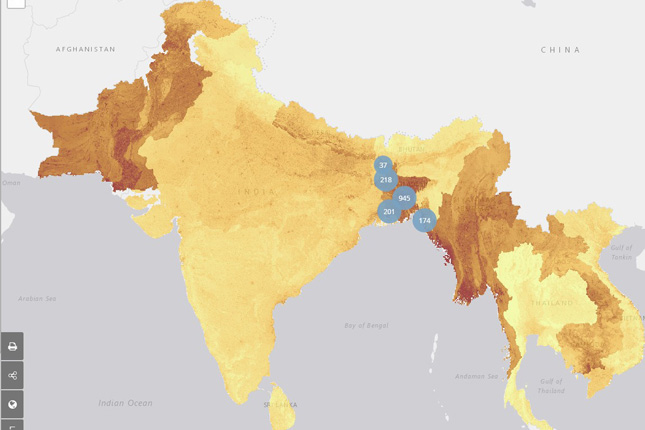
    To kick-off the New Year, we’re highlighting CensusInfo 2010—an initiative to help countries distribute their census data in a format that is free, flexible, and customizable to meet diverse public needs. For us, it’s a new tool to access and visualize census data from around the globe.

    The CensusInfo software(the program must be downloaded and installed) allows users to create tables, graphs, and color-coded maps depicting indicators such as population density, fertility rate, and sex ratio. The data’s resolution—national, regional, district, or smaller—is up to the user, but limited by the information reported by each country’s census bureau. When older data is available, users can also view trends over time.


    The heart of CensusInfo is data presentation. Robust options include: capacity to import new datasets, compatibility with Google Earth and NASA’s World Wind technologies, and the ability to download visualizations as images, “animated flipbooks,” and videos.

    Aside from the relatively steep learning curve to master each of its functions, the software is principally limited by the small number of countries in its database: only 10 countries are included in the software’s pre-installed dataset. That number, however, could increase in the near future.

    In what CensusInfo 2010 hopes will be a trend, the Palestinian Central Bureau of Statistics, as of August 2009, became the first National Office of Statistics to independently incorporate its data into CensusInfo. While a powerful piece of software, CensusInfo’s potential rests on whether others follow suit.

    Photo Credit: CensusInfo’s output of population density in India.
    MORE
  • Google’s Fight Against Climate Change

    ›
    Eye On  //  December 16, 2009  //  By Dan Asin
    After erroneous reports last January that “two Google searches generate the same carbon dioxide as boiling a kettle for a cup of tea,” Google is making environmental news for the right reasons, with the launch of its Google Earth-integrated climate change “tours.”

    Narrated by the “Governator” himself, the most recent tour combines stunning graphics, images, and data to illustrate how climate change will impact California over the next century and outlines current and future mitigation and adaptation efforts.

    Other Google Earth tours delve into how climate change projections work; climate and health connections in Africa; and projects to reduce deforestation in Borneo, the Amazon, and Madagascar.

    In addition, Google has partnered with CNN to create a COP15 YouTube Channel where users can explore behind-the-scenes videos from the Copenhagen summit and watch highlights from a December 15 debate featuring world leaders, climate activists, and user-generated questions.

    For up to the minute information on Google’s environmental work and initiatives, check out the following sites:
    • Google’s Official Blog: Sorted by the “green” tag for all news on Google tools, events, and technology related to the environment
    • Google Earth Outreach Showcase: Home to Google Earth tools and tours created by third-party organizations working on climate, the environment, disease, and other issues
    • The Unofficial Google Earth Blog: A source for all things Google Earth, with a dedicated section to the environment.
    MORE
Newer Posts   Older Posts
View full site

Join the Conversation

  • RSS
  • subscribe
  • facebook
  • G+
  • twitter
  • iTunes
  • podomatic
  • youtube
Tweets by NewSecurityBeat

Trending Stories

  • unfccclogo1
  • Pop at COP: Population and Family Planning at the UN Climate Negotiations

Featured Media

Backdraft Podcast

play Backdraft
Podcasts

More »

What You're Saying

  • Volunteers,At,The,Lagos,Food,Bank,Initiative,Outreach,To,Ikotun, Pan-African Response to COVID-19: New Forms of Environmental Peacebuilding Emerge
    Rashida Salifu: Great piece 👍🏾 Africa as a continent has suffered this unfortunate pandemic.But it has also...
  • A desert road near Kuqa An Unholy Trinity: Xinjiang’s Unhealthy Relationship With Coal, Water, and the Quest for Development
    Ismail: It is more historically accurate to refer to Xinjiang as East Turkistan.
  • shutterstock_1779654803 Leverage COVID-19 Data Collection Networks for Environmental Peacebuilding
    Carsten Pran: Thanks for reading! It will be interesting to see how society adapts to droves of new information in...

What We’re Reading

  • Rising rates of food instability in Latin America threaten women and Venezuelan migrants
  • Treetop sensors help Indonesia eavesdrop on forests to cut logging
  • 'Seat at the table': Women's land rights seen as key to climate fight
  • A Surprise in Africa: Air Pollution Falls as Economies Rise
  • Himalayan glacier disaster highlights climate change risks
More »
  • woodrow
  • ecsp
  • RSS Feed
  • YouTube
  • Twitter
  • Facebook
  • Home
  • Who We Are
  • Publications
  • Events
  • Wilson Center
  • Contact Us
  • Print Friendly Page

© Copyright 2007-2021. Environmental Change and Security Program.

Woodrow Wilson International Center for Scholars. All rights reserved.

Developed by Vico Rock Media

Environmental Change and Security Program

Woodrow Wilson International Center for Scholars

Ronald Reagan Building and International Trade Center

  • One Woodrow Wilson Plaza
  • 1300 Pennsylvania Ave., NW
  • Washington, DC 20004-3027

T 202-691-4000