-
Aging in the 21st Century: A Celebration and a Challenge
›
“We are in the midst of a silent revolution,” said Ann Pawliczko, a senior technical advisor in the population and development branch at the United Nations Population Fund (UNFPA), quoting former UN Secretary-General Kofi Annan. “It is a revolution that extends well beyond demographics, with major economic, social, cultural, psychological, and spiritual implications.”
-
Joel Cohen on Why Students Should Consider Demography
›“Why should you consider taking a demography course in college?” That’s the question Joel Cohen, noted demographer and professor at Rockefeller and Columbia University, looks to answer in a 45-minute introduction to demography produced by the Floating University and released for free on YouTube.
-
Making ‘Beyond Seven Billion’: Reporting on Population, Environment, and Security
›
“When I embarked on this series, I approached it as an environmental reporter: What does a growing number of us and growing consumption mean for our planet?” said Los Angeles Times reporter Ken Weiss at the Wilson Center on October 9. Weiss, along with photographer Rick Loomis, recently completed a five-part series and multimedia presentation on global population that was the culmination of a year of research and travel through more than six countries. [Video Below]
-
Simon Zadek, Project Syndicate
Age Against the Machine
›September 21, 2012 // By Wilson Center StaffThe original version of this article, by Simon Zadek, appeared on Project Syndicate.
The elderly are a crucial link in the chain that binds generations and sustains civilized society. Today, however, older people are largely considered to be out of touch with the modern, technology-driven world, and incapable of paying their own way. But much evidence shows otherwise: If aging were framed as an economic opportunity, the growing number of older people worldwide could become modernity’s gift, rather than society’s burden.
-
Farzaneh Roudi for the Middle East Program
Iran Is Reversing Its Population Policy
›Excerpted below is the introduction by Farzaneh Roudi. The full report is available for download from the Wilson Center’s Middle East Program.
Once again, the Iranian government is reversing its population policy – its fertility policy, to be more precise. Alarmed by the country’s rapidly aging population, Iran’s Supreme Leader Ayatollah Ali Khamenei is now calling on women to procreate and have more children, and the Iranian Minister of Health and Medical Education Marzieh Vahid Dastjerdi has recently said, “The budget for the population control program has been fully eliminated and such a project no longer exists in the health ministry. The policy of population control does not exist as it did previously.”
-
PRB’s 2012 World Population Data Sheet
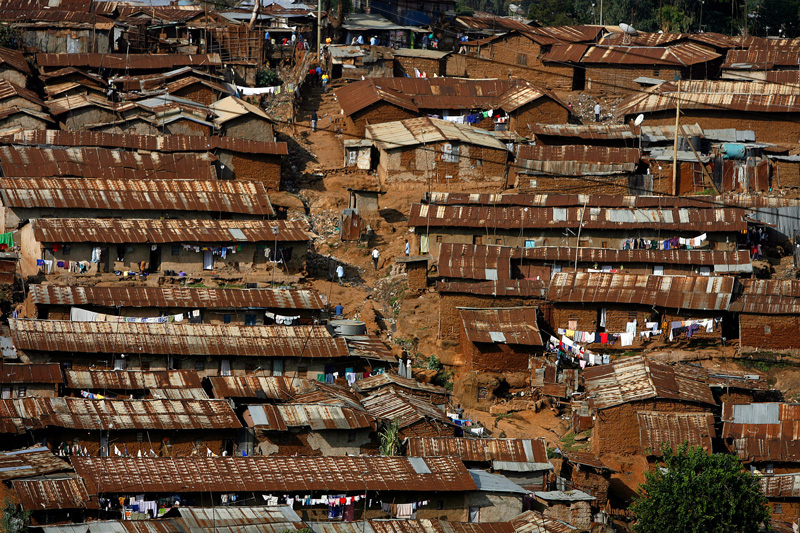
›“The most rapid population growth in many ways [occurs in] the countries that can least afford it,” said Carl Haub in a webinar on July 19 to launch the Population Reference Bureau’s (PRB) 50th annual World Population Data Sheet. This year, the report explores aging populations in more developed countries, rapid population growth in less developed countries, and the increased global prevalence of non-communicable diseases in an interactive map, which concisely illustrates global trends. PRB estimates that the world’s population is 7,057,075,000 as of mid-2012; the global population crossed the seven billion threshold in October 2011.
 “The most rapid population growth in many ways [occurs in] the countries that can least afford it,” said Carl Haub in a webinar on July 19 to launch the Population Reference Bureau’s (PRB) 50th annual World Population Data Sheet. This year, the report explores aging populations in more developed countries, rapid population growth in less developed countries, and the increased global prevalence of non-communicable diseases in an interactive map, which concisely illustrates global trends. PRB estimates that the world’s population is 7,057,075,000 as of mid-2012; the global population crossed the seven billion threshold in October 2011.
Aging Europe and East Asia
Haub explained that population growth in Europe has been declining since the 1970s and is more or less a “pre-programmed destiny” for these countries. People of child-bearing ages make up a smaller percent of the population in many more developed countries, so unless there is an “enormous increase” in total fertility rates, these populations will continue to decline for the foreseeable future.
Haub noted that these aging populations are unprecedented. In Germany and Italy, for example, 21 percent are over the age of 65; many other European countries have similar figures, as do other developed countries like Japan and South Korea. PRB expects these percentages to increase throughout the next century and for European countries to struggle to support greater numbers of retirees.
Many such states have already found it difficult to raise the retirement age, even though medical advances allow people to work until later ages. PRB projects that in Japan, 42 percent of their population will be over the age of 60 in 2050; if such a large percentage of the population is no longer in the labor force, it will be difficult for to find the resources to support them.
The report shows that the United States, on the other hand, is still experiencing modest population growth. The higher birthrate is in part due to immigration, as recent immigrants to the United States tend to have more children. Haub noted that European states have been reluctant to accept greater numbers of migrants to try to reverse their declining population.
Youthful Developing Countries
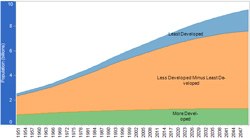
While the demographic destiny of aging countries is somewhat determined, the future for less developed countries is more uncertain. Many countries in sub-Saharan Africa, the Middle East, and South Asia have large and growing youth populations, and how many children these “future parents” will have is uncertain. That uncertainty is underscored by the variety of scenarios for future population growth. The UN has four variants – high, medium, low, and constant fertility – which vary considerably in their projections for future populations, and PRB’s global projections for 2050 are some 600 million people more than the commonly-used medium variant UN projection.
Rapid growth in the least developed countries is hardly a new phenomenon, but PRB breaks down the numbers to an impressive degree. The 2012 Data Sheet provides updated net migration rates, projected population as a multiple of today’s, infant mortality rates, rate of natural increase, and other basic statistics. PRB also provides population pyramids from the wealthiest and poorest quintiles of the population of Malawi, as an example of the utility of desegregating data to better allocate resources to the underserved. They found that while birthrates have begun to decline for the wealthiest one-fifth of Malawians, the poorest citizens still have a total fertility rate of over seven children per woman.
Measuring Health Systems
Devastating infectious diseases – malaria, tuberculosis, and HIV/AIDS – have long been entrenched in some of the least developed and most rapidly growing parts of the world. But this year, PRB began to assess health on a broader level by tracking deaths attributed to non-communicable diseases as well. Diseases like cardiovascular disease, diabetes, respiratory illness, and cancer are leading causes of death in developed countries, but they have also increased in prevalence in developing countries at an alarming rate.
PRB is not the only organization to take note of the change in disease predominance. The World Health Organization has issued guidelines targeting four factors which increase the risk of these illnesses: tobacco use, alcohol abuse, poor diet/obesity, and physical inactivity. The UN also called a special session last September to discuss non-communicable diseases. President of PRB Wendy Baldwin noted that the last such discussion on a health issue was 10 years ago about HIV/AIDS.
Baldwin also pointed out that non-communicable diseases can increase the burden on the health systems of developing countries even more so than in developed states. She reported that in south Asia, for example, people have heart attacks on average six years earlier than people in developed countries, meaning more families lose their primary breadwinners.
The risk factors for these non-communicable diseases are difficult to target, especially with increasing urbanization in developing countries. But in a video accompanying the report, Baldwin mentioned that raising the price of cigarettes is an effective way to reduce tobacco consumption, especially for youth. Some countries have also made progress in increasing physical activity through sports programs and making urban areas safer for pedestrians. “The low and middle income countries have a real opportunity to take really positive steps to confront that rise in non-communicable diseases and to address the risk factors that drive them,” she said.
The Data Sheet Over Time
The World Population Data Sheet has long been a vital resource for those in the population, health, and environment fields and has grown to include far more data than its first iteration in 1962. At first, the sheet had only four indicators: a population estimate for the year, annual rate of increase, crude birth rate, and crude death rate. Over time, PRB began measuring a greater number of key figures like infant mortality and life expectancy at birth. Population projections, a staple of the current version, were not added until 1978, perhaps in response to the inception of the United Nations World Population Projections in 1974.
Over the past five decades, the data sheet has been witness to some major shifts in global population trends. While PRB discourages researchers from comparing past data to current figures because the measures and methods of gathering information have likely changed over time, it is still possible to see the rise of importance in several trends based on the indicators PRB chose to focus on each year. For example, extremely young populations have been found to have profound effects on a country’s stability and prosperity, as have aging populations. The 1966 data sheet was the first to measure the percentage of the population under the age of 15, and it didn’t become a consistent data point until 1977.
The number of people living in cities in the developing world surpassed those in the developed in 1970, according to the UN, and in 1972, PRB began tracking the percentage of populations living in urban areas. HIV/AIDS indicators were added in 2000, as global awareness and a commitment to fighting the disease was rising.
PRB’s demonstrated commitment to continually adding more data and refining existing projections makes the data sheet is a valuable resource to those studying the problems of today and the future. Fifty years on, the amount of information collected is staggering. The data sheet provides a glimpse at not just how many people there are in the world, but also where and how they live.
For more information, take a look at the full data sheet!
Sources: Population Reference Bureau, UN Population Division.
Image Credit: PRB; Video: Noncommunicable Diseases and Youth in Developing Countries. -
A Roundup of the ‘Global Trends 2030’ Series on Population Aging
›The National Intelligence Council is trying something new for this year’s Global Trends report: keeping a blog. So far, there have been postings from analysts and contributors on everything from migration and urbanization to international banking and precision strike capabilities, but over the past week, one of the most extensive series yet went up on demography. Though youth bulge theories have often dominated population-related security discussions, 11 posts highlight the newest and least understood of all demographic conditions: advanced population aging.
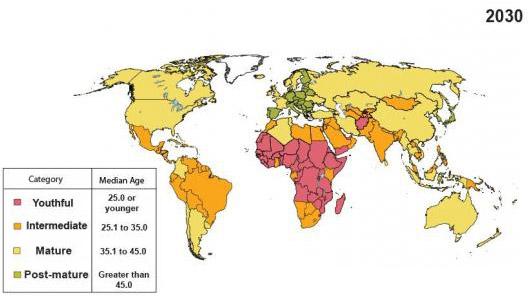
In parts of the world, mainly Europe and several countries in East Asia, populations are set to become “extremely mature” because of sustained declines in average fertility to very low levels and steady increases in lifespan. Demographers measure maturity by a population’s median age – the age of the person for whom precisely half of the population is younger and half older. Japan and Germany currently have the most mature populations; both are reported to have a median age slightly over 45 years. By 2030, UN Population Division and U.S. Census Bureau projections suggest that there may be between 19 and 29 countries that pass this benchmark. In Japan, the median age is projected to be 51.
If 5 out of 10 people in a country over 50 years old sounds unprecedented, that’s because it is. In this series, titled “Population Aging to 2030,” a group of political demographers, economic demographers, political scientists, and historians discuss the implications of this never-before-experienced set of age structures.
In his introductory essay, “Population Aging: A Demographic and Geographic Overview” (cross-posted here on New Security Beat), Richard Cincotta outlines the upcoming demographic trend, identifying the particulars of these novel age structures and indicating the regions that are expected to mature into economically and politically advantageous and disadvantageous demographic profiles.
In “Population Aging – More Security or Less?,” Jack Goldstone examines the effects on the U.S. military of a maturing developed world. With the United States and their traditional allies having proportionally fewer young people, will this impact limit their ability to put “boots on the ground?” Can new partnerships be developed in order to make up for this shortfall in man power?
In “China: the Problem of Premature Aging,” Richard Jackson focuses on China’s unique set of aging issues. Due to strict immigration laws and the one-child policy, China is experiencing the most rapid aging of the major powers. The favorable age structure which has enabled huge economic growth will soon shift to being a major burden on a relatively smaller working-age population, having potential political and societal consequences beyond that.
“The Sun Has Yet to Set on China” provides a different interpretation of the challenges China faces. Jennifer Dabbs Sciubba argues that although there will be changes in age structure, the problems may be overstated and the United States may still face a challenge to its status as sole global superpower.
In “Population Aging and the Welfare State in Europe,” Ronald Lee and Andrew Mason emphasize the stresses aging will exert on the extensive social welfare programs of many European states. The combination of longer life expectancy and declining fertility rates has led to a large and increasing funding gap in the welfare system, leaving questions as to the future viability of these programs.
In “Population Aging and the Future of NATO,” Mark Haas foresees that the welfare funding gap could have far-reaching international security consequences. With European governments diverting more and more resources away from military spending to fund welfare programs, the current U.S. irritation with NATO is likely to continue, as European allies “free ride” on the back of U.S. military supremacy in order to cut their defense budgets.
In “The Beginning of History: Advanced Aging and the Liberalness of Democracies,” Richard Cincotta examines the future of the liberal democratic political systems across aging countries. With increasing pressure on resources and a large disparity likely between the native born and migrant populations, it may become challenging for these states to remain liberal and democratic.
For Toshi Yoshihara, author of “The Strategic Implications of Japan’s Demographic Decline,” the aging process will pose a question of priorities for the leaders of Japan. The decreasing number of personnel available to the military, the effects of which were highlighted by the recent tsunami, will force a strategic decision between a defense force that is prepared primarily to address immediate and local security threats or one that is trained primarily for broader humanitarian interests.
“A Demographic Sketch of a Reunified Korea” provides interesting insights into the hypothetical demography of a single, unified Korea. Putting aside the two very distinct social paths that evolved during the past 60 year, Elizabeth Hervey Stephen uses demographic projections to envisage the challenges and opportunities that could arise from reunification.
David Coleman points to immigration as a possibly-mitigating force to aging in the developed world. In “The Impact of Immigration on the Populations of the Developed World and Their Ethnic Composition,” Coleman concludes that the developed world is likely to become “super diverse” by 2030. But this trend can be volatile. International migration is subject to many political and economic factors, bringing into question whether the developed world can rely on migration to supplement their native growth rates.
In “The Ethnic Future of Western Europe to 2030,” which wraps up the series, Eric Kaufmann examines the ethnic make-up of Western Europe in the coming decades. While the size of ethnic minority populations may be smaller than in the United States, the speed of growth in these minorities is likely to be much more rapid in Western Europe. This unprecedented increase in migrant populations could exacerbate ethnic social tensions, particularly in urban areas.
The broad nature of these essays suggests that advanced population aging will emerge within the context of many types of policy debates in the coming decades. While these 11 brief essays only scratch the surface of their respective areas of research, they provide a broad introduction to the politics of advanced population aging.
Jonathan Potton is a student at the University of Aberdeen and currently interning at the Stimson Center for demographer Richard Cincotta.
Sources: UN Population Division, U.S. Census Bureau.
Image Credit: Courtesy of Richard Cincotta. Data from U.S. Census Bureau’s international database. -
Population Aging: A Demographic and Geographic Overview
›The original version of this article, by Richard Cincotta, appeared on the National Intelligence Council’s Global Trends 2030 Blog. It is the first post in a series on population aging, featuring Jack Goldstone, Richard Jackson, Jennifer Dabbs Sciubba, Ronald Lee, Andrew Mason, Toshi Yoshihara, Elizabeth H Stephen, David Coleman, and Eric Kaufmann.
This series, Population Aging to 2030, begins with an introductory essay aimed at familiarizing readers with some of the demographic and geographic particulars of this phenomenon, and with several key demographic terms. The term most in need of definition is, of course, “population aging.”
Showing posts from category aging.

 “The most rapid population growth in many ways [occurs in] the countries that can least afford it,” said Carl Haub in a webinar on July 19 to launch the Population Reference Bureau’s (PRB) 50th annual