-
What Can Governments Do About Falling Birth Rates?
›
“We have a fairly unique moment in the history of the world,” said Steven Philip Kramer, a professor at National Defense University, at the Wilson Center on April 17. “There’s never been a time when people have voluntarily produced fewer children than is necessary for sustaining the population.” [Video Below]
-
Steven Philip Kramer on ‘The Other Population Crisis’
›
Ever since Thomas Malthus’ 18th-century treatise linked overpopulation with conflict and poverty, population growth has been a subject of concern and controversy. But does population decline warrant similar attention? According to Steven Philip Kramer, the subject of this week’s podcast and author of The Other Population Crisis: What Governments Can Do About Falling Birth Rates, it does.
-
What Can Demography Tell Us About the Advent of Democracy?
›April 28, 2014 // By Elizabeth Leahy MadsenDemocracy is fickle. Many of the competing theories on the best ways to foment and consolidate plural, inclusive governance or predict its rise and fall focus on political and economic forces. Yet a small group of demographers have explored population age structure as a catalyst for and reflection of a host of changes in societies that can affect governance. -
Environmental Impacts of Household Size, Bringing Family Planning Outside the Health Sector
›What are the environmental implications of changing household sizes? A recent article by Mason Bradbury, M. Nils Peterson, and Jianguo Liu, published in Population and Environment, analyzes data from 213 countries over 400 years and finds the average number of occupants per home tends to decline as population grows. This dynamic, they write, indicates that accommodating housing could prove to be one of “the greatest environmental challenges of the twenty-first century.” As countries develop and urbanize, “according to convergence theory, household size decreases (often from greater than five to less than three).” Other cultural shifts, like increasing divorce rates, urban sprawl driven by rising affluence, decreasing numbers of multigenerational households, and larger houses (in the United States, homes more than doubled in size between 1950 and 2002, according to the article) compound the issue. As population growth continues in parts of the world, these trends pose critical questions for conservation and environmental sustainability, since “households are the end consumers of most natural resources and ecosystem services.” -
Andrew Revkin: Local Population Dynamics Crucial to Understanding Climate Vulnerability
›February 10, 2014 // By Schuyler Null“What’s become clear to me on population is that it’s really a local issue,” said Andrew Revkin in an interview at the Wilson Center. “You get the impression, ‘Oh didn’t we solve that problem?’” And to some extent, demographic shifts around the world are largely heading in the direction people anticipated, with a leveling off mid-century. But “no one really knows what happens then,” he said. “All it takes is a tiny diversion of fertility rates and things could really grow or shrink.”
-
David Canning: Africa’s High Fertility Can Change Quickly, Help Harness the Demographic Dividend
›
Compared to East Asia and Latin America, the “demographic transition” in Africa has been slower to date, prolonging periods of rapid growth and creating very youthful populations. But, explains David Canning in this week’s podcast, “the high level of fertility in Africa doesn’t seem to be something that is set in stone.”
-
Jay Gribble: For Demographic Dividend, Invest in Health, Education, and Governance
›
Developing countries with youthful populations may have the opportunity to take advantage of a phenomenon called the “demographic dividend,” when a decline from high to low fertility rates leads to slower population growth and a large working age population. But “age structure alone isn’t going to make it happen,” says Jay Gribble of Abt Associates in this week’s podcast.
-
For Fast-Growing Countries, Should Aging Be a Concern? Planning for the Second Demographic Dividend
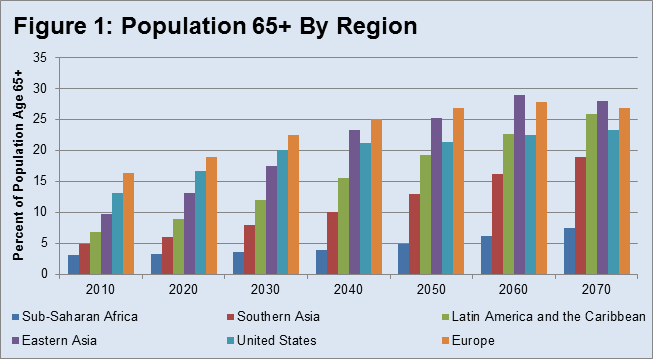
›September 10, 2013 // By Elizabeth Leahy MadsenPopulation aging and decline are frequently described as a threat to countries’ economic development and social stability. Evocative language, such as “demographic winter” and “graying of the great powers,” portrays the serious consequences that many observers envision as fertility and growth rates decline and the elderly comprise a greater percentage of the population. These concerns reach around the globe, including in Africa, which has the lowest percentage of elderly among the world’s major regions.
Showing posts from category aging.