-
Poor Land Tenure: A Key Component to Why Nations Fail
›The murder of five land rights campaigners during the last two months – one in Colombia, three in Brazil, and one in Cambodia – have not captured many headlines, but they are a reminder of the central role land tenure plays not just in rural economic development but also in sparking broadly distributed economic gains throughout a society.
-
Richard Cronin, World Politics Review
China and the Geopolitics of the Mekong River Basin
›April 25, 2012 // By Wilson Center StaffThe original version of this article, by Richard Cronin, appeared in World Politics Review.
Two decades after the Paris Peace Accord that ended the proxy war in Cambodia, the Mekong Basin has re-emerged as a region of global significance. The rapid infrastructure-led integration of a region some call “Asia’s last frontier” has created tensions between and among China and its five southern neighbors – Cambodia, Laos, Myanmar, Thailand, and Vietnam. Both expanded regional cooperation as well as increased competition for access to the rich resources of the once war-torn region have created serious environmental degradation while endangering food security and other dimensions of human security and even regional stability.
China’s seemingly insatiable demand for raw materials and tropical commodities has made it a fast-growing market for several Mekong countries and an increasingly important regional investor. Economic integration has been boosted by a multibillion dollar network of all-weather roads, bridges, dams, and power lines largely financed by the Asian Development Bank (ADB) that is linking the countries of the Lower Mekong to each other and to China. To date, the ADB’s Greater Mekong Subregion (GMS) cooperative development program has primarily benefited large population centers outside the basin proper in China, Thailand, and Vietnam. Unfortunately, the same infrastructure that speeds the flow of people and goods to urban centers also facilitates the environmentally unsustainable exploitation of the forests, minerals, water resources, and fisheries that are still the primary source of food and livelihoods to millions of the Mekong’s poorest inhabitants.
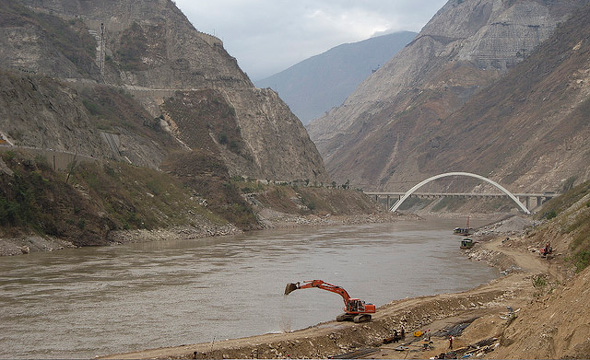
No aspect of China’s fast-growing role and influence in the Mekong region is more evident and more problematic than its drive to harness the huge hydroelectric potential of the Upper Mekong through the construction of a massive cascade of eight large- to mega-sized dams on the mainstream of the river in Yunnan Province. The recently completed Xiaowan dam, the fourth in the series, will mainly be used to send electricity to the factories and cities of Guangdong Province, its coastal export manufacturing base some 1,400 kilometers away. China’s Yunnan cascade will have enough operational storage capacity to augment the dry season flow at the border with Myanmar and Laos by 40-70 percent, both to maintain maximum electricity output and facilitate navigation on the river downstream as far as northern Laos for boats of up to 500 tons.
Continue reading in World Politics Review.
Photo Credit: “Xiaowan Dam Site,” courtesy of International Rivers. -
Karen Newman: Population and Sustainable Development Links Are Complex, Controversial, and Critical
›April 23, 2012 // By Kate Diamond“The one child family norm in China has fixed the global imagination around population to be around doing something which constricts people’s and women’s choices, rather than expands women’s possibilities to take control of their lives,” said Karen Newman, the coordinator for the UK-based Population and Sustainability Network. But contemporary population programs are about educating people on and providing access to voluntary reproductive, sexual, and maternal health services.
Newman spoke to ECSP, during the Planet Under Pressure conference this year, about family planning efforts and the connection between population dynamics and the environment.
“You have what I would describe as a sort of kaleidoscope of complexity” between climate change and population dynamics – not just growth, said Newman, but urbanization and migration.
For example, China recently overtook the United States as the world’s largest emitter of carbon, and although China has 1.3 billion people compared to the United States’ 310 million, population can hardly be credited as the most important driver for the country’s emissions. “How fair is it [to credit population growth] without in the same nanosecond saying, ‘but most of the carbon that was emitted in China was to manufacture the goods that will of course be consumed in the West?” said Newman.
“It makes it more difficult to say in a sound bite that ‘OK, population and sustainable development, it’s the same conversation,’ which I believe it to be.”
The Population and Sustainability Network, working through the Population and Climate Change Alliance, collaborates with international organizations from North America, Europe, Ethiopia, and Madagascar to support on-the-ground groups working on integrated population, health, and environment programming. These programs address environmental issues, like marine conservation and deforestation, while also providing reproductive health services, including different methods of contraception, diagnosis and treatment of sexually-transmitted diseases, antenatal and postnatal care, and emergency obstetric care.
“As a result of people wanting to place a distance between those coercive family planning programs in the ‘60s and the way that we do reproductive health now…because it’s such a large package, there is a sense that…this reproductive health thing is too much, we can’t really get ahold of this,” said Newman.
“What I think we need to do is keep people focused on the fact that these are women’s rights,” she said. “But we at the same time have to say ‘this is relevant if you care about sustainable development and the world’s non-renewable resources.’”
Sources: United Nations Population Division. -
Natural Resource Management, Climate Change, and Conflict
›In Climate Change and Conflict: Lessons From Natural Resource Management, a new report from the Danish Institute for International Studies, authors Mikke Funder, Signe Marie Cold-Ravnkilde, Ida Peters Ginsborg, and Nanna Callisen Bang, review literature on how natural resource management, climate change, and conflict interact on the local, national, and transboundary levels, from which they offer lessons for development policymakers and programmers. Since natural resource management is “strongly related” to how climate change and conflict interact, they write, a better understanding of how natural resource management has taken conflict prevention and resolution into account would benefit development work aimed at mitigating climate change’s “multiplier effect” on conflict. Recommendations include working on as local a level as possible; working with and strengthening existing customary and legal conflict resolution frameworks; and coordinating development efforts across sectors so that policymakers and programmers can minimize the risk of unintentionally causing or aggravating conflict.In his March 2012 Transatlantic Academy paper, “The Geostrategic Implications of the Competition for Natural Resources: The Transatlantic Dimension,” François Heisbourg analyzes the strategic implications of emerging trends affecting the global energy marketplace, including climate change and scarcity. Whereas Europe and the United States shaped energy markets in the 19th and 20th centuries, respectively, there is no comparable leader in the 21st century marketplace, writes Heisbourg, nor is it clear that one will emerge. Instead, there will be a growing number of influential countries, like Brazil, India, and China, that will have an impact as both consumers and producers. That said, the Persian Gulf will remain geopolitically important given its dominance of the oil market, giving reason for the United States, Europe, India, and China to actively pursue cooperation in the Gulf in order to minimize the risk of future energy crises, Heisbourg concludes. -
Military-to-Military Environmental Cooperation: Still a Good Idea for China and the United States
›March 1, 2012 // By Geoffrey D. DabelkoAs Washington begins to assess the recent visit of Chinese Vice President Xi Jinping, who is expected to become president of China early next year, the search for ways to build confidence between the two powers is on the table yet again.
-
Water and Population: Limits to Growth?
›February 3, 2012 // By Laurie MazurWater – essential, finite, and increasingly scarce – has been dubbed “the new oil.” Experts debate whether human societies are approaching “peak water,” beyond which lies a bleak future of diminishing supplies and soaring demand. Others observe that, for many, the water crisis has already arrived.
-
Reducing Urban Poverty: A New Generation of Ideas
›Download Reducing Urban Poverty: A New Generation of Ideas from the Wilson Center.
In 2008 the global population reached a remarkable turning point; for the first time in history, more than half of the world’s people were living in cities. Moving forward into the 21st century, the world faces an unprecedented urban expansion with projections for the global urban population to reach nearly five billion by the year 2030. Virtually all of this growth will occur in the developing world where cities gain an average of five million residents every month, overwhelming ecosystems and placing tremendous pressure on the capacity of local governments to provide necessary infrastructure and services. Failure to incorporate urban priorities into the global development agenda carries serious implications for human security, global security, and environmental sustainability.
Recognizing a need to develop and strengthen urban-focused practitioner and policymaking ties with academia, and disseminate evidence-based development programming, the Wilson Center’s Comparative Urban Studies Project, USAID’s Urban Programs Team, the International Housing Coalition, the World Bank, and Cities Alliance teamed up to co-sponsor an academic paper competition for graduate students studying urban issues. The first competition took place in the months leading up to the 5th World Urban Forum, held in Rio de Janeiro in March 2010.
This publication, Reducing Urban Poverty: A New Generation of Ideas, marks the second annual academic paper competition. “Reducing urban poverty” was chosen as the theme with each author focusing on one of three topics: land markets and security of tenure; health; and, livelihoods. A panel of urban experts representing the sponsoring institutions reviewed 70 submitted abstracts, from which 16 were invited to write full length papers. Of these, six were selected for this publication. We congratulate the graduate students who participated in this competition for their contribution to our understanding of the complex relationship between urbanization and poverty.
These papers highlight the new research and innovative thinking of the next generation of urban planners, practitioners, and policymakers. It is our hope that by infusing the dialogue on these issues between the academic and policy worlds with fresh perspectives, we will foster new and innovative strategies to reduce global urban poverty.
Sources: UNFPA, UN-HABITAT. -
Michael Kugelman for Seminar
Safeguarding South Asia’s Water Security
›November 4, 2011 // By Wilson Center StaffThe original version of this article, by Michael Kugelman, appeared in the public policy journal Seminar.
In today’s era of globalization, the line between critic and hypocrite is increasingly becoming blurred. Single out a problem in a region or country other than one’s own, and risk triggering an immediate, yet understandable, response: Why criticize the problem here, when you face the same one back home?
Such a response is particularly justified in the context of water insecurity, a dilemma that afflicts scores of countries, including the author’s United States. In the parched American West, New Mexico has only 10 years-worth of drinking water remaining, while Arizona already imports every drop. Less arid areas of the country are increasingly water-stressed as well. Rivers in South Carolina and Massachusetts, lakes in Florida and Georgia, and even the mighty Lake Superior (the world’s largest fresh-water lake) are all running dry. According to the U.S. Environmental Protection Agency, if American water consumption habits continue unchecked, as many as 36 states will face water shortages within the next few years. Also notable is the fact that America’s waterways are choked with pollution, and that nearly twenty million Americans may fall ill each year from contaminated water. Not to mention that more than thirty U.S. states are fighting with their neighbors over water.
Such a narrative is a familiar one, because it also applies to South Asia. However, in South Asia, the narrative is considerably more urgent. The region houses a quarter of the world’s population, yet contains less than five percent of its annual renewable water resources. With the exception of Bhutan and Nepal, South Asia’s per capita water availability falls below the world average. Annual water availability has plummeted by nearly 70 percent since 1950, and from around 21,000 cubic meters in the 1960s to approximately 8,000 in 2005. If such patterns continue, the region could face “widespread water scarcity” (that is, per capita water availability under 1,000 cubic meters) by 2025. Furthermore, the United Nations, based on a variety of measures – including ecological insecurity, water management problems and resource stress – characterizes two key water basins of South Asia (the Helmand and Indus) as “highly vulnerable.”
These findings are not surprising, given that the region suffers from many drivers of water insecurity: high population growth, vulnerability to climate change, arid weather, agriculture dependent economies, and political tensions. This is not to say that South Asia is devoid of water security stabilizers; indeed, its various trans-national arrangements, to differing degrees, help the region manage its water constraints and tensions. This paper argues that such arrangements are vital, yet also incapable of safeguarding regional water security on their own. It asserts that more attention to demand-side water management within individual countries is as crucial for South Asian water security as are trans-national water mechanisms.
Continue reading on Seminar.
Michael Kugelman is a program associate for the Asia Program at the Woodrow Wilson Center.
Sources: The American Prospect, Jaitly (2009), The New York Times, UNEP, UN Population Division, Washington Post.
Video Credit: “Groundwater depletion in India revealed by GRACE,” courtesy of flickr user NASA Goddard Photo and Video. For more on the visualization, see the story on NASA’s Looking at Earth.
Showing posts from category China.